But God released him

Acts 2:23-26 With the help of lawless Gentiles, you nailed him to a cross and killed him. But God released him from the horrors of death and raised him back to life, for death could not keep him in its grip. King David said this about him: “I see that the Lord is always with me. I will not be shaken, for he is right beside me. No wonder my heart is glad, and my tongue shouts his praises! My body rests in hope.”

I’ve written before on this blog about 1 Thessalonians 4:13-14: Though we grieve for our beloved ones who have died, we have hope! “. . . For since we believe that Jesus died and was raised to life again, we also believe that when Jesus returns, God will bring back with him the believers who have died.”

Our hope for being with our beloved ones again is rooted in Jesus’ resurrection! Because Jesus is alive, “He will wipe every tear from their [our] eyes, and there will be no more death or sorrow or crying or pain” (Revelation 21:4). Through releasing Jesus, God will one day release us all from the curse of death that came through the fall (Genesis 2:17). Isn’t it cool how Easter links the very beginning (Genesis) to the very end (Revelation) of Scripture?

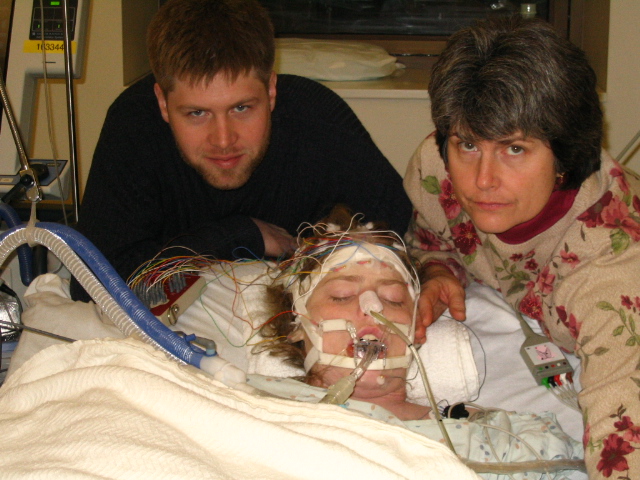
Following a February surgery in 2009 that set off severe rejection, the doctors told us at Easter time to gather our family because there was no hope for Karis’s life. But God gave her back to us. Three weeks later, May 2, Karis wrote in her journal, still in the hospital but out of ICU!:

Worship. How can I express this, even remotely? The thrill, the awareness of You so visceral. I want to share this. That which You whisper in the dark to me I want to declare on the rooftops.

I want to learn about this Earth and her many peoples and their histories and geographies—the different smells of her many airs . . . I want to learn to see her more and more through Your eyes, Father. To hear her groans and to be for her people the fragrance of hope.

Because of Jesus’ resurrection, we have hope, no matter our present circumstances or what the future may bring. That’s how our Father sees us, with hope, because he knows the end of our story, individually and collectively, is abundant life. Breathe in that fragrance. Let your soul absorb its healing balm.

But Christ has been raised from the dead!

1 Corinthians 15:17-20 If Christ has not been raised, then your faith is useless . . . And if our hope in Christ is only for this life, we are more to be pitied than anyone in the world. But in fact, Christ has been raised from the dead. He is the first of a great harvest of all who have died.

Did you have a nice Easter?

That question would normally think of Easter Sunday. In liturgical traditions, though, Easter began on Sunday, but it lasts fifty days, until Pentecost, June 9. Fifty days to celebrate the Resurrection of Christ! I want to consider during these weeks some of the implications of this biggest “But God” of them all. After Pentecost I’ll go back to posting the rest of the Stones of Remembrance.

At our church here in Pittsburgh, the 6:00 a.m. Easter vigil is one of the highlights of the entire year. The service begins in total darkness. The last time we’ve been in this space was Good Friday, after the “stripping of the altar” at the Maundy Thursday service, when all decorations were removed from the church, leaving it bare. The pastor walks up the dark aisle singing “The light of Christ” while candles are lit behind him. When all the lights come on halfway through the vigil, we are rewarded not only by an explosion of glorious praise music and the sunrise shining through the stained glass, but by flowers everywhere, with all of the normal accoutrements back in place. It’s a breathtaking celebration of Resurrection glory.

Our first few years in São Paulo we attended a church that didn’t have an Easter sunrise service. Since this was a cherished tradition for us, we decided to have our own. We lived a few blocks from one of the city reservoirs (called a represa). The six of us (Dave and I and our four small children) would make our way there while it was still dark, spread a blanket over the dewy grass, and shiver together, singing Easter songs as the sun rose. Then we enjoyed an Easter breakfast picnic.

The delight of these events was somewhat marred by what was revealed around us as it grew light. One year I actually took pictures. Holding the camera at the right angle, the scene was lovely:

Represa - Lite

Lowering the camera just a little, though . . .

Lixo - lite

Not quite the same impact as the experience at Church of the Ascension in Pittsburgh. And yet, there’s a parable here. The light of Christ reveals what’s true in our lives, so we can face it and offer it to him to clean up—which is too big a job for us, but he can do because he conquered sin on the cross! We go to him as we are, and as he brings new life to us, we can extend it to others.

Two remnants of my childhood come to mind. One is the song “Brighten the corner where you are.” The other is my mother’s training: “Always leave a place better than you found it.” I find that a renewed challenge to myself this Easter season. Not just in terms of ecology—though that is VERY relevant to living out Easter, as the resurrection reverses the original curse and takes us back to the Genesis mandate to tend the garden—but in terms of order, and peace, and hope, and joy.

By the way, that area by the represa? It’s been transformed into a lovely park! Loide, one of my best friends in São Paulo, presented a proposal to the city that was accepted and has transformed that little corner of the megalopolis. It’s another part of the parable . . . I’ll be there next week, and will try to remember to take a photo for you.

But we see Jesus

Hebrews 2:9  But we see Jesus, who was made lower than the angels for a little while, now crowned with glory and honor because he suffered death, so that by the grace of God he might taste death for everyone.

Last night at our Maundy Thursday service we sang one of my favorite communion songs, “Behold the Lamb.” Take a few minutes to listen and see, with the eyes of your heart; share in the Bread of Life:

https://www.youtube.com/watch?v=481xyHUrwQA

Last night we read a portion of Psalm 78. Verses 19-20 and 24-25 were poignant for Karis and me through the many years of our “wilderness,” trying to figure out how to nourish a body with a malfunctioning, non-functioning or, from November 2004 until January 2006, completely absent intestine:

Can God set a table in the wilderness?

True, he struck the rock, the waters gushed out, and the gullies overflowed;

But is he able to give bread or to provide meat for his people?


. . . He rained down manna upon them to eat and gave them grain from heaven.

So mortals ate the bread of angels; he provided for them food enough.


What is your wilderness? What is your hunger? Take it, as I will, to the cross today. See Jesus, tasting death so that we can drink life. “He drained death’s cup that all may enter in to receive the life of God. So we share in this Bread of Life, and we drink of his sacrifice, as a sign of our bonds of grace around the table of the King” (verse 2 of “Behold the Lamb”).

But Jesus spoke of the temple of his body

Taking a Holy Week break from the Stones of Remembrance.

John 2:18-22 The Jewish leaders then said to him, “What sign have you to show us for doing this?” [Chasing the merchants out of the temple].  Jesus answered them, “Destroy this temple, and in three days I will raise it up.”  The Jewish leaders then said, “It has taken forty-six years to build this temple, and will you raise it up in three days?” But he spoke of the temple of his body. When therefore he was raised from the dead, his disciples remembered that he had said this; and they believed the Scriptures and the word which Jesus had spoken.

Like me, you probably watched in horror yesterday as flames engulfed the iconic Notre Dame Cathedral. What a tragic, dramatic, incomprehensible introduction to Holy Week.

The ashes of Notre Dame Cathedral heartrendingly illustrate for us John’s record of Jesus’ words comparing his own body to the temple in Jerusalem. How ludicrous to imagine rebuilding the Cathedral in three days! Jesus’ boldness in comparing his body to Herod’s temple tells us that his resurrection is just as impossible.

His accusers later used their own version of these words to condemn Jesus before the Jewish high council and to mock him on the cross (Matthew 26:60-61, 27:40). They had no idea Who they were mocking; no understanding that the fullness of God actually indwelt this broken, beaten body they had destroyed. That death could not hold the Author of Life. That there was at work a deeper magic from before the dawn of time, to borrow from C. S. Lewis.

All four of the Gospel writers slow down the narrative when relating Jesus’s last days, and that is exactly what we are called to this week: to slow down our own frenetic lives to walk with Jesus to the cross, through the emptiness of Saturday, and then to allow the glory of Easter morning to astonish us once more. It occurs to me today that I did exactly the same thing in Karis, All I See Is Grace, paying extra attention to the details of Karis’s last days with us. And I can well imagine that for everyone who visited or worked in the Notre Dame Cathedral last week, that privilege has taken on entirely new dimensions. I can imagine each one thinking and saying, “I was there . . . I didn’t know . . . !”

This week is the time we slow down long enough to remember. To walk with Jesus. To open ourselves to new comprehension of what it all means. To identify with those who love him, around the world and through all time. To say with Karis, “All I see is grace.”


One day at a time

“What’s with the rocks?”

“Do you have a few minutes? Pick a rock and I’ll tell you a story.” 

Rock #5 green: Miracles

There was a time in my life when I could easily think about the future: imagine possibilities, make plans, dream dreams . . .

But when I found myself in survival mode not just for days or weeks, but for months that stretch into years, I found I couldn’t do that. My husband Dave would say things on the phone or by email like, “I have these goals for the next five years,” or “Next year let’s” do such and such, and I would stare blankly, as if he was speaking a foreign language. It was all I could do to imagine getting through that day. It was hard even to imagine tomorrow.

In the middle of life and death crises, which came around all too unpredictably and too often, my world narrowed down even further, to getting through this hour, or these minutes. For these minutes, Karis is still alive. God hasn’t taken her yet.

To help you understand this, let me describe a not-unusual day. Karis wakes up smiley and perky, describing to me all that she wants to do today: the friends she wants to call or visit, that new coffee shop she’s been longing to try, the birthday gift for a child in the hospital she wants to finish making, the passage from the Qur’an she wants to study and translate and compare with Scripture before she next sees her Arabic-speaking friend, what she wants to make for dinner and the shopping list it has generated . . .

By lunchtime all we’ve accomplished is getting her through her physical therapy routine, her bath, her bandage changes, her morning pills and IVs, and moved her from her bedroom to the living room couch, where she needs to rest after all the exertion of the morning. She talks to a friend on the phone, and I hear them making plans that I can’t imagine will ever take place.

Then she falls asleep, and over the next couple of hours I see her skin change from pale to flushed and damp. A hand on her forehead confirms she’s spiking a fever, but I need to measure it with a thermometer before I call her transplant coordinator. And I know what Cindy will say: bring her in; I’ll set up the admission.

On the way to the hospital I get a call from Dr. Costa: “Take Karis directly to the ICU.” “Why?” “Just do it.”

How does this man know?? By the time we reach the hospital Karis is struggling to breathe. There is already a transporter waiting for us at the emergency room, but triage takes her blood pressure: 60 over 40. They rush her away, and I follow to the ICU waiting room more slowly, knowing I will have a long wait while they stabilize her. I sit and pray. I thank God for Dr. Costa’s intuition. I thank God for nurses and doctors who know Karis well and love her. I know she’s in the best possible hands, not just medical hands, but God’s hands.

I’m not surprised when the ICU doctor emerges to tell me Karis is sedated and on a ventilator. I can go in and “see” her for a few minutes. It seems to be pneumonia, but there is suspicion of a central line infection as well. They’ve used pressors to stabilize her blood pressure, but she does seem to be septic. They’ll cover her with broad-spectrum antibiotics until they know what they’re actually treating.

I go in to “see” Karis long enough to wipe her sweaty forehead and pray for her and thank her nurses for their care. Then they need me out of the way, so I return to the waiting room to ponder whether I should call my husband in the midst of ministry in Brazil. I settle on an email, to him and to my other children. I decide to wait on posting on Karis’s prayer blog until I have something more positive to say.

I suddenly remember the friends who planned to come see Karis at home this evening, and call them to cancel. Before long my phone starts ringing: my other kids, friends who had already heard through the grapevine . . . My son, “Mom, I’ll get there as soon as I can, but you ought to phone Dad.”

The ICU nurse calls me in to go through Karis’s current medication list, which doesn’t completely match what’s in her computer. Dr. Costa comes by and I ask him, “How did you know?” “It was just a feeling,” he says, “because she spiked such a high fever so quickly.” “What are you thinking?” I ask him. “It’s too soon to tell, but I am very concerned—there’s too much going on all at once.” “She was perfectly fine this morning.” “I know—I saw her vital signs. Why don’t you go get something to eat, and then check back in. We’ll page you if we need you.”

I can’t tell you how many times this type of scenario repeated itself: going from fine to critically ill within hours. This was life with profound immunosuppression, necessary because of the mismatch between Karis’s graft and the two other immune systems present in her body. One step forward; two steps back. Stable to scary with no warning. It happened often enough that I became hypervigilant, like a child in an unpredictably abusive family. How could I make plans, or think concretely about the future?

One day at a time. One hour at a time. Holding on to God’s presence and his promises through the scary times and the more stable times. Clinging to Scriptures like Lamentations 3:20-27, which became my anchor:

I will never forget this awful time . . . yet I still dare to hope when I remember this: The faithful love of the Lord never ends! His mercies never cease. Great is his faithfulness; his mercies begin afresh each morning. I say to myself, “The Lord is my inheritance; therefore, I will hope in him!” The Lord is good to those who depend on him, to those who search for him. So it is good to wait quietly for salvation from the Lord. And it is good for people to submit at an early age to the yoke of his discipline.”

The discipline for me was this: to trust God for this day, this hour, and leave tomorrow with him. I thought a lot about the Israelites in the desert, dependent on God’s manna each morning. God gave them just enough for one day. If they gathered more than that, in anxiety over whether there would be provision for tomorrow, the extra would spoil.

God gave me just enough faith for one day, sometimes one hour at a time. It’s easy to understand the concept, but for me, it was hard to live into. I wanted more. I wanted to gather manna for tomorrow, to have margin, to have some sense of control over what might happen next. But that simply didn’t work. I had to walk and breathe and learn to relax into his provision for today, for now. His mercies new every morning.

After months and years of doing this, like any discipline, it becomes a habit—a habit I’ve found hard to break. It is easier now for me to think about and plan for the future, like making a plan for my book trips this fall. But I hold everything very loosely. God may have something different in mind; something I’m not able to see right now. Whether things run smoothly or there are unhappy surprises, I know I am dependent on my Father for his provision of what I need—one day at a time.

But God heard and answered, by David Kornfield

Psalm 31:22 In panic I cried out . . . But you heard my cry for mercy and answered my call for help.

In my early marriage I sold Fuller Brush products door to door. One Sunday I put the week’s checks from my customers on the top of the car as we were putting things inside to go to church. I forgot to take them from the top of the car – some $1000 back in 1978 when that meant a great deal. Arriving at church, I went into a panic. I got a ticket driving home as fast as I could, but found no checks anywhere.

A lady had a dream about finding signed checks all over the place. She asked herself if that were to happen, what she would do. And then as she took her morning walk, she saw a piece of paper fluttering in a bush. Intrigued, she went over and found a signed check… and then another… and another. She looked up our name and address and showed up at our apartment later that day with some twenty signed checks. Whewee!

We lose things. All kinds of things! We sometimes think we’re losing our minds. BUT GOD…! 🙂

But God himself watches over you, by David Kornfield

Psalm 121:5 God himself watches over you.

God cares. Psalm 121 starts out “I lift my eyes to the hills – where does my help come from?” The Psalmist is clearly in trouble. He’s looking for help, somewhat desperately. In the remaining seven verses of the Psalm, the phrase “he who watches over you” or a similar phrase are repeated five times! Sometimes we may feel like we have to look for help or look for God. Little do we know that he’s looking much more than we are! Looking out for us!

Last week I badly wanted something for my ministry. It was taken away from me. Something else was offered. While I really wasn’t happy with what was offered, by the end of the week I realized that what was offered was a far better fit for my calling than what I had so much wanted.

I wanted one thing, BUT GOD… God watched over me and kept me from what I wanted because He knew that what I really needed was something else entirely. Thank You, God!

But God watches over, by Rachel Kornfield Becker

Psalm 33:17-18 Don’t count on your warhorse to give you victory–for all its strength, it cannot save you. But the Lord watches over those who fear him, who rely on his unfailing love.

One night I had a bad nightmare.  The next morning, I went running with a friend with whom I regularly exercise.  We were halfway up a hill at Frick Park and we were discussing my dream when I stumbled, hit the ground hard, bounced a few times, and my car key and cell phone went flying out of my hands.  I got up rather stunned and grabbed my phone but completely forgot about my car key.  I limped back to my car, bleeding, and then realized I didn’t have the key.  My friend had to leave for work so I walked back down the path to look for the key but couldn’t quite locate the place I fell and didn’t see the key anywhere.  I was so grateful I had my phone and could call an uber to get me home, and grateful for simple things like antibacterial lotion and band aids.  My husband and I went back by the park that evening to pick up the car with his key and we discussed spending about $250.00 to buy a new electronic key fob once we got back from vacation.  We were leaving in a couple days.

Two days into vacation my husband pulls up to our rental house, gets out of the car, walks around to the windshield wiper and pulls out something that was stuck there.  It’s the key!  Someone must have found it at the park, used it to identify the car, and instead of driving away with the car simply tucked it there for us to find!  Meanwhile, that conversation with my friend also helped me work through what my nightmare was about and I didn’t have that dream again.  These extraordinary displays of human kindness remind me of the loving heart of God toward me.

But God watched over them

Ezra 5:3-5 [Governor] Tattenai soon arrived in Jerusalem and asked, “Who gave you permission to rebuild this Temple? . . . But because God was watching over them, the Jews were not prevented from building.

The first few chapters of Ezra describe Zerubbabel and Jeshua’s challenges and successes as they led the small remnant of Jews in Jerusalem to rebuild the Temple that had been destroyed seventy years before. We wouldn’t know this story if Ezra hadn’t come along fifty-some years later and written it down. We would have missed an important link in the chain of God’s relationship with his people.

Reading Ezra has encouraged me these days in my own efforts to record what I know from Karis’s journals and have experienced myself of God watching over our family even through our toughest times. Here’s an example, a very simple one but it had great impact for me:

I was keeping vigil at Karis’s bedside during a time when, because of bleeding and seizures caused by overdose of one of her medications, she wasn’t mentally occupying the same reality the rest of us were in touch with. I was hungry, but even more exhausted than hungry. The idea of walking down to the hospital cafeteria and standing in line and having to choose what to eat all seemed like too much effort.

I was thinking about this, not even actually verbalizing it to the Lord, when there was a knock on the door and a nurse walked in with a tray of food. “This patient was already discharged and the food will just be thrown away. I thought maybe . . .?”

The nurse was actually embarrassed about offering this to me, as if I might be offended. But she was even more discomfited by the tears that sprang to my eyes. She said, “Don’t tell anyone. I’m not actually supposed to do this.”

Several more times during that hospitalization when that nurse was on duty, trays of food “mysteriously” appeared in Karis’s room that Karis, of course, couldn’t eat. (But please don’t tell anyone.)

God was watching over me in such a precious, personal way. And I have no doubt he is watching over you too. So here’s a little challenge for you:

Between now and Thanksgiving, write down a story about God caring for you. And on Thanksgiving Day, share that story with someone.

If you like, you can send your story to me for this blog. I would love to share a dozen stories of God watching over us.

But God is planting seeds of peace and prosperity

Zechariah 8:11-13 [This is what the Lord says after listing challenges facing his people.] “But now I am planting seeds of peace and prosperity among you. . . . I will rescue you and make you both a symbol and a source of blessing. So don’t be afraid. Be strong and get on with rebuilding the Temple.”

Here is another time God is saying “Don’t be afraid.” Zechariah was a contemporary of Haggai (last post). Clearly this was a message people of that time needed to hear as they faced both internal and external opposition to their work of rebuilding the Temple.

And I think it’s a message we need, as we face opposition to rebuilding the temple of the Lord, the church (see 1 Corinthians 3:16). What are the obstacles you face today? Are they more internal (your own personal struggles to live in a godly and fruitful way) or external (attempts by others, consciously or unconsciously, to sabotage your work)? What are your particular vulnerabilities? Can you hear God say to you today, “Don’t be afraid. I get it—I see what you’re facing. But don’t worry. I’ve got this!”?

I can’t imagine anything more wonderful than to be both a symbol and a source of blessing. This is what I long for with the Karis story: to encourage others. So I find it interesting to note what God says he will do: 1) plant seeds of peace and prosperity among us, 2) rescue us, and 3) make us both a symbol and source of blessing. That’s his part. Our part is 1) don’t be afraid, 2) be strong, and 3) get on with rebuilding the temple.

In every case, though, I find myself dependent on the Lord to be able to do “my” part. I can only not be afraid because God has promised to walk with me, even through the valley of the shadow of death. Even through remembering the tough times.  I can only be strong because his joy is my strength. I can only get on with the work he has given me because of his gifting and blessing. It’s really all about him!