But Jesus waits

Hebrews 10:10-18 God’s will was for us to be made holy by the sacrifice of the body of Jesus Christ, once for all time. Under the old covenant, the priest stands and ministers before the altar day after day, offering the same sacrifices again and again, which can never take away sins. But our High Priest [Jesus] offered himself to God as a single sacrifice for sins, good for all time. Then he sat down in the place of honor at God’s right hand. There he waits until his enemies are humbled and made a footstool under his feet. For by that one offering he forever made perfect those who are being made holy. . . And when sins have been forgiven, there is no need to offer any more sacrifices.

In anticipation of celebrating the pouring out of the Holy Spirit at Pentecost, I’ve been reading Scriptures about waiting. This one caught my attention, because it’s not us who are waiting. It’s Jesus. He’s sitting in the place of honor at God’s right hand waiting for his enemies to be defeated.

Doesn’t it seem like he should be out fighting his enemies, instead of just . . . sitting and waiting?

Thinking about this, several incidents flashed through my mind. Doctors say to us, “All that can be done has been done.” We ask, “So what happens next?” And they say, “We sit and wait.”
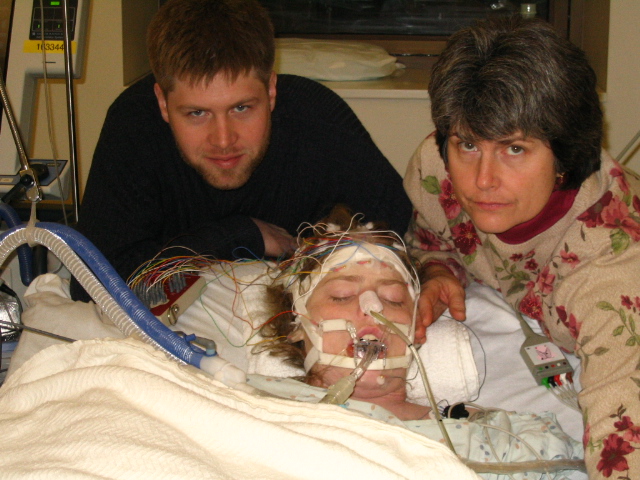
Karis ICU w Deb and Dan (2)

Dan and I waiting . . . after Karis’s seizures and brain bleed in 2009

Aargh! If you’ve been in a situation like that, you know it feels like the toughest thing in the world. Give me something to DO!! But there’s nothing left to do. It’s all been done. Now, we just wait. Either the antibiotics will defeat the bad bugs before all her systems fail—or they won’t. Either the swelling and bleeding in her brain will go down–or it won’t. Either God wants her here with us a little bit longer—or he doesn’t.

That’s the whole point of this passage, isn’t it. Everything that could be done has been done. There’s nothing more for Jesus to do. He’s done it. Now he sits and waits to see whether we accept his incredible sacrifice, given willingly out of profound love for us. There’s nothing we can do except receive his gift. And that’s how his enemies are defeated, one by one—the enemies that have held us captive, but that he already conquered on the cross.

Psalm 110, that this passage quotes, was apparently a favorite among the New Testament writers and preachers, because they refer to it often. That means this concept—that everything that needed to be done has been done—was very important to them. Yet I so often want to add something to what has already been done. I want to make more sacrifices. I want to try to save myself. I want to somehow earn favor with God; then I’ll have something to be proud of. I’ll think I’m somehow more worthy.

As High Priest, Jesus sat down because there was only one sacrifice to be made, and he had made it. He had completed his work. The ball’s in our court now. Will we accept his gift, or keep trying to save ourselves?


But the Father promised a gift

Acts 1:3-5 Jesus appeared to the apostles over a period of forty days and spoke about the kingdom of God. On one occasion, while he was eating with them, he gave them this command: “Do not leave Jerusalem, but wait for the gift my Father promised, which you have heard me speak about. For John baptized with water, but in a few days you will be baptized with the Holy Spirit.”

Waiting is built into the medical system. Hospitals, clinics, doctors’ offices all have spaces set apart just for waiting. If you’re a transplant patient or family member, waiting becomes a major part of your life. You can either endure it—go into a sort of mental lala land when you walk through the door of a waiting room—or you can choose to make those endless, uncountable hours count.

Karis, of course, chose the latter. For her, waiting rooms were ideal spaces for connecting significantly with other patients and their families or friends.

But there was another sort of waiting that was much harder for us to manage: the wait for a transplant call. We went through this twice, the first time for eight months, and the second time for about seven months, knowing she might not survive that wait. But of course we didn’t know how long the wait would be. It’s so much easier to wait when you know it will be “about 45 minutes.” Or “just a couple more hours until we arrive at our destination.” Or, as Jesus so graciously told his disciples, only “a few days.”

Since Karis and I had no idea when the call might come, we woke up each morning thinking, “It could be today!” That daily possibility limited us. Had we known it would be eight months, we could have made all kinds of plans. We could have traveled, taken on projects or jobs or classes, rather than continue day after day after day in this limbo of waiting.

At least, that’s what we told ourselves. The reality was that Karis wasn’t well enough to commit herself to much of anything. She volunteered to be an after-school tutor, but only managed to do it twice in a couple of months, thus more of a liability than a help, leaving her assigned child in the lurch. She applied for a fast-food job, but wasn’t able to complete even one shift. She tried online translation jobs, but failed to make the deadlines. How many times can one say, “Sorry, I was in the ICU”? She tried taking community college courses, but missed too many classes to make the experience worthwhile.

This uncertain waiting time deeply affected me, too. I had left a very busy, productive life in Brazil to suddenly find myself just—waiting. Waiting in a foreign-for-us city. Caring for Karis in her ups and downs, ins and outs from the hospital. Figuring out a day at a time what she was well enough to do that morning, or that afternoon. One of the hardest things for me was the fact that I had left behind in Brazil a just-turned-sixteen-year-old daughter, whose father traveled constantly and was not able to provide her a stable sense of home. What was God doing? Was I in the right place, doing the right things? What about all the important commitments I had left behind in Brazil? I didn’t know who I was, or how I fit in this new place, other than as an appendage of Karis.

During that time, God’s promises became very important to me, especially this one: “I will never leave you nor forsake you.” And this: “NOTHING can ever separate us from God’s love. . . neither our fears for today nor our worries about tomorrow.”

Ironically, when everything started going wrong after Karis’s first transplant, I found myself wishing we could go back to that waiting time. I wished we could have waited a little longer, until an organ came along that was a better match for Karis’s immune system, though I don’t know how that could have been discerned. I try to remember, now, when I’m waiting for something, that I don’t want to cut the waiting time short, if it means the outcome will be less optimal than it could be were I more patient. “In the fullness of time,” that old-fashioned phrase from the King James version in Galatians and Ephesians, that’s what I want in regard to the big stuff. Not stress or pressure or rush, but trust.

This week, as liturgically I wait with the disciples for the promised gift of the Holy Spirit poured out on Pentecost, I want to practice trust in each area that has me waiting on God. Will you join me in asking for the gift of trust for those things it seems God is being slow to respond to in your life?

But Jesus went Home to his Father

John 13:2; 14:2, 12, 28; 16:5, 10, 16, 17, 28; 17:11 (Actually quoting from John 16:4-5) I’m telling you these things now, so that when they happen, you will remember my warning. . . But now I am going away to the one who sent me, and not one of you is asking where I am going.

“Father, please take me Home.” Karis wrote this phrase in her journal multiple times in the last year of her life. Because Jesus is ALIVE, she could look forward to seeing him whom she loved more than any other. Face to face. Seated at the right hand of her Father.

This vision, this living hope, allowed Karis to hang on through all kinds of indignities, hassles, losses, frustrations, uncertainties, weakness, and pain. She knew all of that was “light and momentary” (2 Corinthians 4:17-18) in comparison to the joy of the abundant life beyond imagining awaiting her. All she had to do was get through the messy process of dying, whenever God would grant that to her, so that she could leave death behind and leap into Life.

Re-reading the last few chapters of John, I’m intrigued by the number of times Jesus comments during his last days about going to his Father. Clearly, he too was excited, anticipating his Home-going. All he had to do was get through rejection, betrayal, abandonment, a farcical trial, beatings, abuse, nakedness, scorn, unimaginable suffering, and finally, death. THEN, he would be free—free in a way no other person in the history of the universe has ever been. He didn’t just die, like Karis. His Father brought him back to life, in this world, reversing the whole process of death and decay. Death could not hold the author of life!

Hebrews 12:2 has this to say about how Jesus anticipated his Home-going: “Because of the joy awaiting him, Jesus endured the cross, disregarding its shame. Now he is seated in the place of honor beside God’s throne.” Watch how Jesus did it, the author of Hebrews tells us. Think of all he endured, then you won’t despair and give up. He endured because Joy awaited him!

Today is Ascension day, when the liturgical church celebrates Jesus’ return to his Father. It’s interesting that, like the disciples, not one of whom asked Jesus about where he was going, the church in general pretty much ignores the Ascension. Or we think about it just in terms of Acts 1:8, the mandate to go into the world telling people about Jesus.

But there’s so much more to it than that! The Ascension is actually the climax of the incarnation story. It’s the time when Jesus once again assumes his throne, the place of honor beside the Father that he had occupied from before the beginning of time. It’s Philippians 2:9. It’s referred to again and again by Luke in the book of acts, by Paul and Peter and the author of Hebrews in their letters, by John in his and in the Revelation. Clearly, the forty days after his resurrection when Jesus spoke to his disciples about the Kingdom of God (Acts 1:3) had a huge impact on them! So I’m challenged to discover the importance of the Ascension for myself.

I picture God placing the crown once again on his head, over the healed scars from the crown of thorns that would mark him forever (Revelation 5:5-6). I imagine the Joy of the reunion with the Father, who says, “Well done, my Son, you did it!” I thrill with the worship of the angels, celebrating the exquisite delight of Heaven once more complete, for the beloved Son had returned!

And I kneel before the King of kings and Lord of lords as he again takes up the task of governance of his Kingdom, ruling in righteousness and justice, with all the upside-down values he lived out during his time on Earth. His government, we can’t yet see it, is more REAL than the parallel governments on earth, which come and go with more or less impact for good or evil through time. I understand more clearly Colossians 3:1-4.

I sometimes joke with Dave, saying “I’m watching you to learn how to age gracefully!” (He is all of a year and four months older than I am.) Today, I’m watching Jesus, to learn how to live through whatever this world yet has for me, and graduate from it with the joy and hope of a glorious Home-going. I’m watching him to understand his orders for me to day, as one of the subjects of his Kingdom.

How long, King Jesus, before your invisible government becomes visible again to us here on Earth? How long before you set everything right? Help us, who give you our first allegiance, to make your Kingdom visible, to open our hearts to your Spirit, thereby able to reflect the righteousness and justice which are the hallmarks of your rule.

But God has promised new heavens and a new earth

2 Peter 3:4, 10-14 Scoffers will say, “What happened to the promise that Jesus is coming again? . . . But the day of the Lord will come as unexpectedly as a thief. . . . What holy and godly lives you should live, looking forward to the day of God. On that day, he will set the heavens on fire, and the elements will melt away in the flames. But we are looking forward to the new heavens and new earth he has promised, a world filled with God’s righteousness.”

“If you could ask God for anything, what would you ask?”

The question came from Adriana, in a hilarious “spin the bottle” game that suddenly took a serious turn. Idagly responded, “I would ask for justicia in Venezuela.”

“Justicia” means both justice and righteousness. “What do you see happening in Venezuela right now that is good?” I wondered.

“The return of hope!” her husband Otto exclaimed, with a light in his eyes. “Guaidó has given us hope for freedom, for a new beginning. Last year the national mood was despair, and even apathy. Now, we have a vision that things could actually change, that we could actually be freed from our enslavement to the current corrupt government. We don’t know how long it will take, but we believe it will happen!”

whatsapp-image-2019-05-25-at-1.02.55-pm

Otto is far right, with Idagly in red next to Adriana center front (photo May 23, 2019)

The next day, on a walk down one of Bogotá’s busy avenues, I asked Idagly more about what she longed to see happen in her broken country. “I hope the young people will come back,” she responded. “We will need them in the reconstruction.”

When the time of reconstruction comes . . .”

I heard Idagly use this phrase several times during our days together last week. I had not heard her say that before. It illustrates the renewed hope she nurtures. It’s a parable for me of the hope we have not just for Venezuela, but for the whole world: the hope that Jesus will return and make everything right. Because of Jesus’ resurrection, with Idagly we can say “when,” not if—with a light in our eyes.

But God made you alive with Christ

Colossians 2:13-15 You were dead because of your sins and because your sinful nature was not yet cut away. But God made you alive with Christ, for he forgave all our sins. He canceled the record of the charges against us and took it away by nailing it to the cross. In this way he disarmed the spiritual rulers and authorities. He shamed them publicly by his victory over them on the cross.

Because God raised Jesus from the dead, he gives us new life as well, when we confess our sins and go to him for forgiveness.

Here’s an amazing exercise that makes this truth vivid. I’ve done this with people on retreats in several countries. It requires butcher paper as long as your body, and several colors of markers. If possible, do this with several friends.

  1. Lie down on the butcher paper and have someone draw the outline of your body using a black marker.
  2. Using a green marker, write inside the outline of your body any lies that you were told and believed when you were growing up, by your parents or other authority figures. Choose three that still affect you now. Draw a circle around these three.
  3. Using a red marker, write inside the outline of your body any lies you were told and believed within your closest adult relationships (marriage or intimate friendships). Draw a circle around the three that most impact you now.
  4. Using a blue marker, write inside the outline of your body any lies you have told yourself. Again, choose the three that most affect you now and draw a circle around them.
  5. On a piece of paper, copy the nine lies you identified as most significant in your life.
  6. Using a brown (or black) marker, draw a big cross over the outline of your body (like the cross where Jesus died). One by one, ask God to “nail” these lies to the cross by giving each one to him. Express to him how each one made you feel and the impact it has had on your life. Freely express emotions, contrition, etc.—whatever you feel as you do this.
  7. Thank Jesus for bearing these lies on the cross when he died for you. Express to Jesus all your feelings in regard to this.
  8. Thank God the Father for canceling the record of all these lies by nailing them to the cross.
  9. When you have completed this intimate conversation with Jesus and the Father, return to the paper where you wrote down the nine most significant lies. Below that list, write another expressing the truth in each case. Speak these nine truths out loud, and thank God for them.
  10. Share these nine lies and the truths God has shown you with a friend. Then tear away the lies and burn them or throw them away. Each morning when you wake up and each evening when you go to sleep for the next ten days, read the truth statements out loud and ask God to make them penetrate and heal your soul. Put them into practice in every way you can. Celebrate the ways these truths bring you new life and hope.

At some retreats, this exercise is followed by a bonfire in which the butcher papers covered with lies are burned as the group worships God with praise songs and prayers. It’s an unforgettable experience!

Log fire on black background

But God never abandons us

2 Corinthians 4:8-10 We are pressed on every side by troubles, but we are not crushed. We are perplexed, but not driven to despair. We are hunted down, but never abandoned by God. We get knocked down, but we are not destroyed. Through suffering, our bodies continue to share in the death of Jesus so that the life of Jesus may also be seen in our bodies.

As I continue through this Easter season to think about the implications of Jesus’ resurrection, I woke this morning, Mother’s Day, filled with gratitude for the privilege and wonder of participating in the creation of new life. In my case, five brand new, never-existing-before, unique human beings: Michael and Karis in heaven, Dan, Rachel, and Valerie still with us here.

I finished reading on the flight back from Brazil yesterday the story of a girl who was abandoned by her parents. The book, written by Arlete Castro in the charming Portuguese of Portugal, took Pérola through unconscionable abuse and neglect and into the fallout of all this in her own marriage and family. Arlete weaves into the story Pérola’s sense even from very young that someone was with her and protecting her, someone just out of reach of vision and touch. The detailed account of her emotional release and healing is the story of this someone becoming visible to her, with deep compassion because he had walked through it all with her. Pérola’s devastation at her abandonment by her human parents is absorbed little by little into the heart of Jesus as she is able to pour out to him her anguish and anger.

Parenting can be hard. In the case of Pérola’s mother, a battered wife, it was so hard that she gave up, closing her heart and abandoning her children to the streets. The disciples witnessing Jesus’ death felt like he had abandoned them. Healing came through his resurrection. Those still struggling heard his promise, “I will be with you always” (Matthew 28:20; see Hebrews 13:5 and Deuteronomy 31:6 and 8).

Since death could not conquer him, nothing can separate us from Jesus’ love—not even what you and I are dealing with today, as moms or in any part of our lives. May his life be seen in us.

P.S. Here’s some Mother’s Day history and trivia, sent to me by my sister-in-law Elaine:

Mother’s Day is celebrated on different dates around the world.  It has been celebrated on the 4th Sunday in Lent in England since the 16th century–called “Mothering Sunday” and a chance for servants to go home to mom, it is also 9 months before Christmas; in France it is the last Sunday in May unless that is Pentecost, then the first Sunday in June; in Spain and Portugal it is Dec 8 which I assume is Immaculate Conception day as it is here–nobody got any of those quiz questions! Mexico and Guate copied the initial May 10 date from the US and it became a national holiday in Guate in 1968.)
I got a kick out of learning more about the creation of Mother’s Day in the US.  The woman who wrote “Battle Hymn of the Republic” tried to kick off such a day as an anti-war effort, but it didn’t gain traction.  But Anna Jarvis and her brother, a doctor, formed Mothers Day Friendship Clubs in West Virginia to teach sanitation.  They refused to take sides in the Civil War and provided nursing and sanitation methods that saved lives.  After the war she promoted peace and hosted family picnic days to honor mothers that had an underlying purpose of reconciling neighbors who had taken different sides in the conflict.
After she died, her daughter Anna advocated for a national Mother’s Day. She chose the white carnation as a symbol, saying “Its whiteness is to symbolize the truth, purity and broad charity of mother love; its fragrance, her memory and her prayer.  The carnation does not drop its petals, but hugs them to its heart as it dies, and so, too, mothers hug their children to their hearts, their mother love never dying.” (Florists came up with red for living moms, white for the deceased, and people DID get that question!)
After getting Congress to pass a law in 1914 instituting Mother’s Day, Anna was horrified by the commercialization and called florists, greeting card makers, and candy makers “charlatans, bandits, pirates, racketeers, kidnappers, and termites that would undermine with greed one of the finest, noblest and truest movements and celebrations.”  The flower delivery people offered her a cut on their profits and she was outraged and refused.  She thought people should write letters to their moms rather than send cards.  So she tried to get the law revoked and she was arrested for disturbing the peace over the sale of carnations! But at the end of her life when she was old and poor and in a care facility, the florists paid for her care.  The part I love the most is the irony of the arrest over a holiday she instituted!!
They say $23 billion was spent on Mother’s Day last year and they expect $25 billion to be spent this year 🙂 Not sure what Anna would think, but I think she could be pleased with the fact that moms get noticed and appreciated!

But Jesus restores joy and peace

John 20:19-20, 26 That Sunday evening the disciples were meeting behind locked doors because they were afraid of the Jewish leaders. Suddenly, Jesus was standing there among them! “Peace be with you,” he said. As he spoke, he showed them the wounds in his hands and his side. They were filled with joy when they saw the Lord! . . .  Eight days later the disciples were together again, and this time Thomas was with them. The doors were locked; but suddenly, as before, Jesus was standing among them. “Peace be with you,” he said.

Losing someone precious requires a period of time “behind locked doors” for the work of grieving. How long that time will be is different for every person; there’s no “prescription” for grief that works for everyone. I’m always surprised when I’m told, “You should go and comfort [a person recently bereaved] because you understand what they’re going through.” Maybe I understand a little bit, but grief is not cookie-cutter. Unless I have the opportunity to do a lot of listening, I don’t understand this person’s experience. Jesus is the only one who actually does.

I empathize with the disciples hiding behind locked doors because they were afraid. I felt fear even while I anticipated this “homecoming” to São Paulo. What would be the impact of all the memories, so many happy ones, but difficult ones as well? It’s been five years since Karis died, and in August it will be eighteen years since she left home to go to college. Yet walking with a realtor through the house where we lived for nineteen years as our kids grew up, as he evaluated it for sale, felt like a “wrinkle in time” that brought the past close enough to touch.

Still, sharing stories and tears this week, including Karis’s Homegoing, with precious friends who lived those years with our family, Jesus has walked through my locked doors to stand with me. HE is close enough to touch. His sacred presence with me softens the memory-space into joy, and peace. I know he is simultaneously with Karis. Face to face. Fully Home.

So I am remembering Karis’s birthday today with thankfulness and worship. Jesus is ALIVE! He bridges for me Heaven and earth, past and present, grief and celebration.

https://www.youtube.com/watch?v=GpIC0d_3bWo

But Jesus lives to intercede for us

Hebrews 7:16, 23-25 Jesus became a priest, not by meeting the physical requirement of belonging to the tribe of Levi, but by the power of a life that cannot be destroyed. . . There were many priests under the old system, for death prevented them from remaining in office.  But because Jesus lives forever, his priesthood lasts forever.  Therefore he is able, once and forever, to save those who come to God through him. He lives forever to intercede with God on their behalf.

There is a church here in São Paulo (yes! I’m spending a wonderful week here catching up with friends, eating wonderful Brazilian food . . .) with a huge mural on its ceiling. I wish I had time to travel across the city to take a picture for you. The design is circular. At the top is God, pictured as an old man. At “9 o’clock” is Jesus. People are trying to get to God with his help, but they fall down into flames of fire. At “3 o’clock” is Mary. People trying to get to God with her help are successful. Yes, this church is dedicated to Mary.

I remember the shock and hurt I felt when I first saw this mural, in the early 90s. I really couldn’t believe it at first, and kept staring at it trying to make it say something less heretical, less anti-biblical, less misleading, less denigrating of Jesus, his death and resurrection, his position now at the Father’s right hand where he lives forever to intercede for us. This passage from Hebrews is exactly the Scripture that came to my mind. JESUS is our great high priest. HE is our mediator, There is one God and one mediator who can reconcile God and humanity—the man Christ Jesus” (1 Timothy 2:5). I can imagine his precious mother cringing at being made the object of idolatry, being worshiped in place of her Son.

Imagine Jesus and the Father, talking lovingly together about YOU. Imagine Jesus explaining to the Father what it feels like to be a human, facing all that you face. Imagine having your own personal advocate, who understands you perfectly, representing you and asking for what he knows you truly need: “. . . we have an advocate who pleads our case before the Father. He is Jesus Christ, the one who is truly righteous” (1 John 2:1). And though Jesus is truly righteous, we have access to him at any time: “This High Priest of ours, Jesus the Son of God, understands our weaknesses, for he faced all of the same testings we do, yet he did not sin. So let us come boldly to the throne of our gracious God. There we will receive his mercy, and we will find grace to help us when we need it most” (Hebrews 4:15).

What do you need from the Lord today? Come boldly. Receive his mercy. Find his grace. Jesus is alive! And he loves you.

[By the way, the picture I promised you of the beautiful park my friend Loide designed to replace the trash dump by the represa? There’s been so much rain here that most of the park is flooded. I can’t get close enough to take a decent photo. But it hasn’t rained since I’ve been here, so maybe in a couple more days the water will recede.]

But God released him

Acts 2:23-26 With the help of lawless Gentiles, you nailed him to a cross and killed him. But God released him from the horrors of death and raised him back to life, for death could not keep him in its grip. King David said this about him: “I see that the Lord is always with me. I will not be shaken, for he is right beside me. No wonder my heart is glad, and my tongue shouts his praises! My body rests in hope.”

I’ve written before on this blog about 1 Thessalonians 4:13-14: Though we grieve for our beloved ones who have died, we have hope! “. . . For since we believe that Jesus died and was raised to life again, we also believe that when Jesus returns, God will bring back with him the believers who have died.”

Our hope for being with our beloved ones again is rooted in Jesus’ resurrection! Because Jesus is alive, “He will wipe every tear from their [our] eyes, and there will be no more death or sorrow or crying or pain” (Revelation 21:4). Through releasing Jesus, God will one day release us all from the curse of death that came through the fall (Genesis 2:17). Isn’t it cool how Easter links the very beginning (Genesis) to the very end (Revelation) of Scripture?

Following a February surgery in 2009 that set off severe rejection, the doctors told us at Easter time to gather our family because there was no hope for Karis’s life. But God gave her back to us. Three weeks later, May 2, Karis wrote in her journal, still in the hospital but out of ICU!:

Worship. How can I express this, even remotely? The thrill, the awareness of You so visceral. I want to share this. That which You whisper in the dark to me I want to declare on the rooftops.

I want to learn about this Earth and her many peoples and their histories and geographies—the different smells of her many airs . . . I want to learn to see her more and more through Your eyes, Father. To hear her groans and to be for her people the fragrance of hope.

Because of Jesus’ resurrection, we have hope, no matter our present circumstances or what the future may bring. That’s how our Father sees us, with hope, because he knows the end of our story, individually and collectively, is abundant life. Breathe in that fragrance. Let your soul absorb its healing balm.

But Christ has been raised from the dead!

1 Corinthians 15:17-20 If Christ has not been raised, then your faith is useless . . . And if our hope in Christ is only for this life, we are more to be pitied than anyone in the world. But in fact, Christ has been raised from the dead. He is the first of a great harvest of all who have died.

Did you have a nice Easter?

That question would normally think of Easter Sunday. In liturgical traditions, though, Easter began on Sunday, but it lasts fifty days, until Pentecost, June 9. Fifty days to celebrate the Resurrection of Christ! I want to consider during these weeks some of the implications of this biggest “But God” of them all. After Pentecost I’ll go back to posting the rest of the Stones of Remembrance.

At our church here in Pittsburgh, the 6:00 a.m. Easter vigil is one of the highlights of the entire year. The service begins in total darkness. The last time we’ve been in this space was Good Friday, after the “stripping of the altar” at the Maundy Thursday service, when all decorations were removed from the church, leaving it bare. The pastor walks up the dark aisle singing “The light of Christ” while candles are lit behind him. When all the lights come on halfway through the vigil, we are rewarded not only by an explosion of glorious praise music and the sunrise shining through the stained glass, but by flowers everywhere, with all of the normal accoutrements back in place. It’s a breathtaking celebration of Resurrection glory.

Our first few years in São Paulo we attended a church that didn’t have an Easter sunrise service. Since this was a cherished tradition for us, we decided to have our own. We lived a few blocks from one of the city reservoirs (called a represa). The six of us (Dave and I and our four small children) would make our way there while it was still dark, spread a blanket over the dewy grass, and shiver together, singing Easter songs as the sun rose. Then we enjoyed an Easter breakfast picnic.

The delight of these events was somewhat marred by what was revealed around us as it grew light. One year I actually took pictures. Holding the camera at the right angle, the scene was lovely:

Represa - Lite

Lowering the camera just a little, though . . .

Lixo - lite

Not quite the same impact as the experience at Church of the Ascension in Pittsburgh. And yet, there’s a parable here. The light of Christ reveals what’s true in our lives, so we can face it and offer it to him to clean up—which is too big a job for us, but he can do because he conquered sin on the cross! We go to him as we are, and as he brings new life to us, we can extend it to others.

Two remnants of my childhood come to mind. One is the song “Brighten the corner where you are.” The other is my mother’s training: “Always leave a place better than you found it.” I find that a renewed challenge to myself this Easter season. Not just in terms of ecology—though that is VERY relevant to living out Easter, as the resurrection reverses the original curse and takes us back to the Genesis mandate to tend the garden—but in terms of order, and peace, and hope, and joy.

By the way, that area by the represa? It’s been transformed into a lovely park! Loide, one of my best friends in São Paulo, presented a proposal to the city that was accepted and has transformed that little corner of the megalopolis. It’s another part of the parable . . . I’ll be there next week, and will try to remember to take a photo for you.