Galatians 5:22-23 But the Holy Spirit produces this kind of fruit in our lives: love, joy, peace, patience, kindness, goodness, faithfulness, gentleness, and self-control. There is no law against these things!
Luke 6:35-36 [Jesus said] Love your enemies! Do good to them. … Then you will truly be acting as children of the Most High, for he is kind to those who are unthankful and wicked. You must be compassionate, just as your Father is compassionate.
An act or word of kindness, especially when undeserved or unexpected, can instantly move me to tears.
It can be as thoughtful as my husband washing and putting away the dishes to ease my way when I came home exhausted from an intense day.
It can be as generous as a friend paying me for work I would have been delighted simply to do for her, meeting a need I had expressed to no one.
It can be as compassionate as a friend saying, “Of course you feel this way today,” instead of judging me for a wave of grief for my daughter triggered by a certain date on the calendar.
It can be as merciful as the judge in traffic court reducing my penalty for speeding.
It can be as gentle as my five-year-old granddaughter placing her hand on my shoulder as I lay on the couch on her home with a migraine, saying “I hope you feel better soon, Grammy.”
It can be as gracious as a friend speaking well of me to a new acquaintance.
All of these expressions fit within chrestotes, the characteristic of love in Galatians 5:22 most often translated kindness or gentleness.
When have you most recently experienced or practiced chrestotes?
Critical, unkind judgments and words seem to appear frequently in our political and social discourse. What if we Christ-followers intentionally turn this around? Might our Spirit-kindled kindness spark more gentleness in each one of our spheres of influence?
An old song comes to mind. Perhaps you remember this! Here’s more info about this 1912 song.
Hosea 11:1-4, 7, 8, 11; 12:6When my people were children, I loved them … I myself taught them to walk, leading them by the hand. But they don’t know or even care that it was I who took care of them. I led them along with my ropes of kindness and love. I myself stooped to feed them. … But my people are determined to desert me. … Oh, how can I give you up? How can I let you go? My heart is torn within me, and my compassion overflows. … Someday, the people will follow me. … And I will bring them home again, says the Lord. … So come back to your God.
In Hosea 10, God spoke like a farmer. In chapter 11, he is a parent, broken over his children’s rebellion against him. A New Testament parallel is Jesus’ parable often called “The Prodigal Son.” In both cases, the father yearns for the return of his beloved, fugitive child, longing for restoration.
Shutterstock: Adam Jan Figel
I may have commented before that when I write stories, the characters themselves tell me what happens to them, and I just write it down. One scene, reminiscent of Luke 15, still brings tears to my eyes.
In Horse Thief 1898, Cally and Teddy went missing because they had been kidnapped by abusive relatives who wanted to use the orphans as farm labor. The loving people who had been caring for them did all they could to find and free them, but it was the children themselves who found their way home.
Nathanael, prepared to attend Ignacy Paderewski’s Carnegie Hall piano concert,
… sat on his porch swing singing an off-key tune to [his baby] Jimmy, waiting for James to bring the brougham. How grand to hear the famous Mr. Paderewski in the new concert hall!
Tobias wandered out holding the hand of his brother Ben, faces scrubbed, hair still wet.
“Father, look! Is that—”
Nathanael leaped to his feet, thrust Jimmy into Tobias’s arms, and ran down the street, his arms open wide.
Cally and Teddy were filthy. It didn’t matter.
Just so, our Father is thrilled when we come home to him. Even when we’re filthy. He is the one who makes us clean again; to quote Curt Thompson, “Seen, soothed, safe, and secure.”
Hosea 4:1, 3, 6, 7, 12, 18 The Lord has brought charges against you, saying: “There is no faithfulness, no kindness, no knowledge of God in your land … That is why your land is in mourning. … My people are being destroyed because they don’t know me. … They have exchanged the glory of God for the shame of idols. … Longing after idols has made them foolish. … They love shame more than honor.
Nearly three thousand years ago, long before writers like John Bradshaw and Brené Brown helped us understand shame, the prophet Hosea linked it with not knowing God, not understanding his compassion and love, his yearning for a close relationship with his beloved people.
Instead, in Hosea’s day, both leaders and ordinary people turned to idols [anything that takes God’s place in our hearts], pleasures, addictions, violence, unfaithfulness in relationships, sexual depravity, cheating, and other forms of robbery.
Has anything changed in the last three thousand years?
The Hebrew word Hosea uses is gâlôwn, translated shame in most English versions. Associated words are disgrace, confusion, dishonor, ignominy [public disgrace], reproach. This shame is vile, base, and despicable.
“My people are being destroyed because they don’t know me,” laments the Lord (Hosea 4:6, 2:20). “Oh, that we might know the Lord,” cries Hosea (6:3).
The kind of shame Hosea describes is extremely painful. Why would we choose shame rather than honor? Perhaps we fear God’s judgment? Fear the loss of things we’ve come to love? Fear rejection by others if anyone detects our true struggles? As Brené Brown often points out, shame thrives in secrecy, in darkness, in isolation. Shame flees when brought into the light. Yet we fear exposing our shame to God, to others, and even to ourselves, even though that’s the best way to be free from it.
A friend recently described to me her cycle of shame. She feels lonely, or disappointed, or betrayed. To ease those feelings, she escapes into her addiction, soothing herself with a temporary pleasure. When she comes out of that, she’s embarrassed and frustrated with herself that she gave in to a temptation that she knows is harmful to her health. When she’s alone, those feelings are so uncomfortable that she again buries them with her addiction. And on and on her cycle of shame spirals. When she’s with other people, her shame prevents her from indulging, and prevents her from finding help, because she doesn’t want to expose her struggle and become an object of pity or of disdain or of judgment.
Every one of us can relate. Each of us has our own way of trying to escape painful feelings. If we realize it’s not just us, maybe we can become more willing to let an understanding friend listen to our struggle. And go with us into the presence of God, who longs to heal us and show us his compassion—as my friend courageously did with me. And I with her.
This high priest of ours [Jesus] understands our weaknesses, for he faced all the same testings we do, yet he did not sin. So let us come boldly to the throne of our gracious God. There we will receive his mercy, and we will find grace to help us when we need it most (Hebrews 4:15-16).
Hebrews 12:2-3 … keeping our eyes on Jesus, the champion who initiates and perfects our faith. Because of the joy awaiting him, he endured the cross
Hebrews 5:7 While Jesus was here on earth, he offered prayers ad pleadings, with a loud cry and tears, to the one who could rescue him from death. And God heard his prayers because of his deep reverence for God.
Psalm 116:10 I believed in you, SO I said, “I am deeply troubled, Lord.”
My daughter Rachel invited me to a “Darkest Night” gathering at her home tomorrow evening. Here’s part of her invitation:
“As we approach the longest night of the year on 12/21, we remember that in the midst of Christmas joy we also hold distress, loss and longing – sometimes especially at holiday times when there’s a face missing from around the table or we recognize distance from those we love or we realize that there is darkness just outside the candlelight of our world.”
How does joy fit together with grief and trauma?
The first Christmas week after Karis died, I lay on the couch where she had so often rested, trying to get myself together enough to do my part toward making Christmas happy for the rest of my family.
While I still had not managed to overcome my grief enough to pull out the Christmas boxes, a friend came to visit me. She looked around at the absence of decorations in my home, and said, “Debbie, I am so disappointed in you. I always thought you were a woman of faith.”
On that note, she left me. Oppressed by an added layer of guilt and shame, and the sense that I had another loss to grieve—the loss of trust in my friend—I returned to the couch.
In stark contrast, another friend appeared at my home. She quickly discerned my condition, and said, “Debbie, talk to me. Tell me what you’re feeling.” She wasn’t shocked or offended by my outpouring of grief and tears. She didn’t say, “If you only had faith, you would get your act together.”
She said, “What is the most important thing you want to do for Christmas? I have time. I’ll help you do it.”
This friend understood and shared my grief. She didn’t take it on herself, but she walked with me through it.
After she helped me put up my family’s stockings, each with their name, including Karis’s, my friend left me. The comfort of her presence and compassion lifted my spirits enough that I continued decorating my house. Later, my two daughters completed what I didn’t manage to do. I hold their kindness in my heart as the most precious gift of that Christmas.
The invitation to lament, to acknowledge and express grief, can open space in our souls for joy.
Psalm 103:14-16 For the Lord knows how weak we are; he remembers we are only dust. Our days on earth are like grass; like wildflowers, we bloom and die. The wind blows and we are gone—as though we had never been here.
For our presumption and abuse of your means of grace,
Lord, have mercy upon us,
For we have sinned against you.
As we approach the end of Lent, this 19th century song is as reassuring now as it was when Charitie wrote it: Before the Throne of God Above, Charitie Lees Bancroft (1841-1892) and Vicki Cook, sung by Kristyn Getty
Before the throne of God above I have a strong and perfect plea A great High Priest whose name is love Who ever lives and pleads for me My name is graven on His hands My name is written on His heart I know that while in heav’n He stands No tongue can bid me thence depart.
When Satan tempts me to despair And tells me of the guilt within Upward I look and see Him there Who made an end to all my sin Because the sinless Savior died My sinful soul is counted free For God the Just is satisfied To look on Him and pardon me.
Behold Him there, the risen Lamb My perfect, spotless Righteousness The great unchangeable I Am The King of glory and of grace One with Himself, I cannot die My soul is purchased by His blood My life is hid with Christ on high With Christ my Savior and my God
Psalm 103:13 The Lord is like a father to his children, tender and compassionate to those who fear him.
Litany of Penitence 9
For all false judgments, for prejudice and contempt of others,
And for all uncharitable thoughts and actions toward our neighbors,
Lord, have mercy upon us,
For we have sinned against you.
Oh, merciful Lord …
We desperately need you to teach us your tenderness and compassion. Convict us and heal us. Show us that sin against others is sin against YOU, whom we claim to love.
I’m reading the biography of John Lewis. He taught and profoundly believed that nonviolent resistance required cultivating love for those who sinned against him (like multiple times beating him, bashing in his head, and arresting him dozens of times for simply asking for the most basic of human rights). An incredible example for us. Reminds me of something I heard a long time ago … oh yeah. Matthew 5:11-12. And 43-48.
When my work takes me places I don’t want to go Christ before me And my heart aches with sorrow as I hit the road Christ be with me
When the care of my family takes all that I have Christ within me When I’m worn and exhausted, ashamed that I’m mad Christ defend me
Refrain:
I rise up today in a strength that is not my own I’m held by the promise of God that I’m never alone
When I’m tossed to the side and I want to give up Christ beside me When I’m breaking my back but it’s never enough Christ beside me When I work hard but someone else gets the reward God’s eyes see me I ask for promotion and they shut the door God’s ears hear me
When I climb the first steps toward a long-held dream Christ above me And I leap out in faith and I hope to find wings Christ beneath me
Joel 2:12-13 That is why the Lord says, “Turn to me now, while there is time. Give me your hearts. Come with fasting, weeping, and mourning. 13 Don’t tear your clothing in your grief, but tear your hearts instead.” Return to the Lord your God, for he is merciful and compassionate, slow to get angry and filled with unfailing love. He is eager to relent and not punish.
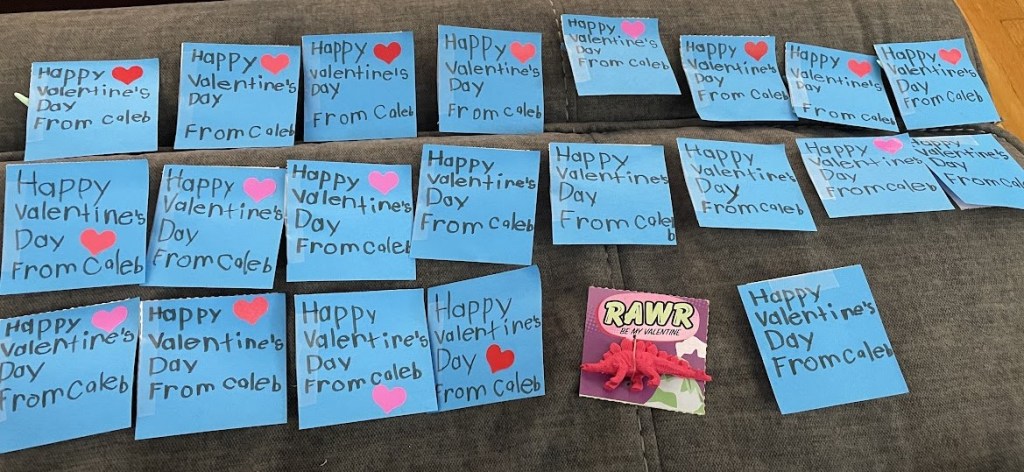
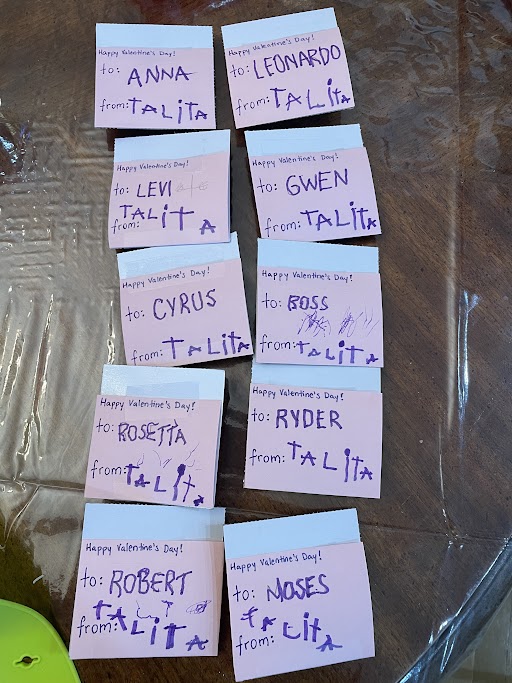
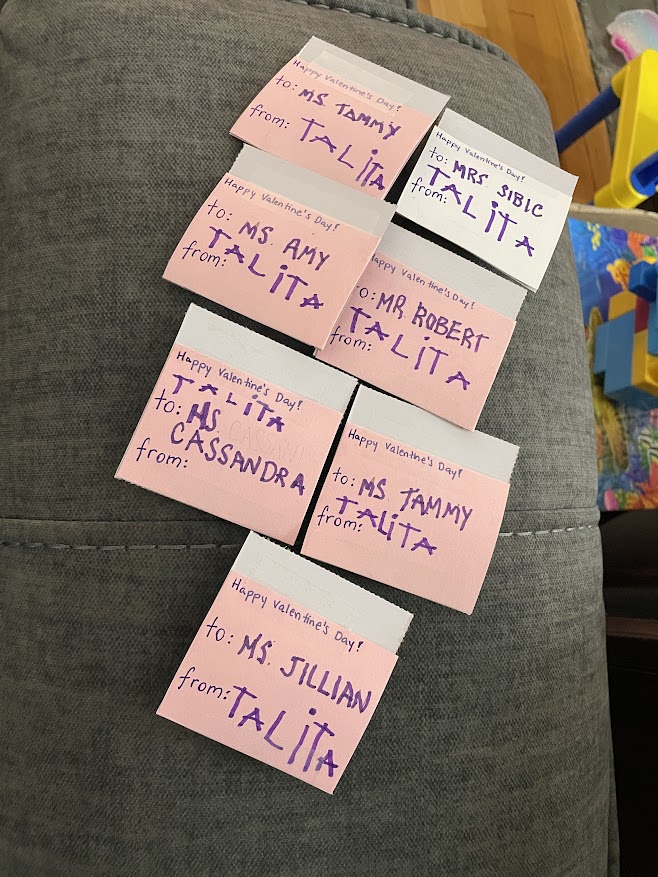
Today and tomorrow, I’m helping get Caleb and Talita to school and home again because their dad is traveling for work and their mom is a nurse who leaves home early and gets back late. The kids have spent hours laboring over their valentines for their classmates and teachers. Caleb wrote his greetings by himself.
Valerie “dotted” the names for almost-four Talita to trace, and she wrote her name by herself on all these cards:
So much effort to communicate friendship and appreciation!
I’ve been musing over how to combine Valentine’s Day with Ash Wednesday. The prophet Joel gave me the answer. God’s heart is full of unfailing love for us, and he wants us to love him back. He wants to repair his broken relationship with us. He can do so if we turn back to him, admitting and grieving what we’ve done that hurts him.
Our “valentine” for him is humility, and honesty, and a desire to hear and honor his heart of love.
And there’s no better source of love for those we care about than his Spirit, free to flow within and through us (John 7:37-39). That’s why I’ve chosen a flowing river as an image for Lent. The Spirit wants to cleanse us and grow and water his fruit in the garden of our hearts. Starting with love.
Shutterstock: Liinna Lilli
The Holy Spirit produces this kind of fruit in our lives: love, joy, peace, patience, kindness, goodness, faithfulness, gentleness, and self-control (Galatians 5:22-23).
Isaiah 25:9 (Isaiah 46:3-4, Malachi 4:2, Romans 5:10-11, Hebrews 4:15, 16, 2 Peter 1:1) In that day the people will proclaim, “This is our God! We trusted in him, and he saved us! This is the Lord, in whom we trusted. Let us rejoice in the salvation he brings.”
Trust isn’t easy, especially when we’ve been betrayed. When someone we have trusted has not just disappointed us, but has deliberately hurt us for their own ends. Because the Three-in-One God understands this, Jesus came, to experience in a body what betrayal is. That’s why we can go to him to find mercy and grace in our time of need. This is our God, not a being far off, but one who draws near, in compassion and full understanding. With healing in his wings.
Isaiah 36 and 37 “This is what the great king of Assyria says: ‘What are you trusting in that makes you so confident?’ … Don’t let Hezekiah deceive you. Don’t let him fool you into trusting in the Lord by saying, ‘The Lord will surely rescue us.’” … The prophet Isaiah said to King Hezekiah, “This is what the Lord says: ‘Do not be disturbed by this blasphemous speech against me from the Assyrian king’s messengers. Listen! I myself will move against him.’” … Hezekiah prayed this prayer before the Lord: “You alone are God of all the kingdoms of the earth. You alone created the heavens and the earth. Bend down, O Lord, and listen! … Then all the kingdoms of the earth will know that you alone, O Lord, are God.” Then Isaiah sent this message to Hezekiah: “This is what the Lord, the God of Israel says: ‘Because you prayed … For my own honor and for the sake of my servant David, I will defend this city and protect it.’” That night the angel of the Lord went out to the Assyrian camp and killed 185,000 Assyrian soldiers. Then King Sennacharib of Assyria broke camp and returned to his own land.
Psalm 116:1-2 I love the Lord because he hears my voice and my prayer for mercy. Because he bends down to listen, I will pray as long as I have breath!
It happens regularly when I’m with my young grandchildren. The tug on my clothing or my hand. The urgency in the child’s voice, “Grammy, listen!”
He or she wants me to stop what I’m doing, bend down to their level so our eyes can connect, and give exclusive attention to whatever the issue is: “I need to show you something,” “I think …” “I want you to help me …” “I’m sad [or mad or glad] because …”
Shutterstock: XiXinXing
I thought of this when I read Isaiah 36 and 37, this story of a desperate king needing assurance that God saw and cared about his situation. King Hezekiah had no resources in himself adequate to the overpowering strength of the Assyrian army, bent on conquest.
What situation do you face today that’s simply too difficult for you to face on your own? What army do you find arrayed against you?
Cry out to the Lord. Picture him bending down to you, as an adult to a small child. Pour out your need and watch for him to act on your behalf.
I’ve written about this before, but it’s such a powerful example of God bending down to us that I want to remind you and myself again of an experience Karis recorded in her journal. In January 2006, Karis had received a five-organ transplant (the first intestinal transplant in 2004 had failed). After a two-and-a-half-year absence from school as she battled for restoration of health, Karis was able to return to Notre Dame for fall semester, 2006. In January 2007, a doctor told Karis the steroid she had to take to combat rejection had destroyed her hip. He recommended immediate surgery, which would require her dropping out of one more semester at Notre Dame.
Karis was devastated. She threw herself down on the grass beside Mary Lake, her despair too great for words.
And Jesus came to her. She saw him with each one of her scars on his body, in the deepest imaginable identification with her pain. He knew, he cared, he faced this new crisis with her.
God does bend down to listen.
Surely, he took up our pain and bore our suffering (Isaiah 53:4).
Isaiah 15:5, 7, 8, 16:2-5 My heart weeps for Moab … their cries of distress can be heard. … The people grab their possessions and carry them … A cry of distress echoes through the land from one end to the other. … The women of Moab are left like homeless birds. “Help us,” they cry. … Let our refugees stay among you. Hide them from our enemies until the terror is past.When oppression and destruction have ended … then God will rule with mercy and truth. He will always do what is just and eager to do what is right.
Since Isaiah continues the theme of refugees, I want to tell you about For the Nations, https://ftnro.org/ “Refugee Care that Changes Lives,” in Dallas, Texas. Our niece Claire Kornfield works fulltime with For the Nations teaching refugee children. Here’s what Claire says:
The nations are coming to us as refugees and God’s hand is at work in this. It is now shockingly easy to share the Gospel with people from cultures where Jesus is little known.
To understand this ministry, it is helpful to know what a refugee is. Refugees are people who were in grave danger in their home country. These dangers often arise because of race, religion, or politics. They flee from their home country and generally end up in refugee camps in a second country where they apply for refugee status with the United Nations. These camps can be very unsafe themselves. They usually remain in the camps for a minimum of a year and a half, but some have been known to be trapped there for 20 years. Some refugees are eventually, after much vetting, invited by the United States to come and live here as permanent, legal residents. This process of getting to the United States is very long and painful.
And it is just the beginning. Once they arrive here, they usually do not speak English. They also may not know how to read, drive, use a washing machine, go to the doctor, find a job, etc. They are given about three months of housing by the government (which they must pay back) and after that, need to provide for themselves.
This is very overwhelming and does not even touch on the traumas they have likely also endured. But it is exactly at this overwhelming and terrible moment that the people of God have the opportunity to be His hands and feet and welcome the sojourner.
At For the Nations: Refugee Outreach we do this by focusing on education, family services, and sharing the Gospel. For education, we offer English and GED classes for adults and accompanying preschool/childcare for their little ones. This helps the adults get jobs and prepares their young children for kindergarten. We also offer homework help for older children after school. And in the summer (my favorite time of year), we run a program that is something like a cross between summer school and vacation Bible school for about eight weeks.
Family services include: helping them find a job, get a car, learn to drive, understand what to do with speeding tickets, learn how the bus system works, learn how to get medical help, etc. At times family services involve helping protect refugees from those who would exploit them, such as teaching them their rights and helping them with wrongful evictions.
We try to include sharing the Gospel in all of our programs. As I’ve already said, this is surprisingly easy. The founder of For the Nations began by simply tutoring children after school at their apartment complex. She asked their parents if she could also tell the children about Jesus and they readily agreed. We have a time for a Bible lesson in our adult and children’s classes. Additionally, we have Bible studies for seekers or those who are already believers.
I really believe that refugees in this country are an example where “the harvest is plentiful, but the workers are few.” We have large wait-lists for our English classes and homework help program because we do not have enough staff or volunteers. These are missed opportunities of people who would willingly come and let us tell them about Jesus, but who we have to turn away; there are many such missed opportunities across this country.
Staff like me raise support like missionaries. We are able to do this missional work because churches and individuals partner with us in serving and sharing the Gospel. There are now many refugees in this country and what I want to say most is, “Seize the opportunity!” Maybe you can volunteer, tutor, teach, or befriend. And if you can’t, maybe you can support someone who does. I serve in Dallas and, personally, would be grateful for prayer or financial support (This link can be used for financial support: https://ftnro.org/claire/). However, it may be equally or more important to find or create services for refugees to support in your own city.









 Debra Kornfield