Psalm 18:25-26 To the faithful you [God] show yourself faithful; to those with integrity you show integrity. To the pure you show yourself pure. But to the wicked you show yourself hostile.
Psalm 101:2-4 I will be careful to live a blameless life—when will you come to help me? I will lead a life of integrity in my own home. I will refuse to look at anything vile and vulgar. … I will reject perverse ideas and stay away from every evil.
Tuesday night we hosted Rory Birkbank from Safesurfer for our Justice Night on the topic of pornography. A couple good quotes:
“Porn is sex trafficking with a camera rolling.”
“Disrespecting women—that is what porn is, obviously.”
Unfortunately, this isn’t “obvious” to everyone. Rory gave us an excellent presentation of what is happening online, why and how to protect our own families from it, and how to pray against it.
If you have not looked into Safesurfer before, please do. They help with more than porn: social media, gambling, malware, etc.
Honestly, I have been taken aback a bit by Safesurfer. I knew that it was one of the leading internet protection services in the world. … Then I stumbled on their offices, upstairs in the back of one of the local churches here in Tauranga. I thought it must be a different organization with the same name. After all there is a lot of surfing in Tauranga. This group must be about safety while surfing in the ocean, right?
Nope. They are one of the leading global protection services – in this back office of a random church in Tauranga. They’re a small group of genius Christians with such a heart for families. They have set up their systems so none of their staff have to view the objectionable materials. They automatically report child sexual abuse material (CSAM) to global law enforcement. They provide a free service to remove all nudity – from all devices.
Don’t think you need it for your family? One in four kids have seen porn by age 14. Almost 50% of them have seen it by accident, not looking for it at all. They don’t have to be searching with obvious words. It comes up in so many unexpected places.
Let’s join David in Psalm 101, committing ourselves and our families to living with integrity.
Psalm 105:1-2, 7-8 Give thanks to the Lord and proclaim his greatness. Let the whole world know what he has done. Sing to him; yes, sing his praises. Tell everyone about his wonderful deeds. … He is the Lord our God. His justice is seen throughout the land. He always stands by his covenant—the commitment he made to a thousand generations.
Matthew 26:28 This is my blood, which confirms the covenant between God and his people. It is poured out as a sacrifice to forgive the sins of many.
I was only thinking of three generations when I wrote Karis: All I See Is Grace: my own generation, my children, and my grandchildren, yet unborn. I wanted my children’s spouses and my future grandchildren to know what God had done in our family through his faithfulness to Karis. Verses 1 and 2 of this psalm were part of what motivated me to persist through the three years it took me to write the book, along with Psalms 78:4-7, 102:18, 107:2, 118:17, and 145:4 and 12. All of them instruct us to remember and to tell what God does for us.
Imagine making a commitment to a thousand generations! I know that number means “all the generations to come,” but if we think about it literally and conservatively, choosing twenty years as the length of a generation, a thousand generations is 20,000 years. God keeps his covenant for at least that long. All recorded history is a small dent. Here we are, in our generation, still praising God for his faithfulness to us. If we notice what God does for us when it happens, remember it, and tell others, we’ll be part of Asaph’s vision in Psalm 78.
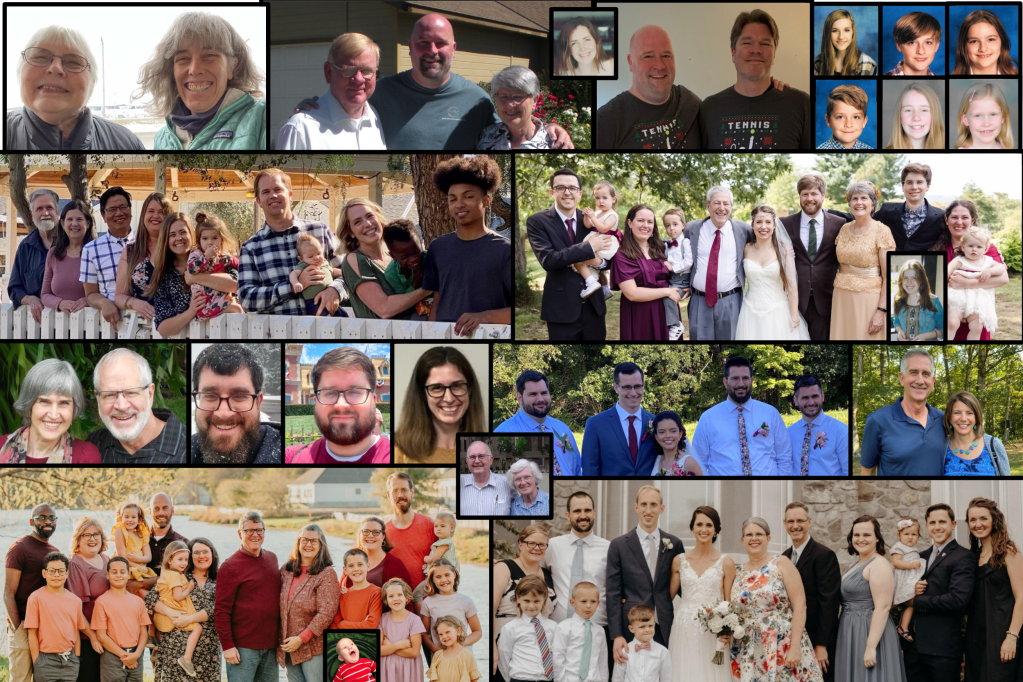
Last week in Idaho, my sister Marsha and I put together the “reunion puzzle” our daughter Valerie created from photos of the members of the extended Elliott family, in keeping with our reunion theme, “Pieces of a Whole.” The progeny of my parents, Ray and Helen Elliott, now numbers 81, with three to be born in the next three months.
Our reunion puzzle Three more babies coming, in September, October, and November!
As the beloved faces emerged in the puzzle, I prayed for each of us to remember and celebrate God’s covenant of love for us, in the past, in the present, and stretching into the future to those not yet born and those yet to be brought into the family by marriage or by adoption.
Keeping covenant is costly. It’s not simple or easy. It cost God the life of his son. That’s the measure and standard he set for us. Today, my 68th birthday, I’m asking him to show me day by day in this next year how to live out his covenant; with more boldness remembering and telling, “so the next generation will set its hope anew on God” (Psalm 78:4-7).
Psalm 81:8-16 Listen to me, O my people, while I give you stern warnings. Oh, if you would only listen to me! . . . Open your mouth wide, and I will fill it with good things. But no, my people wouldn’t listen . . . But I would feed you with the finest wheat. I would satisfy you with wild honey from the rock.”
This morning I made French toast with yogurt and strawberries, scrambled eggs, and sausage for my husband for breakfast. A way of making up, I suppose, for the week of dry cereal he just had while I traveled to Idaho to visit my sister Marsha and her husband Vance. Of course, if he wished, he could learn to cook! But he has too many other irons in his fire.
While I was making breakfast, I thought about this blog. Some days are French toast days. Some are cold cereal days, when other priorities of life must take precedence. Today, I think, is a cold cereal day, because I’m preoccupied with completing the manuscript for Treasure Hunt 1904. Next Monday the 15th is the deadline for turning it in to the publisher. Four days! Yikes!!
But I do want to honor the Lord today. As I prayed about my trip to Idaho, he gave me this Scripture from Psalm 81, which made me think of baby birds in a nest, trustfully opening their beaks to receive what their mother would bring them.
I wanted to be one who listened, who paid trustful attention to what the Lord was doing in Idaho and in my life and the intersection of the two for a week. I traveled with a sense of curiosity and anticipation.
Some of what God did, I expected. Like the peace and the warm welcome I feel in Vance and Marsha’s home. Their kindness and generosity. Their joy in living one day at a time despite challenging circumstances.
But God filled my mouth with surprises, too. I will treasure forever my sister’s beautiful voice soaring in worship. A dancing fountain became for me an image of the Holy Spirit’s delight in delighting us. I was able to see beauty in the desert this time I had not been able to appreciate on other visits to Idaho. Vance had given me a book to read called Desert Spirituality and Cultural Resistance by Belden C. Lane which nurtured new concepts for me about the hard times in our lives. It challenges me to pay attention, to listen, to watch for the ways our Father draws close to us when we are not distracted by all our stuff and our own “important and urgent” work. To pay more attention to his voice than to having a voice of my own—though of course, the two are intertwined.
Opening my mouth wide is not just for travel to the high desert of Idaho. It’s for Pittsburgh too.
2 Peter 1:16-18 For we were not making up clever stories when we told you about the powerful coming of our Lord Jesus Christ. We saw his majestic splendor with our own eyes when he received honor and glory from God the Father. The voice from the majestic glory of God said to him, “This is my dearly loved Son, who brings me great joy.”We ourselves heard that voice from heaven when we were with him on the holy mountain.
John 17:18, 22, 26 [Jesus prayed,] “Just as you sent me into the world, I am sending them into the world. … I have given them the glory you gave me, so they may be one as we are one. … I have revealed you to them, and I will continue to do so. Then your love for me will be in them, and I will be in them.”
Last Saturday, August 6, the Church worldwide remembered the Transfiguration of Jesus, another pivotal moment in his life when, as at his Baptism, God the Father reminded his Son that he loved him and found great joy in him.
So it seems fitting that we conclude our consideration of Peter’s writings by returning to chapter 1 of his second letter, when he recalls the impact of Jesus’ transfiguration on his own life. Peter was there! He saw the glory of the Lord revealed on that mountain. He must have recalled his own inept response, yet that was swallowed up into the wonder of this intimacy with his Lord. We saw with our own eyes … we heard … we were with him.”
After his baptism, the Spirit sent Jesus into the desert, where he was tempted. After his transfiguration, Jesus turned toward Jerusalem, where he would be killed. In both moments of his life on planet Earth, Jesus carried as an anchor in his soul his Father’s love and his own deep resonance with his Father’s joy.
One of the greatest delights of my life is to walk into the home of either of my daughters and be met with cries of “Grammy! Grammy!” Talita does a little dance. Caleb runs to show or tell me something. Liliana stretches out her arms. And my heart responds with profound gratitude. “Thank you, Lord, that through these little ones you communicate your love and joy to me. I receive it with thanksgiving and wonder.”
There’s another side, though, to August 6. It’s also the anniversary of the first bomb the United States dropped on Hiroshima. Greater even than the wonder of the love of children is the mystery that God still loves and claims his children even when they destroy one another. Even when they crucified Jesus. Even then, Peter tells us, God is patient, not wanting anyone to be destroyed but rather to repent (2 Peter 3:9). On the cross, Jesus said about those who were driving those horrid nails into his flesh, “Father, forgive them, for they don’t know what they are doing” (Luke 23:34).
“Tis mercy all, immense and free. … Amazing love, how can it be.”
2 Peter 3:8-9, 13 A day is like a thousand years to the Lord, and a thousand years is like a day. The Lord isn’t really being slow about his promise, as some people think. No, he is being patient for your sake. He does not want anyone to be destroyed but wants everyone to repent … what holy and godly lives you should live, looking forward to the day of God and hurrying it along. … We are looking forward to the new heavens and new earth he has promised, a world filled with God’s righteousness.
Chapter 1 of 2 Peter gives us a pattern of godly living. Chapter 2 warns us not to follow false teachers, showing us the antithesis of godly living. Chapter 3 reminds us Jesus will return and set the world right.
It’s the hope Christians have held on to for two thousand years.
Imagine: already when Peter wrote this, just a few years after Jesus returned to Heaven, believers—including people who personally knew Jesus—already felt like it was taking a long time for him to come back. And here we are, almost two thousand years later, still yearning for the day we will meet our beloved Lord face to face.
But what catches my attention as I read chapter 3 is the word “repent” in verse 9, because it reminds me of Peter’s repentance and restoration after he denied Jesus. Hours before he had brashly said, “I’m ready to die for you” (John 13: 37). Jesus answered, “Die for me? I tell you the truth, Peter—before the rooster crows tomorrow morning, you will deny three times that you even knew me.”
Ouch.
No wonder Peter escaped into fishing. And then Jesus performed a miracle that mirrored one of Peter’s early encounters with him, with one critical difference. Compare Luke 5:5-7 with John 21:11: The first time, the nets were so full they began to tear. In writing about the second time, John makes a point of detailing that there were 153 large fish, and yet the net did not tear.
The first time Jesus performed this miracle, Peter wasn’t ready for his role as a fisher of men. Here’s The Chosen’s dramatization of this event. https://www.youtube.com/watch?v=hWGCkovAUWM
The second time, Jesus took Peter through an intriguing process of repentance and restoration, entrusting his “lambs” to Peter’s care, and gave him a new identity: a shepherd.
A friend in Brazil sent us a moving song about Peter. You’ll capture its soul by listening even if you don’t understand Portuguese. Jesus tells Peter, “I know you own your boat. But I own the sea.” And Jesus reminds Peter how to live his life: “Your knowledge will only matter if you know how to love.”
I’ve seen 2 Peter 3:9 and 15 applied to evangelism, the role of the fisherman. I think there’s more to it than that. I think they applies to each of us in the areas we each need to repent and be made whole, as we are cared for by our Shepherd. Like Peter himself.
Through the centuries, people have made predictions about Jesus’ return and have exhorted believers to prepare for that Day, sailing their boats as well as they knew how. Let’s remember: The Lord owns the sea. He decides.
And meanwhile, our instructions are clear. Make every effort to be found living peaceful lives that are pure and blameless in God’s sight. … Grow in the grace and knowledge of our Lord Jesus Christ.
The Lord whom Peter came to know very, very personally.
But God’s light breaks through our darkness July 28, 2022
2 Peter 1:19-20 You must pay close attention to what the prophets wrote, for their words are like a lamp shining in a dark place—until the Day dawns and Christ the Morning Star shines in your hearts. … Those prophets were moved by the Holy Spirit, and they spoke from God.
Have you ever been in a dark place, and found that words of Scripture were like a light, bringing you hope? I would love for you to share that experience with But God readers, to encourage us.
I heard Elise Massa and Andy Clark’s new song, “O Gracious Light” just in time for this post. Elise and Andy collaborated at a Resound Worship Songwriters Retreat in Yorkshire, England a couple of weeks ago. If you’re a worship artist, check outUnited Adoration!
One such experience: Karis was in the ICU for 75 days straight in 2004-2005, not expected to live. That space became claustrophobic for me.
One morning I read Psalm 118 in the NIV. When I reached verse 5, the light went on: When hard pressed, I cried to the Lord; he brought me into a spacious place. “Oh Lord!” I prayed. “Please, please do this for me.” And he did. He allowed the walls of that high pressure place to recede. He filled the space with light and gave lightness to my spirit. I often remembered as I re-entered the ICU C.S. Lewis’s phrase about the stable in The Last Battle, that it was bigger inside than it was outside.
The NLT renders Psalm 118:5 like this: In my distress I prayed to the Lord, and the Lord answered me and set me free. In what way or ways has the Lord set you free? Please tell us!!
2 Peter 1:1, 4-5; 3:9-10 I [Peter] am writing to you who share the same precious faith we have. This faith was given to you because of the justice and fairness of Jesus Christ, our God and Savior. … He has given us great and precious promises that enable you to share his divine nature and escape the world’s corruption caused by human desires. … The Lord isn’t really being slow about his promise, as some people think. No, he is being patient for your sake. … But the day of the Lord will come.
“It’s not fair!”
Six-year-old Karis banged the front door and stomped into the kitchen. “It’s not fair that the English language is so hard to spell! It’s okay for me because I already know how to read. But it’s ridiculously hard for the kids who are just learning. Who decided the f sound should be written with a gh?!”
Sent to me by Karis when she was in college.
Ten-year-old Karis wept into her pillow. “It’s not fair that so much money is being spent on me, just to keep me alive! What about the children who starve not because they can’t eat, like me, but because they don’t have food? Can’t we ask the insurance company to buy food for them instead of paying my hospital bill?”
Twelve-year-old Karis, once she was stabilized from her immediate crisis, greeted me from her hospital bed with tears running down her cheeks. “It’s not fair that you canceled our family vacation! Take the other kids and go! I’ll be fine here. I can’t bear causing them disappointment AGAIN!”
Sixteen-year-old Karis, after passing out at school from dehydration, glared at me defiantly. “I refuse to return to Hospital Einstein. It’s not fair to pay for a five-star hospital when my Brazilian friends have to go to Hospital Grajaú! Take me to Hospital Grajaú!” (This story is in Karis: All I See Is Grace.)
It’s not fair … true. The world is not fair. We have a zillion blessings others don’t have. But our Lord Jesus will return and set everything right. It’s a promise as dependable as God’s immutable integrity. It’s the solid hope we have as we mourn the corruption around us. (Whoa, Peter—are you sure you didn’t visit 2022 when you wrote chapter two?)
As I read Peter’s brief second letter, I keep remembering that these are his last recorded words. I sense his urgency, after years and years of walking with Jesus, to communicate with us, warn us, encourage us, remind us what really matters. Jesus could come back any moment! How do you want to be found when he does?
We are looking forward to the new heavens and new earth he has promised, a world filled with God’s righteousness. So, dear friends, while you are waiting for these things to happen, make every effort to be found living peaceful lives that are pure and blameless in his sight (2 Peter 3:13-14).
1 Peter 5:9-12 Remember that your Christian brothers and sisters all over the world are going through the same kind of suffering you are. … So after you have suffered a little while, God will restore, support, and strengthen you, and he will place you on a firm foundation … What you are experiencing is truly part of God’s grace for you. Stand firm in this grace.
We’ve come to the end of 1 Peter at the same time we’re celebrating Juneteenth, an opportunity to remember and honor the hard-won end of Black enslavement in the United States.
But thinking of the horrific suffering engendered by the Civil War on both sides of the conflict, and the betrayals Black people experienced in the Jim Crow years and beyond, I find I want to argue with Peter. How can suffering be part of God’s grace?
Shutterstock: rarrarorroThis article describes the beautiful symbols on the Juneteenth flag.
The Civil War was an unconscionable tragedy rooted in greed, cruelty, violence, and a distorted perspective of God’s purposes and plans for his people. The war (as do all wars) engendered shattering losses of life and livelihood, families divided and decimated, resources squandered.
Today, the tragedy of war is replaying in the Ukraine. Where is the grace? What are you saying, Peter?
I read an article this morning titled “Why White Men Should Celebrate Juneteenth.” Without the Civil War, our nation would have broken into two and the double standard which fractured our nation into slave and free despite the bold statement in the Declaration of Independence of the “self-evident truth” that all men were created equal would have continued to poison our progress. As Frederick Douglass said, a healthier nation is built upon “one country, one citizenship, and one liberty for all the people.”
But did this have to come at such an immense cost? Where is the grace, Peter?
According to the UNHCR, there are over 84 million displaced people in the world. Where is the grace, Peter?
According to Safe Horizon, 24.9 million people are victims of “modern slavery” in the United States, including 3.8 million adults and 1 million children exploited by sex trafficking. Come on, Peter. You dare speak of grace?
Every year, more than ten million women and men in the United States experience domestic violence. More than 400,000 children in the US were in foster care last year. Grace??
What is Peter saying?? Please look back over 1 Peter and tell me what you think!
But God has given each of us a gift, by David Kornfield
1 Peter 4:8-11 Most important of all, continue to show deep love for each other, for love covers a multitude of sins. … God has given each of you a gift from his great variety of spiritual gifts. Use them well to serve one another. Do you have the gift of speaking? Then speak as though God himself were speaking through you. Do you have the gift of helping others? Do it with all the strength and energy that God supplies. Then everything you do will bring glory to God.
I just spent two precious hours participating in a virtual retreat with beloved friends in Brazil, a wonderful gift from God to me. I felt deeply loved through their prayer for me after I shared what God had put in my heart to speak to them.
What makes the difference between doing something for someone as a job or responsibility and doing it with positive spiritual impact? I believe the difference is whether we offer our service with love mediated by the Holy Spirit. An example comes from the experience of my friend Carol. She told a group of friends Tuesday night that she believes God has put her in exactly the right place. She has started her new job at the information desk of a large hospital this week. Already a person requested a form to tell the hospital Carol’s service to him had been exceptional.
“It’s not me, it’s the Holy Spirit,” Carol told us. “I try to see each person who comes to the desk as God sees them. I’ve been amazed at what God has shown me and has filled my heart to say as encouragement to each one. Hospitals are stress-filled places. I want them to carry a sense of peace and support as they leave me.”
She then told us the story of a man who left the desk to visit his wife and returned to tell her his wife had died. “Why would a total stranger tell me that?” Carol wondered. “Only because he somehow felt the sweet presence of the Holy Spirit calming and comforting him.”
Peter’s linking of the concepts of love and gifts reminds me of Gary Chapman’s “love languages.” So I asked my husband Dave to share from a conversation he had with God about one of his growth goals, to better love the people around him. God showed him how he (God) expresses all five of Chapman’s love languages:
In my devotional life, I talk with God, and he talks with me. This calls for a sanctified imagination, but I believe it’s real. What follows is God speaking to me about His love languages.
I love you. I never get tired of telling you that. It would be tricky to try to limit my love to any given love language, but verbal love is certainly a very big part of my love! Consider how I express all five:
Verbal love. “In the beginning, was the Word and the Word was with God, and the Word was God.” (John 1.1). My verbal love starts there and never stops. You can track it through other key references like John 1.14-18; 5.39, 40; 2Tm 3.16-17 and Heb 4.12 for starters. Then you can pick it up in my love expressed in my creation (Ps 19.1-7), spilling over to my written Word (Ps 19.8-14; all of Ps 119!).
Touch or physical love. Go through the Gospels some time and notice how often Jesus touched people physically or they touched him physically. Dozens of times! And since his Ascension, the Body of Christ is his hands and feet, touching others physically and tangibly (Mt 25.31-46).
Gifts. John 3:16 declares how my love expressed itself in the greatest gift of all, which opens the door for spiritual birth and transformation (John 1.12-18). And then my love goes on to spiritual gifts – Eph 4.9-116; 1Co 12-14; Rm 12.8-16; 1Pe 4.8-11 – all of them in the context of love. And that’s only the beginning of the gifts I’ve poured out on you – physical, financial, social, spiritual, relational – so many!
Service. Mt 20.25-28; Ph 2.1-9. My utter and profound commitment to being ezer [helper, a frequent descriptor of God in the Old Testament, e.g. Psalm 46:1, and of Eve in Genesis 2:18]. Serving. Elevating. Raising up. For the Son of Man came not to be served but to serve others (Mark 10:45).
Quality time. That’s what you experience with Me at the beginning of every day and in your divine encounters, in my kairos. I make everything beautiful in My time (Ec 3.11).
I am off any scale you can picture in using all five. Try finding the horizon of any of those and you will find it’s like looking at the ocean. There is a horizon, but that’s simply the limit of your vision. It doesn’t come close to reaching the end of the ocean! That’s how I am toward you in each of these five love languages.
Hmm, why am I not surprised, Lord? I guess the only surprise is that I haven’t seen this so clearly before. I’ll find it easier now to learn and use all five languages. Looking at you, I see how to do it. This adds depth to Your words “Walk with me and work with Me – watch how I do it!” [Matthew 11:29, The Message].
Help me today, Lord, to walk in Your love and be a conduit of Your love to each person I meet virtually, by email, WhatsApp, Zoom or in any other way, including personal connection with Deb and anyone else you bring to my home today. I pray in your holy name, so be it.
A suggestion from Dave:
Ric Warren’s The Purpose-Driven Life is a wonderful forty-day devotional describing how God fulfills His purposes in each of us. Days 29-35 focus on God shaping us for His service. Day 31 in particular highlights the S.H.A.P.E. he used for each of us: Spiritual gifts, Heart, Abilities, Personality, Experience. You can learn more about that here.
What gift(s) have you received from God? Today is a great day to tell him thank you, and to ask him to make his gifts to you even more effective in sharing his love, through the Holy Spirit.
1 Peter 2:11-25 Dear friends, I warn you as “temporary residents and foreigners” to keep away from worldly desires that wage war against your very souls. Be careful to live properly among your unbelieving neighbors. Then even if they accuse you of doing wrong, they will see your honorable behavior, and they will give honor to God when he judges the world.
A sweet, unexpected thing happened. I walked outside to get in my car and a stranger walking by spoke to me, saying, “I always like walking by your house because of your heart-shaped tree stump. It encourages me.” And her dog pulled her away.
The stump left from our beloved dead tree is heart-shaped? I hadn’t noticed.
My neighbor’s comment healed some of my sadness at having to cut down our aged beloved tree. Her “honorable behavior” blessed me. I don’t know exactly where she lives. I’m watching for her so I can meet her properly and thank her.
When I walked out this morning to take a photo of the stump, I noticed a thistle growing beside it. Thanks to all the rain we’ve had, weeds are flourishing. I decided the thistle illustrates the heart-weeding I need to do of the “worldly desires that wage war against our souls.” So for the moment, I left it in the ground, and in the photo, to remind me to do both kinds of weeding.
Thistle vs. heart-stump. “Worldly desires” vs. “honorable behavior” flowing from hearts filled with God’s love. Peter offers twelve indicators of honorable living. Look up the passage and count them!
I want to focus today on the last one, “you have turned to our Shepherd for healing of your wounds and for spiritual protection,” in verses 24 and 25. I’ll do this by sharing with you ten thoughtfully penned Principles of Healing recently sent to me by my sister-in-law Elaine Elliott. Check out Elaine’s Art and Scripture posts. You’ll love the way she illustrates Scripture with inspiring art from a wide variety of artists.
Elaine’s explanation is longer than what I usually post, but so worth your consideration. I’ve bolded the principles to help you return to them when you need them. I’ll post five today and five next time.
As one of Karis’ aunts, I watched her life (usually from afar) with wonder. The fact that she survived beyond her first month made her a miracle baby. The sacrificial care Debbie gave to her repeatedly prolonged her life. When the family moved to Brazil as Karis seemed completely healed and well, this marked another miracle. When her health declined and eventually led to her transplants, we followed the ups and downs with prayers for her. When in a medically induced coma after the first transplant failed, I assumed this was the end of the story so was astonished when she traveled to Brazil before transplant #2. Her example of patience with pain and determination to enjoy life despite her limits served as an inspiration.
For me, Karis’ life, and the book Karis: All I See Is Grace remains an inspiring story of healing despite the messy medical procedures, her suffering, and her ultimate death. My own journey to understand healing explains why.
The following ten principles have emerged for me over the years.
Principle 1: Accept and use wisely the advances in medical science
During my freshman year of college, I heard for the first time about the baptism of the Spirit as a post-new-birth experience which led to increased gifting and power. I was immediately on-board and immersed myself in this exciting new way of being a Christian. Of all the gifts, healing struck me as the most glamorous, and I read books by contemporary healers hoping to receive this gift.
My immediate thought as a healthy person was to pray that my eyes would heal, thereby removing the need for contact lenses or glasses. When this did not come about after about three months of unnecessarily poor eyesight (while in college squinting at the blackboard!), it suddenly struck me that I was ignoring the obvious: if God gave mankind wisdom to come up with something as ingenious as contact lenses, then I should accept that healing could come through medicine.
This became an important principle for my understanding of how God works, teaching me we must simultaneously pray and trust God as we collaborate with medicine and doctors. We should not be like King Asa of whom it says he “developed a serious foot disease. Yet even with the severity of his disease, he did not seek the Lord’s help but turned only to his physicians.” (II Chronicles 16:12) Nor do we want to be like the woman Jesus healed who “had suffered a great deal from many doctors, and over the years she had spent everything she had to pay them, but she had gotten no better. In fact, she had gotten worse.” (Mark 5:26)
God has used scientific advances to transform treatment of leprosy, such a scourge throughout the Bible. Identified as caused by bacteria in 1873, the first disease so recognized, the accidental discovery of antibiotics in 1928 led to an effective drug in the 1940s and became multi-drug therapy by the 1980s. The disease has nearly been eliminated. I think of how important it was for Jesus to heal lepers with no cure available then or for nearly 20 more centuries. For new cases today healthcare workers diagnose the disease and prescribe some pills. This all can be celebrated as a gift from a wise God who shares his wisdom with curious people.
Using the wisdom regarding preventative illness correlates well with some of the sanitation, dietary, and admonitions to rest in the OT law. We do well to eat well, exercise, rest, and reduce our stress—all things consonant with living in the Spirit.
Principle 2: Accept the possibility of death as God’s way of healing
I learned another principle when in my second year of college, we went to pray for a girl about eighteen years old whose family went to our church. The girl was so developmentally disabled she was confined to a crib, which I found horrifying. I prayed diligently for her healing. One afternoon I was so convinced she had been healed that it shocked me completely when my grandmother told me she had just died.
After the shock subsided, I suddenly realized, “She is completely healed in heaven!” Ever since, I have held the strong belief that God, who has the power of life and death, knows when it is best for someone ill to be with him, relieved of their suffering. When things are uncertain, we know death can be an acceptable outcome. As Paul says, “when our dying bodies have been transformed into bodies that will never die, this Scripture will be fulfilled: ‘Death is swallowed up in victory. O death, where is your victory? O death, where is your sting?” (I Corinthians 15:54,55) We may grieve, but we have hope.
Principle 3: Prayer close by and from a distance both matter
Often those praying for healing lay hands on someone or anoint with oil or remain present in prayer. But prayers from far away matter too. As the Roman officer who trusted Christ’s authority said, “Just say the word from where you are, and my servant will be healed.” (Matthew 8:8) Our family experienced a profound healing of my sister Bev who had convulsions at the age of 18 while in Mexico. She went into a coma and the doctors predicted either death or brain damage. I learned about her situation while far away in Tucson but prayed for her as did many friends far and wide. She opened her eyes, but at first seemed like a small child. By the time I saw her several months later at Christmas time, she had partially recovered—perhaps to grade school level—but by the following fall went to the university with no ill effects and no one aware of her severe illness unless she told them. Though far away, I felt very present to her through prayer as did many others. It convinced me my prayers mattered.
Principle 4: We can have faith for others even when they lack faith
Another principle is that while it may be helpful for the sick person to have faith for themselves, it also works for us to have faith for others. It is unnecessary to guilt anyone about their illness or to demand they exercise faith. The disciples praying were the ones exhorted that their faith had been inadequate when they failed to heal the epileptic child. (Matthew 17:19,20)
Someone I knew who struggled with alcoholism did not have much faith for change. We who cared provided the faith that this challenge could be overcome and rejoiced when that happened.
Principle 5: Exercise compassion rather than ascribing sin or judgment as the cause of illness.
We do not have a right to explain illness as God’s judgment for sin. When the disciples saw a blind man, they asked “Why was this man born blind? Was it because of his own sins or his parents’ sins?” “It was not because of his sins or his parents’ sins,” Jesus answered. “This happened so the power of God could be seen in him.” (John 9:2,3) God’s power then proceeded to heal him.
Even if someone contributed to their own illness in some way, including sin, Jesus is present to heal, not to condemn. Jesus wasted no time castigating the paralyzed man brought by friends on a mat but pronounced forgiveness and told him to stand. We too can receive forgiveness and forgive others as we have been forgiven, a critical part of inner healing which leads to physical changes.
I remember a woman telling me “Depression is just sin.” But traumatic events that create depression often are not the fault of the one suffering. Seeing trauma and depression healed, I am convinced that loving presence helps transform painful experiences into something full of wisdom. Compassion always matters.