No dissing, ghosting, or discarding

But God will never throw us away

Isaiah 41:9-10 [The Lord says] I have chosen you and will not throw you away. Don’t be afraid, for I am with you. Don’t be discouraged, for I am your God. I will strengthen you and help you. I will hold you up with my victorious right hand. … For I hold you by your right hand—I, the Lord your God. And I say to you, ‘Don’t be afraid. I am here to help you.’”

Isaiah 41 lit up for me this week because two dear Pittsburgh friends are stuck in Tel Aviv. They took a tour in Israel to celebrate their retirement, and their tour guide was called to active duty. Then their flight home was cancelled. Another reason to pray for God’s mercy, along with our prayers for both Israelis and Palestinians caught in the crossfire with Hamas.

I have chosen you.

I will not throw you away.

I am with you.

I am your God.

I will strengthen you.

I will help you.

I will hold you up.

I hold you by your hand.

I am here to help you.

So, don’t be afraid or discouraged.

DON’T BE AFRAID.

Here is the story of this beloved hymn (authorship unknown) linked above, whose second stanza is taken from Isaiah 41:10.

Gently

But God understands

Isaiah 40:11, 27-29 He will feed his flock like a shepherd. He will carry the lambs in his arms, holding them close to his heart. He will gently lead the mother sheep with their young. … How can you say the Lord does not see your troubles? … The Lord is the everlasting God, the Creator of all the earth. He never grows weak or weary. No one can measure the depths of his understanding. He gives power to the weak and strength to the powerless.

From the time Karis was small, Isaiah 40 was important to us, she the lamb carried in the Lord’s arms, I the mother sheep He gently led. During long nights in hospitals and surgeries, we knew He was not weak or weary. No matter what our current crisis, dilemma, or grief, we knew He understood what we faced.

Karis with her sisters and cousins at a family reunion in Bolivia, 1992 (age 9). On this trip, Karis started getting sick again, after God gave her (and us!) two years of good health to adapt to living in Brazil. Karis was the oldest of eight granddaughters of Dave’s parents. Dan was their only grandson–adored by all the girls. Age 9 was the year Karis started keeping journals.

Aligned with Isaiah 40, two songs encouraged us. The first one you will likely recognize, “Holy, Holy, Holy,” which contains the beautiful line, “merciful and mighty.” It invoked our “lifeline” verses, Lamentations 3:22-24. We counted on God’s mercy and his power, renewed for us every single day.

The other, “Tu és soberano” (You are sovereign), we learned after we moved to Brazil when Karis was seven. Karis had a profound belief that NOTHING happened to her except by her Father’s permission and for some divine purpose. She was always asking not “Why did this happen to me?” in a self-pitying kind of way, but rather “What purpose does God want to accomplish through this?”

Because she asked this question, she was alert to what was going on around her. Who else was in the hospital this time to whom she could extend love? Who would God bring to her whose troubles she could better understand at a heart level because of her own pain and losses?

“Tu és soberano” includes this beautiful line: “Apesar dessa glória que tens, Tu te importas comigo também, e esse amor tão grande eleva-me, amarra-me a Ti, Tu es tremendo” (Despite the glory you have as Sovereign of the universe, you care about me too, and this love lifts me up and binds me to you. You are amazing).

Tears come to my eyes as I remember singing this beautiful worship song, full-throated, with my beloved brothers and sisters in Brazil. They have been God’s human arms to care for us and lift us to the Father not only while we lived in São Paulo, but through their prayers ever since.

I hope Isaiah 40 will encourage you today too.

Even when words aren’t adequate

But God bends down to listen

Isaiah 36 and 37 “This is what the great king of Assyria says: ‘What are you trusting in that makes you so confident?’ … Don’t let Hezekiah deceive you. Don’t let him fool you into trusting in the Lord by saying, ‘The Lord will surely rescue us.’” … The prophet Isaiah said to King Hezekiah, “This is what the Lord says: ‘Do not be disturbed by this blasphemous speech against me from the Assyrian king’s messengers. Listen! I myself will move against him.’” … Hezekiah prayed this prayer before the Lord: “You alone are God of all the kingdoms of the earth. You alone created the heavens and the earth. Bend down, O Lord, and listen! … Then all the kingdoms of the earth will know that you alone, O Lord, are God.” Then Isaiah sent this message to Hezekiah: “This is what the Lord, the God of Israel says: ‘Because you prayed … For my own honor and for the sake of my servant David, I will defend this city and protect it.’” That night the angel of the Lord went out to the Assyrian camp and killed 185,000 Assyrian soldiers. Then King Sennacharib of Assyria broke camp and returned to his own land.

Psalm 116:1-2 I love the Lord because he hears my voice and my prayer for mercy. Because he bends down to listen, I will pray as long as I have breath!

It happens regularly when I’m with my young grandchildren. The tug on my clothing or my hand. The urgency in the child’s voice, “Grammy, listen!”

He or she wants me to stop what I’m doing, bend down to their level so our eyes can connect, and give exclusive attention to whatever the issue is: “I need to show you something,” “I think …” “I want you to help me …” “I’m sad [or mad or glad] because …”

Shutterstock: XiXinXing

I thought of this when I read Isaiah 36 and 37, this story of a desperate king needing assurance that God saw and cared about his situation. King Hezekiah had no resources in himself adequate to the overpowering strength of the Assyrian army, bent on conquest.

What situation do you face today that’s simply too difficult for you to face on your own? What army do you find arrayed against you?

Cry out to the Lord. Picture him bending down to you, as an adult to a small child. Pour out your need and watch for him to act on your behalf.

I’ve written about this before, but it’s such a powerful example of God bending down to us that I want to remind you and myself again of an experience Karis recorded in her journal. In January 2006, Karis had received a five-organ transplant (the first intestinal transplant in 2004 had failed). After a two-and-a-half-year absence from school as she battled for restoration of health, Karis was able to return to Notre Dame for fall semester, 2006. In January 2007, a doctor told Karis the steroid she had to take to combat rejection had destroyed her hip. He recommended immediate surgery, which would require her dropping out of one more semester at Notre Dame.

Karis was devastated. She threw herself down on the grass beside Mary Lake, her despair too great for words.

And Jesus came to her. She saw him with each one of her scars on his body, in the deepest imaginable identification with her pain. He knew, he cared, he faced this new crisis with her.

God does bend down to listen.

Surely, he took up our pain and bore our suffering (Isaiah 53:4).

An abundance of flowers!

But God’s vision is joy!

Isaiah 35 Even the wilderness and desert will be glad in those days. The wasteland will rejoice and blossom … There will be an abundance of flowers and singing and joy! … With this news, strengthen those who have tired hands, and encourage those who have weak knees. Say to those with fearful hearts, “Be strong, and do not fear, for your God is coming to save you. … The lame will leap like a deer, and those who cannot speak will sing for joy! … Those who have been ransomed by the Lord will return singing, crowned with everlasting joy. Sorrow and mourning will disappear, and they will be filled with joy and gladness.

Luke 7:22 “Tell John what you have seen and heard—the blind see, the lame walk, the lepers are cured, the deaf hear, the dead are raised to life, and the Good News is being preached to the poor.”

1 Peter 1:6 So be truly glad. There is wonderful joy ahead, even though you have to endure many trials for a little while.

In my Bible beside Isaiah 35:2 I noted in 2012, “Val’s wedding!”

I’ve never attended an event with such an abundance of flowers. The wedding was held at a campsite outside of Joinville, in southern Brazil. The decorators did such an amazing job with flowers, linens, crystal, china, and candles that you would never know you were in a plain camp dining room.

I was as surprised as any other guest when I walked into this gorgeous setting. Though mother of the bride, I was unable to participate in the planning of this milestone in Valerie’s life because I was in Pittsburgh caring for Karis. She (Karis) had planned for months to travel to Brazil for her beloved little sister’s wedding, but an untimely accident left her in the hospital instead of on an airplane. That’s another whole long story. Karis called it the biggest disappointment of her entire life.

I left Karis in the care of my beloved younger sister and traveled to Brazil with no idea of the beauty that awaited all of us. I experienced in my own small way the joy foretold in Isaiah 35. For that day, I was able to set aside my “tired hands, weak knees, and fearful heart” for Karis and let my soul absorb the loveliness and joy of Valerie + Cesar. A celebration that renewed my strength for the long days awaiting me in Pittsburgh on my return.

Maranatha. Come, Lord Jesus, and fulfill in some measure today your promises of future joy.

Those ants!

But God cares about his creatures  September 25, 2023

Isaiah 34:16-17 Search the book of the Lord and see what he will do. Not one of these birds and animals will be missing, and none will lack a mate, for the Lord has promised this. His Spirit will make it all come true.

My five-year-old grandson Caleb asked me questions about his Aunt Karis as we drove home from the park. We rounded a corner and I had to slam on the brake to avoid a deer crossing the road. For Pittsburghers this is a frequent occurrence, but I was a bit rattled by how close we had come to hitting the deer, likely killing it, and causing an accident to my car and possibly others on that busy road.

Caleb asked me why I was so worried about hitting the deer. “I might have killed it,” I told him.

“But Grammy, you told me heaven is a wonderful place and Aunt Karis is very happy there. So, wouldn’t it be better for the deer to be there instead of here? Maybe Aunt Karis would like to have this deer with her in heaven.”

Disregarding the folly of taking on five-year-old logic, I endeavored to explain that God is in charge of life and death, and it isn’t up to me to decide an animal should die. God knows better than I do what is best for the deer and his other creatures and for people, too.

“Then why did you kill those ants in your kitchen this morning?”

Treasure

But God is our sure foundation

Isaiah 33:5-6 Though the Lord is very great and lives in heaven … he will be your sure foundation, providing a rich store of salvation, wisdom, and knowledge. The fear of the Lord will be your treasure.

Last night Dave and I put together a jigsaw puzzle while listening to music on Youtube. Hillsong’s “Oceans” randomly came on and made me teary. It was one of Karis’s favorite songs, an articulation of her lifelong treasure hunt: to find God in the circumstances she faced each day, no matter how painful or challenging or disappointing or rewarding.

The lyrics follow, and you can listen here.

You call me out upon the waters
The great unknown where feet may fail
And there I find You in the mystery
In oceans deep my faith will stand

And I will call upon Your Name
And keep my eyes above the waves
When oceans rise
My soul will rest in Your embrace
For I am Yours and You are mine

Your grace abounds in deepest waters
Your sovereign hand will be my guide
Where feet may fail and fear surrounds me
You’ve never failed and You won’t start now

Spirit lead me where my trust is without borders
Let me walk upon the waters
Wherever You would call me
Take me deeper than my feet could ever wander
And my faith will be made stronger
In the presence of my Saviour

I will call upon Your Name
Keep my eyes above the waves
My soul will rest in Your embrace
I am Yours and You are mine

Accurate disagreement, with Julian Adorney, Braver Angels volunteer

But God gives fresh joy to the humble

Isaiah 29:13, 19-21, 24 The Lord says, “These people say they are mine. They honor me with their lips, but their hearts are far from me. … [But] the humble will be filled with fresh joy from the Lord. The poor will rejoice in the Holy One of Israel. The scoffer will be gone, the arrogant will disappear … Those who convict the innocent by their false testimony will disappear. A similar fate awaits those who use trickery to pervert justice and who tell lies to destroy the innocent. … Then the wayward will gain understanding, and complainers will accept instruction.

1 Peter 3:14-16 Even if you suffer for doing what is right, God will reward you for it. So don’t worry or be afraid of their threats. Instead, you must worship Christ as Lord of your life. And if someone asks about your Christian hope, always be ready to explain it. But do this in a gentle and respectful way. Keep your conscience clear.

I’ve mentioned before an organization called Braver Angels whose purpose is to build bridges across the divides that polarize America. BA is committed to equal numbers of Republicans and Democrats throughout the organization, so everyone has a voice. I want to share with you part of a letter I received from a BA volunteer that seems directly connected to what Isaiah says in chapter 29 as well as Peter centuries later.

Here’s Julian:   

At Braver Angels, we talk a lot about civility. But what does civility mean?

Civility isn’t just a desire to find common ground, or to bury our differences and sing “kumbaya” with people who disagree with us. It’s not a desire for ideological unity, a jettisoning of our core convictions, or a refusal to engage in healthy conflict.

Here’s what civility means to me.

1) If I want to criticize Critical Race Theory (for instance), then I need to read books and listen to TED talks by the most prominent supporters of CRT. I want to grapple with the best reasons that someone might support CRT, not the worst; and also get an accurate picture of what proponents like Robin DiAngelo and Kimberlé Crenshaw truly believe.

2) I won’t spend a lot of time reading or citing other critics of CRT. I want to avoid a game of telephone i.e. “I think that CRT is bad, and I’ll define CRT according to how this other critic defines it.”

Rules 1 and 2 are part of what Braver Angels calls “accurate disagreement.” In a republic, we the people should disagree vociferously. But we should also disagree accurately. We should try to learn what the other side thinks, and we should get this education from the horse’s mouth. Abiding by these two rules can help us to have more productive conversations on contentious topics, because it reduces the extent to which we all talk past each other.

3) Be hard on ideas and soft on people.  Though I disagree with them, when I read their books, I get the sense that CRT proponents like Richard Delgado and Jean Stefancic are good, decent and smart human beings who just want to make their communities and their country a better place.

4) Whenever possible, I’ll mention the good ideas that an ideology brings to the table. Few ideologies are monolithically bad (though some are) and I want to acknowledge these shades of gray and also give credit where it’s due.

Of course, all of this sounds like a lot of work. What’s the point?

The first benefit of civility is that it reduces affective polarization. A world in which we hate every member of the other team is bad, both for our country and for ourselves as human beings. Accurate disagreement and seeing the good in our opponents’ views can help us forge a healthier union.

But there’s another benefit that’s not talked about enough: civility makes it possible to have bigger and better conversations. When we’re civil, our discussions get more rigorous and more intense, because we’re discussing bigger things—the future of civilization and what it means to forge a more perfect union—rather than mudslinging at our political opponents. When we spend less time and energy throwing insults and attacking the other side, we free up those resources to have the conversations that really matter.

For me, this second benefit of civility is summed up in one of my favorite lines from the old TV show The West Wing, by Leo McGary: We’re gonna raise the level of public debate in this country. And let that be our legacy.

So let’s all disagree a little more rigorously. And a little more civilly. But I repeat myself.

— Julian Adorney, Braver Angels volunteer

(Debbie again) Christians at least theoretically believe that God loves the world (John 3:16) and that he shows no favoritism (Romans 2:11, 1 Timothy 5:21, James 3:17-18) and that we are to love and pray for our “enemies” (Matthew 5:43-48). We’re to demonstrate the fruit of the Spirit in every part of our lives (Galatians 5:22-23). This is the heart close to the Lord (Isaiah 29:13); what James calls God’s kind of wisdom (James 3:17-18).

Food for thought as we head into this week.

Alone, no!

But God is a gardener

Isaiah 27:2-3 In that day, sing about the fruitful vineyard. I, the Lord, will watch over it, watering it carefully. Day and night I will watch so no one can harm it.

John 15:1-5 [Jesus said] “I am the true grapevine, and my Father is the gardener. … Yes, I am the vine; you are the branches. Those who remain in me, and I in them, will produce much fruit. For apart from me you can do nothing.”

Acts 20:28 Keep watch over yourselves and all the flock of which the Holy Spirit has made you overseers.

“Watering it carefully” Shutterstock: Max Lindenthaler

“Sozinho, não!”

“Solito, no!”

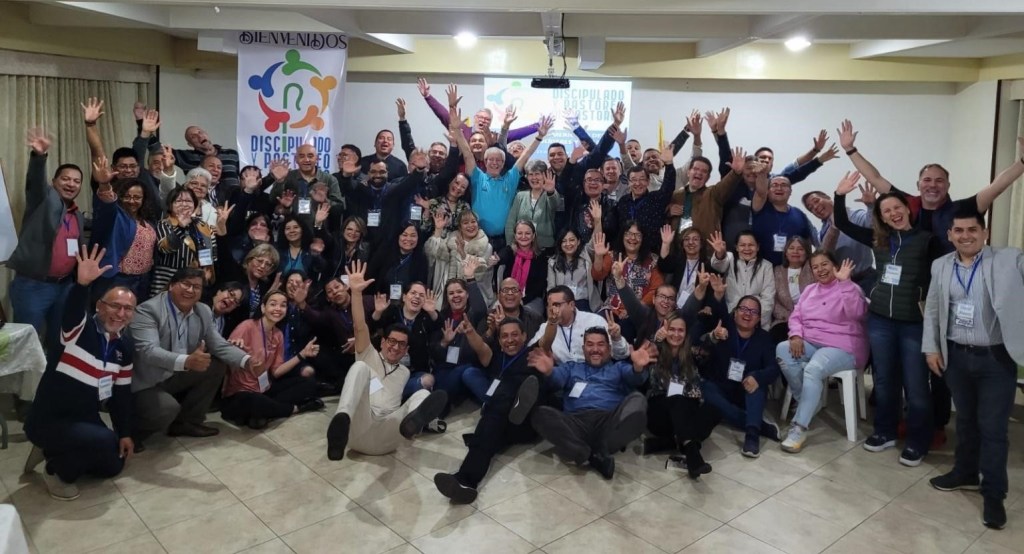
This is the rallying cry or slogan of my husband Dave’s ministry, Discipling and Pastoring of Pastors in Brazil and Latin America (see dppastores.com). It means “Alone, no!”

A Pastoring of Pastors retreat in Brazil

Many pastors in Latin America do feel alone. They’ve been taught that the success of their church is on their shoulders. Denominational leaders tend to communicate demands more than support. They don’t have anyone with whom to share their burdens and receive encouragement, either personally or ministerially. Often, they are afraid of potential consequences if they tell anyone they are vulnerable or needy in any way. Sometimes they are afraid to admit this even to their spouses. They don’t have help in “watching over themselves.”

And sometimes all that explodes into a scandal of one kind or another. Sometimes that’s because the pressure the pastor feels becomes overwhelming. Especially the pressure of loneliness.

Other times, the pastor simply quits. The stats on this are not pretty. The loss of pastors is part of what has been called “the great dechurching”**—in the US as well as Central and South America.

Over the years, Dave has had the privilege of participating in the restoration of pastors. The process is different, of course, in each case. But it always involves this basic concept: You can’t do ministry alone. It must be a team effort, with encouragement, support, and accountability. You must be connected to the vine AND to the other branches.

Sozinho, não!

I encourage you—and myself—to pray for your pastors, support them however you can, and be very careful about gossip and a critical attitude. Resolve conflicts directly and with love. Don’t “church hop” because of disagreements over nonessentials. Don’t turn your worshiping community into a political battlefield. And maybe most important: God didn’t ever intend us to be loner Christians. We need each other. Each of us needs to be a part of a body of believers submitted to Christ as Lord, growing in grace, and caring for each other. Alone, no!

When I started writing this post, I didn’t realize it would become so long. So I’m breaking it into two parts, with an exciting announcement next time!

**For example, in this book. You can Google other books and articles and discussions.

This little light of mine

But God’s walls surround us August 31, 2023

Isaiah 26:1, 3, 8, 12, 19 We are surrounded by the walls of our salvation. … You will keep in perfect peace all who trust in you, all whose thoughts are fixed on you! … Lord, we show our trust in you by obeying your laws; our heart’s desire is to glorify your name. … Lord, you will grant us peace; all we have accomplished is really from you. … For your life-giving light will fall on your people like dew.

I woke up at 4:00 to the rhythms of my husband snoring beside me and my son snoring in the next tent over. My heart filled with thankfulness for these two men, for who they are, for the richness and depth and beauty of what each of them contributes to those around them.

On this early Saturday morning at Raccoon Creek State Park, almost a week ago now, the day before our 46th anniversary, my mind wandered over God’s faithfulness to us, so amazing. Our marriage had every reason to fail, and honestly, but for David’s stubbornness and God’s grace, it would have. Our life together was off the charts traumatic and stressful for so many years that I came close to an emotional breakdown—long before I was diagnosed with PTSD after Karis’s death. Dave went through periods of depression. The kind where I might open the door to his office to ask him a question and find him lying on the floor in the dark staring blindly at the ceiling.

But God

Friday evening our family had sat around the campfire singing silly songs, telling stories, even reciting “Jabberwocky.” We had joined our daughter Rachel singing “This Little Light of Mine,” which she had taught three-year-old Liliana to sing when she felt afraid of the dark. Valerie quickly followed with the Portuguese, “Minha pequena luz, vou deixar brilhar …”—so appropriate, because when Val was a teenager, her friends called her “Pequeno raio de luz”—little ray of light.

Here’s the thing: I could so easily have spoiled this precious time together. Not because I got distracted and the sausage hobo meals I had labored over with the “help” of Caleb and Talita—supper for ten of us—burnt to a crisp in the coals of Rachel’s fire. But because of my reaction to this fiasco.

Can you relate?

Everyone else took it in stride and ate more watermelon and s’mores made with Brian’s ginormous marshmallows. Caleb, Talita, and Liliana shrieked with laughter as Uncle Dan chased them around our tents. Baby Juliana blessed us with her marvelous smile and her enthusiasm for crawling not just in the grass but in the dirt.

I was so disappointed though that internally, all kinds of buttons were pushed—the perfectionist button, the “how could you” button, the “you are such a—” button, even the “could this be an early sign of Alzheimer’s” button. I was tempted to make my camp cooking failure an issue for the whole family. To make it about me.

Please tell me I’m not the only one to experience this temptation!

But God let me see instead the family laughing, talking, sharing what we did have to eat, even Cesar finding a consumable bite or two in the cinders of my burnt offering. The light of their smiles, each one of them, shone into the darkness of my heart and chased the shadows away.

This little light of mineMinha pequena luzsurrounded me like a wall as Rachel and Valerie sang in the glow of the campfire Friday evening. I felt its protection still as I eased through the door of our tent into the dewy grass at the first lightening of the sky the next morning. As we hiked through the lovely woods and the kids swam in the lake. Even as we broke down our camp and said our goodbyes. And as Dave said “Happy anniversary” to me early Sunday.

Borrowing Isaiah’s words, Lord, you have granted us peace; all we have accomplished—even our emotional healing and growth—is really from you. My heart’s desire is to glorify your name.

This is our God

But God will remove the cloud of doom

Isaiah 25:7-9 God will remove the cloud of doom, the shadow of death that hangs over the earth. He will swallow up death forever! The Sovereign Lord will wipe away all tears. … In that day the people will proclaim, “This is our God! We trusted in him, and he saved us! Let us rejoice in the salvation he brings.”

Psalm 68:5 Father to the fatherless, defender of widows—this is God, whose dwelling is holy. God places the lonely in families; he sets the prisoners free and gives them joy.

Revelation 21:4 God himself will wipe every tear from their eyes, and there will be no more death or sorrow or crying or pain.

To my surprise, when I walked into church yesterday, Josh was singing “Rock of Ages”! It had nothing to do with my last post–except for me. Josh chose the song based on Isaiah 51:1 and Matthew 16:18. You can listen to Kevin’s challenging sermon on those passages here. You might need to give Wes a day or two to post it.

But I felt chills. I don’t remember hearing that hymn sung in our church. It seemed God was saying back to me, “Remember what you just posted? You, Debbie, too easily forget the Rock who can hide you.”

On my mind was the strong sense that God wanted me to write something very difficult into Book 3, Facing the Faeries 1906, something I will weep over, in my emotional attachment to my characters. And for which I fear criticism and negative pushback. I need to write it this week–my personal little “cloud of doom.”

Shutterstock: Undrey

I took my dilemma to a prayer team. They understood that my challenge is to trust—to trust that God sets prisoners free and gives them joy—even the characters in this book to whom I am inordinately attached. Even me. This is what he does. God reminded me of my “year verse”: Be truly glad. There is wonderful joy ahead, even though you have to endure many trials for a little while (1 Peter 1:6).

As you and I head into the challenges of this new week, let’s take a few minutes to reaffirm our trust in the Lord, and rejoice! Here are three artists to help us, each inspired by Isaiah’s words, “This is our God”:

Chris Tomlin

Phil Wickham

Hillsong