New life: our part

But God holds us individually responsible

Romans 6:13 Give yourselves completely to God, for you were dead, but now you have new life. So use your whole body as an instrument to do what is right for the glory of God. [See also: Romans 5:18, 1 Corinthians 15:22, 2 Corinthians 5:15, Galatians 3:21, 1 Peter 1:23.]

Galatians 6:4-5 Pay careful attention to your own work, for then you will get the satisfaction of a job well done, and you won’t need to compare yourself to anyone else. For we are each responsible for our own conduct.

Ever since I posted that photo of our Lenten roses with the comment about living a confessional lifestyle, not just a discipline for Lent, I’ve been wondering what I could offer that might be helpful to us (starting with me) in practicing this daily grace. Alice Fryling gave me an answer through her book Aging Faithfully, which Dave and I are reading for an upcoming mission retreat. Fryling quotes ideas she learned from Adele Calhoun in her Spiritual Disciplines Handbook. (I love the interweaving that led to enrichment for me!)

I imagine you’ve heard of 16th century Ignatius Loyola’s Daily Examen rooted in his concepts of consolation and desolation (we can talk about them another day). The Daily Examen has helped people through the centuries to walk more closely with God and it can’t be “improved,” even while it requires some training to practice. Fryling takes the basic idea and suggests we ask six simple questions each day, similar yet more specific than the practice may of us are familiar with of identifying our high point and low point in a given period of time. I added the Scripture references to Fryling’s questions:

  • For what moments today am I most grateful? For what moment today am I least grateful (Colossians 3:15)?
  • When did I give and receive the most love today? When did I give and receive the least love today (John 13:34)?
  • Where was I aware of living out of the fruit of the Spirit? Where was there an absence of the fruit of the Spirit (Galatians 5:22-23)?

What do you think? Would you like to join me in responding to these questions daily through this short Easter season until Pentecost?

I think they will help us notice and be thankful for the new life God is growing in our lives.

God gives pansies life and makes them grow, but he won’t plant them for me! Shutterstock: lcrms

A new and life-giving way

Hebrews 10:19-20 We can boldly enter heaven’s Most Holy Place because of the blood of Jesus. By his death, Jesus opened a new and life-giving way through the curtain into the Most Holy Place.

Mark 15:37-38 Then Jesus uttered another loud cry and breathed his last. And the curtain in the sanctuary of the Temple was torn in two, from top to bottom.

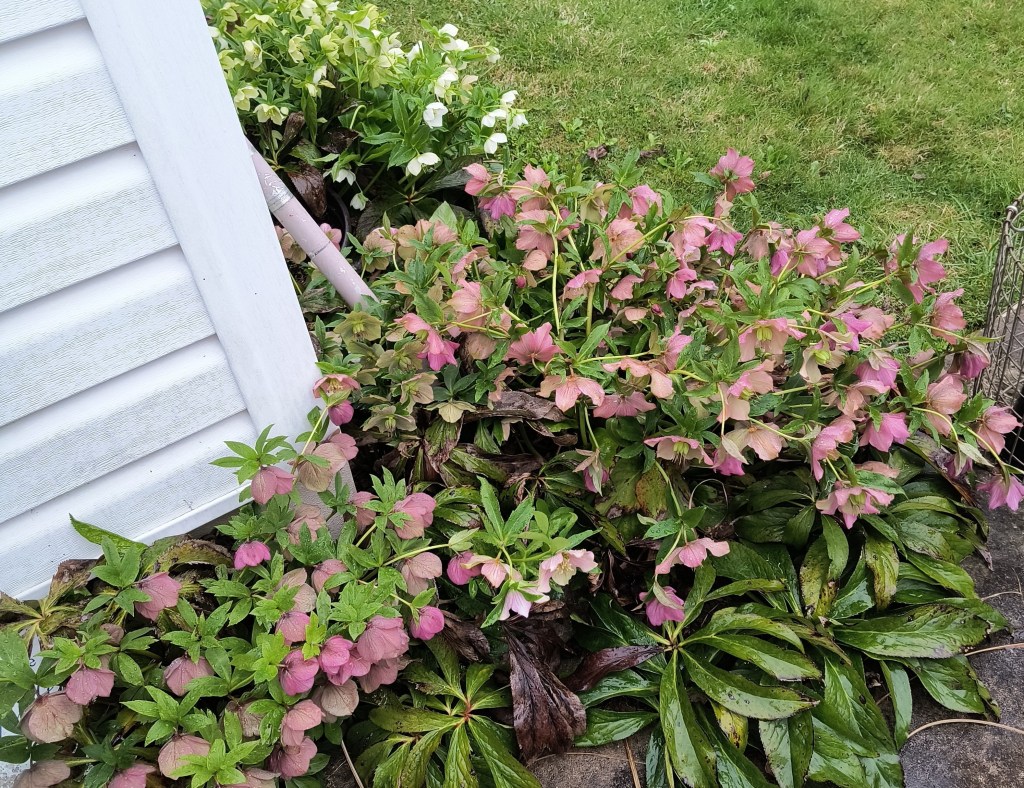
Our Lenten roses are still blooming, reminding me that the confessional life we practiced during Lent is meant to be not a fad but a lifestyle.

“Grammy, if it’s spring, why is it snowing?” asked six-year-old Caleb when he got off his school bus a couple of weeks ago.

“Caleb, we’re going to look for signs of spring!” his four-year-old sister Talita told him. “Come on!”

They didn’t stop at ten, the number I had suggested. They found sixteen signs of spring in their yard. And each time since that I’ve gone to their house, they’ve shown me more.

In this hemisphere, spring is associated with Easter. It’s a natural fit: the celebration of new life. In Brazil, though, Easter comes as fall begins to ease the heat of summer. Jesus is truly a man for all seasons.

Since I’m in Pittsburgh, though, I’ve been thinking about new things. A quick survey of the New Testament revealed references to 33 new things (plus repeated references) in the NLT New Testament. For this brief Easter season (which ends with Pentecost on May 19), I’m going to choose a few of those to highlight, beginning today with one of the consequences of Jesus’ death and resurrection: direct access to God.

This was a completely new concept for Jews steeped in God’s holy inaccessibility. God’s Presence filled a small space in the Temple protected by a thick curtain (9cm/3 ½ inches thick, according to Jewish tradition). Hebrews 9:7-8 reminds us that “only the high priest ever entered the Most Holy Place, and only once a year … the entrance to the Most Holy Place was not freely open as long as the Tabernacle and the system it represented were still in use.” (See Luke 1 for a story about this. The chosen priest entered the Most Holy Place with a cord tied around his ankle, so his body could be pulled out in case he was struck dead by the holiness of God.)

I find the tearing of this 3 ½ inches-thick curtain, from top to bottom, one of the most startling and intriguing collateral events associated with Jesus’ death. Clearly, no human could have done this. Hebrews tells us that now we can “come boldly to the throne of our gracious God” for his help and mercy (4:16). And Paul says our own bodies are now the Temple of God, where Christ dwells in us through the Holy Spirit (1 Corinthians 3:16, 6:19-20, 2 Corinthians 6:16). Think about that next time you’re tempted to abuse or misuse your body!

Jesus, through his incarnate life, brought God close to us. Through his death, he ended the separation between us and his Father. And in his resurrection and ascension, he left his Spirit to indwell, teach, nurture, guide, convict, gift, and empower us, growing beautiful fruit in our souls (Galatians 5:22-23).

What signs of new life do you find in the garden of your heart?

Let’s listen again to Kristyn Getty sing Before the Throne of God Above.

Doxology

But God’s kingdom encompasses all he created  March 28, 2024

Psalm 103:19-22 The Lord has made the heavens his throne; from there he rules over everything. … Praise the Lord, you armies of angels who serve him and do his will. Praise the Lord, everything he has created, everything in all his kingdom.

Litany of Penitence 12

For our failure to commend the faith that is in us

Lord, have mercy upon us,

For we have sinned against you.

In The Psalms, Jesus’s Prayer Book, Volume 3 Psalms 73-106, Douglas D. Webster says:

“Psalm 103 reminds us that we bow before King Jesus. The third stanza widens the circle of praise to include all of creation. All the angels and the heavenly hosts are summoned to worship before the throne of him who rules over all. Total praise. There are no spectators. Everyone is in the choir and everything is centered around the throne of the Lord. … Whatever your perspective on worship styles … in the end we’ll be worshiping together. … The key concept for the future of the human community is doxology.

So, besides confessing our failure to “commend the faith that is in us,” how can I, how can you, share our hope with all whom we love, so they too can join this worship fest around the Throne? How can we free the River of Life to overflow from our hearts?

Shutterstock: Stanislavskyi

A beautiful hymn, based on Psalm 103, celebrates much of what we’ve been considering this Lent as we’ve worked our way through the Litany of Penitence: Praise my Soul the King of Heaven, by Henry Francis Lyte, 1834, sung by St Laurence’s Church.

This evening our church has a Maundy Thursday service. The word Maundy comes from the Latin for “commandment” – Jesus’s “new” commandment (John 13:34) to love others just as he has loved us. If you know Spanish or Portuguese, think mandamiento or mandamento. The service includes footwashing (John 13:1-17). At the end of the service, the lights will slowly dim as the altar is stripped of all ornamentation (and we remember Jesus’s arrest). As we find ourselves in total darkness, a voice reads Psalm 22. We exit in silence.

Tomorrow, we watch with Mary as her Son hangs on the cross from noon until 3:00 p.m., when he cries “It is finished.” Artists in the congregation have created pieces depicting each of the Stations of the Cross. (I featured last year’s Good Friday artwork on this blog.)

On Saturday, a quiet day of meditation, I’ll post the final prayer from the Litany of Atonement and the final line from Psalm 103.

Easter Sunday at 6:00 a.m., we enter the sanctuary in darkness, and the first half of the service is held by candlelight. Gradually, daylight filters through the stained glass, but remember, the last time we were in this space, it was stripped of all other adornment. When the lights suddenly come on, though, and the organ and trumpets and choir announce Jesus’s resurrection, we see the church filled with fragrant flowers. All of our senses are engaged in this magnificent celebration of restored Life. Once again, we can sing and say “Alleluia,” which we have not done since Lent began.

While all this is wonderful, I find it bittersweet, because Karis loved Easter so much. But in a flash I remember: all we can do is but a shadow of the incredible joy of being in the very Presence of God on his rainbow throne. We may still experience waves of grief. But for her, and for each one of our missing beloved ones and yours, all is glory.

I’ll wish you and your family now a lovely Easter.

See him there

But God knows we are frail  March 21, 2024

Psalm 103:14-16 For the Lord knows how weak we are; he remembers we are only dust. Our days on earth are like grass; like wildflowers, we bloom and die. The wind blows and we are gone—as though we had never been here.

Shutterstock: MVolodymyr

Litany of Penitence 10

For our negligence in prayer and worship,

For our presumption and abuse of your means of grace,

Lord, have mercy upon us,

For we have sinned against you.

As we approach the end of Lent, this 19th century song is as reassuring now as it was when Charitie wrote it: Before the Throne of God Above, Charitie Lees Bancroft (1841-1892) and Vicki Cook, sung by Kristyn Getty

Before the throne of God above
I have a strong and perfect plea
A great High Priest whose name is love
Who ever lives and pleads for me
My name is graven on His hands
My name is written on His heart
I know that while in heav’n He stands
No tongue can bid me thence depart.

When Satan tempts me to despair
And tells me of the guilt within
Upward I look and see Him there
Who made an end to all my sin
Because the sinless Savior died
My sinful soul is counted free
For God the Just is satisfied
To look on Him and pardon me.

Behold Him there, the risen Lamb
My perfect, spotless Righteousness
The great unchangeable I Am
The King of glory and of grace
One with Himself, I cannot die
My soul is purchased by His blood
My life is hid with Christ on high
With Christ my Savior and my God

Oh merciful Lord …

But God is tender  March 18, 2024

Psalm 103:13 The Lord is like a father to his children, tender and compassionate to those who fear him.

Litany of Penitence 9

For all false judgments, for prejudice and contempt of others,

And for all uncharitable thoughts and actions toward our neighbors,

Lord, have mercy upon us,

For we have sinned against you.

Oh, merciful Lord …

We desperately need you to teach us your tenderness and compassion. Convict us and heal us. Show us that sin against others is sin against YOU, whom we claim to love.

I’m reading the biography of John Lewis. He taught and profoundly believed that nonviolent resistance required cultivating love for those who sinned against him (like multiple times beating him, bashing in his head, and arresting him dozens of times for simply asking for the most basic of human rights). An incredible example for us. Reminds me of something I heard a long time ago … oh yeah. Matthew 5:11-12. And 43-48.

A song based on The Breastplate of Saint Patrick, by Wendell Kimbrough and Dan Wheeler:

When my work takes me places I don’t want to go Christ before me
And my heart aches with sorrow as I hit the road Christ be with me

When the care of my family takes all that I have Christ within me
When I’m worn and exhausted, ashamed that I’m mad Christ defend me

Refrain:

I rise up today in a strength that is not my own
I’m held by the promise of God that I’m never alone

When I’m tossed to the side and I want to give up Christ beside me
When I’m breaking my back but it’s never enough Christ beside me
When I work hard but someone else gets the reward God’s eyes see me
I ask for promotion and they shut the door God’s ears hear me

When I climb the first steps toward a long-held dream Christ above me
And I leap out in faith and I hope to find wings Christ beneath me

Our “helping” can harm

But God’s love is unfailing  March 11, 2024

Psalm 103:11 The Lord’s unfailing love toward those who fear him is as great as the height of the heavens above the earth.

Other English translations render checed or hesed, “unfailing love,” as mercy, kindness, lovingkindness, steadfast love, faithful love, gracious love, and loyal love (also in verses 8 and 17). How does God make his love visible in the world? Through us, his Body, his hands and feet, animated by the Spirit within us, not motivated by any agenda other than love. But is this possible? Can we in fact, messy, broken, proud, self-centered and self-deceiving as we are, come even close to imaging God’s hesed love?

Litany of Penitence 7

For our blindness to human need and suffering,

And our indifference to injustice and cruelty,

Lord, have mercy upon us:

For we have sinned against you.

I like the fact that today’s confession comes after we’ve acknowledged our pride, vanity, hypocrisy, dishonesty, exploitation of others, self-indulgence, and all the rest of the sins named so far. Because it’s so easy

1) to reach out to others to be noticed for how good and generous we are and

2) to blindly believe we know best what other people need, without taking the time to listen and understand their stories or their deeper wounds and struggles and to respect what they say they need, and

3) to unconsciously feel and project that we are somehow “better” than others because we think we have to be better to earn God’s favor or approval and to feel OK about ourselves. Too often we re-write history to favor ourselves, when in fact the reality is appalling.

Such “helping” may not help at all. It may cause more harm that good. I’ve been there. I struggle with these three vulnerabilities all the time. All the time. They push me back to the mercy of God and his love for me as his child, with nothing to prove, everything to learn, and only gratitude to express.

Jesus walked, sat, listened, ate, played, laughed, grieved, danced, wept, and shared himself with people. He didn’t worry about what was PC or would win him likes. He dared to speak truth to power, with integrity, from his heart. He freed people from all kinds of oppression and lies, in many unorthodox ways, including from the unbearable rules of performative religion.

And his unfailing, compassionate, faithful, gracious love took him to the cross, where in the midst of his agony he said, “Father, forgive them. They don’t know what they are doing” (Luke 23:34).

Sometimes the flow of the Spirit in our hearts is a pounding torrent, not a peaceful stream. Shutterstock: Maridav

Instant gratification? No.

But God is compassionate, slow to get angry March 5, 2024

Psalm 103:8 The Lord is compassionate and merciful, slow to get angry and filled with unfailing love.

Litany of Penitence 5

For our self-indulgent appetites and ways,

And our intemperate pursuit of worldly goods and comforts;

Lord, have mercy upon us:

For we have sinned against you.

The Lenten discipline of fasting is transferable: it can teach us self-control, equipping us to say no to temptations that can hurt us or others. We say no to physical satiation so we can be filled with God’s unfailing love. If you listened to Kevin Antlitz’s sermon from February 25, recommended in my last post, this statement will sound familiar to you.

The Lenten discipline of fasting is abstaining from food for spiritual purposes. Not everyone can fast from food; perhaps you, like me, need to fast from something else. But here are guidelines for food fasting from Adele Ahlberg Calhoun’s Spiritual Disciplines Handbook (thanks, Kevin):

  1. Don’t fast if you are in a hurry and are fasting for immediate results regarding some decision. Fasting is not magic.
  2. Stay hydrated. Always drink plenty of water and fluids.
  3. If you are new to fasting, begin by fasting for one meal. Spend the time with God that you would normally be using to eat.
  4. Work up to longer fasts. Don’t attempt prolonged fasts without guidance.
  5. If you decide to fast regularly, give your body time to adjust to new rhythms of eating. You may feel more tired on days you fast. Adjust your responsibilities appropriately.
  6. Begin a fast after supper. Fast until supper the next day. This way you miss two meals rather than three.

Fasting benefits us, not God. We don’t do it to earn his approval or favor, but to grow in character like his. He’s not a mean, angry person just waiting to punish us. He wants our best, just like we desire for our own children. We reap the benefits over the long term. Spiritual disciplines are a marathon, not a sprint. In that way too they are counter-cultural. We need to train for them and build our tolerance and skills slowly, finding joy along the way.

Be still, my soul Shutterstock: Eva Pruchova

“Self-denial is incomprehensible to our culture”

But God wants us to know and reflect his pure love 

Psalm 103:7 The Lord revealed his character to Moses and his deeds to the people of Israel.

Litany of Penitence 4:

For our sexual impurity, our exploitation of other people,

And our failure to give of ourselves in love;

Lord, have mercy upon us:

For we have sinned against you.

What do you think of the heading to this post, from last Sunday’s sermon by Kevin Antlitz? (You can listen to the context of his statement here (Feb 25): we choose to say no to ourselves so we can say yes to God and to those we love and care for. How do you embrace self-denial personally?

O Love that will not let me go, sung by Dana Masters and Kristyn Getty

I trace the rainbow through the rain … Bray Head, Ireland, March 2023

Don’t believe everything you think

But God loves fairness

Psalm 103:6 The Lord gives righteousness and justice to all who are treated unfairly.

Litany of Penitence 3:

For our unrighteous anger, bitterness, and resentment

For all lies, gossip, and slander against our neighbors.

Lord, have mercy upon us:

For we have sinned against you.

There are two sides to this confession: our response to those who have hurt us, and our own unjust thoughts, feelings, words, and actions against others.

We need God’s mercy and healing in both. He longs to restore us rather than punish us.

For I, the Lord, love justice. I hate robbery and wrongdoing. I will faithfully reward my people for their suffering … The Sovereign Lord will show his justice to the nations of the world. Everyone will praise him! His righteousness will be like a garden in early spring with plants springing up everywhere (Isaiah 61:8, 11).

Shutterstock: StudioSmart

Be truly glad. There is wonderful joy ahead, even though you have to endure many trials for a little while. … Don’t repay evil for evil. Don’t retaliate with insults when people insult you. Instead, pay them back with a blessing. That is what God has called you to do, and he will bless you for it (1 Peter 1:6, 3:9).

One of Karis’s favorite songs:

Oceans (Where Feet May Fail), Hillsong