But God’s power works through our weakness July 15, 2024
2 Corinthians 12:7-10 I was given a thorn in my flesh … Three different times I begged the Lord to take it away. Each time he said, “My grace is all you need. My power works best in weakness.” So now I am glad to boast about my weaknesses, so that the power of Christ can work through me. … For when I am weak, then I am strong.
I’m sure you’ve had the experience, as I did last week, of injuring a finger on the thorn of a rose and then asking “Why? Why do beautiful roses have such sharp thorns?”
Shutterstock: Albatros-Design
And you may have noticed, as I’ve been working my way through 2 Corinthians on this blog, that I skipped the best-known part of chapter 12. I did that because I’ve written about it so many times as the theme of Karis’s life. This began when she was eleven, when she asked her father and me not to pray any longer for her healing, and instead to pray that she would understand and fulfill God’s purposes for her life.
This theme prompted her to write in her journal at age sixteen, “All I see is grace,” the phrase I chose for the subtitle of her book. Perhaps you have read Karis: All I See Is Grace and understand from her life a bit more about God’s love extended to us through suffering and loss. (I just noticed in looking up this link that it’s on sale right now on Amazon.)
So why am I doubling back to this passage today? I just listened to a sermon on it by Lauren Scharf at our church on July 7, a day we were away. I want you to take time to listen to it, because she expresses so well what Karis learned and what she lived out: Our intimacy with Jesus is enhanced when we go through grief and suffering because he, the Man of Sorrows, acquainted with deepest grief (Isaiah 53:3), knows from his own personal experience what it’s like. He understands. He walks with us through the deep valleys (Psalm 23), offering us grace to help us when we need it most (Hebrews 4:15-16).
Whatever your “thorn” is, whatever you are struggling with, you are not alone. Jesus is with you. Please take a few minutes to listen to Lauren’s sermon. It might be the best thing you do all week!
Romans 12:10 Be devoted to one another in love. Honor one another above yourselves.
(Debbie) Expand your horizons through Elaine’s rich and fascinating Art and Scripture. I love celebrating the determination, faithfulness, and stamina represented in golden wedding anniversaries! Here is Elaine’s description of an extraordinary day in Ordinary Time. It took place in San Diego, where all three of Steve and Elaine’s children and their families live.
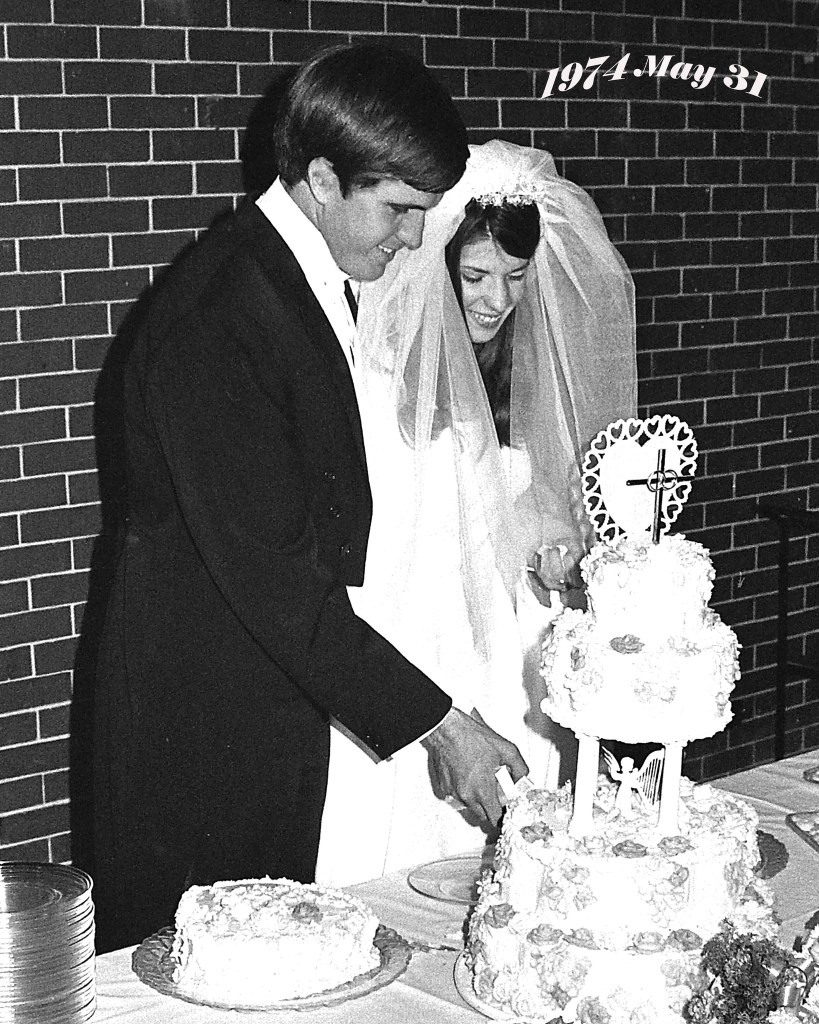
On our 50th wedding anniversary (May 31) we received congratulations all day long. On Facebook, my husband Steve posted a picture of younger us cutting the cake and was delighted to receive many likes and comments.
The wedding took place in Mexico, where Elaine grew up as a Wycliffe missionary kid.
Unexpectedly, we received a video message from our pastor in Antigua honoring us, expressing love and appreciation. This should not have been surprising since the church articulates a vision for church culture in which honoring others is one of a dozen values (see the But God post on July 20, 2023):
“We give honor—to those we lead, we work beside, and those we follow. The cross gives every human being immeasurable worth. And we will treat people with the honor the cross displays and demands they deserve.”
To feel this deeply in our church context has been a great gift.
We decided to celebrate multiple family milestones and held a special luncheon on June 22 for 48 extended family members. Each milestone includes a back-story of God’s faithfulness. My mother, Margaret Daly, reached 95 the previous week, and we celebrated her. Many had not seen one another since our last gathering to celebrate her 90th birthday, and her good health is a sign of the excellent care that my sister Sharon and her husband Todd have provided. Before she moved in with them, her health was declining, she was falling, and definitely would not have reached this milestone. (Margaret wrote for But God on July 27, 2023.)
Our daughter Bec and her partner Paul sponsored the location for the luncheon. We celebrated Bec’s new business, which emerged from a dream she talked about as a young person. Our grandson Ja’Quan’s graduation from an elite private Christian high school came about because of his adoption into our son Jon and Lissa’s family. Multiple family members (twelve!) have June/early July birthdays and God has cared for each one, including Steve, our oldest daughter Marie, our daughter-in-law Lissa, and my sister Sharon. At the event, we acknowledged the birthdays of two of the great-grandchildren, but we have been celebrating birthdays all month!
Family members arrived from Oregon, North Carolina, Arizona, and even Kazakhstan (!) to celebrate. We engaged in activities together, ate special food, dressed up, decorated festively, gave/received gifts and said words of praise—all familiar ways of honoring others.
Fifty years!
Our daughter Marie’s toast for our anniversary left us feeling deeply honored with her comments on reconciliation and unity. The consensus was that the place, décor, food, and program turned out wonderfully and we were grateful.
The backstory of God’s grace in our marriage involves post-traumatic stress in the context of civil war where we worked in Guatemala, a five-year separation, life in the US, reconciliation, and a return to Guatemala where we see the good results of the peace process. Our story is not tidy, but we really did make it through fifty years of marriage, most of them happy ones! At our 25th anniversary Steve joked, “We’ve been happily married twenty years which is really not bad out of twenty-five.” We’ve recycled that to “happily married forty-five years…”
We don’t want honoring to take place only at special events. Honoring others in ordinary times “brings heaven to earth.” Let’s do it!
But God doesn’t want what we have. He wants us. July 8, 2024
2 Corinthians12:14-15, 19 I don’t want what you have—I want you. After all, children don’t provide for their parents. Rather, parents provide for their children. … I will gladly spend myself and all I have for you. Everything we do is to strengthen you.
1 John 3:1, 16; 5:3, 21 See how very much our Father loves us, for he calls us his children. … We know what real love is because Jesus gave up his life for us. … Loving God means keeping his commandments, and his commandments are not burdensome.
My young grandchildren often give me things. A drawing (rainbows predominate these days). A dandelion, carefully tucked in a buttonhole or behind my ear. A bite of a cookie. A song.
These offerings are sweet because of the love that infuses them. At the same time, I need to remind them from time to time, what really shows me that you love me is your obedience. What I ask of you is not for myself—it’s for you, to help make your lives orderly and peaceful and happy. And the same is true for your mommy and daddy. You often tell me that you love them. Don’t just say it; show it—by obeying them, by doing cheerfully the simple things they ask of you.
Love and generosity are meant to be a two-way street. But that’s not what everyone experiences, and it’s hard—and not safe—to give our hearts and our obedience to those who aren’t trustworthy. In REVER (the restoration ministry Dave started in Brazil in the ‘90s), we talk about a “father wound” and a “mother wound.” So many people resonate with these concepts. They were hurt, rather than loved appropriately by their fathers and/or their mothers. This wounding made them profoundly vulnerable to abuse by other people. Often, they struggled with loving God, their parents, and other people, because in their formative years, they did not feel generously loved and cared for by the most important people in their lives.
Our heavenly Father, out of his profound, pure, self-giving love, can and longs to heal these soul wounds. Jesus said, “Let the little ones come to me.” I think that’s each one of us. His heart breaks when he sees abuse carried out in his name, throwing up barriers to him rather than a helping hand.
I’m reminded to be careful of my own heart, words, and actions. I want to open a way to the Father, not clutter it with pitfalls or align God’s pure name with harmful words and behavior.
Where I grew up, this was a common way to clear a path. Shutterstock: n_defender
If someone asks you about your Christian hope, always be ready to explain it. But do this in a gentle and respectful way … Let them see the good life you live because you belong to Christ. … who died to bring us safely home to God (1 Peter 3:15-16, 18).
I have always had the idea that imitating my Creator opened spiritual paths in my life to which I should pay attention. So, I began seeking that path in my daily life which led me to be more observant. There were many blessings given to me each day. They had been given throughout my life, but there were also hardships. In recalling these situations, it became apparent that there are Godly truths all around us. I began to pursue these truths. The music of my ordinary life was easy to commit to paper.
And then the Holy Spirit intervened. In 2020, when the Lockdown began, it occurred to me that I should deepen my writing and now I had the time to do so.
Each morning I sit aside the first hour of the day to pray and during this time, things I had seen or things I had forgotten would be clearly revealed, and so I put these thoughts on paper and spent most of my time writing. I can honestly say that the ideas that came to me during this time were not conscious ideas. I could use this prayerful time because I was physically alone and isolated. I have known since I was a child that the Triune Trinity is continually close.
I did not set out to write a book. As the Nation and indeed, the World became more and more secular, my concern was that the values which had been instilled in me since childhood were disappearing and perhaps all of us were bogged down with despair; confusion and depression.
But God’s Truth is ever present and everlasting. It is there in the small things and the large; in our daily encounters, in music, in relationships good and bad, in nature. In every aspect of our lives, God’s truth can be found. This book attempts to bring to our minds and our spirits the knowledge that God is always present and He reveals himself in every aspect of our daily lives! We can find the sacred in the secular.
It is worth our time to seek Him and give Him praise!
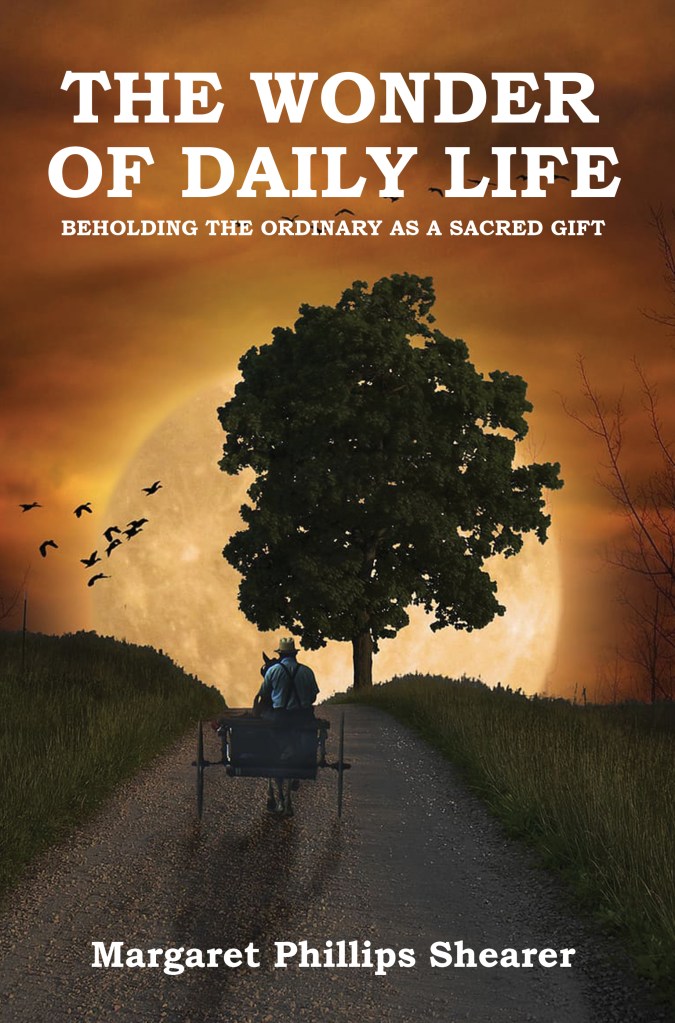
(Debbie) Read more below about Margaret’s beautiful book. You can find it here.
In troubled spiritual times in our nation, world, and in our daily lives,
we can live with hope and inspiration!
With amazing photographs to illuminate the text, it makes a great gift.
Can wonder really be found In ordinary life? If you’re stuck in thinking the path we walk is ‘merely’ ordinary, nothing could be further from the truth! Light shines through the ordinary, and inspiration can be found in its reflection. I started my search to find truth in the spiritual darkness our nation seems to be in and discovered spiritual truth beyond what I saw and experienced each day.
I invite you to join me on this path. Once seen, I believe you will find, as I did, that the ordinary becomes extraordinary! It is there to be found. We can lift our every-day experiences to the light and behold the ordinary as a sacred gift.
My writing includes poems, short stories and op ed columns accompanied by beautiful photographs which pertain to each subject. These are stories which illuminate the long-held American values that seem to be disappearing. Here’s a sampling:
What’s In Your Ordinary Room Midwest American Values, They Do Exist Soul Food At The Corner Store How Do Single Mothers Survive Laughter Is Important There’s Richness in Solitude Can We Count The Steps of a Lifetime A Cat Teaches A Lesson In Sharing It’s Not Just A Game, It’s Baseball
May you be blest in your search, find your way, and become a blessing to others who may be seeking THE WONDER OF DAILY LIFE.
With love, Margaret
Margaret Phillips Shearer holds degrees in Fine Arts and Master of Arts in Creative Writing from Stephens College. As a professional actress she performed leading roles in over 150 productions in major theatres across the country including the Stratford, Oregon Shakespeare Festival. She appeared in featured roles in film and television including ABC’s six-part mini-series, Black Beauty and as Desdemona in the ABC TV National production of Othello.
In order to spend more time with her two young sons, she moved into the creative development area of film and television, and for over 25 years worked at Disney Studios, Island Pictures, Warner Brothers, Scott Free (Ridley Scott’s Production Company), and DreamWorks in Los Angeles. She was an Op Ed Columnist for the Glendale News Press, owned by the LA Times and distributed throughout the Los Angeles area, all while raising her two sons as a single mother.
Mrs. Shearer is semi-retired, is an active volunteer at her church and still appears in films and television commercials as well as being a lecturer on Shakespeare at local colleges and universities in the Pittsburgh area where she now lives. She is the mother of two sons and has two grandchildren.
But God’s authority builds up; it doesn’t tear down July 1, 2024
2 Corinthians 10:8, 17, 11:3 Our authority builds you up; it doesn’t tear you down. … As the Scriptures say, “If you want to boast, boast only about the Lord.” … I fear that somehow your pure and undivided devotion to Christ will be corrupted.
I am grieving today. After a devastating aneurysm and stroke last week, our dear friend Donna left us yesterday. We will miss her so much.
At the same time, we KNOW where Donna is now, and that we’ll see her again (1 Thessalonians 4:13). God’s Spirit hovered over her and her family in precious ways these last sacred days. I hope, as I always do, that Karis was there to meet her and help orient her to the wonders of her new Home, face to face with her beloved Savior.
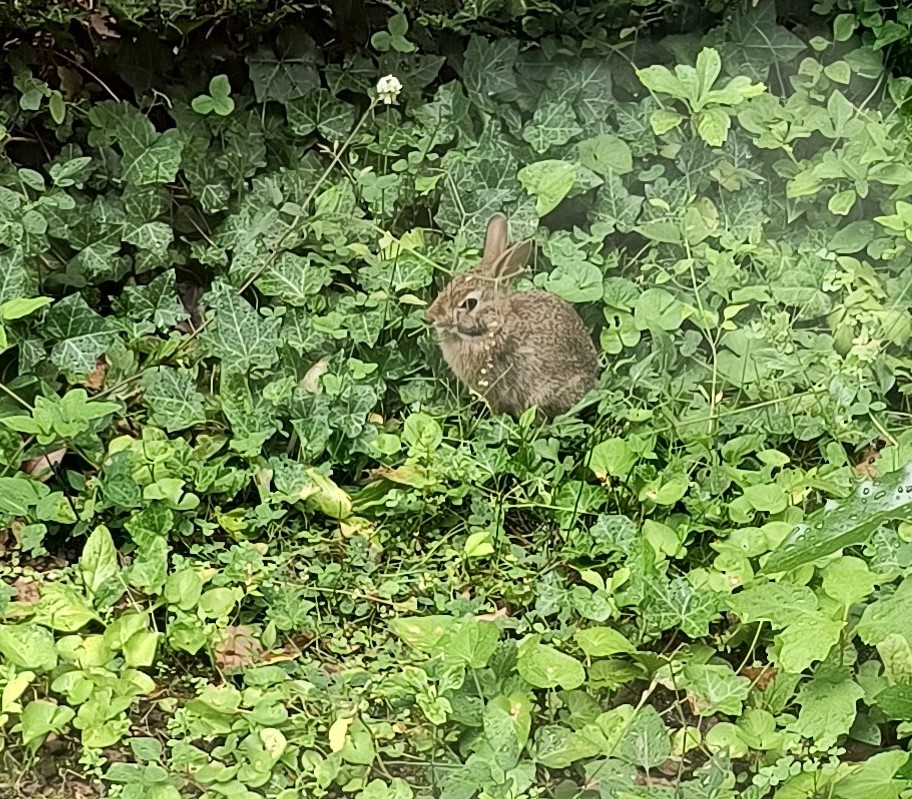
Another thing happened yesterday, before we knew it would be Donna’s Homegoing day. I was chatting with a friend in the hallway after the early service when she noticed a bunny in the church’s meditation garden. SOOO cute!
As we watched, the wee rabbit attacked one of the flowers. Suddenly it didn’t look quite as cute, even though it was simply acting according to its nature. My mind flipped to the morning I looked outside to see two rabbits devouring my flowers, and my grandson saying, “We should have looked for rabbit-resistant, not just deer-resistant.”
How did that bunny get into the completely enclosed “courtyard” garden at church? No idea.
Sooo cute — until it started attacking the flowers
I kept thinking about the bunny while participating in a discussion of a book by Michael Wear called The Spirit of Our Politics, in which the author calls us back to loyalty to God in first place, rather than allowing politics to usurp our Lord’s place in our hearts. Politics, Wear says, while important for the betterment of our society, is penultimate, not ultimate. It is prudential and conditional, not absolute. He calls us to daily growth in character, so we can become the people who faithfully live out the way of Jesus in every area of our lives, including politics. The fruit of the Spirit—love, joy, peace, patience, kindness, goodness, faithfulness, gentleness, and self-control—will be evident as we seek to serve our communities.
So, I wondered, how did the rabbit of self-interest get into the enclosed garden of our hearts, trampling and consuming the beautiful fruit the Spirit wants to grow there? How is it possible that we look to politics to meet our heart-needs? How can we justify allowing the precious, holy name of Christ to be associated with a political “brand,” while behaving nothing like him? How do othering, aversion, and misplaced moralism advance the Gospel (Wear’s terms—you’ll have to read the book)?
I’m grateful for the shining life of our friend Donna, who showed us so consistently the beautiful fruit of the Spirit.
Almighty God, your truth endures from age to age. Direct in our time, we pray, those who speak where many listen and write what many read; that they may speak your truth to make the heart of this people wise, its mind discerning, and its will righteous, to the honor of Jesus Christ our Lord. Amen. BCP 51
Psalm 62:8 O my people, trust in God at all times. Pour out your heart to him, for he is our refuge.
Last Sunday I visited a church with my family. The sermon was about storms (from Acts 27), times when we might feel forsaken, and learning to remember God’s promises in those moments. Afterward, we sang the song “Trust in God” by Elevation Worship. As we sang, scenes from my entire life flashed before my eyes. I will copy the lyrics below, and I will fill in a few of these scenes, as I believe they are “But God” moments.
Blessed Assurance, Jesus is mine
He’s been my fourth man in the fire, time after time
Born of His Spirit, washed in His blood
And what He did for me on Calvary is more than enough
I trust in God, my Savior
The one who will never fail
He will never fail
Perfect submission, all is at rest
I know the author of tomorrow has ordered my steps
So this is my story and this is my song
I’m praising my risen King and Savior all the day long
He didn’t fail you then
He won’t fail you now
When I was three years old, afraid of going upstairs at night, and my sister Rachel taught me to sing “this little light of mine…”
With my sisters visiting our grandparents in Bolivia, Rachel (left), Karis (center)
I sought the Lord and He heard and He answered
When I was in first grade in Brazil, praying for the Lord to bring my mom and sister home safely from her surgery in the U.S…
I sought the Lord and He heard and He answered
When I was in second grade, afraid I would never have a friend, I learned Jesus could be my friend…
I sought the Lord and He heard and He answered
That’s why I trust Him, that’s why I trust Him
When I was at home at night working on a book report about The Hiding Place, and my dad rushed to the hospital to be with my mom as my sister might be dying…
I sought the Lord and He heard and He answered
When I was in middle school on a missions trip, so shy I could not open my mouth – the Lord gave me words to speak, and he gave me friends…
I sought the Lord and He heard and He answered
When I was in high school and the world had lost all color – because I could not see God’s love as my sister suffered in the ICU, so I could not believe in love, so I could not believe in God, then I decided…
I sought the Lord and He heard and He answered
That’s why I trust Him, that’s why I trust Him
When I was in high school, overwhelmed by living in different friends’ houses since my mom was in the U.S. with Karis for intestinal transplant and my dad traveled often, with the uncertainty of my sister’s illness and many giants too great for me to conquer, I found comfort in singing “GREAT is the Lord…”
I sought the Lord and He heard and He answered
When I was a freshman at Notre Dame, at a loss before all the staggering changes in my life – from a small school in Brazil to a large school in the U.S., I knew God remained the same, “Great is thy Faithfulness…”
I sought the Lord and He heard and He answered
When I was a sophomore at Notre Dame, at times feeling profoundly alone, I found a beautiful community of people from all over the world…
I sought the Lord and He heard and He answered
That’s why I trust Him, that’s why I trust Him
When I was a junior at Notre Dame, studying abroad in Italy, struggling to find a Christian community, I found the Baha’i community and was embraced
I sought the Lord and He heard and He answered
When I was in Brazil after my junior year, connected to friends everywhere and nowhere, feeling lost, God opened the door to the kindling of a relationship with my future husband
I sought the Lord and He heard and He answered
When I finished with Notre Dame and nursing school, unsure of how to continue a relationship long-distance, God opened doors for me to move back to Brazil and we were married there amidst beautiful springtime flowers…
I sought the Lord and He heard and He answered
That’s why I trust Him
That’s why I trust in God, my Savior
The one who will never fail
He will never fail
Oh, I trust in God, my Savior
The one who will never fail
He will never fail
I sought the Lord
When I arrived in Pittsburgh in January 2014 to spend time with Karis, after a long time apart and challenging communication due to her brain fog, I had rich days with her in the hospital, days before she left us…
I sought the Lord and He heard and He answered
I sought the Lord (and He delivered me from all my fears)
I sought the Lord (from everything)
And He heard and He answered, oh
That’s why I trust Him, that’s why I trust Him
When I was starting my life in Pittsburgh with Cesar, as we looked for jobs and a place to live…
I sought the Lord and He heard and He answered
When I struggled with infertility…
I sought the Lord and He heard and He answered
My precious miracle son, Caleb, now six years old
When I was living through the nightmare of Covid isolation with my family…
I sought the Lord and He heard and He answered
That’s why I trust Him, that’s why I trust in God
There are many other stories I could tell, but I want to share a moment recently when I felt that I failed to trust the Lord – my daughter was admitted to the hospital due to dehydration, and I felt that everything was out of control, my anxiety was heightened, and I thought this was a sign that I did not know how to trust the Lord.
My daughter Talita, 4, happy and well again.
I have realized that trusting the Lord is not about ME, but about THE LORD. He will never fail. Remembering these stories helps me with this blessed assurance.
2 Corinthians 9:5-8 But I want it [the Corinthians’ gift to the needy church of Jerusalem] to be a willing gift, not one given grudgingly. … You must each decide in your heart how much to give. Don’t give reluctantly or in response to pressure. … And God will generously provide all you need. Then you will always have everything you need and plenty left over to share with others.
2 Corinthians 8:12-13 Whatever you give is acceptable if you give it eagerly. And give according to what you have, not what you don’t have. Of course, I don’t mean your giving should make life easy for others and hard for yourselves.
“Work harder.” “Give more.” “Give until it hurts.”
Does that sound like God’s voice?
Sometime, maybe so. Paul commends the Macedonian church: “I can testify that they gave not only what they could afford, but far more” (8:3). He hastens to say, though that they did it joyfully, of their own free will. Not because of manipulation or pressure or guilt.
When famine hit the church in Jerusalem, Paul asked for aid from believers who had more at that time. He encouraged the Corinthians to consider a donation, saying “I only mean that there should be some equality. Right now, you have plenty and can help those who are in need. Later, they will have plenty and can share with you when you need it” (8:13-14).
I grew up in a small Mayan village in Guatemala where people lived at “subsistence” level. Our family lived humbly by North American standards—a family of ten in a house with two bedrooms (once Dad set up his study in the garage so he and Mom could move out of the living room), for which Dad paid $25/month rent, out of our $200 missionary income. We had books, and a few toys and games, and a small refrigerator. By comparison with our neighbors, we were wealthy, and our family generously shared what we had, receiving so much more in return of friendship and richness of culture and place.
When I came to the U.S. on furloughs as a child, I was overwhelmed by the extravagance of all that I saw around me. I struggled deeply with the question, “How can people live like this, when so many in the world barely have enough to eat?” I felt an obligation to work hard, to meet not just my own simple needs but to share with others. I gave sometimes from nothing, skipping meals to make up what lacked, and it was a joy to do so. Money has never caused me anxiety. I see this as a gift from God that has eased tensions when, for example, Dave and I struggled to make ends meet. I found it easy to believe God would provide what we needed financially. And we could always cut back, whether with groceries or in other ways.
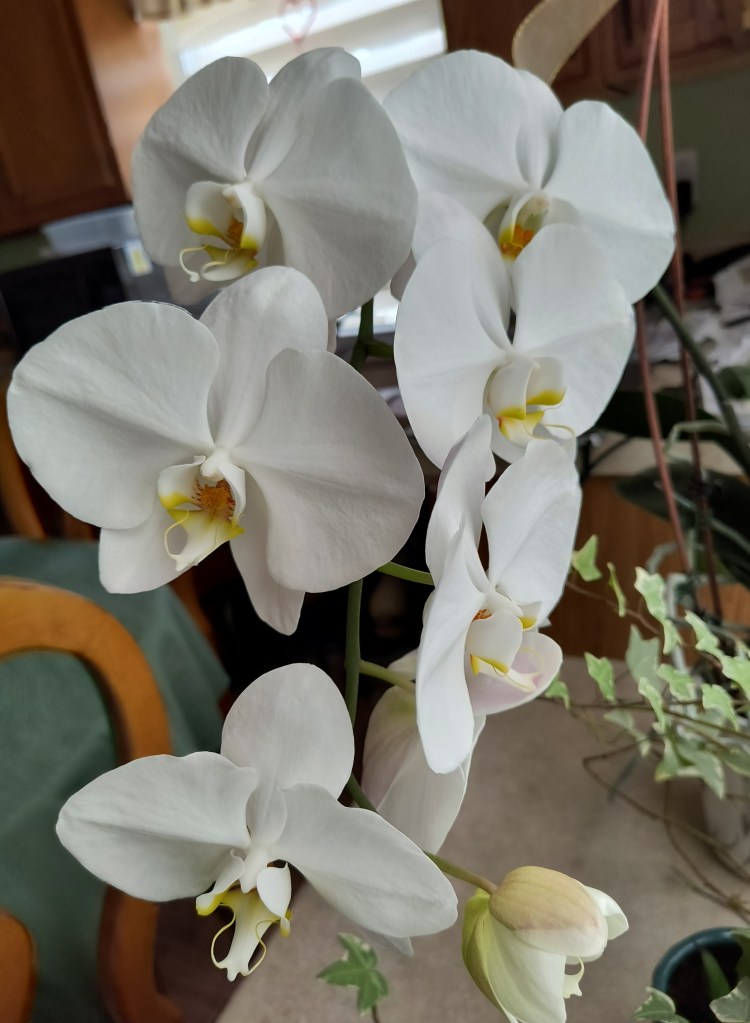
On June 4 there were just two blossoms. God’s generosity blooms right in front of me.
It’s taken me a lifetime, though, to understand that saying “no” to service—the overextension of another kind of giving, my time and energy—can be an act of faith. Saying no acknowledges my smallness and God’s bigness; my creaturely limitations. Can I trust God to care for others through different means and people when my own resources—including emotional ones—have run dry? When I just want to crawl in a hole for a while and hide? Can I acknowledge my own needs for rest as being legitimate? That has been a much bigger struggle, and of course there’s more to it than what I’ve said here.
I’m sure I’ve made mistakes trying to live out this kind of faith, when obedience actually means saying no. Sometimes I’ve given when I shouldn’t have. Sometimes I haven’t when I should have, missing out on the special joy of sharing what God has given me.
In both cases, though, God’s love is bigger than my poor powers of discernment. Would God care for the people of Jerusalem some other way if the Corinthians pulled back on what they had promised to give? What do you think? I would love to know!!
I admire caring people who can take a careful look at their own situation and decide without guilt or self-recrimination to trust God with a given circumstance. Especially when I see them at other times give generously with enthusiasm and joy. They don’t think they have to respond to every need that comes their way. Yet they love to share when they can, when God has blessed them with more than they need. I see these people living simply, stewarding their resources because they so delight in giving to others.
Paul says two things result when we give in this way: people’s needs are met (sometimes through me; more often through others), and God receives praise (9:12). Later, he also says that the recipients of the gift will pray for the giver with deep affection. It’s a win-win; “overflowing grace” in both directions (9:14). I’m still learning to practice this grace-filled way of living.
P.S. I really would love to know your thoughts on my question a couple paragraphs back!
Luke 4:17-19 Jesus unrolled the scroll of Isaiah the prophet and found the place [Isaiah 61:1-2] where this was written: “The Spirit of the Lord is upon me, for he has anointed me to bring Good News to the poor. He has sent me to proclaim that captives will be released, that the blind will see, that the oppressed will be set free, and that the time of the Lord’s favor has come.” … Then Jesus began to speak to them. “The Scripture you’ve just heard has been fulfilled this very day!”
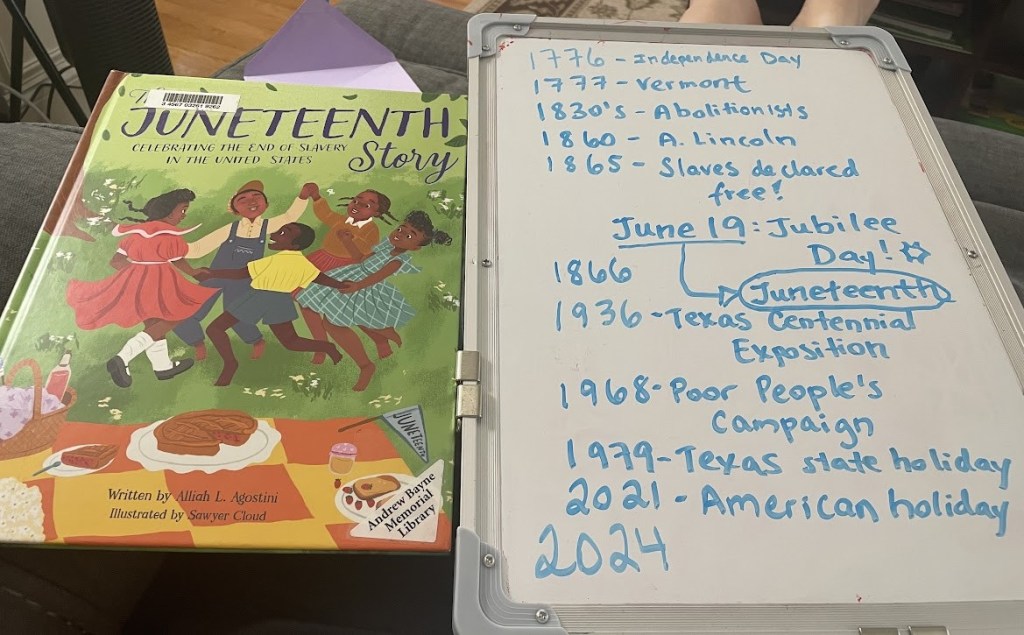
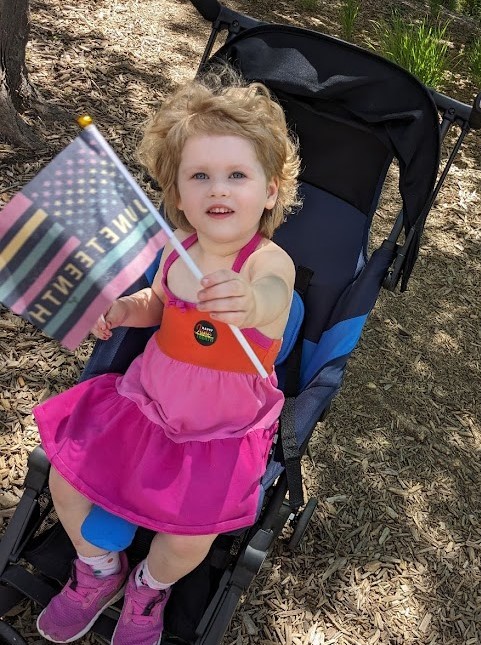
On Juneteenth we celebrate the emancipation of slaves in the United States. The story of the slaves in Texas learning about this, months after it became true, will be told many times today.
Sadly, true freedom has taken—is taking—much longer to experience, because the other part mentioned by Isaiah in this passage, that Jesus applied to himself, is that the blind will see. John shows us in John 9 how many different types of blindness there are, especially of those who think they can see, those who hold power to bless others or to harm them (um, that would be each of us, right?).
My daughter Valerie teaching her kids about Juneteenth
Today, I pray that God will heal my blindness. Especially in areas where I think I can see. And I pray blessing on all those whom God is using to heal the racial wounds within the Body of Christ. Be the Bridge. Here in Pittsburgh, Sisters Celebrating Diversity. You can fill in those working for healing where you live.
My granddaughter Liliana (Rachel’s daughter) at a Juneteenth parade.
As an aside, I will mention that June 19 is an important date for me in other ways too. My beloved older brother Steve was born on June 19. It’s the day our family, the kids sweating under long sleeves and pants to cover up their chickenpox, arrived in São Paulo, Brazil in 1990. On June 19 exactly one year later we moved into the house that would be our home for nineteen more years.
And it’s the day I have before me right now, in which to rejoice in the many ways God has set me free and to pray for those who still find themselves in bondage and oppression.
For the Lord is the Spirit, and wherever the Spirit of the Lord is, there is freedom (2 Corinthians 3:17).
2 Corinthians 8:2-3, 5, 9 The churches in Macedonia are being tested by many troubles, and they are very poor. But they are also filled with abundant joy, which has overflowed in rich generosity [to the suffering church in Jerusalem]. For I can testify that they gave not only what they could afford, but far more. And they did it of their own free will … for their first action was to give themselves to the Lord. … You know the generous grace of our Lord Jesus Christ. Though he was rich, yet for your sakes he became poor, so that by his poverty he could make you rich.
I think these verses describe well many pastors and leaders to whom God has given a passion for discipleship and disciplemaking across Latin America. They inspire us daily.
If those terms sound strange or antiquated to you, here’s a simple definition of discipleship and disciplemaking: a commitment to grow and to help others grow into being more like Jesus.
What then does “being more like Jesus” look like? For me, it’s a blue butterfly. More on that below.
This isn’t the blue butterfly in my vision, but enough to give you the idea
The best summary of being like Jesus is his own: “Love each other. Just as I have loved you, you should love each other. Your love for one another will prove to the world that you are my disciples” (John 13:34-35).
“Just as I have loved you.” Until we personally experience Jesus’ love for us, we can’t love others in the same way. As Paul puts it: First, we give ourselves to the Lord.
And when we feel dry, we return to him. We offer our needy hearts to him again.
Maybe because I grew up “poor” by some standards, I tend to feel uncomfortable and insecure around people for whom wealth is a value. I know I will fall short in every direction when judged by their standards.
Perhaps that’s why Jesus’ choice to live as a poor man means so much to me. I can approach him without that paralyzing feeling of unacceptability. I know he values what matters to me: people’s selves, their souls.
One time God blessed me with a vision of myself as a child, playing in a beautiful meadow with Jesus and a lovely blue butterfly. This is the scene I return to when I feel needy of a fresh experience of his rich, unhurried, unpressured, uncomplicated love.
And when we feel his love so filling us that it spills over to others, we return to him, in thanksgiving. As noted in the last blog, “we ourselves are like fragile clay jars containing this great treasure. This makes it clear that our great power is from God, not from ourselves” (2 Corinthians 4:7).
I know, and you know, the Source of anything good in our lives. I invite you to join me today in taking time to relax in his presence, opening our hearts to his great love. Then—be amazed at what he chooses to do through the overflow to others of his richly generous love.
Psalm 16:11 You make known to me the path of life; in your presence there is fullness of joy; at your right hand are pleasures forevermore.
Note from Debbie: If you are a pastor or perceive that your pastor has lost his or her joy, contact the House of Gladness to schedule a retreat, a time to be heard and supported in one of the most difficult jobs on earth. Here’s an idea: Make it a gift from your congregation for Father’s Day. Write to Jim for availability: jim@houseofgladness.com.
As we talk with pastors, we continue to hear a deep weariness in their voices. The partisan ethos of our culture has so thoroughly marinated their congregations that every slight difference of opinion in the congregation often becomes a major point of disagreement that requires stances to be taken by the leadership of the congregation. Who knew that green carpets were signs of complete capitulation to the works of Satan? (Only a slight exaggeration!) As you pray for the ministry of House of Gladness, pray for weary and discouraged pastors who are berated by all sides. Research continues to show that a large percentage of pastors (just over 1/3) are giving serious thought to finding a less stressful occupation (like used car salesman, middle school social studies teacher, or alligator farmer).
When raising children, it can seem like 20-80% of one’s day is spent finding lost items: shoes, cups, coats, socks, books, papers, tablets…anything and everything. After the tragedy of the lost treasure is announced (because every lost item is always, by definition, “my favorite!”) the parental mantra is, “Where did you last have it?”
That question is a great starting point for pastors and lay leaders who have lost their joy in ministry. “Where did you last have it?” To remember a time of joy, many of us would need to go back before COVID-19 threw our worlds into turmoil.
When you do remember a time when you were serving the Lord with gladness, where did the joy come from? Quite likely, your joy bubbled up from some blend of satisfying accomplishments, supportive relationships, a clear purpose, and consistent prayer times. If you are looking for lost joy, starting with those four sources is wise. The most critical one is time with the Lord because, when the other three wells of joy dry up, there is fullness of joy in the Lord’s presence.
Before you toss this aside as an admonition from a person standing on the beach to someone caught in a rip current to “swim harder,” let me assure you that praying harder (at least in my experience) rarely increases joy. Guilt, shame, frustration, yes; rarely joy. Instead, I’m inviting you to rediscover the presence of the Lord. You may encounter the Lord on your knees at set times of formal prayer (which the Church from the beginning has declared important). But you might also experience His presence while walking, or conversing with a friend, or reading, or painting, or bird watching, or lying in a hammock.
Added by Debbie: Or at a personal retreat at the House of Gladness. I have myself found rest and renewal in the Hobbys’ home several times—before this tender ministry was formalized as the House of Gladness. God has gifted Jim and his wife Shari for this work and equipped them through deep suffering of their own. They offer their love with empathy, grace, and prayer.