
But God lifts our heavy burdens
Isaiah 9:2, 4 The people who walk in darkness will see a great light. For those who live in a land of deep darkness, a light will shine. … For you will break the yoke of their slavery and lift the heavy burden from their shoulders.
I was born and grew up in Guatemala. My parents worked with Wycliffe Bible Translators, who used the name Summer Institute of Linguistics (Instituto Lingüístico de Verano, ILV below) for their educational contracts with Latin American governments. Their work included analyzing the linguistic structure and creating an alphabet and literacy materials for languages not previously written. My mom, for example, created primers for teaching people to read, and trained trainers to teach others to read.
Dad devoted his time to translating the Scriptures into Maya Ixil. He told fascinating stories about the translation process. One of my favorites was about translating 1 Peter 5:7. It illustrates, I think, the beauty and significance of the mosaic described below.
Dad told us he made an initial translation of 1 Peter 5:7, “Give all your worries and cares to God, for he cares about you,” and read it to his Ixil assistant. The man said, “Oh no, you can’t say that.” Dad tried a series of different words until he had exhausted his Ixil vocabulary, each time receiving the same response.
Finally, he returned to his original rendition and asked, “If I were to say this, what would it mean?”
His assistant replied, “Why, it would mean that God cares about us. That’s not possible!”
Dad said, “But that is exactly what this text is telling us.”
The man’s eyes grew wide. Then he leaned back and laughed and laughed and laughed.
All his life he had been terrified of God and of the spirits that inhabited every aspect of nature. They were not benign or personal. He and his family spent much of their resources on trying to make the spirits happy enough to simply leave them alone.
The idea that God cared – about him! – was revolutionary. This Scripture literally transformed his life. He later told my parents, “This Word has made me sweet inside.”
When I was fourteen, I lived with my parents and youngest sister at a Wycliffe base in Ixmiquilpan, north of Mexico City. Occasionally we visited the ILV Tlalpan center in Mexico City. I loved gazing at a huge three-story mosaic on the side of the main administration building. It illustrated Isaiah 9:2 and helped me appreciate my parents’ work.
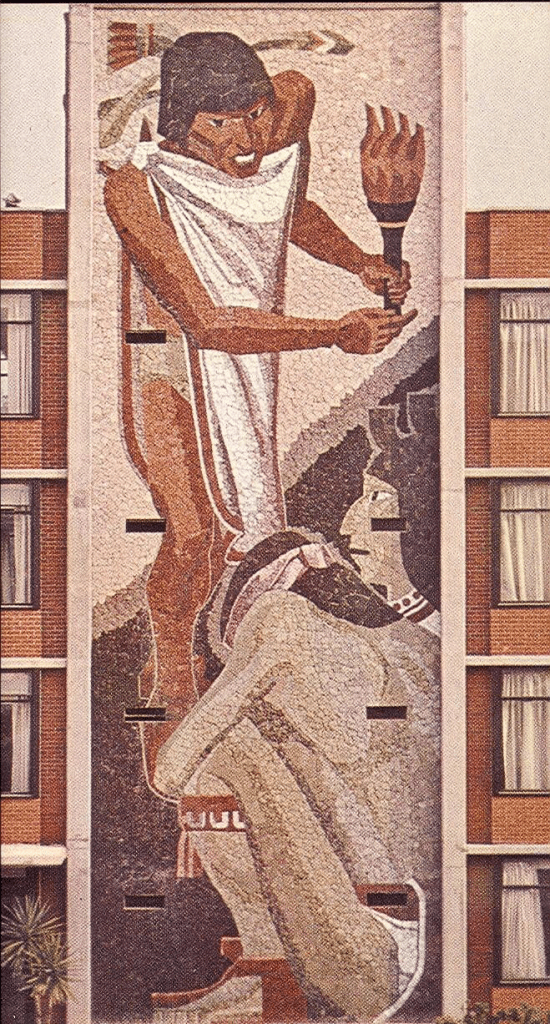
“The teaching of your Word gives light” (Psalm 119:130)
I asked veteran Wycliffe translator Margaret Daly, retired from her work in Mexico, to describe this amazing mosaic for us:
“Thinking about Isaiah 9:2 and the stone mosaic on the former ILV office building in Tlalpan, I guess you are not so much interested to know how Katie Voigtlander came up with the concept and the various aspects of the construction of the mural as you are with the connection between what is pictured and the translation work of ILV. Am I right?”
“Yes. Thank you, Margaret.”
“As I recall, Katie wanted the mural to show how the introduction of the gospel message in languages the people understood brought them from spiritual darkness into the light of life in Christ. Note that the figure at the bottom has its head lowered and shoulders bowed, indicating a lack of interest. The figure in the middle has his head raised, indicating interest has been aroused because what is being told is understandable. The figure at the top is carrying a torch to light the way to truth for his fellow man. The lighted torch symbolizes the translated Scripture.
“The mural is not a painting — Katie went to the quarry and chose the colored stones to be used. A three story ‘tablet’ was formed on which the ‘cartoon’ (the enlarged drawing of Katie’s concept) was carefully traced so that she could see how it all fit together, make any necessary changes in perspective, and finally follow the cartoon in placing the stones.”
(Me) “I read an article in Spanish that identifies eight colors and types of stones used in the mosaic.”
“Yes. I’m sending you another article too that tells more about Katie’s intent and process.”
[If you’re interested, you can read the article below.]
“To transfer the cartoon to the tablet, Ted Engel, one of the Swiss ILV members who was a trained mountaineer, lowered himself from the roof of the building. Katie climbed the scaffolding daily for several months to work with the stone masons.”
(Me) “The Tlalpan mosaic honors the work you and your husband John devoted your lives to accomplish, Margaret. Thanks so much for helping us better understand the impact of Bible translation through Katie’s stunning mural.”
(Margaret, quoting Marilyn NIckel Ahrens Baer):”I found the following article when I was working in the Mexico-Cardenas Museum at JAARS***. We were also given, by the Mexico Branch, the original drawing that Katie made before the mosaic was created.”
The Mural on San Fernando Avenue
Reported by Carlos Zugasti, resident of the Barrio del Niño Jesús, Tlalpan
This mosaic mural, full of mythological symbolism, is in the tradition and style of Mexican murals, and in this case has the aura of primitive civilization. Mexico is no stranger to this tradition. Long before any contact with peoples from other latitudes, people here designed and built mosaic murals; the ancient Aztecs practiced this art of painting with pieces of stone. They created mosaics on objects destined to propitiate their many gods and by which they represented ritually the equilibrium of the cosmos. They displayed on masks, earrings, medallions, knives and necklaces scenes of importance for religion, history or everyday life relating to education and culture. In Mexico the history of mosaic art cannot be reduced to a simple chronicle of decoration for rooms or for educational buildings. It is a compendium of the art produced with great dedication and talent during the Aztec dynasty by artists of world class ability.
Tlalpan has various examples of mosaic art, some done in stone and some in glass. With pride we focus on the one found on San Fernando Avenue, between the Viaducto to Cuernavaca and Retama Street, in the Barrio del Niño Jesús, on the building which now belongs to the Centro Nacional de Cancerología.The mural was created under the auspices of the Instituto Lingüístico de Verano, A.C., which in its time was charged with the task of designing phonemic alphabets for Indian Languages of Mexico and which was a pioneer in the elaboration of dictionaries for these languages.
During her long career, the Mexican linguist Artemisa Echegoyen* compiled a dictionary of the Otomi language of the Sierra, and published oral histories of the Mexican Revolution in the journal Tlalocan. She collaborated in the translation to Otomi of the Gospel of Saint John and also wrote articles about the indigenous culture. In collaboration with Katherine Voigtlander** she published the grammar “Luces Contemporaneas del Otomi,” and prepared many other linguistic studies as well as promoting and publishing literature in Indian languages.
Katherine is the one who designed and executed this mural, utilizing natural stones of different colors and hues. She brought together Venician red, sienna, rose, salmon, grey, obsidian black, Calcedonian white (like marble) and Tikal green. With them she created a mural measuring almost 38 square meters that covers part of the headquarters building of the old Linguistic Institute. The theme of the mosaic is an Indian man carrying a torch to illuminate the darkness. Katherine Voigtlander executed the work with regular “teselas”, stones selected and cut to the desired shape. The colors of the minerals in these natural stones became part of the artwork of the mural which covers three stories of the building which housed the library and classrooms as well as administrative offices of ILV.
Cata, as we all knew her, in addition to her linguistic expertise, had unique abilities for drawing and painting. She illustrated many of the manuals, missals, booklets and dictionaries in Mexican Indian languages. With her great artistic sensibility, she designed the mural, learned the technology for building a mosaic mural, and produced a great work of art, worthy of wide recognition. She has left for posterity this monument in stone that in its time was symbolic of the work of the Summer Institute of Linguistics. It forms part of the Route of Murals that includes those of the National University of Mexico executed by Diego Rivera, David Siquieros, Juan O’Gorman and the mosaic murals we see in the Anahuacalli of Coyoacán.
*Artemisa Echegoyen passed away Febuary 11, 2006.
**Katherine Voigtlander moved to Arizona; she celebrated her 90th birthday April 19, 2007. She died August 13, 2011.
***JAARS, Jungle Aviation and Radio Service, was founded by Cameron Townsend (who also founded Wycliffe) 75 years ago to assist Bible translators living in remote areas with transportation and radio connection. Margaret’s son Charles Daly (Chuck) has worked with JAARS his entire career. See https://www.jaars.org/about/.
 Debra Kornfield
So interesting to know how this mural was made, and what a beautiful symbol of Bible translation work.
LikeLiked by 1 person
I found it interesting too!
LikeLike
I enjoyed this so much! I remember that year at Ixmi and Tlalpan, as well as this amazing mural. I never considered the story of the mural. Thanks to you and Margaret for sharing it with us!
LikeLiked by 1 person
It is quite an amazing story!
LikeLike