A willing gift

But God asks us to decide without pressure

2 Corinthians 9:5-8 But I want it [the Corinthians’ gift to the needy church of Jerusalem] to be a willing gift, not one given grudgingly. … You must each decide in your heart how much to give. Don’t give reluctantly or in response to pressure. … And God will generously provide all you need. Then you will always have everything you need and plenty left over to share with others.

2 Corinthians 8:12-13 Whatever you give is acceptable if you give it eagerly. And give according to what you have, not what you don’t have. Of course, I don’t mean your giving should make life easy for others and hard for yourselves.

“Work harder.” “Give more.” “Give until it hurts.”

Does that sound like God’s voice?

Sometime, maybe so. Paul commends the Macedonian church: “I can testify that they gave not only what they could afford, but far more” (8:3). He hastens to say, though that they did it joyfully, of their own free will. Not because of manipulation or pressure or guilt.

When famine hit the church in Jerusalem, Paul asked for aid from believers who had more at that time. He encouraged the Corinthians to consider a donation, saying “I only mean that there should be some equality. Right now, you have plenty and can help those who are in need. Later, they will have plenty and can share with you when you need it” (8:13-14).

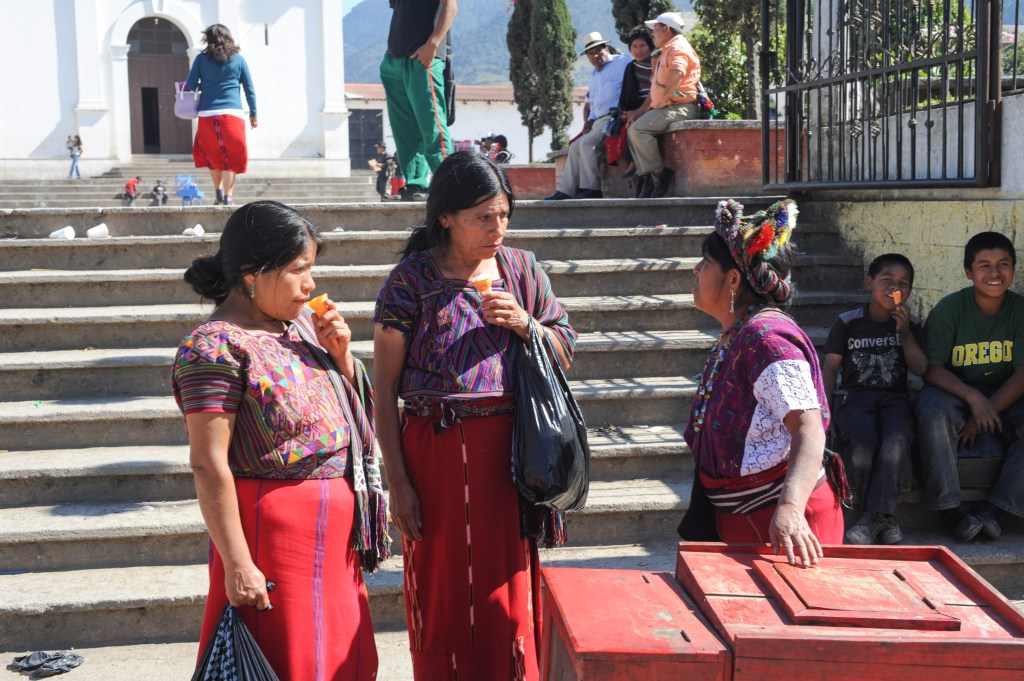
I grew up in a small Mayan village in Guatemala where people lived at “subsistence” level. Our family lived humbly by North American standards—a family of ten in a house with two bedrooms (once Dad set up his study in the garage so he and Mom could move out of the living room), for which Dad paid $25/month rent, out of our $200 missionary income. We had books, and a few toys and games, and a small refrigerator. By comparison with our neighbors, we were wealthy, and our family generously shared what we had, receiving so much more in return of friendship and richness of culture and place.

When I came to the U.S. on furloughs as a child, I was overwhelmed by the extravagance of all that I saw around me. I struggled deeply with the question, “How can people live like this, when so many in the world barely have enough to eat?” I felt an obligation to work hard, to meet not just my own simple needs but to share with others. I gave sometimes from nothing, skipping meals to make up what lacked, and it was a joy to do so. Money has never caused me anxiety. I see this as a gift from God that has eased tensions when, for example, Dave and I struggled to make ends meet. I found it easy to believe God would provide what we needed financially. And we could always cut back, whether with groceries or in other ways.
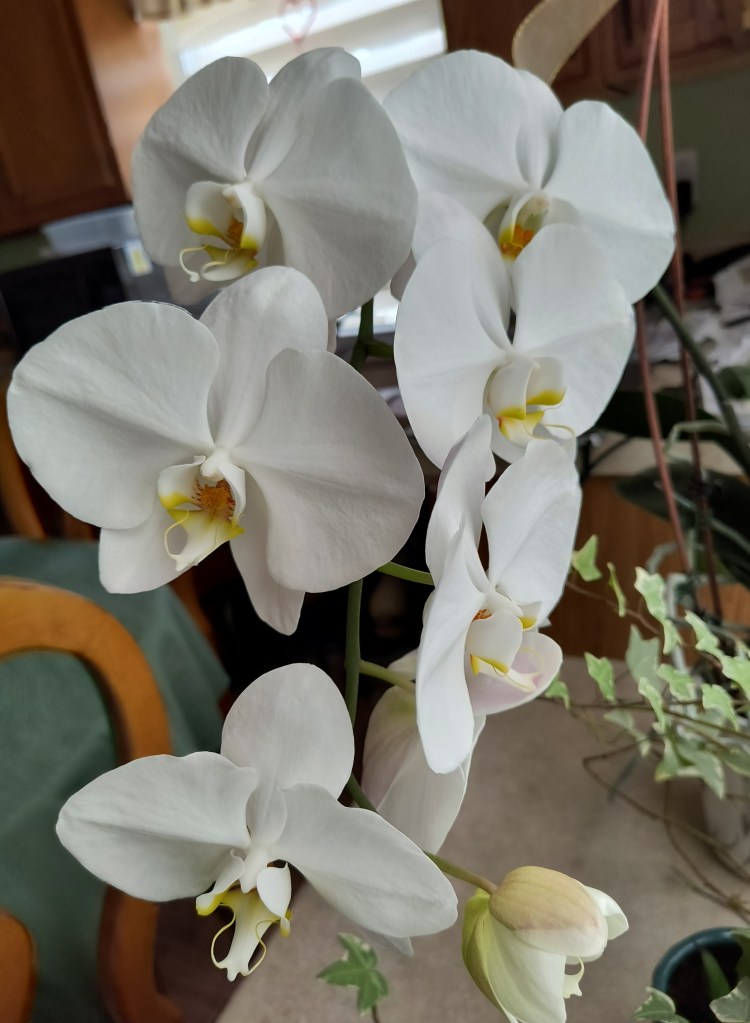
On June 4 there were just two blossoms. God’s generosity blooms right in front of me.

It’s taken me a lifetime, though, to understand that saying “no” to service—the overextension of another kind of giving, my time and energy—can be an act of faith. Saying no acknowledges my smallness and God’s bigness; my creaturely limitations. Can I trust God to care for others through different means and people when my own resources—including emotional ones—have run dry? When I just want to crawl in a hole for a while and hide? Can I acknowledge my own needs for rest as being legitimate? That has been a much bigger struggle, and of course there’s more to it than what I’ve said here.

I’m sure I’ve made mistakes trying to live out this kind of faith, when obedience actually means saying no. Sometimes I’ve given when I shouldn’t have. Sometimes I haven’t when I should have, missing out on the special joy of sharing what God has given me.

In both cases, though, God’s love is bigger than my poor powers of discernment. Would God care for the people of Jerusalem some other way if the Corinthians pulled back on what they had promised to give? What do you think? I would love to know!!

I admire caring people who can take a careful look at their own situation and decide without guilt or self-recrimination to trust God with a given circumstance. Especially when I see them at other times give generously with enthusiasm and joy. They don’t think they have to respond to every need that comes their way. Yet they love to share when they can, when God has blessed them with more than they need. I see these people living simply, stewarding their resources because they so delight in giving to others.

Paul says two things result when we give in this way: people’s needs are met (sometimes through me; more often through others), and God receives praise (9:12). Later, he also says that the recipients of the gift will pray for the giver with deep affection. It’s a win-win; “overflowing grace” in both directions (9:14). I’m still learning to practice this grace-filled way of living.

P.S. I really would love to know your thoughts on my question a couple paragraphs back!

Goodness of God, by Hillsong

First things first

But Jesus’ poverty makes us rich 

2 Corinthians 8:2-3, 5, 9 The churches in Macedonia are being tested by many troubles, and they are very poor. But they are also filled with abundant joy, which has overflowed in rich generosity [to the suffering church in Jerusalem]. For I can testify that they gave not only what they could afford, but far more. And they did it of their own free will … for their first action was to give themselves to the Lord. … You know the generous grace of our Lord Jesus Christ. Though he was rich, yet for your sakes he became poor, so that by his poverty he could make you rich.

I think these verses describe well many pastors and leaders to whom God has given a passion for discipleship and disciplemaking across Latin America. They inspire us daily.

If those terms sound strange or antiquated to you, here’s a simple definition of discipleship and disciplemaking: a commitment to grow and to help others grow into being more like Jesus.

What then does “being more like Jesus” look like? For me, it’s a blue butterfly. More on that below.

This isn’t the blue butterfly in my vision, but enough to give you the idea

The best summary of being like Jesus is his own: “Love each other. Just as I have loved you, you should love each other. Your love for one another will prove to the world that you are my disciples” (John 13:34-35).

“Just as I have loved you.” Until we personally experience Jesus’ love for us, we can’t love others in the same way. As Paul puts it: First, we give ourselves to the Lord.

And when we feel dry, we return to him. We offer our needy hearts to him again.

Maybe because I grew up “poor” by some standards, I tend to feel uncomfortable and insecure around people for whom wealth is a value. I know I will fall short in every direction when judged by their standards.

Perhaps that’s why Jesus’ choice to live as a poor man means so much to me. I can approach him without that paralyzing feeling of unacceptability. I know he values what matters to me: people’s selves, their souls.

One time God blessed me with a vision of myself as a child, playing in a beautiful meadow with Jesus and a lovely blue butterfly. This is the scene I return to when I feel needy of a fresh experience of his rich, unhurried, unpressured, uncomplicated love.

And when we feel his love so filling us that it spills over to others, we return to him, in thanksgiving. As noted in the last blog, “we ourselves are like fragile clay jars containing this great treasure. This makes it clear that our great power is from God, not from ourselves” (2 Corinthians 4:7).

I know, and you know, the Source of anything good in our lives. I invite you to join me today in taking time to relax in his presence, opening our hearts to his great love. Then—be amazed at what he chooses to do through the overflow to others of his richly generous love.

Are you wealthy? Or poor?

Luciene update: Surgery yesterday went well, and she is home at Val and Cesar’s house. Pray for pain management today and for God’s provision of $50,000 to pay for the surgery! Thank you!!

But God chose the poor to be rich in faith  

Isaiah 3:14-15 The Lord comes forward to pronounce judgment on the elders and rulers: “How dare you crush my people, grinding the faces of the poor into the dust?” demands the Lord, the Lord of Heaven’s Armies.

James 2:1, 5, 8 My dear brothers and sisters, how can you claim to have faith in our glorious Lord Jesus Christ if you favor some people over others? … Hasn’t God chosen the poor in this world to be rich in faith? … Yes indeed, it is good when you obey the royal law as found in the Scriptures: “Love your neighbor as yourself.”

Strong words from Isaiah today, echoed by James almost 800 years later, reminding us that God’s character doesn’t change. It’s so easy for us, who are among the world’s and history’s most wealthy, to equate poverty with crime, with character defects like laziness, with bad habits and lifestyle choices, with inferior intellect and wisdom. In so doing, of course, we elevate ourselves and justify our own ways of living.

As I sit here, though, a series of snapshots flit through my mind of people who would be considered poor by most standards who have, out of kindness and generosity, deeply blessed my life. Of wisdom and perspective I gained from the fruit of the Spirit shining through people living lives of grace within terrifically difficult circumstances. Of gentle care extended to me as a child by people living in one-room earthen floor thatched roof homes. Of friends who grew up in favelas (urban slums), who were abused and hungry and cold, yet whose hearts were wide open to God’s love and somehow carried forgiveness instead of grudges.

I feel like I’ve had the privilege of at least some insight into God’s tenderness toward his people, the ones he chose to be rich in faith, the poor.

Poverty is such a relative concept. Everyone (almost!) is “poor” when compared to some others—and wealthy when compared to a different set of people. I felt this viscerally when our family spent a year in the US when I was eleven. In our small village in Guatemala, we were considered unbelievably wealthy. Even though our house was small (especially for our large family!), we had a tile floor, and Dad devised a way for us to have running water, heated by our wood stove. We children went away to school. We each had more than one set of clothes. We ate fruits and vegetables. We owned a vehicle. We had games and toys and jigsaw puzzles and a crank record player. We had resources to help other families.

The complexity of two cultures (and ours as a third) with lopsided power and wealth sharing, occupying the same physical space in the town where I grew up (Shutterstock: Stefano Ember)

A week of travel, though, took us to a city in the US where we were considered poor. My classmates wore new clothes, not hand-me-downs. (We joked about the used tea bags included with missionary donations.) When special events came to town, they could attend. Their teenage siblings didn’t have to go to work after school as mine did, leaving me, at eleven, responsible for my four younger sisters and brother, along with housework and cooking. So they could visit each other’s homes and play after school or learn special skills like gymnastics or other sports. At age eleven, I resented being different from my peers.

But was I poor? No, I don’t think so. I had a home to go to, food to eat, clothes to wear. I spoke (to some degree) three languages. I had grown up amid two other cultures that interfaced in complex fashion in my part of Guatemala. (After I left home, my town was caught in the crossfire of a brutal, years-long civil war engendered by these disparities.) My parents were well-educated (Dad that year was earning an advanced degree in linguistics at the University of Chicago) and good at their work of Bible translation. I had been well cared for at my boarding school, learning enough that the academic part of life in the US seemed easy to me (except latitude and longitude—for some reason I could never remember which was which!).

God’s point, recorded by Isaiah, is of course about kindness and generosity, living by the royal law rather than greed and abuse. Today I am filled with gratitude, for the unexpected riches of a zillion blessings, for many opportunities to share them with others. And for daily invitations from the Lord to grow in faith.