Why do roses have thorns?

But God’s power works through our weakness July 15, 2024

2 Corinthians 12:7-10 I was given a thorn in my flesh … Three different times I begged the Lord to take it away. Each time he said, “My grace is all you need. My power works best in weakness.” So now I am glad to boast about my weaknesses, so that the power of Christ can work through me. … For when I am weak, then I am strong.

I’m sure you’ve had the experience, as I did last week, of injuring a finger on the thorn of a rose and then asking “Why? Why do beautiful roses have such sharp thorns?”

Shutterstock: Albatros-Design

And you may have noticed, as I’ve been working my way through 2 Corinthians on this blog, that I skipped the best-known part of chapter 12. I did that because I’ve written about it so many times as the theme of Karis’s life. This began when she was eleven, when she asked her father and me not to pray any longer for her healing, and instead to pray that she would understand and fulfill God’s purposes for her life.

This theme prompted her to write in her journal at age sixteen, “All I see is grace,” the phrase I chose for the subtitle of her book. Perhaps you have read Karis: All I See Is Grace and understand from her life a bit more about God’s love extended to us through suffering and loss. (I just noticed in looking up this link that it’s on sale right now on Amazon.)

So why am I doubling back to this passage today? I just listened to a sermon on it by Lauren Scharf at our church on July 7, a day we were away. I want you to take time to listen to it, because she expresses so well what Karis learned and what she lived out: Our intimacy with Jesus is enhanced when we go through grief and suffering because he, the Man of Sorrows, acquainted with deepest grief (Isaiah 53:3), knows from his own personal experience what it’s like. He understands. He walks with us through the deep valleys (Psalm 23), offering us grace to help us when we need it most (Hebrews 4:15-16).

Whatever your “thorn” is, whatever you are struggling with, you are not alone. Jesus is with you. Please take a few minutes to listen to Lauren’s sermon. It might be the best thing you do all week!

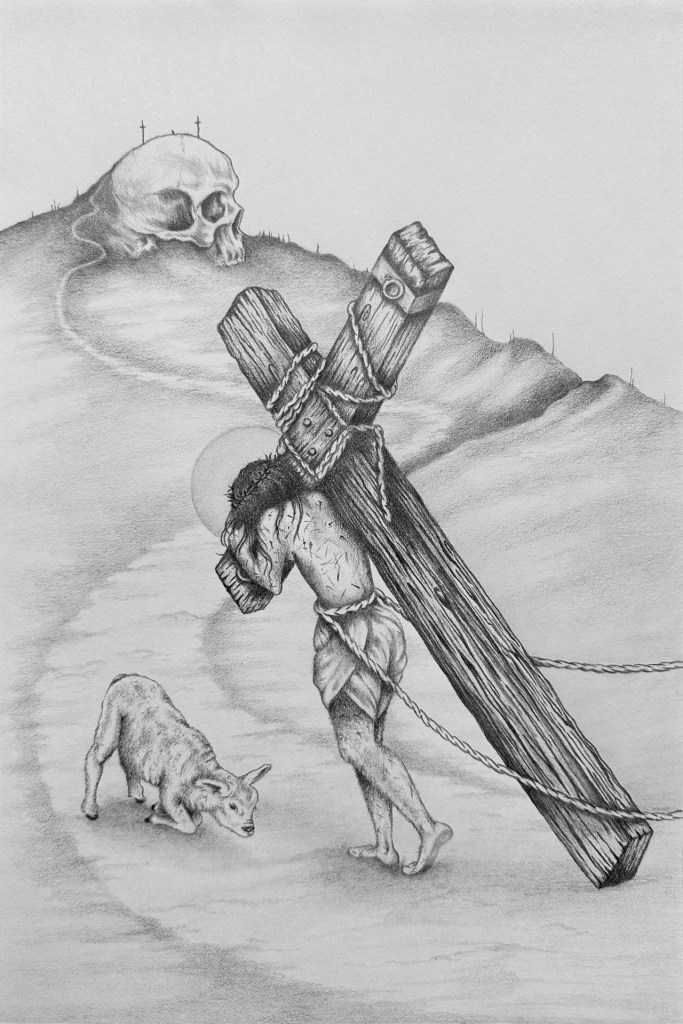
“I found myself rather emotional,” by artist Marissa Bowles, Pittsburgh

But Jesus carried his cross  April 27, 2023

Then Pilate turned Jesus over to them to be crucified. So they took Jesus away, carrying the cross by himself. … Even though Jesus was God’s Son, he learned obedience from the things he suffered. … He was led like a sheep to the slaughter. And as a lamb is silent before the shearers, he did not open his mouth. … Worthy is the Lamb who was slain, to receive power and riches and wisdom and strength and honor and glory and blessing. (John 19:16-17, Hebrews 5:8, Acts 8:32/Isaiah 53:7, Revelation 5:12)

Station 2: Jesus Takes Up His Cross

Marissa wrote the following about the significance and the process of creating this drawing:

Before anything else, I prayed. I prayed that the gift of art God gave me would be used to first and foremost glorify him. That after some time away from creating fine art, God would melt away feelings of self-doubt and use me and my now willing hands and heart to create again. I prayed to be led by the Holy Spirit to create something that would be a blessing to many and tell of the immeasurable love that God has for everyone.

Then, I spent time meditating on the Station 2 Scriptures [quoted above]: 

I found myself drawn to the use of symbolism. The skull-shaped hilltop with cavernous, tomb-like recesses represents death. Ropes tied about Jesus’ waist, held out of view by soldiers and intended to pull him onward like a lamb led to slaughter, instead trail behind him, symbolizing Jesus’ willing spirit. A halo of light surrounds Jesus’ head, symbolizing his coronation as King of Heaven and Earth. A lamb, traveling the rocky, dirt path opposite Jesus, bows in reverence and gratitude to the truly sinless, spotless Lamb of God, illustrating Jesus as the once-for-all perfect sacrifice for sin. The little lamb is set free from death by Christ’s sacrifice as we too are set free and redeemed — the sheep of his pasture bowing before our Lord. The scene is one of solitude, inviting us to imagine the loneliness that Jesus may have experienced as he selflessly walked the path ahead of him.

I chose graphite on paper as my medium as it has always been a favorite of mine and is forgiving. It often provides me with a feeling of being more connected to the image and the details as they begin to emerge. In particular, I found myself rather emotional, holding back tears, when I began to render Jesus’ wounds. With each stroke of lead, I felt uneasy, sorrowful, guilty and repentant.

I’m so thankful to have had the opportunity to create a piece like this and to be in the company of so many talented artists within the body of the church. I pray that this experience will be a catalyst for more art inspired by Scripture to come into being, not only in the reflective time of Lent, but year round.

In Christ, Marissa

Places we would rather not go

But Christ is the treasure in the darkness

Isaiah 61:1-2 The Spirit of the Sovereign Lord is upon me, for the Lord has anointed me to bring good news to the poor. He has sent me to comfort the brokenhearted and to proclaim that captives will be released and prisoners will be freed. He has sent me to tell those who mourn that the time of the Lord’s favor has come.

Why must we walk with Jesus his path to the cross? Why can’t we skip directly to Easter?

Dr. Diane Langberg thinks deeply about what it means to share the anointing Jesus claimed as his own (Luke 4:20). Here is a selection from “The Fellowship of His Sufferings,” Chapter 5 of her book Suffering and the Heart of God (emphasis mine):

These verses [Isaiah 61:1-3] bring us comfort, but if we are to follow Jesus we must walk into poverty, brokenness, prisons, darkness, mourning, and despair. These are not places we desire to go. … He has called us to live and serve him in this dark place of death, this world, moving among those who are dead in their trespasses and sins, calling them to light and life.

It is not the kind of invitation most of us like to receive. He is the Man of Sorrows and familiar with suffering. He was despised and rejected. He took up our griefs and carried our sorrows. He was crushed for our sins, oppressed, judged, and cut off from the land of the living. And you and I, as the servants of God, are called to complete in our lives what is lacking in regard to Christ’s suffering, for the sake of his body.

The call to share in the fellowship of his sufferings is preceded by the call to worship, the call to truly know him as he is. … Unless we begin from the pace of worship, we will not have power to descend to the places of suffering. … God is on his throne and is our eternal refuge. Worship must come first or we will exalt ourselves and think that the drab drudgery of the rubble is not meant for us. …

God must permeate your being if you are to bring life to dead places. … We must first allow the Spirit of God to bring his power to bear in the dark and dead places of our own lives. We must begin on our knees. He has borne our selfishness, our complacency, our love of success, and our pride. There is no part of any tragedy that he has now known and carried.

God will use the suffering of others to drive you to himself for more of him. Such darkness would overwhelm and lead to despair were there not a treasure there. The treasure in the darkness is the Crucified Christ. To enter into the fellowship of his sufferings is to find him.

Just a greeting?

But Christ gives us peace

1 Peter 5:13-14 My son Mark sends you greetings. Greet each other with Christian love. Peace be with all of you who are in Christ.

Not many responded to my question about what Peter is saying to us about suffering. I hope that means you’ve been spending your time watching the January 6 hearings. I found yesterday’s particularly riveting, a great example of people in real time who have stood firm in their convictions to honor their oaths of service and preserve their integrity despite overwhelming pressure to give in to the mad claims of one person bent on his own glory, not God’s. May the Lord grant them his peace in the midst of their suffering.

But with her permission, here is part of what one friend wrote after a review of some of the suffering she has experienced or known about:

“… There are many other instances where one is left in awe at how people find ways to transfigure their suffering into something that benefits others. So, I see grace in at least these things:

* God suffers with us

* people’s faith, love and courage in trouble remain beautiful

* rescues/survival allow the stories to be told to encourage others

* the goods of beauty, love, creativity, and those who serve to alleviate suffering exist amid suffering

* people transform their pain into service

* people find God in suffering. 

“Not comfortable or easy. But “survivors” move into a different period of life where there is much ordinary delight, appreciation of God having been present, more wisdom, and a determination to enjoy and be grateful for each day of life as a great gift.  Peter seems to say, ‘the suffering is temporary and good times are coming!’”

Thank you, my friend.

Peter frames his letter with the desire for his readers to experience God’s grace and peace (1:2 and 5:14). In between his main focus is their suffering. Let’s do our own quick review of what he says. I encourage you not to just skim through this, but to take enough time to let it soak in and hearten you in whatever you are facing:

1:6 Be truly glad. There is wonderful joy ahead, even though you have to endure many trials for a little while.

1:7 These trials will show that you faith is genuine … your faith is far more precious than mere gold. So when your faith remains strong through many trials, it will bring you much praise and glory and honor on the day when Jesus Christ is revealed to the world.

1:13-14 So think clearly and exercise self-control. … Live as God’s obedient children … holy in everything you do.

2:19 God is pleased with you when you do what you know is right and patiently endure unfair treatment … For God called you to do good, even if it means suffering, just as Christ suffered for you. … He left his case in the hands of God, who always judges fairly. … By his wounds you are healed.

3:8-9, 14 … Sympathize with each other. … Don’t repay evil for evil. Don’t retaliate with insults when people insult you. Instead, pay them back with a blessing. That is what God has called you to do, and he will bless you for it. … Don’t worry or be afraid of people’s threats. Instead, worship Christ as Lord of your life.

3:18 Christ suffered for our sins once for all time. He never sinned, but he died for sinners to bring you safely home to God.

4:1 Since Christ suffered physical pain, you must arm yourselves with the same attitude he had, and be ready to suffer, too. … Remember that those who slander you will have to face God, who will judge everyone, both the living and the dead.

4:12-14 Dear friends, don’t be surprised at the fiery trials you are going through, as if something strange were happening to you. Instead, be very glad—for these trials make you partners with Christ in his suffering … So be happy when you are insulted for being a Christian, for then the glorious Spirit of God rests upon you.

4:17, 19 Remember, it is better to suffer for doing good than to suffer for doing wrong! … So if you are suffering in a manner that pleases God, keep on doing what is right, and trust your lives to the God who created you, for he will never fail you.

5:6-7 So humble yourselves under the mighty power of God, and at the right time he will lift you up in honor. Give all your worries and cares to God, for he cares about you.

5:9 Remember that your Christian brothers and sisters all over the world are going through the same kind of suffering you are.

5:10 In his kindness God called you to share in his eternal glory by means of Christ Jesus. So after you suffered a little while, he will restore, support, and strengthen you, and he will place you on a firm foundation. … What you are experiencing is truly part of God’s grace for you.

There is evil in the world. There are people who care nothing about the suffering they cause others, as in the examples I cited in the last post. But God sees, cares, encourages us, walks through our suffering with us, bears our burdens, restores, supports, and strengthens us. And one day he will make everything right.

Some things Karis wrote in her journal as a teenager “stuck” in the hospital come to mind. I’ll close this post (though certainly not this topic) with this:

May 12, 1999 Oh, Lord! Sometimes I am so afraid. The doctors don’t know what to do with me, and it hurts so much! I feel like I’m running on energy not my own, like I’m walking on such thin ice. Lord—is it to be like this forever? I am not strong enough to bear it.

Sometimes, inside I am rejoicing. But it is not a smiley affair, not always. Sometimes joy can be very grave or even be there bittersweet in the midst of terrible pain.

May 19, 1999 What now? What can I do to glorify you in this prison of mine? So strange, my body: at the same time a part of me and my enemy.

Jun 1, 1999 I’ve been poked with needles until my arms are black and blue and red. I thought last night as they poked me again, “What must it have been like for Jesus, not to be pierced by loving nurses and these tiny sharp needles, but rather the soldiers, the nails…” I remember Christ and find not the strength not to complain but rather there is nothing to complain about.

Where is the grace? Tell me what you think Peter is saying.

But God’s grace can include suffering

1 Peter 5:9-12 Remember that your Christian brothers and sisters all over the world are going through the same kind of suffering you are. … So after you have suffered a little while, God will restore, support, and strengthen you, and he will place you on a firm foundation … What you are experiencing is truly part of God’s grace for you. Stand firm in this grace.

We’ve come to the end of 1 Peter at the same time we’re celebrating Juneteenth, an opportunity to remember and honor the hard-won end of Black enslavement in the United States.

But thinking of the horrific suffering engendered by the Civil War on both sides of the conflict, and the betrayals Black people experienced in the Jim Crow years and beyond, I find I want to argue with Peter. How can suffering be part of God’s grace?

Shutterstock: rarrarorro This article describes the beautiful symbols on the Juneteenth flag.

The Civil War was an unconscionable tragedy rooted in greed, cruelty, violence, and a distorted perspective of God’s purposes and plans for his people. The war (as do all wars) engendered shattering losses of life and livelihood, families divided and decimated, resources squandered.

Today, the tragedy of war is replaying in the Ukraine. Where is the grace? What are you saying, Peter?

I read an article this morning titled “Why White Men Should Celebrate Juneteenth.” Without the Civil War, our nation would have broken into two and the double standard which fractured our nation into slave and free despite the bold statement in the Declaration of Independence of the “self-evident truth” that all men were created equal would have continued to poison our progress. As Frederick Douglass said, a healthier nation is built upon “one country, one citizenship, and one liberty for all the people.”

But did this have to come at such an immense cost? Where is the grace, Peter?

According to the UNHCR, there are over 84 million displaced people in the world. Where is the grace, Peter?

According to Safe Horizon, 24.9 million people are victims of “modern slavery” in the United States, including 3.8 million adults and 1 million children exploited by sex trafficking. Come on, Peter. You dare speak of grace?

Every year, more than ten million women and men in the United States experience domestic violence. More than 400,000 children in the US were in foster care last year. Grace??

What is Peter saying?? Please look back over 1 Peter and tell me what you think!

Walk through this week with Jesus

But Jesus says, “You did it for me” by Ed Fox, from San Andrés Sajcabajá, Guatemala

Matthew 25:34-40 Then the King will say, “Come … For I was hungry, and you fed me. I was thirsty, and you gave me a drink. I was a stranger, and you invited me into your home. I was naked, and you gave me clothing. I was sick, and you cared for me. I was in prison, and you visited me. … I tell you the truth, when you did it to one of the least of these my brothers and sisters, you were doing it to me!

As we walk with Jesus through Holy Week, we can experience once again the way he identifies with us in our own much smaller suffering. As so many people are pouring out resources to care for victims of the war in Ukraine and in other places of deep need, Jesus says they are doing it for him. But first, he poured out his life for us.

Ed Fox, a childhood friend from Guatemala, responded to the last post, “Turn toward not away,” illustrating this. Thank you for sharing with us, Eddie.

Antigua, Guatemala (home of my brother Steve and Elaine) Holy Week sawdust carpets GettyImages-505656257

“This story and lesson from Karis’s and your experiences has touched me to the core. So many of the thoughts she expressed to you and in her journals are similar to my own.

My own dad experienced terrible physical and emotional suffering and anguish. He turned towards Jesus and not away. Until the day he died, I asked God to put at least some of Dad’s suffering on me, in part so he might finish the tasks God had given him as a Bible translator. He and Mom did indeed finish shortly before he passed away, and I think of your dear parents, as well, and Mary and myself, as we stumble to the finish line.

About six months following Dad’s departure to Heaven, my own chronic sufferings began and have never ended. Many friends in Guatemala consider my physical (and perhaps emotional) suffering to be a result of my own sin and shortcomings. The “health and wealth” gospel is the main thing going in many of the new Guatemalan congregations, both Evangelical and Catholic. On top of that is the reticence in Mayan culture to make public any illness or trouble in one’s own life. That has fed the idea that it is shameful or an embarrassment when one must ask for prayer. Most troubles in this life are considered to be brought on by one’s own failings and shortcomings.

My suffering, though, has drawn me much closer to Jesus. I believe Jesus has chosen me to walk with Him in His and other people’s sufferings. In turn, I have chosen, as Dad and Karis did, to walk with Jesus and do my best to encourage others along the way.

We have a choice. We can choose to suffer and walk with Jesus, or we can choose to suffer and be bitter and angry. As you say, we choose to turn towards, not away. Although God has provided me with many small encouragements and victories along the way, He has chosen not to heal me completely. I’m usually okay with that after 22 years, but not always! Mary hears my complaints nearly every day of our lives, and so does God!

I want to leave you with a song that encourages me in my pain. Thy will be done on earth as in Heaven.