Grief

A personal note:

The last couple of months have been intense, and I’ve gotten behind on a long series of responsibilities and projects. Until I catch up–especially with a book I need to complete–I’ll be posting here only once a week, aiming for Wednesdays.

One part of the challenge was the decision our daughter Valerie and her husband Cesar made to move back to Brazil–with just six weeks before Val would have to start work there. They accomplished a major move, including participation in our Elliott family reunion and a trip to New York to secure documents they needed, in that short time. Truly amazing! We will miss them. And we rejoice with them, for all the goodness they will experience “back home.”

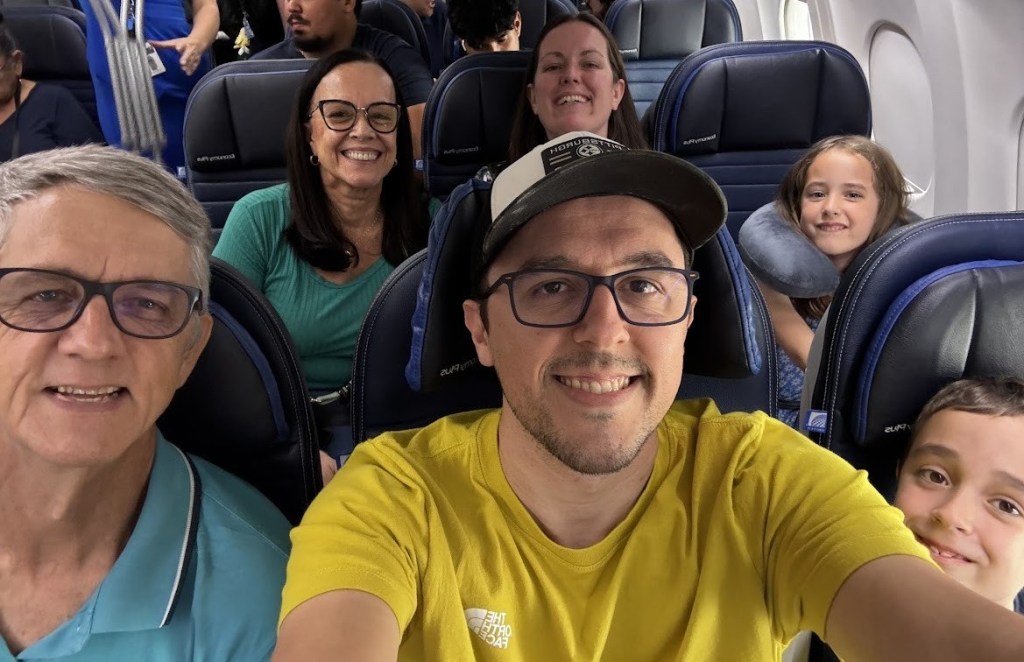
Here they are on the airplane; destination: a new chapter of life in São Paulo.

They did it!! Girls and guys: Back row Luciene (Cesar’s mom), Valerie, Talita. Front row Cesar Sr., Cesar Jr., Caleb. Lu and Cesar Sr., who came to visit before the Brazil decision was made, worked incredibly hard to make this move possible, including preparing the house for sale. Anyone looking for a cute house to purchase in Pittsburgh?

I asked you to pray for my sister. Thank you. She’s doing better, for which we are so grateful. And she has a long road ahead.

It’s helpful to me right now to know that the Holy Spirit understands grief. This blog considers a particular kind of grief, not the separation of loved ones moving to another continent, but the rupture caused by our sin, when we harm ourselves and others.

But the Holy Spirit grieves

Psalm 51:10-12 Create in me a clean heart, O God. Renew a loyal spirit within me. Do not banish me from your presence, and don’t take your Holy Spirit from me. Restore to me the joy of your salvation and make me willing to obey you.

Ephesians 4:30 Do not bring sorrow to [grieve, offend, vex, sadden] the Holy Spirit by the way you live. Remember, he has identified [put his seal on] you as his own, guaranteeing that you will be saved on the day of redemption.

1 Thessalonians 5:19 Do not stifle [quench, suppress, smother, hold back, try to stop] the Holy Spirit.

Grief. It touches each of us sooner or later, to a greater or lesser degree.

Grief even touches the Holy Spirit. Why? Because he expects us to obey a random set of arbitrary rules or face capricious anger and punishment from God?

No. God deeply loves each of us. What hurts him is our unnecessary suffering because we do what is not lifegiving and harm ourselves and others, whom he loves just as profoundly.

In Psalm 51 King David records his anguished cry of repentance after the prophet Nathan confronted him with seducing Bathsheba and murdering her husband. David rightly fears that God will take the Holy Spirit from him as he did with David’s predecessor, King Saul (1 Samuel 16:14). God’s Spirit is holy; he cannot associate himself with rebellion and evil. And in the Old Testament, pre-Pentecost, the Spirit was given to particular people in select circumstances. Not, as Paul stated to the Ephesians, to all believers as a guarantee of our salvation.

God’s Spirit is all about life, health, growth, creativity, blessing, fruitfulness, beauty. When we choose to harm ourselves or others, we limit his power and effectiveness in our lives. And we grieve him.

The way back to joy is exactly what David did: admit and confess our wrongdoing; no excuses. There still will be consequences. Saying “I’m sorry; I was wrong” does not bring a murdered person back to life or make adultery OK. David and Bathsheba’s firstborn died.

But the relationship with God can be repaired, and often (not always) ruptures with other people can heal.

Restoration begins with humility and honesty. Repentance opens the door once more to the Holy Spirit’s wonderful work in our lives.

The sacrifice you desire is a broken spirit. You will not reject a broken and repentant heart, O God (Psalm 51:17).

And the Holy Spirit helps us in our weakness. … The Holy Spirit prays for us with groanings which cannot be expressed in words (Romans 8:26).

Wrongdoing is real

But God says, “Turn to me for healing”

Isaiah 6:5-6 Then I [Isaiah] said, “It’s all over! I am doomed, for I am a sinful man. I have filthy lips, and I live among a people with filthy lips. Yet I have seen the King, the Lord of Heaven’s Armies.” Then one of the seraphim flew to me with a burning coal he had taken from the altar with a pair of tongs. He touched my lips with it and said, “See, this coal has touched your lips. Now your guilt is removed, and your sins are forgiven.”

Isaiah 6:10 The hearts of these people are hardened… Their hearts cannot understand, and they cannot turn to me and let me heal them. (Greek version)

I remember, as a child (I think I was seven), not being able to sleep one night because I had told my father a lie. I tossed and turned and finally crept into my parents’ bedroom, woke Dad and confessed my sin. I still remember how relieved I felt when he forgave me. My heart filled with thankfulness as I returned to my bed and to sleep.

Shutterstock: Chernyshov Konstantin

Dad didn’t say, “Oh, honey, that’s nothing to worry about.” He took my confession seriously and extended the solution to my guilt: forgiveness.

God doesn’t say, “Oh, no worries, Isaiah. Don’t feel bad. I’m sure everything will turn out all right. Other people are worse than you. You should cultivate the ability to feel good about yourself.” This was, essentially, the message of the false prophets to the people of Isaiah’s time.

No. There is right and there is wrong. It’s not all fuzzy and gray and rationalizable. It’s no gift to sugarcoat sin, any more than it would be a kindness for an oncologist to deny the presence of cancer in a patient’s body.

God accepted Isaiah’s self-diagnosis, his recognition and confession of his sin. And he offered a solution, one that caused physical pain but healed Isaiah spiritually. (Isaiah has enough to say the rest of his life that we know the burn on his lips also healed.)

I used a translation of Isaiah 6:10 from the Greek version of the Old Testament because that’s the one Jesus quotes in Matthew 13:14-15/Mark 4:12/Luke 8:10 when he’s explaining the parable of the Sower to his disciples. And it’s the version Luke uses at the end of the book of Acts that Paul quoted while preaching the Gospel to Roman Jews from prison (28:26-27). Some were persuaded, but others did not believe. Paul quotes Isaiah to say, “Even if you Jews will not accept the Gospel, the Gentiles will” (Acts 28:28).

So, what is required of me if I seek God’s forgiveness and healing? I must:

1. Acknowledge my need. In the presence of God, Isaiah realized he could not fulfill God’s calling of him—to communicate God’s words to the people—with lips that had spoken sinfully. His need became clear when he encountered firsthand God’s sovereignty and holiness.

2. Recognize my part in causing my condition. I have made sinful choices, allowed sinful thoughts to occupy my mind, carried out sinful deeds that violate God’s holiness and harm other people as well as myself. Isaiah made no excuse for his sinful lips. He blames no one else.

3. Realize I can’t change myself with any amount of positive thinking, discipline, or willpower. Isaiah despaired; he believed his life was over because he could not help himself.

4. Accept the cleansing and forgiveness God offers. He is ready and wanting to heal me, when I “understand with my heart” and turn to him. The future sacrifice of Jesus (which Isaiah foretells in his writings more clearly than any other prophet) is symbolized by the burning coal from the altar, which purified his lips, the agents of sin in Isaiah’s confession.

Isaiah felt such gratitude for God’s cleansing and healing that he was ready to say, “Here I am. Send me.” He served God the rest of his life not to earn forgiveness, but out of thankfulness for his healing. He passionately desired to guide the people of his generation to likewise find release and forgiveness from their sinfulness.

One clear message for us from Isaiah 6: Understand with your heart your need for forgiveness, and turn to God for healing.

Healing at the lake, Part 3

But Jesus says, “Don’t be afraid”

Luke 5:4-10 Jesus said to Simon, “Now go out where it is deeper, and let down your nets to catch some fish.” “Master,” Simon replied, we worked hard all last night and didn’t catch a thing. But if you say so, I’ll let the nets down again.” This time the nets were so full of fish they began to tear! … When Simon Peter realized what had happened, he fell to his knees before Jesus and said, “Oh, Lord, please leave me—I’m too much of a sinner to be around you.” … Jesus replied to Simon, “Don’t be afraid.”

Romans 8:1-2 So now there is no condemnation for those who belong to Christ Jesus. … The life-giving Spirit has freed you from the power of sin. … Letting the Spirit control your mind leads to life and peace.

The sun grew warm as I built a sandcastle with my brother and sisters. I took off my sweater and laid it on a rock. After a while, we ran to the lake to splash in the waves lapping the shore. When I returned, my sweater was gone.

Shutterstock: Pressmaster

My seven-year-old heart was terrified to tell my mother I had lost my sweater. I delayed returning to our vacation house for as long as I could. Thus I was doubly in trouble, not only for my carelessness but for not showing up in time to help with lunch. I was denied lunch and grounded for the remaining day and a half of our vacation. But what hurt most were the words my mother poured out on me, and the tone of those words. I’m not sure I learned to be more responsible. I do know my fear of her dug even deeper roots into my soul.

It’s natural for a child to project that experience of fear onto God, to assume God is like our parents or other authority figures who haven’t known how to support and encourage us. The breakthrough, healing moments (I’ll tell about one of them in the next post) come from discovery that Jesus isn’t like them. That’s what Simon learned.

“The Chosen” depicts Simon in BIG trouble over his debt to the Roman government. The miraculous catch of fish more than paid Simon’s taxes. It freed him to give up fishing and follow Jesus.

But Simon had an even bigger debt, the debt of his sin, which made him ashamed to come close to the Holy One. Dane Ortlund in his precious book Gentle and Lowly: The Heart of Christ for Sinners and Sufferers, points out in almost every chapter that the only safe thing to do with ourselves when we recognize our sin is to go straight to Jesus. Remember the story in John 8 of the woman caught in adultery? (No mention is made of the man … apparently, she was committing adultery by herself.) Jesus said to her, “Neither do I condemn you. Go and sin no more.”

Compassion. That’s what we’ll find when we go to Jesus in our sin. He weeps over the wounding that takes place within us and in others when we sin. He wants to free us from sin’s devastating impact.

Ortlund says (page 174), “His love is great because it surges forward all the more when the beloved is threatened, even if threatened as a result of its own folly.” I wish for courage this Lent, for you and for me, to trust Jesus’s heart of love, his compassion, his gentleness, his longing to connect with us, to free and heal us. Hear him say to you as he did to Simon, “Don’t be afraid.”