“I found myself rather emotional,” by artist Marissa Bowles, Pittsburgh

But Jesus carried his cross  April 27, 2023

Then Pilate turned Jesus over to them to be crucified. So they took Jesus away, carrying the cross by himself. … Even though Jesus was God’s Son, he learned obedience from the things he suffered. … He was led like a sheep to the slaughter. And as a lamb is silent before the shearers, he did not open his mouth. … Worthy is the Lamb who was slain, to receive power and riches and wisdom and strength and honor and glory and blessing. (John 19:16-17, Hebrews 5:8, Acts 8:32/Isaiah 53:7, Revelation 5:12)
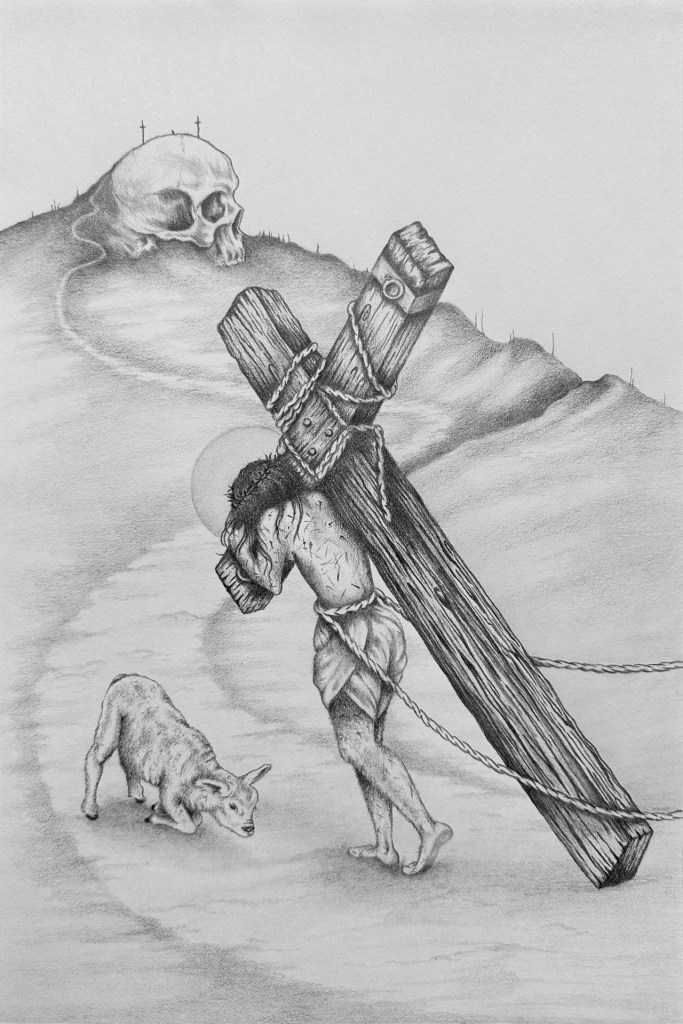
Station 2: Jesus Takes Up His Cross

Marissa wrote the following about the significance and the process of creating this drawing:

Before anything else, I prayed. I prayed that the gift of art God gave me would be used to first and foremost glorify him. That after some time away from creating fine art, God would melt away feelings of self-doubt and use me and my now willing hands and heart to create again. I prayed to be led by the Holy Spirit to create something that would be a blessing to many and tell of the immeasurable love that God has for everyone.

Then, I spent time meditating on the Station 2 Scriptures [quoted above]: 

I found myself drawn to the use of symbolism. The skull-shaped hilltop with cavernous, tomb-like recesses represents death. Ropes tied about Jesus’ waist, held out of view by soldiers and intended to pull him onward like a lamb led to slaughter, instead trail behind him, symbolizing Jesus’ willing spirit. A halo of light surrounds Jesus’ head, symbolizing his coronation as King of Heaven and Earth. A lamb, traveling the rocky, dirt path opposite Jesus, bows in reverence and gratitude to the truly sinless, spotless Lamb of God, illustrating Jesus as the once-for-all perfect sacrifice for sin. The little lamb is set free from death by Christ’s sacrifice as we too are set free and redeemed — the sheep of his pasture bowing before our Lord. The scene is one of solitude, inviting us to imagine the loneliness that Jesus may have experienced as he selflessly walked the path ahead of him.

I chose graphite on paper as my medium as it has always been a favorite of mine and is forgiving. It often provides me with a feeling of being more connected to the image and the details as they begin to emerge. In particular, I found myself rather emotional, holding back tears, when I began to render Jesus’ wounds. With each stroke of lead, I felt uneasy, sorrowful, guilty and repentant.

I’m so thankful to have had the opportunity to create a piece like this and to be in the company of so many talented artists within the body of the church. I pray that this experience will be a catalyst for more art inspired by Scripture to come into being, not only in the reflective time of Lent, but year round.

In Christ, Marissa

Places we would rather not go

But Christ is the treasure in the darkness

Isaiah 61:1-2 The Spirit of the Sovereign Lord is upon me, for the Lord has anointed me to bring good news to the poor. He has sent me to comfort the brokenhearted and to proclaim that captives will be released and prisoners will be freed. He has sent me to tell those who mourn that the time of the Lord’s favor has come.

Why must we walk with Jesus his path to the cross? Why can’t we skip directly to Easter?

Dr. Diane Langberg thinks deeply about what it means to share the anointing Jesus claimed as his own (Luke 4:20). Here is a selection from “The Fellowship of His Sufferings,” Chapter 5 of her book Suffering and the Heart of God (emphasis mine):

These verses [Isaiah 61:1-3] bring us comfort, but if we are to follow Jesus we must walk into poverty, brokenness, prisons, darkness, mourning, and despair. These are not places we desire to go. … He has called us to live and serve him in this dark place of death, this world, moving among those who are dead in their trespasses and sins, calling them to light and life.

It is not the kind of invitation most of us like to receive. He is the Man of Sorrows and familiar with suffering. He was despised and rejected. He took up our griefs and carried our sorrows. He was crushed for our sins, oppressed, judged, and cut off from the land of the living. And you and I, as the servants of God, are called to complete in our lives what is lacking in regard to Christ’s suffering, for the sake of his body.

The call to share in the fellowship of his sufferings is preceded by the call to worship, the call to truly know him as he is. … Unless we begin from the pace of worship, we will not have power to descend to the places of suffering. … God is on his throne and is our eternal refuge. Worship must come first or we will exalt ourselves and think that the drab drudgery of the rubble is not meant for us. …

God must permeate your being if you are to bring life to dead places. … We must first allow the Spirit of God to bring his power to bear in the dark and dead places of our own lives. We must begin on our knees. He has borne our selfishness, our complacency, our love of success, and our pride. There is no part of any tragedy that he has now known and carried.

God will use the suffering of others to drive you to himself for more of him. Such darkness would overwhelm and lead to despair were there not a treasure there. The treasure in the darkness is the Crucified Christ. To enter into the fellowship of his sufferings is to find him.

Two turtledoves …

But God is close

Psalm 145:17-18 The Lord is righteous in everything he does; he is filled with kindness. The Lord is close to all who call on him, yes, to all who call on him in truth.

Hebrews 2:16-18 We know the Son did not come to help angels; he came to help the descendants of Abraham. Therefore, it was necessary for him to be made in every respect like us, his brothers and sisters, so that he could be our merciful and faithful High Priest before God. Then he could offer a sacrifice that would take away the sins of the people. Since he himself has gone through suffering and testing, he is able to help us when we are being tested.

It seems like every time I ask Youtube to play Christmas carols, sooner or later I’m treated to yet one more rendition of “The Twelve Days of Christmas.” And on NPR I learned that someone (sorry, I didn’t catch who) prices the cost of the “goods and services” in this song each year as a measure of inflation: giving your true love the gifts of all twelve days would cost you 10.5% more this year than last year. Especially turtledoves! Sorry, that’s about all I remember, but feel free to research it!

What is it that so fascinates us about this dated song that we keep on playing it and listening to it?

Hearing about this on NPR did prompt me to think about turtledoves, because they show up periodically in Scripture. They are cited in Song of Solomon as a sign of spring (no wonder they are expensive at the moment, huh). In Psalm 74:19, God’s beloved people are compared to turtledoves. In Leviticus a series of texts describes using them for sacrifices, for those too poor to purchase a lamb. In Luke we learn that Mary and Joseph fell into that category, because they took two turtledoves to the Temple to substitute legally for their firstborn Jesus’s dedication to the Lord when he was circumcised at eight days of age.

The Temple priests didn’t know Jesus was the Lamb, the One who would be sacrificed for each one of us. The One described by the old man Simeon in the Temple as “the consolation of Israel.”

Two turtledoves, the offering of the poor. For the Magi had not yet arrived to bring him their costly gifts.

On this second day of Christmas, I am filled with awe thinking about the mystery of God become a tiny, helpless baby.

My favorite carol again this Christmas: https://www.youtube.com/watch?v=ifCWN5pJGIE