It’s still Easter!

But Jesus calls us “children of the resurrection”

Luke 20:35-36, 38 [Matthew 22:32; Mark 12:27] Jesus said, “In the age to come, those raised from the dead will never die again. … They are children of God and children of the resurrection. … He is the God of the living not the dead, for they [Abraham, Isaac, and Jacob] are all alive.

Romans 8:10-11, 14, 17 The Spirit of God, who raised Jesus from the dead, lives in you. … For all who are led by the Spirit of God are children of God. … And since we are his children, we are heirs of God’s glory.

Did you know it’s still Easter?

In the ancient church calendar, Easter is celebrated for fifty days, until Pentecost, when the Holy Spirit was poured out on the early believers. Forty days into Easter (this year, on May 29), always therefore on a Thursday, comes Ascension Day, when the church remembers Jesus leaving Earth and returning to his Father in Heaven, while promising: He will come back! And the Holy Spirit of God keeps that promise alive within us.

It’s a wild, joyful, sacred dance choreographed by the Trinity, for us, his children, heirs of his glory.

The season of Easter—not just one day, but seven weeks—gives us the chance to soak in, to absorb, the mystery of life overcoming death. Time to ask and to ponder, What does it mean to be children of the resurrection, heirs of God’s glory?

What does this mean to you, today?

And what does Paul mean by this breathtaking sentence: The Spirit of God, who raised Jesus from the dead, lives in you?

We’re each part of the story shared by humanity on this May 13, 2025, a story in which one man’s name dominates the news that we in this part of the world wake up to each morning. A story in which, as Paul puts it, we groan over the impact of death and decay, sin and suffering—the “bondage of corruption” as it’s translated in the KJV (Romans 8:20-23).

At the same time, we’re part of a much bigger and more important story, a story with a gloriously happy ending.

And just as we’re breathing a sigh of satisfaction as we turn the last page of this story, that everything has come right, we’ll realize that ending is just the beginning of an even bigger story, one imbued with freedom and joy and life.

So, one thing being a child of the resurrection means to me today is that I’m not a victim, neither of my own challenging circumstances or of anyone else’s attitudes or actions. What the world is going through, matters. Especially for those whose around the world whose very lives and livelihood are under threat, it matters a lot. Sooner or later, perpetrators of bullying and abuse will be held accountable for the suffering they have inflicted. It matters.

Yet this is not the end of the story. You and I are not victims. We’re heirs of God’s glory!

Last Sunday, the 4th Sunday of Easter, was Good Shepherd Sunday. I invite you to listen to Lauren’s encouraging sermon.

Why and who?

But Jesus touches our deepest needs Lenten/Easter question #18

John 20:15 “Dear woman, why are you crying?” Jesus asked Mary. “Who are you looking for?”

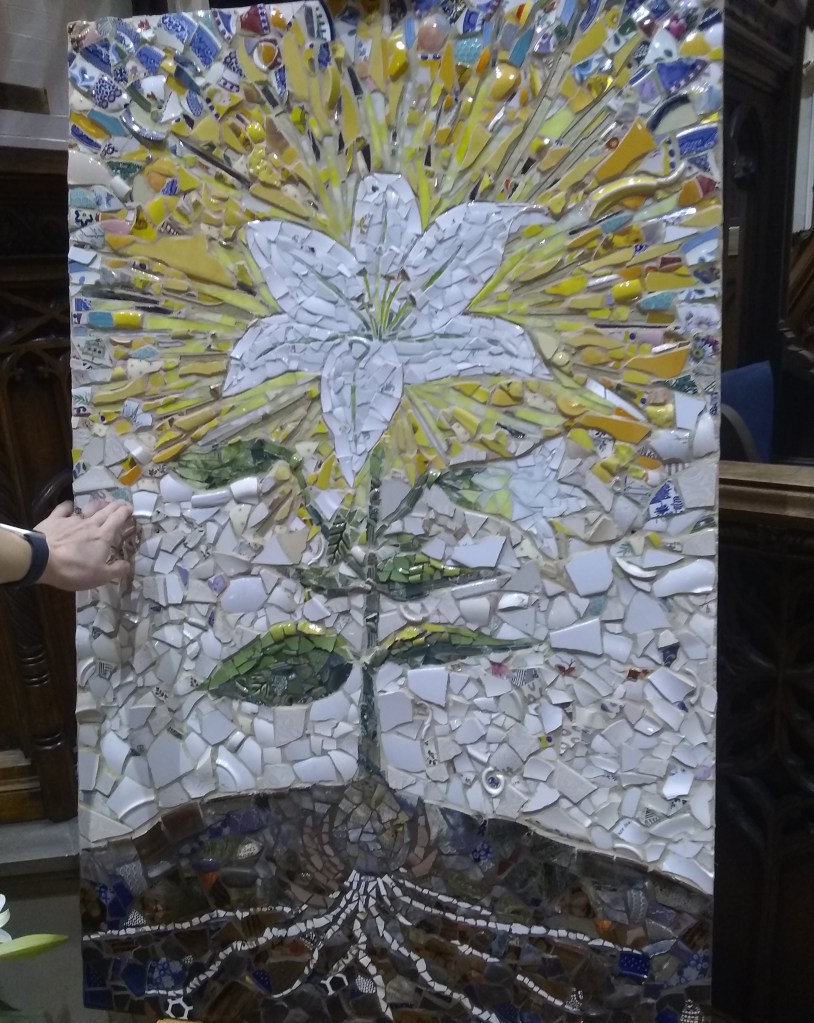
Finding a piece of my cup, among those shattered to create this gorgeous Easter mosaic.

When we lived in Brazil, a pastor’s wife courageously wrote a book called “No Place to Cry,” which directly related to our vision in mission: to care for pastors and their families. In Brazil (and perhaps this is true in other places too), pastors were put on pedestals, a lonely place to live. Pastors and their spouses were expected to care for everyone else, 24/7. They were not supposed to have needs of their own. As my husband often said, “Pastors have a hundred or more ‘kids’ [the members of their congregations]. Their own families are sacrificed on the altar of the church.”

Dave developed mutual support groups for pastors and their spouses, where they could ask each other questions like the ones Jesus asked Mary in the garden after his resurrection. The “safest” groups were interdenominational, because there was little fear what they shared would be gossiped among their peers or superiors or congregations. This had the surprising benefit of breaking down barriers between denominations, as pastors became friends based not on a particular doctrinal emphasis or history, but because of their common experience and needs. Dave’s teachings, summarized in his book “The Leader Who Shines,” helped them accept and practice concepts like boundaries, acknowledging and dealing with their own fears and traumas and complex histories, and developing ministry teams in their churches, rather than trying to do everything themselves. In small, committed groups, they could deeply hear and care for each other. They found a place where they could cry.

John records a series of very personal encounters between Jesus and individual followers after the resurrection. Mary. Thomas. Peter. We can add the two disciples on the road to Emmaus, a story recorded by Luke. This blesses me so much. Even while Jesus sacrificed his life for the world, in the short space of time he spent on earth before his ascension to heaven, he deeply loved and cared for specific people he loved, aware of their unique needs. And within the safety developed over time within the circle of disciples, they could hear and care for each other after he was gone.

Jesus asked Mary, “Who are you looking for?” Obviously, she was looking for him. And that’s true for us, too: the first person we should seek each morning is our Lord. Anchored in relationship with him, whatever happens in our days will be different than if we head into them alone. It occurs to me that in second place, the person we are looking for is our own selves. In the rush of life, we need space to recognize what’s taking place in our own souls. Even a few minutes of quiet with the Lord can help us do this.

Why are you and I crying today, whether we shed tears or stuff it down? Responding to this question is a great way to get in touch with ourselves. Then we can practice Philippians 4:6-7 and experience God’s peace.

Afraid to ask?

But Jesus will turn sadness into joy Lenten question #17 April 17

John 16:16-22 [Jesus said] “In a little while you won’t see me anymore. But a little while after that, you will see me again.” The disciples asked each other, “What does he mean? … We don’t understand.” Jesus realized they wanted to ask him about it, so he said, “Are you asking yourselves what I meant? … I tell you the truth, you will weep and mourn over what is going to happen to me, but the world will rejoice. You will grieve, but your grief will suddenly turn to wonderful joy. … I will see you again; then you will rejoice, and no one can rob you of that joy.”

Our Lenten roses, in full bloom

This will be the last twenty questions post until after Easter, since Jesus asked the last three questions after his resurrection. As Jesus forewarned his disciples about the grief they would feel at his crucifixion, he also told them that horrific event would not be the end of the story.

Soon they would experience their world falling apart. Despite all of Jesus’ warnings along the way, the disciples reacted to Jesus’s arrest, judgment, and death as any of us do to threat and trauma: by “freeze” (their paralysis in the Garden of Gethsemane), by trying to fight (Peter), and by flight (most of them). In his fear, Peter denied knowing Jesus. All of them felt a combination of guilt and despair. Judas killed himself. Others went back to what was safe and familiar (fishing). Thomas lacked the courage to believe the good news when it came. Like Peter and John, he had to see it for himself.

The women, though—including Jesus’s mother—stuck by him. Along with John, they pushed through the mocking crowd close enough to the cross to converse with Jesus as he hung in agony. They witnessed his death.

Did the women remember and believe what he had said, that they would see him again, in great joy? We’re not told. But, like Mary of Bethany (Mark 14:8), they did what they could; they embraced the positive action that was available to them. Still wanting to serve and care for Jesus, they went to his tomb on Sunday, as soon as they could after observing the Sabbath.

Imagine the thrill of the angel, the stone rolled back, the empty tomb, their next task (“Go and tell his disciples”)—and then Jesus, alive! meeting Mary Magdalene in the garden.

Let’s allow ourselves to take part in the narrative, to feel what they felt on that Passover weekend, as the Lamb of God was sacrificed so that his shed blood would protect us from death. With the women and John, let’s find the courage to stand by Jesus at the cross.

 And let’s remember it’s OK to ask our questions. Whatever hard place you are in right now, draw near and share your grief and doubts and fears and confusion with the Lord. He understands and welcomes us. We may not be capable of understanding, yet.

But today is not the end of the story.

He makes all things new

But Jesus IS life Lenten question #13

John 11:23-25 Jesus told Martha, “Your brother [Lazarus] will rise again.” “Yes,” Martha said, “he will rise when everyone else rises, at the last day.” Jesus told her, “I am the resurrection and the life. Anyone who believes in me will live, even after dying. Everyone who lives in me and believes in me will never ever die. Do you believe this, Martha?

1 Thessalonians 4:13-14 And now, dear brothers and sisters, we want you to know what will happen to the believers who have died so you will not grieve like people who have no hope. For since we believe that Jesus died and was raised to life again, we also believe that when Jesus returns, God will bring back with him the believers who have died.

Yesterday my husband and I flew from Colorado back home to Pittsburgh, watching the transformation of desert into well-watered spring. I found myself thinking about a similar flight soon after our daughter Karis’s death, gripped by pain sharper than any other I have experienced. Would this grief ever soften into some version of beauty less stark?

I don’t know even how to describe it. A transplant friend, whose son had died a few months earlier, texted me: “Just BREATHE.” For as long as I owned that phone, I looked back often at that text as loss stabbed me yet again.

Jesus, who wept with Mary and Martha at Lazarus’s grave even though he knew he would shortly bring Lazarus back to life, understands that pain. He offers himself, his presence with us, as we grieve.

As intense as this grieving has been, I’ve often wondered, with deep compassion, what it would have felt like if I didn’t have the hope of life after death. I’ve watched people without that hope enter profound despair. What if I didn’t know that Karis’s SELF did not die, but is whole and well? What if I didn’t know I will see her again, healed, released from her suffering, exuberantly alive? Would I have survived the grief? I don’t know.

I love imagining what people who have gone before us are like now, freed from all that hampered and troubled them on earth and face to face with Jesus, who IS life. Death could not keep him in its grip (Acts 2:24 NLT). Because he broke death’s power, we too can know life after death—the truly abundant life for which God created us.

As I hear Jesus asking me today the question he asked Martha, I can say with profound thankfulness, “Yes. I do believe his resurrection makes possible eternal life for us.” Lazarus did eventually die again, yet I know he now celebrates along with his beloved sisters the unlimited joy of forever resurrection.

A friend whose father recently died shared with me this beautiful anthem, All Things New, by Elaine Hagenberg, sung at the funeral. The text is adapted from a 19th c. poem by Frances Havergal. So appropriate as we walk into next week:

Light after darkness, gain after loss

Strength after weakness, crown after cross.

Sweet after bitter, hope after fears

Home after wandering, praise after tears.

Alpha and Omega, beginning and the end

He is making all things new.

Springs of living water shall wash away each tear.

He is making all things new.

Sight after mystery, sun after rain

Joy after sorrow, peace after pain

Near after distant, gleam after gloom

Love after loneliness, life after tomb. (Refrain)

An anchor for our souls

New birth into a living hope

1 Peter 1:23 (Titus 3:5) Praise be to the God and Father of our Lord Jesus Christ! In his great mercy he has given us new birth into a living hope through the resurrection of Jesus Christ from the dead.

Romans 6:18-19 It is impossible for God to lie. Therefore, we who have fled to him for refuge can have great confidence as we hold to the hope that lies before us. This hope is a strong and trustworthy anchor for our souls.

So, I’m curious: Have you tried the “new song” idea from my last blog—applying praise to whatever is going on in your life today? I would love to know! I sang a “new song” as I found reasons to praise God as our family absorbs the reality and implications of our six-year-old grandson’s Celiac Disease diagnosis.

I’m quite excited about this understanding of “new song,” in part because it takes me back to a vow I made to the Lord while Karis and I were jetting to Pittsburgh from South Bend in the middle of the night in response to the first intestinal transplant call she was ready to consider.

I vowed to find something to praise God for every day of this upcoming adventure. I had no idea at the time how life- and hope-giving that practice would be. Keeping that vow forced me back to the Lord time after time when otherwise I could have floundered in the excruciating disappointments and reversals we experienced. Hope became for me–for us–a lifeline, an anchor, a safety rail, a source of strength for not giving up as Karis faced death day after day after day. I am deeply grateful to the Holy Spirit for prompting me to make that vow.

There are so many wonderful references to hope in the New Testament that I had trouble choosing, even from the book of Hebrews. The Greek words translated as hope are elpis (noun) and elpizo (verb), from the root elpo. They mean to anticipate (usually with pleasure), to trust, and to expect with confidence (and the corresponding nouns).

Peter emphasizes the fact that our hope is rooted in the resurrection of Jesus, whose victory over his own death extends to us in ours. That’s why we don’t grieve when a loved one dies or in thinking about our own mortality with the same despair as those without the hope of new life after death (1 Thessalonians 4:13).

In thinking about this, I remember Karis’s brilliant smile after she wrote in big scrawly letters with her left hand, “I love ____” each one of us. At the end she wrote, “Call the doctor. I can’t breathe,” just as a team burst into her ICU room to induce her last coma to give time for the antiviral to work (it didn’t, but this gave our family time to gather and to prepare ourselves as well as we could for her death). I believe Karis knew she was going Home, which we learned later through her journals she had been pleading with God to allow her to do.

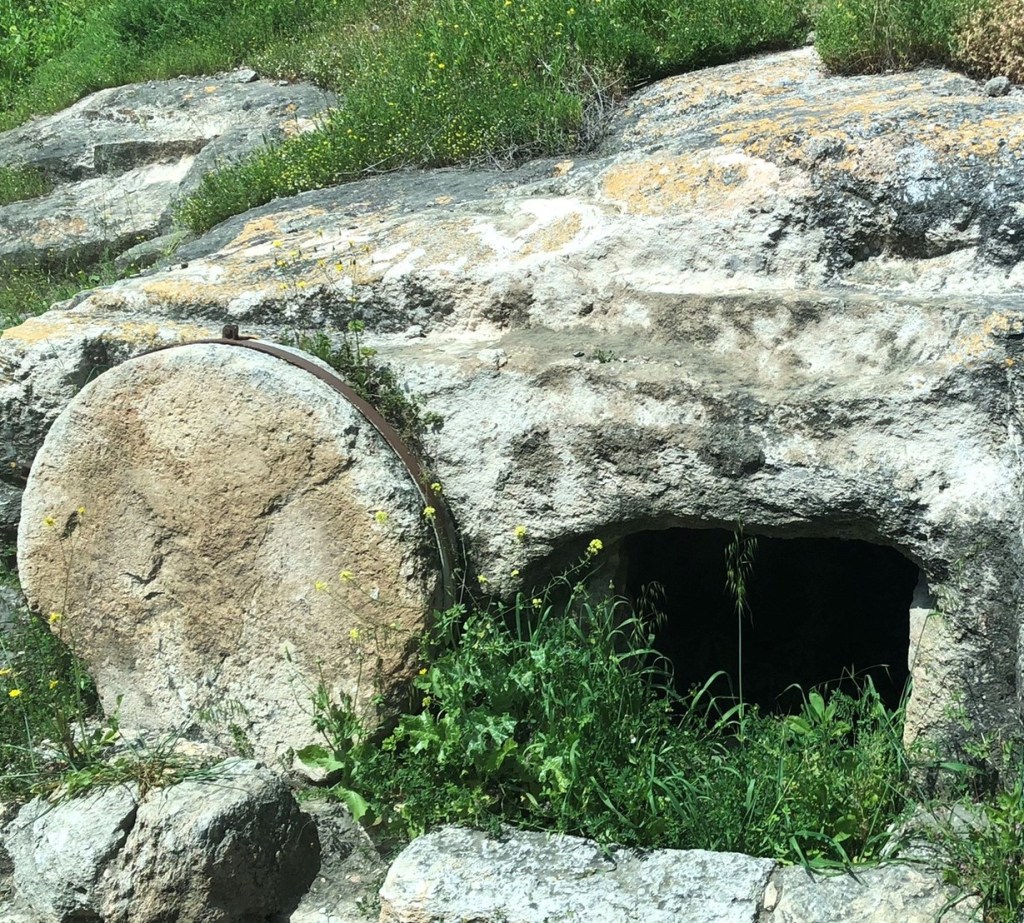
This isn’t Jesus’s tomb, but it is a preserved tomb and round stone from the first century, like his might have been. Thanks to Marilyn Chislaghi for permission to use her photo taken in Israel.

Living hope: an empty tomb. A brilliant smile. An anchor for our souls through terrible times.

The Anchor Holds, by Ray Boltz

He is risen indeed!

Psalm 103:22 Let all that I am praise the Lord.

Litany of Penitence concluding prayer:

Show favor to your people, O Lord, who turn to you in weeping, fasting, and prayer.

For you are a merciful God, full of compassion, long-suffering, and abounding in steadfast love.

You spare when we deserve punishment,

And in your wrath, you remember mercy.

Spare your people, good Lord, spare us;

In the multitude of your mercies, look upon us and forgive us,

Through the merits and mediation of your blessed Son Jesus Christ our Lord, Amen.

Sorry I didn’t post this on Saturday! It’s wonderful to be on the “other side” of Lent now, celebrating Jesus’s resurrection. May his life-giving Spirit continue to flow through our lives as we live into Easter.

Jesus Paid It All, by Elvina M. Hall, 1865, sung by Newsboys

Not sure which of the two cuties below decorated my pillow yesterday.

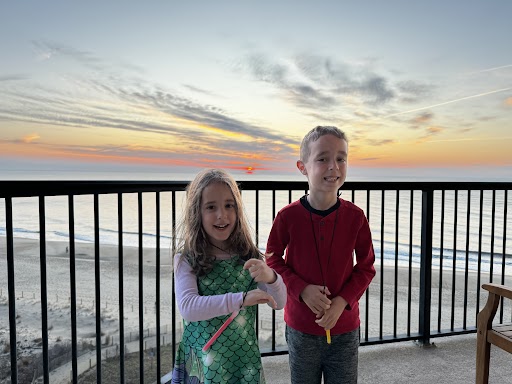
Our other two cherubs enjoyed Easter with their family at the beach. Up in time for sunrise!

The grave could not keep him!

But Jesus rose from the dead

Matthew 28:5-6 Then the angel spoke to the women. “Don’t be afraid!” he said. “I know you are looking for Jesus, who was crucified. He isn’t here! He is risen from the dead, just as he said would happen.”

Hebrews 1:4 The Son radiates God’s own glory and expresses the very character of God, and he sustains everything by the mighty power of his command. When he had cleansed us from our sins, he sat down in the place of honor at the right hand of the majestic God in heaven.

It’s time to celebrate LIFE!!!

It’s time to celebrate!!

But in fact Christ has been raised from the dead!

1 Corinthians 15:17-20 If Christ has not been raised, then your faith is useless and you are still guilty of your sins. And if our hope in Christ is only for this life, we are more to be pitied than anyone in the world. But in fact, Christ has been raised from the dead! He is the first of a great harvest of all who have died.

On this last day of Easter season (Pentecost is tomorrow), we come to “the” chapter about the resurrection of Jesus, 58 verses of some of Paul’s most enthusiastic defense of our faith.

Valerie quoted from verses 42-57 in her blog post Feb. 5, 2014, the day Karis died. So of course that’s the first thing that comes to my mind as I re-read this chapter. The foundation of our confidence in the transformation of Karis’s weak, broken body into a body that will never die is Jesus’ own triumph over death, and his promises that we too will be raised to unending Life—our experience here just a shadow of the real thing. It’s why we can smile as we think of Karis now, in the joy of her victory over death, made possible by Jesus’ resurrection. It’s the joy at the center of the universe, the “deeper magic,” as C.S. Lewis described it.

Paul illustrates the transformation of our bodies with the analogy of what grows from a seed that is buried

But today what is on my mind is the hope we have for the many friends dying from Covid in Latin America and Brazil, more every day. Since our work is with pastors, those are the ones we primarily hear about from the safety of Pittsburgh. Hundreds of pastors across South America, caring for their people without PPE, without vaccines, and without adequate medical care, literally laying down their lives for their sheep (John 10:11).

I want to honor them today, even as we pray for their families and congregations and friends, left behind for now. They did not love their lives so much that they were afraid to die (Revelation 12:11).

Because of our confidence in the resurrection, Paul says to us, Be strong and immovable. Always work enthusiastically for the Lord, for you know that nothing you do for the Lord is ever useless (verse 58). And borrowing from chapter 16, verse 13: Be on guard. Stand firm in the faith. Be courageous. Be strong. And do everything with love.