How long?

But God’s Spirit is more effective than force or strength December 3, 2025

Zechariah 4:6, 7:12 It is not by force nor by strength, but by my Spirit, says the Lord of Heaven’s Armies. … They made their hearts as hard as stone, so they could not hear the instructions or the messages that the Lord of Heaven’s Armies had sent them by his Spirit through the earlier prophets. That is why the Lord of Heaven’s Armies was so angry with them.

Zechariah 9:9, 16; 14:1, 8-9 Look, your king is coming to you. He is righteous and victorious, yet he is humble, riding on a donkey … On that day the Lord will rescue his people, just as a shepherd rescues his sheep. … Watch, for the day of the Lord is coming. … On that day life-giving waters will flow out from Jerusalem … and the Lord will be king over all the earth. On that day there will be one Lord—his name alone will be worshiped.

Image by Carol Amidi

As we enter Advent, the prophet Zechariah offers our last insight into the Holy Spirit at work in the Old Testament. Through God’s Spirit, Zechariah envisioned Advent themes: the sanctification of God’s people ushering in a new age of holiness, and a great shepherd, Messiah, coming to reign over a new kingdom of perfect harmony. Watch, for the day of the Lord is coming, when all earth will be rescued from evil, renewed, rejuvenated, restored.

Zechariah assisted his fellow prophet Haggai, encouraging the people living in Palestine after the Exile to finish rebuilding the Temple and reinstitute worship there under a revitalized priesthood. Centuries later, after the Messiah did come into Jerusalem riding on a donkey, Paul would explain to believers in Messiah’s redemptive work that they themselves, their own bodies, were now the Temple of God, through the Holy Spirit living within them. We, too, need rebuilding from the impact of evil in our time, our worship reinvigorated.

We, too, seek the Lord’s transformation, both personally and collectively, as we also await the Messiah’s coming for the “last battle” as CS Lewis called it. This time, he will usher in the Kingdom, uniting heaven and earth.

We, too, watch and wait for the coming of the Lord, our Shepherd and King.

Zechariah’s words resonate today. We, too, must turn from our evil ways and practices:

Don’t be afraid. But this is what you must do:

Tell the truth to each other.

Render verdicts in your courts that are just and that lead to peace.

Don’t scheme against each other.

Stop your love of telling lies that you swear are the truth.

              I hate all these things, says the Lord. … So love truth and peace.

(Zechariah 1:4; 8:15-17, 19)

How, though? How can we change these things that are so embedded in our culture, in our own hearts? Not by force, nor by strength, but by God’s Spirit, Zechariah tells us. This Advent let’s open our hearts to God’s Spirit so he can do beautiful, regenerative work within and among us.

“How Long” by Ann VosKamp, Leslie Jordan, and Trillia Newbell, sung by St. Andrew’s Lutheran
Grief

A personal note:

The last couple of months have been intense, and I’ve gotten behind on a long series of responsibilities and projects. Until I catch up–especially with a book I need to complete–I’ll be posting here only once a week, aiming for Wednesdays.

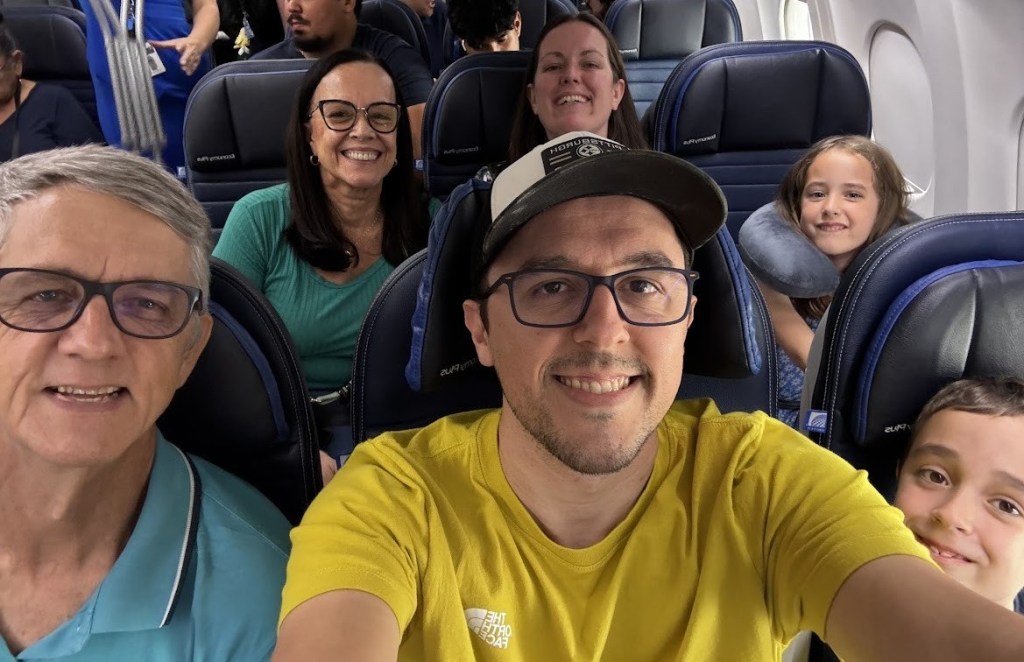
One part of the challenge was the decision our daughter Valerie and her husband Cesar made to move back to Brazil–with just six weeks before Val would have to start work there. They accomplished a major move, including participation in our Elliott family reunion and a trip to New York to secure documents they needed, in that short time. Truly amazing! We will miss them. And we rejoice with them, for all the goodness they will experience “back home.”

Here they are on the airplane; destination: a new chapter of life in São Paulo.

They did it!! Girls and guys: Back row Luciene (Cesar’s mom), Valerie, Talita. Front row Cesar Sr., Cesar Jr., Caleb. Lu and Cesar Sr., who came to visit before the Brazil decision was made, worked incredibly hard to make this move possible, including preparing the house for sale. Anyone looking for a cute house to purchase in Pittsburgh?

I asked you to pray for my sister. Thank you. She’s doing better, for which we are so grateful. And she has a long road ahead.

It’s helpful to me right now to know that the Holy Spirit understands grief. This blog considers a particular kind of grief, not the separation of loved ones moving to another continent, but the rupture caused by our sin, when we harm ourselves and others.

But the Holy Spirit grieves

Psalm 51:10-12 Create in me a clean heart, O God. Renew a loyal spirit within me. Do not banish me from your presence, and don’t take your Holy Spirit from me. Restore to me the joy of your salvation and make me willing to obey you.

Ephesians 4:30 Do not bring sorrow to [grieve, offend, vex, sadden] the Holy Spirit by the way you live. Remember, he has identified [put his seal on] you as his own, guaranteeing that you will be saved on the day of redemption.

1 Thessalonians 5:19 Do not stifle [quench, suppress, smother, hold back, try to stop] the Holy Spirit.

Grief. It touches each of us sooner or later, to a greater or lesser degree.

Grief even touches the Holy Spirit. Why? Because he expects us to obey a random set of arbitrary rules or face capricious anger and punishment from God?

No. God deeply loves each of us. What hurts him is our unnecessary suffering because we do what is not lifegiving and harm ourselves and others, whom he loves just as profoundly.

In Psalm 51 King David records his anguished cry of repentance after the prophet Nathan confronted him with seducing Bathsheba and murdering her husband. David rightly fears that God will take the Holy Spirit from him as he did with David’s predecessor, King Saul (1 Samuel 16:14). God’s Spirit is holy; he cannot associate himself with rebellion and evil. And in the Old Testament, pre-Pentecost, the Spirit was given to particular people in select circumstances. Not, as Paul stated to the Ephesians, to all believers as a guarantee of our salvation.

God’s Spirit is all about life, health, growth, creativity, blessing, fruitfulness, beauty. When we choose to harm ourselves or others, we limit his power and effectiveness in our lives. And we grieve him.

The way back to joy is exactly what David did: admit and confess our wrongdoing; no excuses. There still will be consequences. Saying “I’m sorry; I was wrong” does not bring a murdered person back to life or make adultery OK. David and Bathsheba’s firstborn died.

But the relationship with God can be repaired, and often (not always) ruptures with other people can heal.

Restoration begins with humility and honesty. Repentance opens the door once more to the Holy Spirit’s wonderful work in our lives.

The sacrifice you desire is a broken spirit. You will not reject a broken and repentant heart, O God (Psalm 51:17).

And the Holy Spirit helps us in our weakness. … The Holy Spirit prays for us with groanings which cannot be expressed in words (Romans 8:26).

He decides

But God isn’t slow

2 Peter 3:8-9, 13 A day is like a thousand years to the Lord, and a thousand years is like a day. The Lord isn’t really being slow about his promise, as some people think. No, he is being patient for your sake. He does not want anyone to be destroyed but wants everyone to repent … what holy and godly lives you should live, looking forward to the day of God and hurrying it along. … We are looking forward to the new heavens and new earth he has promised, a world filled with God’s righteousness.

Chapter 1 of 2 Peter gives us a pattern of godly living. Chapter 2 warns us not to follow false teachers, showing us the antithesis of godly living. Chapter 3 reminds us Jesus will return and set the world right.

It’s the hope Christians have held on to for two thousand years.

Imagine: already when Peter wrote this, just a few years after Jesus returned to Heaven, believers—including people who personally knew Jesus—already felt like it was taking a long time for him to come back. And here we are, almost two thousand years later, still yearning for the day we will meet our beloved Lord face to face.

But what catches my attention as I read chapter 3 is the word “repent” in verse 9, because it reminds me of Peter’s repentance and restoration after he denied Jesus. Hours before he had brashly said, “I’m ready to die for you” (John 13: 37). Jesus answered, “Die for me? I tell you the truth, Peter—before the rooster crows tomorrow morning, you will deny three times that you even knew me.”

Ouch.

No wonder Peter escaped into fishing. And then Jesus performed a miracle that mirrored one of Peter’s early encounters with him, with one critical difference. Compare Luke 5:5-7 with John 21:11: The first time, the nets were so full they began to tear. In writing about the second time, John makes a point of detailing that there were 153 large fish, and yet the net did not tear.

The first time Jesus performed this miracle, Peter wasn’t ready for his role as a fisher of men. Here’s The Chosen’s dramatization of this event. https://www.youtube.com/watch?v=hWGCkovAUWM

The second time, Jesus took Peter through an intriguing process of repentance and restoration, entrusting his “lambs” to Peter’s care, and gave him a new identity: a shepherd.

A friend in Brazil sent us a moving song about Peter. You’ll capture its soul by listening even if you don’t understand Portuguese. Jesus tells Peter, “I know you own your boat. But I own the sea.” And Jesus reminds Peter how to live his life: “Your knowledge will only matter if you know how to love.”

I’ve seen 2 Peter 3:9 and 15 applied to evangelism, the role of the fisherman. I think there’s more to it than that. I think they applies to each of us in the areas we each need to repent and be made whole, as we are cared for by our Shepherd. Like Peter himself.

Through the centuries, people have made predictions about Jesus’ return and have exhorted believers to prepare for that Day, sailing their boats as well as they knew how. Let’s remember: The Lord owns the sea. He decides.

And meanwhile, our instructions are clear. Make every effort to be found living peaceful lives that are pure and blameless in God’s sight. … Grow in the grace and knowledge of our Lord Jesus Christ.

The Lord whom Peter came to know very, very personally.