Paul’s songs: His mercy is more

But God had patience

Romans 4:7-8 [quoting Psalm 32:1-2] “Oh, what joy for those whose disobedience is forgiven, whose sins are put out of sight. Yes, what joy for those whose record the Lord has cleared of sin.”

1 Timothy 1:15-16 Christ Jesus came into the world to save sinners—and I am the worst of them all. But God had mercy on me so that Christ Jesus could use me as a prime example of his great patience with even the worst sinners.

By God’s mercy, joy can become the other side of profound distress.I believe this in my head. In many ways I believe it in my heart as well. But it seems God is calling me today to a deeper experience of this joy.
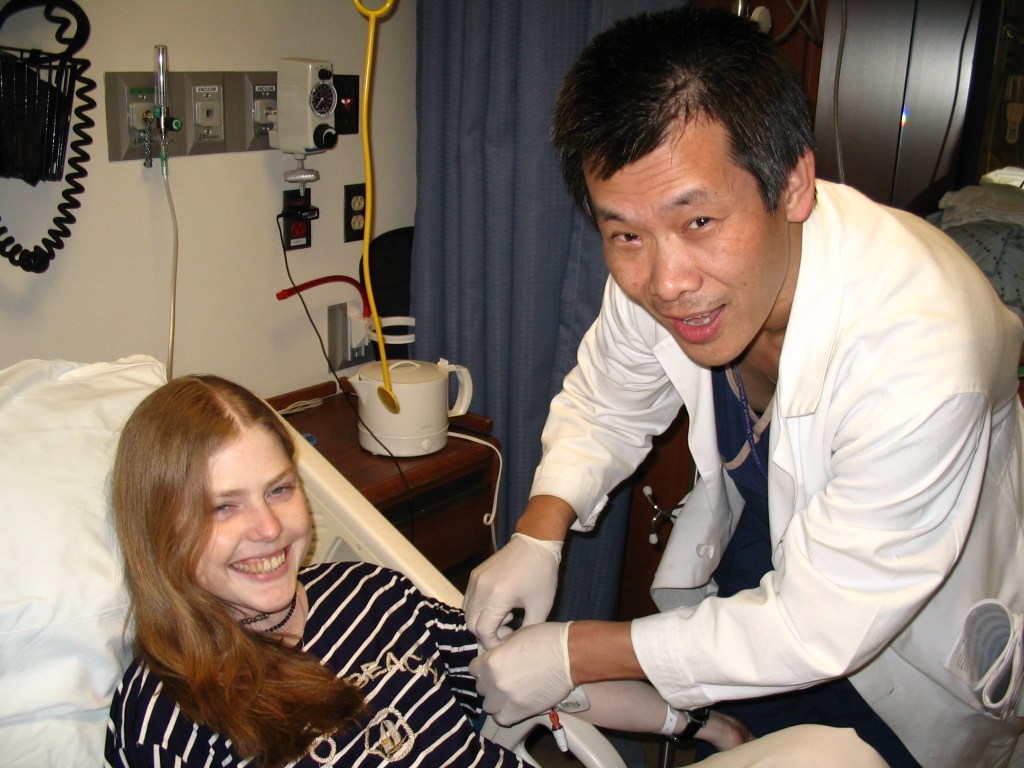
Karis in 2009 with one of her doctors

Spring, 2009. Overwhelmed. Beyond fatigued. No longer tolerating the unrelenting stress. Teetering on the edge of emotional breakdown.

These words inadequately describe my condition when I made an impulsive decision to get out of Dodge. Or in my case, out of Pittsburgh.

Every other time I left Karis in Pittsburgh, I planned and prepared for weeks. The person (most often my generous sister Jan) who relieved me arrived a week ahead of time to get up to speed with the complexities of Karis care. Complexities that one home health agency after another declared too much for their nurses.

This time, no one could come. Desperate for relief, I patched together a care team of five people who reluctantly agreed to cover a day or two each. I “trained” them for a couple of hours, pointing out pages of written instructions they absolutely must follow. Ignoring my conscience, I got on a plane to Brazil. My home. A place to crash, to be accountable to no one. Precious friends who breathed life and energy back into my parched soul.

The first message came from the hospital. “The paramedics were able to stabilize Karis, but we will keep her here until you return.”

Adrenaline flooded me as I began throwing things back into my suitcase.

The next message was just as cryptic. A telegram from the kind friends who had given us space in their home when we could not afford an apartment: “Come back. Now.”

I went there first. The shouting began when I opened the door to the house. It included phrases like, “If she had died under my roof, I WOULD NEVER FORGIVE YOU! NEVER!” and “You are no longer welcome here.”

A bit at a time, the story emerged. One of the caregivers had given Karis ten times the correct dose of insulin. When the ambulance arrived, her blood sugar was 23.

God was merciful. Karis didn’t die. But this was only one of at least a dozen ways Karis could have died, from mistakes of well-meaning but inadequately prepared and resourced friends.

What on earth had I been thinking? How could I have done what I did, exposing my daughter to such danger—and my friends as well, when Karis’s care at home was deemed too difficult even for trained nurses?

The truth, of course, is that I wasn’t thinking about anything but my own survival. Eventually, with help, I was able to accept God’s forgiveness. My friend’s forgiveness—my friend who had sacrificially opened her home to us—and healing of our broken relationship took quite a bit longer.

This morning, out of the blue, I woke up to the startling question, Have I forgiven myself? Where did that come from? I must have been dreaming about this incident in 2009.

The tears that flooded my eyes bore mute testimony to the challenge in this question.

Yes, God was merciful. Karis did not die from my negligence. Profound mercy.

But finding mercy for myself? That’s … different. I don’t yet know how to get there.

And as I read again Paul declaring himself “the worst of sinners,” I wonder. Was he able to forgive himself?

Four other times in 2009 Karis almost died—not from negligence, but because of the extremity of her medical situation. Each of those times our family gathered from three continents to say goodbye. Each time, we experienced mercy as, beyond hope, God brought Karis back to us.

Today, perhaps, God in mercy invites me to a new level of healing. And of joy.

His Mercy is More Matt Boswell and Matt Papa

He makes all things new

But Jesus IS life Lenten question #13

John 11:23-25 Jesus told Martha, “Your brother [Lazarus] will rise again.” “Yes,” Martha said, “he will rise when everyone else rises, at the last day.” Jesus told her, “I am the resurrection and the life. Anyone who believes in me will live, even after dying. Everyone who lives in me and believes in me will never ever die. Do you believe this, Martha?

1 Thessalonians 4:13-14 And now, dear brothers and sisters, we want you to know what will happen to the believers who have died so you will not grieve like people who have no hope. For since we believe that Jesus died and was raised to life again, we also believe that when Jesus returns, God will bring back with him the believers who have died.

Yesterday my husband and I flew from Colorado back home to Pittsburgh, watching the transformation of desert into well-watered spring. I found myself thinking about a similar flight soon after our daughter Karis’s death, gripped by pain sharper than any other I have experienced. Would this grief ever soften into some version of beauty less stark?

I don’t know even how to describe it. A transplant friend, whose son had died a few months earlier, texted me: “Just BREATHE.” For as long as I owned that phone, I looked back often at that text as loss stabbed me yet again.

Jesus, who wept with Mary and Martha at Lazarus’s grave even though he knew he would shortly bring Lazarus back to life, understands that pain. He offers himself, his presence with us, as we grieve.

As intense as this grieving has been, I’ve often wondered, with deep compassion, what it would have felt like if I didn’t have the hope of life after death. I’ve watched people without that hope enter profound despair. What if I didn’t know that Karis’s SELF did not die, but is whole and well? What if I didn’t know I will see her again, healed, released from her suffering, exuberantly alive? Would I have survived the grief? I don’t know.

I love imagining what people who have gone before us are like now, freed from all that hampered and troubled them on earth and face to face with Jesus, who IS life. Death could not keep him in its grip (Acts 2:24 NLT). Because he broke death’s power, we too can know life after death—the truly abundant life for which God created us.

As I hear Jesus asking me today the question he asked Martha, I can say with profound thankfulness, “Yes. I do believe his resurrection makes possible eternal life for us.” Lazarus did eventually die again, yet I know he now celebrates along with his beloved sisters the unlimited joy of forever resurrection.

A friend whose father recently died shared with me this beautiful anthem, All Things New, by Elaine Hagenberg, sung at the funeral. The text is adapted from a 19th c. poem by Frances Havergal. So appropriate as we walk into next week:

Light after darkness, gain after loss

Strength after weakness, crown after cross.

Sweet after bitter, hope after fears

Home after wandering, praise after tears.

Alpha and Omega, beginning and the end

He is making all things new.

Springs of living water shall wash away each tear.

He is making all things new.

Sight after mystery, sun after rain

Joy after sorrow, peace after pain

Near after distant, gleam after gloom

Love after loneliness, life after tomb. (Refrain)

You will find rest

But God always keeps his promises

Psalm 145:2, 4, 13-14 I will praise you every day. … Let each generation tell its children of your mighty acts; let them proclaim your power. I will meditate on your majestic, glorious splendor and your wonderful miracles … I will share the story of your wonderful goodness. … The Lord always keeps his promises; he is gracious in all he does. The Lord helps the fallen and lifts those bent beneath their loads.

It helps. It really does.

When Karis and I came to Pittsburgh in March 2004 for the terrifying prospect of intestinal transplant, not knowing anyone, feeling completely alone and vulnerable, leaving a fruitful and creative life behind, I made a decision. I would find something to thank God for every day. No matter what happened, I would look for what God was doing. “I will praise you every day.” It wasn’t easy, because terrifically painful things occurred, and sometimes the battle for Karis’s life seemed endless.

But I learned a way of seeing, in, through, and beyond the circumstances of a given day or hour. That practice continues to shape me. When troubling and difficult things happen, I know that’s not the whole story. God is keeping his promises today, even with the hard thing I face now. Whatever it is at a given time.

God is gracious in all he does. He helps the fallen and lifts those bent beneath their loads.

What weight are you carrying today? Allow the Lord to bear it with you. Ask a friend to help you do this. Maybe you’ve picked up more than is meant for you. Maybe you’ve let others overload you. Perhaps saying “no” can be a good thing, for you and for others. I need this kind of help a lot.

Shutterstock: Sergey Nivens

What is tripping you up? Stretch out your hand to his strong and loving and faithful one. Let him help you get back on your feet. Perhaps the physical hand grasping yours belongs to one of his people. We are all called to be the Lord’s Body in the world, helping each other as Jesus would if he still lived physically among us.

Has someone you trusted betrayed you? Have you betrayed a promise to someone you love? Lean into God’s faithfulness. The promise-keeper can help you repair and heal your heart and give you strength to live faithfully.

“Come to me, all of you who are weary and carry heavy burdens, and I will give you rest. Take my yoke upon you. Let me teach you, because I am humble and gentle at heart, and you will find rest for your souls. For my yoke is easy to bear, and the burden I give you is light” Matthew 11:28-30).