
But God creates in us the desire to please him
Hebrews 13:21 I fervently ask God to create in you the desire to please Him by doing all kinds of good, accomplishing through your daily activities the things which only Jesus, God’s Appointed One, can equip you for. Such things are especially pleasant in His eyes, for the glory He receives through them endures through all eternity. May it be so in you! (“Consider How the Son Shines!” translation of Hebrews by Ray Elliott)
Last Sunday, October 20th, would have been my dad’s 100th birthday. Thinking about him, I wrote, with contributions from my siblings, a brief synopsis of his adventurous and remarkable life.
Raymond Leroy Elliott, October 20, 1924-November 12, 2008
Birth through age 10, 1924-1934: Born in Independence, Kansas, the second of four boys (Richard, Raymond, Roland, Roger), my father and his family experienced two bitter losses during his first decade of life. First was the death by accident of their baby sister. Second was the loss of their house, foreclosed by their bank for lack of $3.70 to pay their mortgage one month. This sounds unbelievable now. In those years of the Great Depression, the family never fully recovered from the loss of their home.
In his teens, 1934-1944: Dad was a quiet boy, deeply involved in pursuing several interests and hobbies. He couldn’t decide whether he wanted to become a printer or a professional musician or a photographer. In high school, he fell in love with my mom, two years younger. One of her earliest memories of Dad was seeing him stretched out on the floor of his living room eating a huge bowl of popcorn, so immersed in the book he was reading he was oblivious to the high-energy chaos generated by his three brothers and their friends. Dad was 17 when Japan attacked Pearl Harbor. The army refused his service because he had clear vision in only one eye. He decided the best way he could serve people would be as a pastor and began a course of study at Phillips University in Enid, Oklahoma. Mom followed him there after graduating early from high school.
In his 20s, 1944-54: Dad married Helen Ruth Belcher June 10, 1945; he was 20 and she was 18. They took on an interim pastor role for the summer in a small church in the Oklahoma panhandle. To their surprise, that summer they together came to understand the Gospel for the first time (an amazing story). They returned to Enid, OK, where Dad worked and Mom birthed her first baby, Linda, as they prayed for direction. During that year they learned about and moved to Wheaton, Illinois to attend Wheaton College. Both graduated, Dad completed an M.A. in theology, and gained another daughter, Marsha. He and Mom became interested in Bible translation, initially in China, and when those doors closed, in Guatemala.
Back in Independence, a son, Stephen, was born and Dad’s father died. Dad and Mom joined Wycliffe Bible Translators and completed linguistic training. After “jungle camp” in Mexico—training in living in rustic conditions—they moved to Nebaj, a Mayan Ixil village nestled in the Cuchumatanes mountains of Guatemala, where no other white foreigner lived at that time. I was born a year later, in the middle of a CIA-sponsored revolution against the government of Guatemala, two months before Dad turned 30.
In his 30s, 1954-64: Many stories have been told of how Dad and Mom overcame cultural barriers and fear, won acceptance by the Ixil people, and learned their language, which had never been written down. Dad creatively made a tiny two-bedroom home livable, devised an Ixil alphabet, began figuring out Ixil grammar and syntax, ventured into early translation efforts, and fathered two more daughters, Janice and Sharon. Mom offered emergency medical care in a village which had none. Dad transmitted his love of classical and marching band music and singing to his children through LP recordings. One by one, we children left home to study at a boarding school about four hours away on rough roads. Parents were allowed to visit once each semester and had their children at home only for summer vacation and Christmas.
On a furlough in 1961 in Independence, my younger brother, Daniel was born, and Linda moved to Colorado for high school. Back in Guatemala, our youngest sister, Karen, completed the family. Because Dad and his two sons were born in the same hospital in Independence, and all six daughters elsewhere, we joked that if only Mom and Dad had stayed in Independence, perhaps they would have had more sons and fewer daughters.
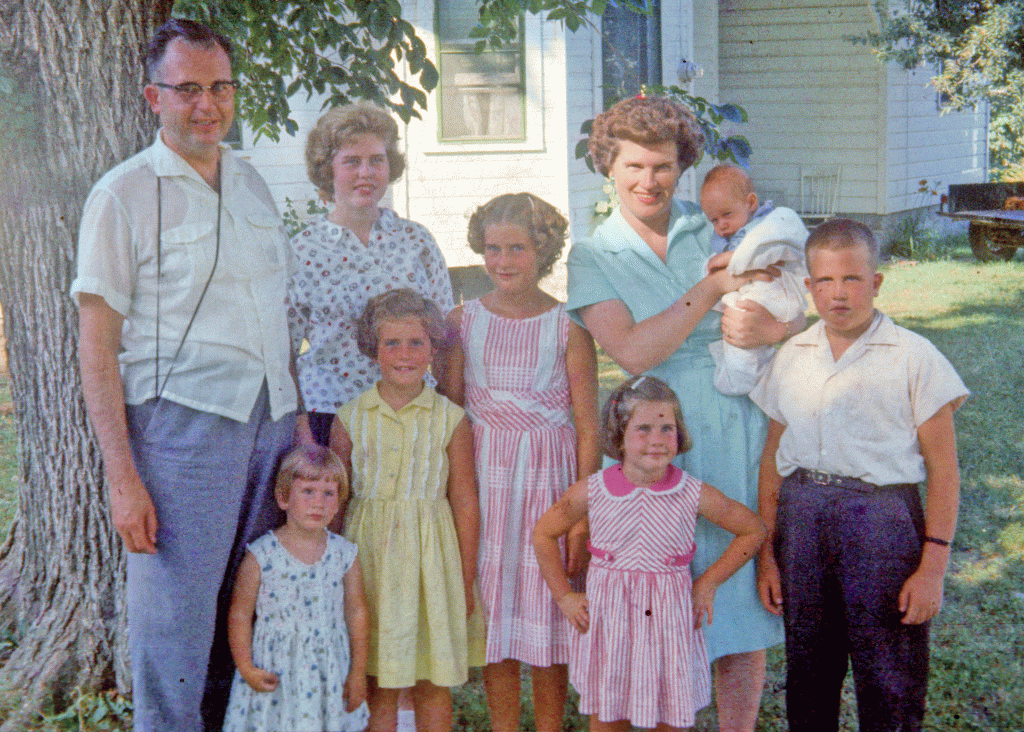
Dad with his family in Independence, KS 1961 (I’m in the yellow dress.)
Just missing Karen …
By God’s grace and with careful nursing, almost thirteen-year-old Marsha survived a severe case of nephritis, but her recovery was slow. Linda took a semester off from college to help the family through this time, since Karen was a toddler and Danny a preschooler. Dad moved the family to a house across the street from our boarding school for a few months so Marsha could continue studying and graduate from eighth grade with her class.
Guatemala, May 1965
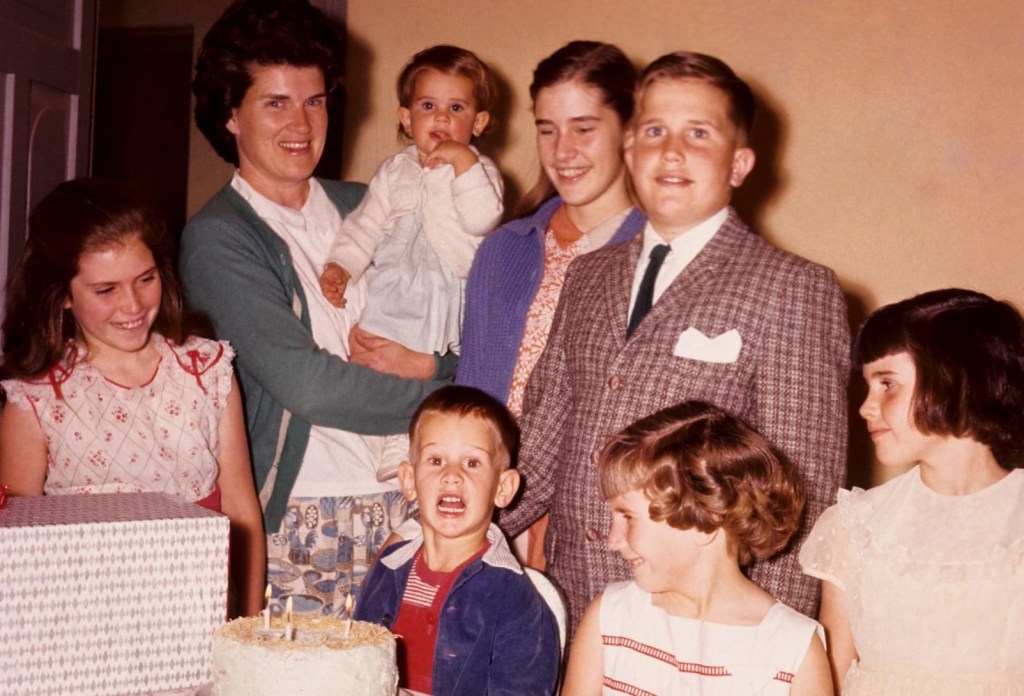
Danny’s 3 year old birthday: Karen 1; Linda in the US for high school. Dad taking the photo.
In his 40s-60s, 1964-94: Dad was asked to become the director of Wycliffe’s Guatemala branch, which required living in Guatemala City more than in Nebaj for a few years and hindered his own Ixil translation work. Dad cultivated his hobby of photography and designed his own needlepoint creations as a way to get through long meetings.
A second furlough, 1965-66, took us to Wheaton, so Dad could complete an M.A. in linguistics at the University of Chicago. Marsha and Steve stayed on in Wheaton for high school. One by one as we in turn graduated from boarding school in Guatemala, the rest of us transitioned to various cities in the U.S. Dad continued Ixil translation work while Mom focused on designing literacy materials and teaching people to read and then train others. Mom invested in building a school in another Ixil village, Salquil, which continues teaching children today. Some years, both of them taught in Wycliffe’s Summer Institute of Linguistics. A brutal civil war (1960-1996) deeply affected the Ixil region of Guatemala in the 1980s, forcing Mom and Dad to spend time in Guatemala City while contributing to relief efforts for the suffering Ixil people.
In his 70s-early 80s, 1994-2008: Dad had a very hard time acknowledging Mom’s early-onset Alzheimer’s. A family intervention when we were together in California for a grandson’s wedding in 1999 forced Dad to accept that he could not safely take Mom back to Guatemala. After some time living with Dan and his family in Wheaton, Dad and Mom moved to a retirement center, Go Ye Village, in Tahlequah, Oklahoma. Finding the silver lining, Dad said, “Helen laughs at my jokes no matter how many times I repeat them.” Dad cared for Mom until his neglect of a leg wound resulted in gangrene (Dad was diabetic). He did not lose his leg, but while he was in the hospital, Mom was moved into a memory care unit and did not live at home again.
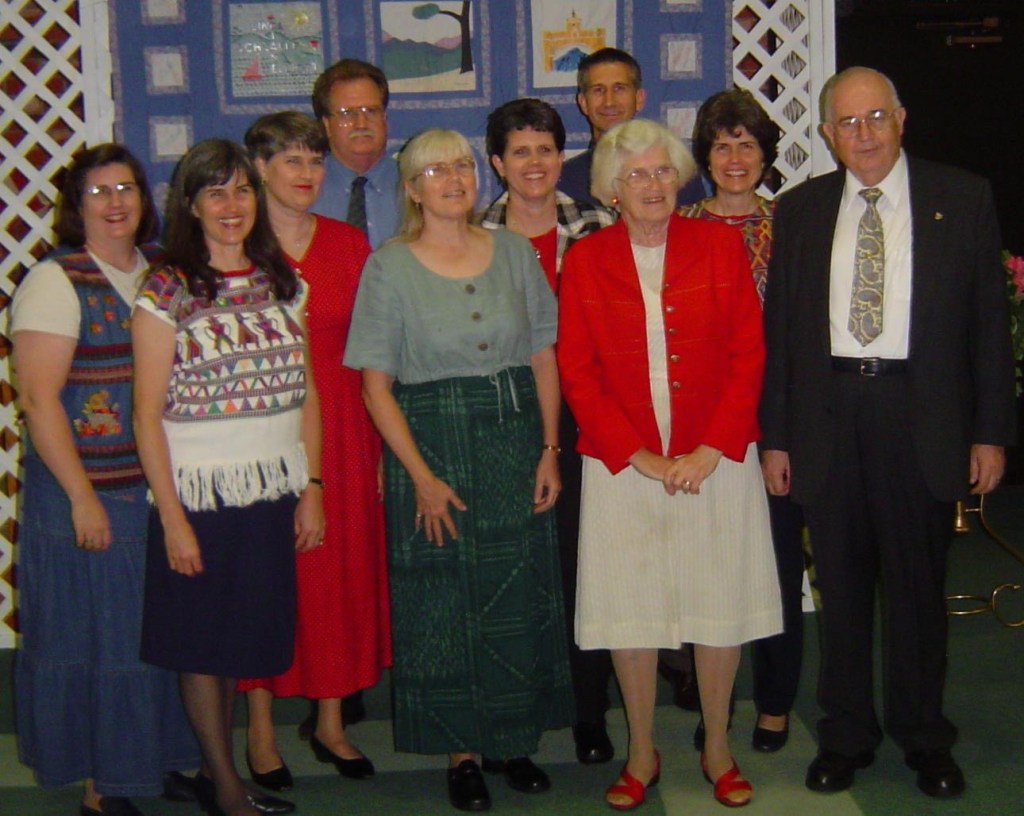
Tahlequah, OK 2004 Dad, Mom, and their eight children on his 80th birthday
With a new lease on his own life after convalescing, Dad began traveling to visit his children and twenty-five grandchildren and participated in a large family reunion in Iowa, where he entertained the kids with his creative whittling. Every day, he called his granddaughter Karis, in and out of hospitals, to encourage her.
In August of 2008, the translation of the New Testament into Ixil was finally published. All eight of Dad’s children, most of his sons- and daughters-in-law and seventeen of his grandchildren joined him in Guatemala for this wonderful celebration. Dad did not feel well while in Guatemala, but attributed this to the travel, joyful stress, and different food of the reunion. On his 83rd birthday two months later, he was diagnosed with metastatic cancer. His eight children and our daughter Karis gathered around him for his last weeks of life, while Dad protested that he had too much to do to take time out for being sick.
Just three weeks after his diagnosis, in the early hours of November 12, with Steve at his bedside, Dad died. Karen had gone home to attend to needs there, escorting Karis back to the hospital in Pittsburgh on her way. The other seven of us sat around his bed for hours talking about our father’s life. We felt he had been snatched away from us too soon. None of us were prepared to lose him. We were just beginning to restore our relationships with him after his years of devotion to Mom, who was too advanced in Alzheimer’s to understand what had happened.
As family and friends, including Karen and her family, gathered for Dad’s funeral a few days later, among many other attributes, we remarked on his sense of humor and love of puns, his resilience, his inventiveness, his thoughtfulness and kindness, and his delight in singing in a barbershop quartet at Go Ye Village.
We are grateful for all Dad gave to us and to the Ixil people through his remarkable life and faithful obedience, and his deep love of Scripture.

 Debra Kornfield