Isaiah 32:15 … until at last the Spirit is poured out on us from heaven. Then the wilderness will become a fertile field, and the fertile field will yield bountiful crops.
Isaiah 34:16 Search the book of the Lord and see what he will do. Not one of these birds and animals will be missing and none will lack a mate, for the Lord has promised this. His Spirit will make it all come true.
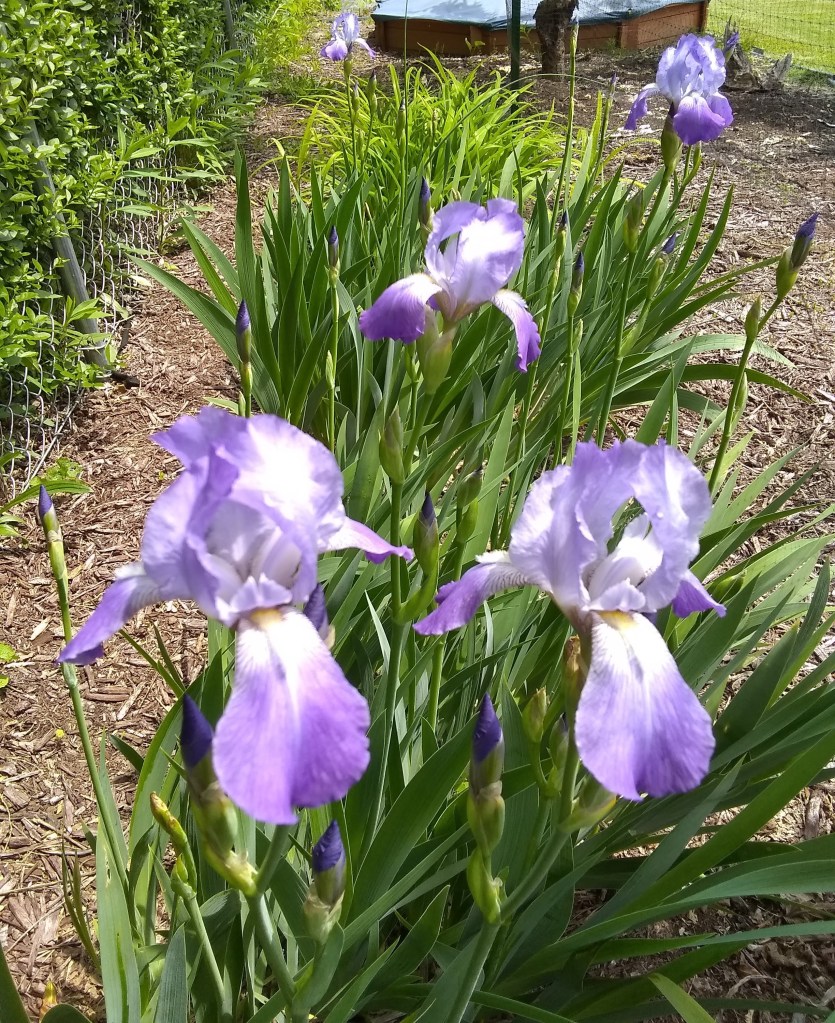
When I think of exuberant beauty, I think of the flowers that transformed a rustic camp into a paradise at my daughter Valerie’s wedding.
Interesting—just before I started writing this blog, I read an article about MAID—Medical Assistance in Dying, which is legal in several countries and (so far) eleven states.
The pros and cons of MAID reminded me of Karis’s struggle to understand transplant friends who made that choice, feeling that life is always the correct answer. In her suffering in the last months of her life, though, she re-thought her perspective to the point of feeling compassion and comprehension of why someone would choose when and how to end his or her life. She didn’t do it, but she certainly thought about the joy of being with the Lord, free from all that constrained and hurt her here on Earth. In the months before her death, she wrote often in her journal, “Father, please, please take me Home. I can’t do this anymore.”
I went from there to contemplation of Isaiah’s celebration of LIFE, of both flora and fauna, mediated by the Holy Spirit, and the blessing to people of flourishing, fertile fields and animals. (Even the deer, groundhogs, turkeys, and bunnies that plague my efforts at gardening, Lord?)
I’m writing a book with a double setting: Bethlehem/Jerusalem and Heaven. The Heaven of my imagination overflows with vibrant life of every kind and natural beauty that is the “real thing,” only reflected in the mountains and valleys, rivers and oceans, gardens and fields of waving grain of our world. In creation, I see how much God cares about the details of texture and color and fragrance, of shape and function, of variety and mystery in our amazing world. How could Heaven not celebrate every form of life?
I think that even when, through human negligence and abuse, species become extinct on Earth, hurting their Creator’s heart, they are preserved in Heaven. How else could Isaiah’s promise be fulfilled, that not one will be missing?
I invite you to read aloud Isaiah 35. Yes, the whole thing, all eleven verses. Because our Lord is the Author of life, in all its forms. And that includes our own hearts and imaginations.
Sorrow and mourning will disappear, and the redeemed will be filled with joy and gladness (Isaiah 35:11).
A 3000-piece puzzle called Life that our daughter Karis put together, framed, and hung.I’m trying to find out the name of the artist.
Nehemiah 9:29-30 [A prayer rehearsing the history of Israel] You warned your people to return to your Law, but they became proud and obstinate and disobeyed your commands. They did not follow your regulations, by which people will find life if only they obey. They stubbornly turned their backs on you and refused to listen. In your love, you were patient with them for many years. You sent your Spirit, who warned them through the prophets. But still they wouldn’t listen! So once again you allowed the peoples of the land to conquer them.
1 Timothy 4:1 Warnings against False TeachersNow the Holy Spirit tells us clearly that in the last times some will turn away from the true faith; they will follow deceptive spirits and teachings that come from demons.
Hebrews 3:6-7, 12-13 We are God’s house, if we keep our courage and remain confident in our hope in Christ [some manuscripts add, “faithful to the end”]. That is why the Holy Spirit says, “Today when you hear his voice, don’t harden your hearts as Israel did when they rebelled, when they tested me in the wilderness.” … Be careful then, dear brothers and sisters. Make sure that your own hearts are not evil and unbelieving, turning you away from the living God.
I’m posting this in Maryland, at a wonderful place called Caboose Farm (Caboosefarm.net) where the extended Elliott family is having a once-every-three-years reunion. I probably won’t post this Thursday.
In the remarkable prayer of praise recorded in Nehemiah 9, the word “but” appears six times in reference to the people of Israel. God was faithful in myriad ways, but his covenant people turned away from him again and again and again.
The author of Hebrews draws a straight line from his time back to the people of Israel in the desert, 1500 years before. If he (or she) could see our hard hearts, two thousand years later, would he (or she) draw a line to us as well? Don’t we need the Spirit’s warning as much as the Hebrews did?
Reflecting on this, I recall that in the last few days I’ve heard or read the following:
“I don’t think God exists, because if he does, he would have healed my beloved sister. I can’t trust him anymore.”
“I was too badly hurt by the church to ever go back. I still believe in God in my heart, but I can’t stand the people who claim to know him yet behave in unkind and cruel ways in his name and say such demeaning things about people different from them.”
“I’m an ex. Ex-Catholic, ex-protestant, ex-atheist, ex-everything. Bottom line: I believe in myself.”
“God is too busy holding this fractured world together to care about me, and people have been cruel. My life has been one disappointment after another. So, I’m considering ending it.”
The good news from the prayer in Nehemiah 9? An entirely different “but.”
“But you are a God of forgiveness, gracious and merciful, slow to become angry, and rich in unfailing love. You did not abandon your people” (v. 17).
“And now, our God, the great and mighty and awesome God, who keeps his covenant of unfailing love, do not let all the hardships we have suffered seem insignificant to you” (v. 32).
Forgiveness. Grace. Mercy. Patience. Unfailing love. God, who keeps his promises, offers them all. Take what you need.
John 11:23-25 Jesus told Martha, “Your brother [Lazarus] will rise again.”“Yes,” Martha said, “he will rise when everyone else rises, at the last day.” Jesus told her, “I am the resurrection and the life. Anyone who believes in me will live, even after dying. Everyone who lives in me and believes in me will never ever die. Do you believe this, Martha?”
1 Thessalonians 4:13-14 And now, dear brothers and sisters, we want you to know what will happen to the believers who have died so you will not grieve like people who have no hope. For since we believe that Jesus died and was raised to life again, we also believe that when Jesus returns, God will bring back with him the believers who have died.
Yesterday my husband and I flew from Colorado back home to Pittsburgh, watching the transformation of desert into well-watered spring. I found myself thinking about a similar flight soon after our daughter Karis’s death, gripped by pain sharper than any other I have experienced. Would this grief ever soften into some version of beauty less stark?
I don’t know even how to describe it. A transplant friend, whose son had died a few months earlier, texted me: “Just BREATHE.” For as long as I owned that phone, I looked back often at that text as loss stabbed me yet again.
Jesus, who wept with Mary and Martha at Lazarus’s grave even though he knew he would shortly bring Lazarus back to life, understands that pain. He offers himself, his presence with us, as we grieve.
As intense as this grieving has been, I’ve often wondered, with deep compassion, what it would have felt like if I didn’t have the hope of life after death. I’ve watched people without that hope enter profound despair. What if I didn’t know that Karis’s SELF did not die, but is whole and well? What if I didn’t know I will see her again, healed, released from her suffering, exuberantly alive? Would I have survived the grief? I don’t know.
I love imagining what people who have gone before us are like now, freed from all that hampered and troubled them on earth and face to face with Jesus, who IS life. Death could not keep him in its grip (Acts 2:24 NLT). Because he broke death’s power, we too can know life after death—the truly abundant life for which God created us.
As I hear Jesus asking me today the question he asked Martha, I can say with profound thankfulness, “Yes. I do believe his resurrection makes possible eternal life for us.” Lazarus did eventually die again, yet I know he now celebrates along with his beloved sisters the unlimited joy of forever resurrection.
A friend whose father recently died shared with me this beautiful anthem, All Things New, by Elaine Hagenberg, sung at the funeral. The text is adapted from a 19th c. poem by Frances Havergal. So appropriate as we walk into next week:
Light after darkness, gain after loss
Strength after weakness, crown after cross.
Sweet after bitter, hope after fears
Home after wandering, praise after tears.
Alpha and Omega, beginning and the end
He is making all things new.
Springs of living water shall wash away each tear.
Hebrews 13:21 I fervently ask God to create in you the desire to please Him by doing all kinds of good, accomplishing through your daily activities the things which only Jesus, God’s Appointed One, can equip you for. Such things are especially pleasant in His eyes, for the glory He receives through them endures through all eternity. May it be so in you! (“Consider How the Son Shines!” translation of Hebrews by Ray Elliott)
Last Sunday, October 20th, would have been my dad’s 100th birthday. Thinking about him, I wrote, with contributions from my siblings, a brief synopsis of his adventurous and remarkable life.
Raymond Leroy Elliott, October 20, 1924-November 12, 2008
Birth through age 10, 1924-1934: Born in Independence, Kansas, the second of four boys (Richard, Raymond, Roland, Roger), my father and his family experienced two bitter losses during his first decade of life. First was the death by accident of their baby sister. Second was the loss of their house, foreclosed by their bank for lack of $3.70 to pay their mortgage one month. This sounds unbelievable now. In those years of the Great Depression, the family never fully recovered from the loss of their home.
In his teens, 1934-1944: Dad was a quiet boy, deeply involved in pursuing several interests and hobbies. He couldn’t decide whether he wanted to become a printer or a professional musician or a photographer. In high school, he fell in love with my mom, two years younger. One of her earliest memories of Dad was seeing him stretched out on the floor of his living room eating a huge bowl of popcorn, so immersed in the book he was reading he was oblivious to the high-energy chaos generated by his three brothers and their friends. Dad was 17 when Japan attacked Pearl Harbor. The army refused his service because he had clear vision in only one eye. He decided the best way he could serve people would be as a pastor and began a course of study at Phillips University in Enid, Oklahoma. Mom followed him there after graduating early from high school.
In his 20s, 1944-54: Dad married Helen Ruth Belcher June 10, 1945; he was 20 and she was 18. They took on an interim pastor role for the summer in a small church in the Oklahoma panhandle. To their surprise, that summer they together came to understand the Gospel for the first time (an amazing story). They returned to Enid, OK, where Dad worked and Mom birthed her first baby, Linda, as they prayed for direction. During that year they learned about and moved to Wheaton, Illinois to attend Wheaton College. Both graduated, Dad completed an M.A. in theology, and gained another daughter, Marsha. He and Mom became interested in Bible translation, initially in China, and when those doors closed, in Guatemala.
Back in Independence, a son, Stephen, was born and Dad’s father died. Dad and Mom joined Wycliffe Bible Translators and completed linguistic training. After “jungle camp” in Mexico—training in living in rustic conditions—they moved to Nebaj, a Mayan Ixil village nestled in the Cuchumatanes mountains of Guatemala, where no other white foreigner lived at that time. I was born a year later, in the middle of a CIA-sponsored revolution against the government of Guatemala, two months before Dad turned 30.
In his 30s, 1954-64: Many stories have been told of how Dad and Mom overcame cultural barriers and fear, won acceptance by the Ixil people, and learned their language, which had never been written down. Dad creatively made a tiny two-bedroom home livable, devised an Ixil alphabet, began figuring out Ixil grammar and syntax, ventured into early translation efforts, and fathered two more daughters, Janice and Sharon. Mom offered emergency medical care in a village which had none. Dad transmitted his love of classical and marching band music and singing to his children through LP recordings. One by one, we children left home to study at a boarding school about four hours away on rough roads. Parents were allowed to visit once each semester and had their children at home only for summer vacation and Christmas.
On a furlough in 1961 in Independence, my younger brother, Daniel was born, and Linda moved to Colorado for high school. Back in Guatemala, our youngest sister, Karen, completed the family. Because Dad and his two sons were born in the same hospital in Independence, and all six daughters elsewhere, we joked that if only Mom and Dad had stayed in Independence, perhaps they would have had more sons and fewer daughters.
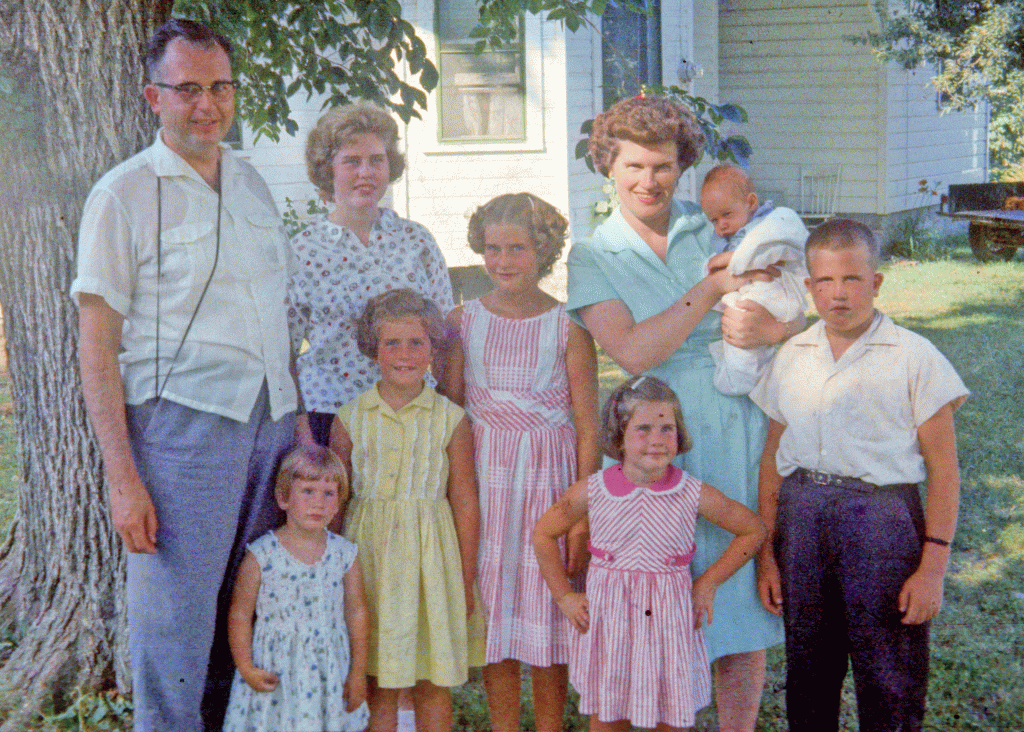
Dad with his family in Independence, KS 1961 (I’m in the yellow dress.)
Just missing Karen …
By God’s grace and with careful nursing, almost thirteen-year-old Marsha survived a severe case of nephritis, but her recovery was slow. Linda took a semester off from college to help the family through this time, since Karen was a toddler and Danny a preschooler. Dad moved the family to a house across the street from our boarding school for a few months so Marsha could continue studying and graduate from eighth grade with her class.
Guatemala, May 1965
Danny’s 3 year old birthday: Karen 1; Linda in the US for high school. Dad taking the photo.
In his 40s-60s, 1964-94: Dad was asked to become the director of Wycliffe’s Guatemala branch, which required living in Guatemala City more than in Nebaj for a few years and hindered his own Ixil translation work. Dad cultivated his hobby of photography and designed his own needlepoint creations as a way to get through long meetings.
A second furlough, 1965-66, took us to Wheaton, so Dad could complete an M.A. in linguistics at the University of Chicago. Marsha and Steve stayed on in Wheaton for high school. One by one as we in turn graduated from boarding school in Guatemala, the rest of us transitioned to various cities in the U.S. Dad continued Ixil translation work while Mom focused on designing literacy materials and teaching people to read and then train others. Mom invested in building a school in another Ixil village, Salquil, which continues teaching children today. Some years, both of them taught in Wycliffe’s Summer Institute of Linguistics. A brutal civil war (1960-1996) deeply affected the Ixil region of Guatemala in the 1980s, forcing Mom and Dad to spend time in Guatemala City while contributing to relief efforts for the suffering Ixil people.
In his 70s-early 80s, 1994-2008: Dad had a very hard time acknowledging Mom’s early-onset Alzheimer’s. A family intervention when we were together in California for a grandson’s wedding in 1999 forced Dad to accept that he could not safely take Mom back to Guatemala. After some time living with Dan and his family in Wheaton, Dad and Mom moved to a retirement center, Go Ye Village, in Tahlequah, Oklahoma. Finding the silver lining, Dad said, “Helen laughs at my jokes no matter how many times I repeat them.” Dad cared for Mom until his neglect of a leg wound resulted in gangrene (Dad was diabetic). He did not lose his leg, but while he was in the hospital, Mom was moved into a memory care unit and did not live at home again.
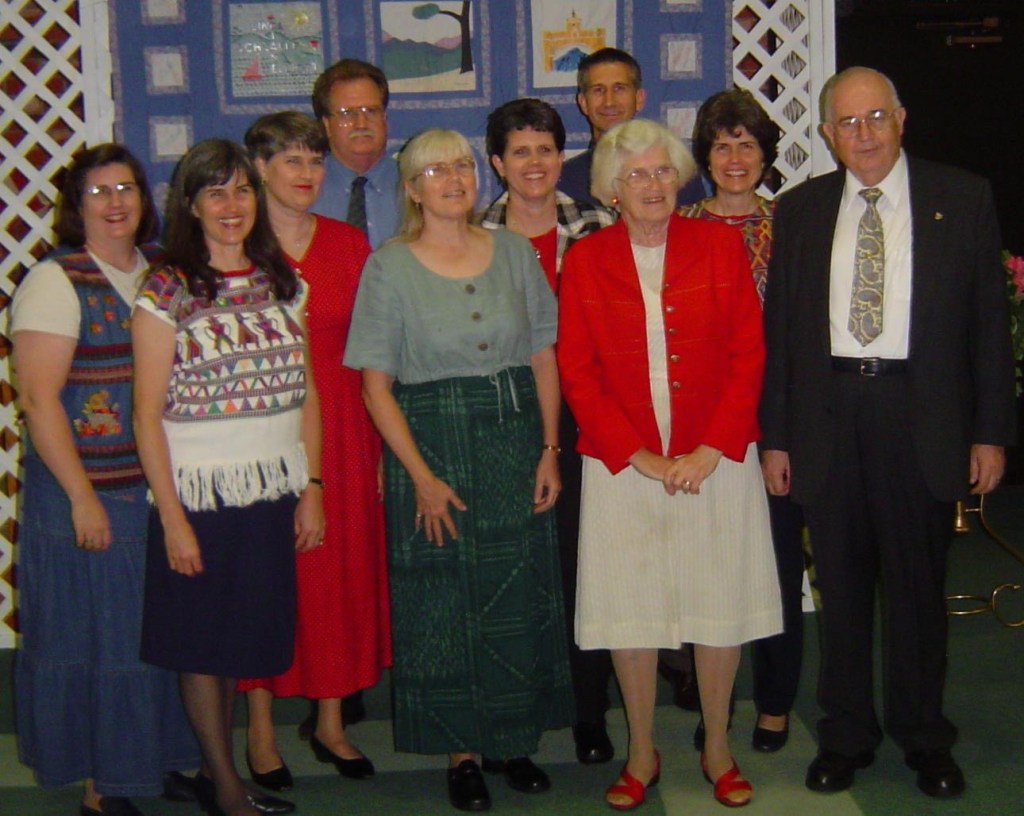
Tahlequah, OK 2004 Dad, Mom, and their eight children on his 80th birthday
With a new lease on his own life after convalescing, Dad began traveling to visit his children and twenty-five grandchildren and participated in a large family reunion in Iowa, where he entertained the kids with his creative whittling. Every day, he called his granddaughter Karis, in and out of hospitals, to encourage her.
In August of 2008, the translation of the New Testament into Ixil was finally published. All eight of Dad’s children, most of his sons- and daughters-in-law and seventeen of his grandchildren joined him in Guatemala for this wonderful celebration. Dad did not feel well while in Guatemala, but attributed this to the travel, joyful stress, and different food of the reunion. On his 83rd birthday two months later, he was diagnosed with metastatic cancer. His eight children and our daughter Karis gathered around him for his last weeks of life, while Dad protested that he had too much to do to take time out for being sick.
Just three weeks after his diagnosis, in the early hours of November 12, with Steve at his bedside, Dad died. Karen had gone home to attend to needs there, escorting Karis back to the hospital in Pittsburgh on her way. The other seven of us sat around his bed for hours talking about our father’s life. We felt he had been snatched away from us too soon. None of us were prepared to lose him. We were just beginning to restore our relationships with him after his years of devotion to Mom, who was too advanced in Alzheimer’s to understand what had happened.
As family and friends, including Karen and her family, gathered for Dad’s funeral a few days later, among many other attributes, we remarked on his sense of humor and love of puns, his resilience, his inventiveness, his thoughtfulness and kindness, and his delight in singing in a barbershop quartet at Go Ye Village.
We are grateful for all Dad gave to us and to the Ixil people through his remarkable life and faithful obedience, and his deep love of Scripture.
John 8:12, 9:5 I am the light of the world. If you follow me, you won’t have to walk in darkness, because you will have the light that leads to life. … While I am here in the world, I am the light of the world.
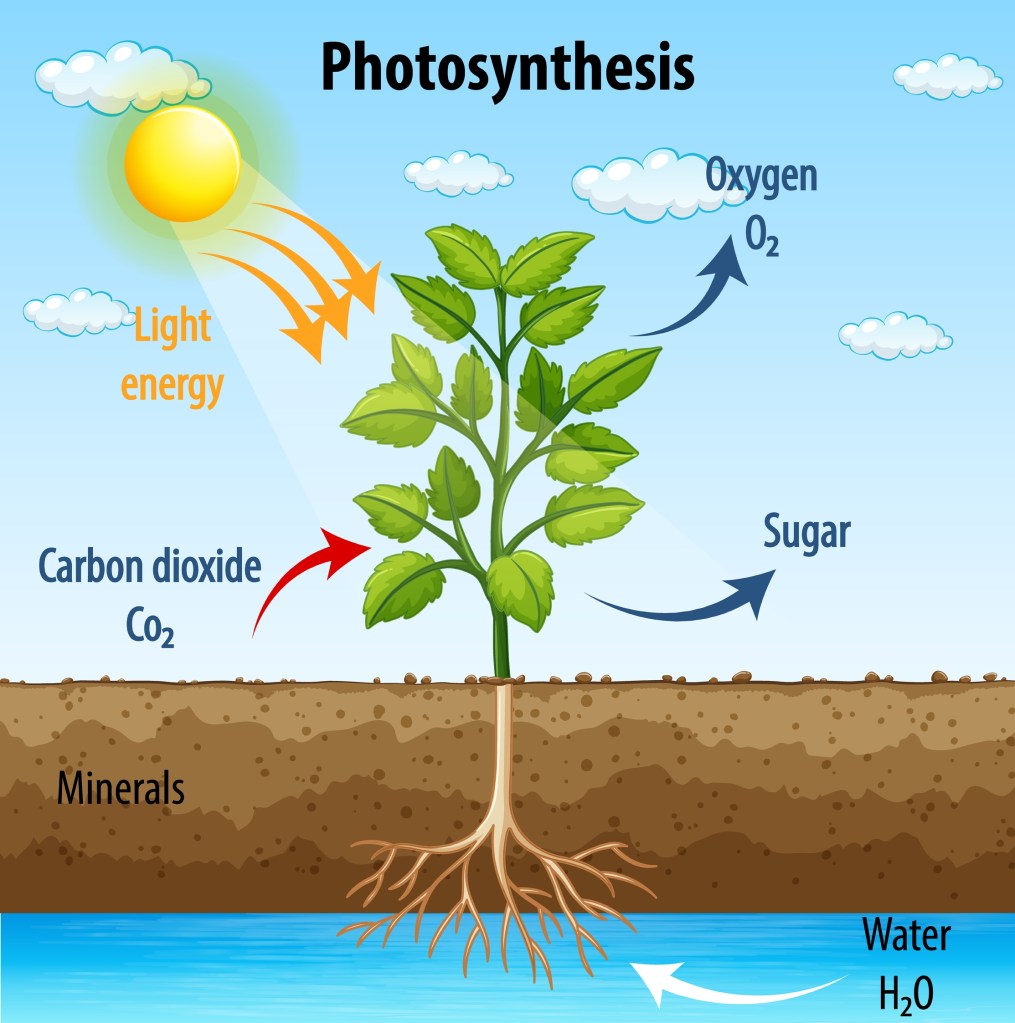
It happens all around us and fuels our lungs and muscles. Photosynthesis is the process by which plants and trees use sunlight, water, and carbon dioxide to create oxygen and energy. Light generates life!
I could so easily get off on the (mostly illegal) destruction of the rain forest, but I’ll spare you the soapbox (except to say one thing: the more beef we eat, the faster the Amazon Forest will be cut down for pasturing methane-belching cows, top of the food chain and doubly injurious to our planet’s health).
Though a description of photosynthesis wasn’t published until 1779, Jesus the Creator, of course, understood it perfectly. As he so often did, he used nature to express spiritual truth. Light is life.
Speaking in the Temple in Jerusalem on the last day of the week-long fall harvest Festival of Sukkot, or Tabernacles, or Booths, or Shelters, Jesus promised living water, another necessary element for life (John 7:37-39)—probably in connection with the daily Sukkot water ceremony, when the priest poured out collected rainwater from the previous season.
And then, sixteen gold bowls in the inner courts of the Temple were filled with oil and lighted. Likely, Jesus stood beneath these lights to declare that he was the Light of the world (John 8:12). The light at the center of Temple worship—but more. Light that could leave the Temple and walk into the world, confronting the darkness found there. Like falsehood, and slavery, and unbelief, and wrong judgment. Some people were so angry they wanted to kill Jesus.
And the intrigue—or offense—intensifies when Jesus repeats the claim of being the light of the world (John 9:5) when on the Sabbath, he heals a man born blind. The intricate interplay of light and darkness in this chapter, of who can see and who can’t, of what is sin and who commits it, challenges all assumptions and the very order and fabric of society.
The man formerly blind who for the very first time can see—imagine!—has the gall to say, “Ever since the world began, no one has been able to open the eyes of someone born blind. If this man were not from God, he couldn’t have done it.” He was thrown out of the synagogue, as people often are who dare to speak truth (Liz Cheney comes to mind). Jesus, who had given the man physical sight, found him and gave him spiritual vision as well.
“If you were blind, you wouldn’t be guilty,” Jesus told the angry leaders. “But you remain guilty because you claim you can see” (John 9:41). In chapter 8, he called people liars. He clearly hadn’t read up on social etiquette. So cringey for this Enneagram 9 who hates conflict and upset apple carts.
Will you and I welcome Jesus’ light shine into the dark corners of our hearts, confronting our sin, healing our blindness, synthesizing new life in us?
Matthew 18:1-10 About that time the disciples came to Jesus and asked, “Who is the greatest in the Kingdom of Heaven?” Jesus called a little child to him and said, “I tell you the truth, unless you turn from your sins and become like little children, you will never get into the Kingdom of Heaven. So anyone who becomes as humble as this little child is the greatest in the Kingdom of Heaven … Beware that you don’t look down on any of these little ones. For I tell you that in heaven their angels are always in the presence of my heavenly Father.”
“An artist is one still able to see angels,” Madeleine L’Engle tells me in Walking on Water. “To be visited by an angel is to be visited by God. To be touched by an angel is to be touched by God.”
Shutterstock: melitas
Immediately, of course, I think of Karis. Dave joked as she was growing up that she needed two guardian angels, not just one, to keep her safe through all her adventuring and exploits. But in reading her journals, I discovered she had three, and often saw them and took comfort and guidance from them.
Those of us around her, intent on keeping Karis safe and alive, tried to limit her, because she seemed to have missed out on common sense. Where is the line between fearlessness and stupidity?
We thought, silly us, looking at all we had invested in her life, that she “owed” us this: to walk within boundaries of safety, to not risk her costly life on (to us) frivolous pleasures. I placed value on what it took for me and others to support her in her extravagant ideas.
But for Karis, every day of life was Gift. So many times, doctors had said her broken body could no longer support life, yet she lived on. This made her careless, or overconfident, or too trusting, from the point of view of us who did not see her guardian angels or accept her absolute conviction that she would live “not one minute more or less than God has planned for me.”
“Where is the line between responsible faith and reckless presumption?” I would ask her.
“Ah, Mama, you worry too much. No one has ever solved the dilemma of free will vs. predestination. You need to embrace the both-and, not try to reduce it to either-or.” A deflection. I was not comforted. I did not worry less.
So if an artist is one still able to see angels, in what ways was Karis an artist? I remember her economics professor at Notre Dame telling me that after he graded Karis badly on an essay filled with her customary multi-hued imagery and made her rewrite it in proper academic diction, she thereafter submitted two essays for every assignment: one she wrote for herself, and one she wrote for him. “Economics is about Life,” she told him. “I can only understand it in that context. Then I translate it for you into the language that makes sense to you.” His view of his subject was transformed.
And that’s what she did for all of us who paid attention. She taught us to listen, to see, to go deeper. To embrace mystery, rather than try to tame it. To touch Joy. And Freedom.
Ah, Karis. I’m so glad James sees you dancing. With the angels. With Jesus.
Therefore we praise you, joining our voices with angels and archangels and with all the company of heaven, who for ever sing this hymn to proclaim the glory of your Name: Holy, holy, holy Lord, God of power and might, heaven and earth are full of your glory.
Acts 2:23-24, 33 You nailed him to a cross and killed him. But God released him from the horrors of death and raised him back to life, for death could not keep him in its grip … Now he is exalted to the place of highest honor in heaven, at God’s right hand. And the Father, as he had promised, gave him the Holy Spirit to pour out upon us.
Imagine the joy, the song, the excitement! Hope renewed.
I tasted this joy so many times over the course of Karis’s life. The joy of life over death, even in the simplicity of IV fluids restoring warmth and color and consciousness to my daughter passed out from dehydration—how many times? Countless. Or seeing her rally against all odds when the doctors told us to call our family together to say goodbye.
But all that pales beside this joy, Jesus alive again! No wonder Peter was so excited he kept a crowd of thousands enthralled for a very long time, with about three thousand responding to his appeal. If you saw someone who was dead come back to life, wouldn’t you want to tell everyone about it?
Neighborhood deer ate my pansies down to the dirt. But they’re coming back! I was so excited to see this bloom today.
At the same time, we know Peter couldn’t and wouldn’t have preached this sermon had it not been for the filling of the Holy Spirit, the gift Jesus had promised his followers before he died. Right away we see some of the fruit of the Spirit in Peter. I love his quoting from Psalm 16:
I see that the Lord is always with me.
I will not be shaken, for he is right beside me.
No wonder my heart is glad, and my tongue shouts his praises!
My body rests in hope…
You have shown me the way of life,
And you will fill me with the joy of your presence.
How different these words are from the Peter of a few weeks before, defeated by his own betrayal of Jesus, ready to quit, to give up on Jesus’ call and return to fishing fish instead of men.
The Holy Spirit lets us know God is with us; we are not abandoned. And where the Spirit is present, there is joy, worship, hope, life—even in distressing circumstances. A joy and hope we couldn’t possibly manufacture ourselves.
Why didn’t Karis give up? Only because of the life and joy of the Spirit within her. The same Spirit in you and me, whatever circumstances we each face. Turn on praise music and dance! God is with you!
1 Corinthians 15:17-20 If Christ has not been raised, then your faith is useless and you are still guilty of your sins. And if our hope in Christ is only for this life, we are more to be pitied than anyone in the world. But in fact, Christ has been raised from the dead! He is the first of a great harvest of all who have died.
On this last day of Easter season (Pentecost is tomorrow), we come to “the” chapter about the resurrection of Jesus, 58 verses of some of Paul’s most enthusiastic defense of our faith.
Valerie quoted from verses 42-57 in her blog post Feb. 5, 2014, the day Karis died. So of course that’s the first thing that comes to my mind as I re-read this chapter. The foundation of our confidence in the transformation of Karis’s weak, broken body into a body that will never die is Jesus’ own triumph over death, and his promises that we too will be raised to unending Life—our experience here just a shadow of the real thing. It’s why we can smile as we think of Karis now, in the joy of her victory over death, made possible by Jesus’ resurrection. It’s the joy at the center of the universe, the “deeper magic,” as C.S. Lewis described it.
Paul illustrates the transformation of our bodies with the analogy of what grows from a seed that is buried
But today what is on my mind is the hope we have for the many friends dying from Covid in Latin America and Brazil, more every day. Since our work is with pastors, those are the ones we primarily hear about from the safety of Pittsburgh. Hundreds of pastors across South America, caring for their people without PPE, without vaccines, and without adequate medical care, literally laying down their lives for their sheep (John 10:11).
I want to honor them today, even as we pray for their families and congregations and friends, left behind for now. They did not love their lives so much that they were afraid to die (Revelation 12:11).
Because of our confidence in the resurrection, Paul says to us, Be strong and immovable. Always work enthusiastically for the Lord, for you know that nothing you do for the Lord is ever useless (verse 58). And borrowing from chapter 16, verse 13: Be on guard. Stand firm in the faith. Be courageous. Be strong. And do everything with love.
1 Corinthians 9:16-17, 26 Yet preaching the Good News is not something I can boast about. I am compelled to do it. How terrible for me if I didn’t preach the Good News! I have no choice, for God has given me this sacred trust…I run with purpose in every step.
Paul was compelled to preach. I feel compelled to write. What sacred trust has God given you?
“This one’s a fighter.” The veteran nurse smiled back as Karis gurgled and grinned, enjoying her bath. “That’s why she’s still alive, not all this paraphernalia. I’ve not known another baby so passionate to live. Don’t lose sight of HER in the middle of all this medical stuff.”
The nurse showed me how to navigate with soap and water between and around the ileostomy on her Karis’s tiny tummy, the Broviac catheter coiled on her chest, the naso-gastric tube emerging from her nose and taped to her cheek.
Hiding most of this under a frilly dress, and taping a matching bow to her bald head, the nurse said, “Go home to your little son. He needs you too.” She settled Karis into a stroller, grasping her IV pole with one practiced hand. “I’ll take Karis around with me to cheer up the other patients.”
At PACA, her school in Brazil, her shirt covering the central line through which she was fed every night.
LIFE in capital letters compelled Karis. On her birthday yesterday, I reflected on how apparent this was even at a few weeks old. And how her bright smile continued cheering others for the next thirty years, years the doctors told us she would never live. “Unplug everything and let her die now,” they told us. “That’s the merciful thing to do for her.”
No. God knew we needed her smile, even through the tough times and the pain. Her zest for life invigorated us. Again and again after that first time, God’s restoring touch reached down to meet her heart’s thirst for more, more of this life, more time with her Beloved, as she called those she loved (virtually everyone who crossed her path). Until finally, she said, “Father, take me Home.”
And now she is truly living LIFE. I imagine her joy and enthusiasm infecting everyone in Heaven as she welcomes more of the Beloved into her Father’s home through these Covid months. Crooning cradle songs in Portuguese over more than two thousand babies dead from Covid in Brazil, but growing up now well and strong. I see her delighting in Jane Pool’s stories and finding just the right shade to paint our dear Alicia Helmick’s nails, wearing one of a collection of brightly-colored shirts saying “Been there. Got the T-shirt.”
Comforting the hundreds of pastors from across Latin America taken as they steadfastly cared for their people: the Good Shepherd will raise up others to love their congregations and their families. Listening intently as those who found life too hard on Earth pour out their stories and find healing in the presence of the Lord . . .
She’s busy. She’s well and strong. Happy. Thrilled with LIFE.







 Debra Kornfield