
But God is the Rock who can hide you
Isaiah 17:10, 18:4, 19:20-25, 24:5, 16 You have turned from the God who can save you. You have forgotten the Rock who can hide you. … For the Lord has told me this: “I will watch quietly from my dwelling place” … The earth suffers for the sins of its people, for they have twisted God’s instructions, violated his laws, and broken his everlasting covenant. My heart is heavy with grief. Deceit still prevails, and treachery is everywhere.
I love this story:
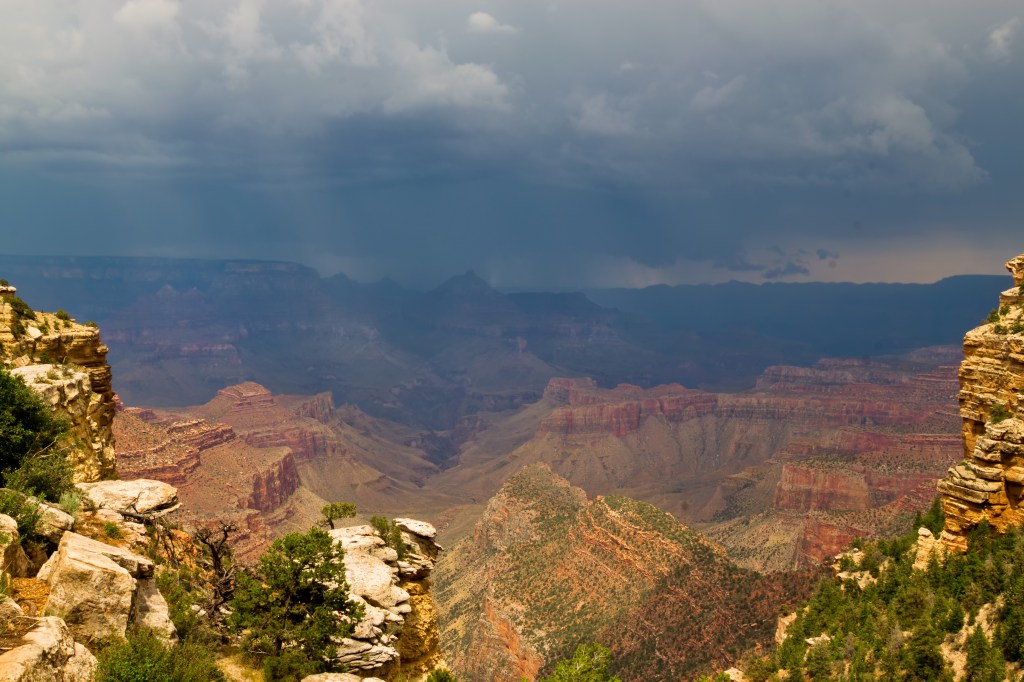
Our family hiked in the Grand Canyon. Dave and Dan (11) had gone on ahead, more ambitious than I was with our three girls, 6, 8, and 10. Suddenly torrential rain poured down on us and the trail became slippery. Should we keep going down or head back up? Not knowing how long this might last, we turned around. Struggling to keep our balance, sliding back as often as we managed progress forward and of course soaked through, we rounded a bend and saw other hikers huddled under a rock overhang. They squeezed together to make room for us. Exhausted and shivering, I watched the grandeur of the tsunami pummeling the valley before us, vaguely aware that one family, with three teenagers, spoke French. Karis focused all her attention on trying to understand what they were saying.
When the storm eased, the mother of the French family, without attempting conversation, took Karis’s and Rachel’s hands and started with them up the trail. This stranger’s kindness freed me to give all my strength to helping little Valerie manage the slick climb. All I knew to say when we reached the top was “Merci. Merci beaucoup.”
Back home in Brazil, Karis started teaching herself French, an interest she pursued through college (adding Spanish and Arabic as well to her Portuguese and English). She was thrilled in high school to be able to visit France, the homeland of that lovingly remembered family.
A cleft in a rock during a storm yielded so much more than just shelter!
As I read Isaiah 17-24 it seemed eerily like today’s news. Syria. Israel. Ethiopia. Egypt. Iraq. Turkey. Jordan. Arabia. Palestine. These places, says Isaiah, are “watched quietly by the Lord” in the hope they will turn to him, away from their greed and selfishness and violence, and be spared anguish and destruction. God’s heart, broken by their betrayal of his covenant of love, is on full display. He longs to be known and for the people to follow his ways of peace and justice.
2,750 years later, we’re no different, are we? God still gives us freedom to decide. He invites us to know and follow him, instead of independently following our own way, suffering the consequences of our foolish choices. He still “watches quietly,” deeply desiring to bless us, wherever we live, whatever language we speak and whatever culture has formed us.
One day, Isaiah 24:14-16 promises:
All who are left will shout and sing for joy.
Those in the west praise the Lord’s majesty.
In eastern lands give glory to the Lord.
In the lands beyond the sea, praise the name of the Lord, the God of Israel.
We hear songs of praise from the ends of the earth,
songs that give glory to the Righteous One!
My song of praise TODAY echoes back through the centuries to gladden God’s heart. I want to remember the place of refuge he offers me in stormy moments. Don’t you? We can hide our souls under the shelter of the Rock of ages as thunder crashes around us.
Here’s a bonus: The Story Behind “Rock of Ages”:
As the young minister traveled through the rugged country near England’s Cheddar Gorge, the clouds burst and torrential sheets of rain pummeled the earth. The weary traveler was able to find shelter standing under a rocky overhang. There, protected from the buffeting wind and rain, Augustus Toplady conceived one of the most popular hymns ever written, “Rock of Ages, cleft for me, let me hide myself in Thee.”
In March 1776 Toplady published the hymn as part of an article in The Gospel Magazine, which he edited. He wrote that just as England could never pay her national debt, so man could never by his own merits satisfy the justice of God. In the middle of the article, he burst into song, printing for the first time the hymn “Rock of Ages”, which so ably describes Christ, the Rock of Ages, as the remedy for all our sin.
Augustus Toplady died of consumption [tuberculosis] at the age of 38. As he neared the end Toplady proclaimed, “My heart beats every day stronger and stronger for glory. Sickness is no affliction, pain no cause, death itself no dissolution…My prayers are now all converted into praise.”
 Debra Kornfield