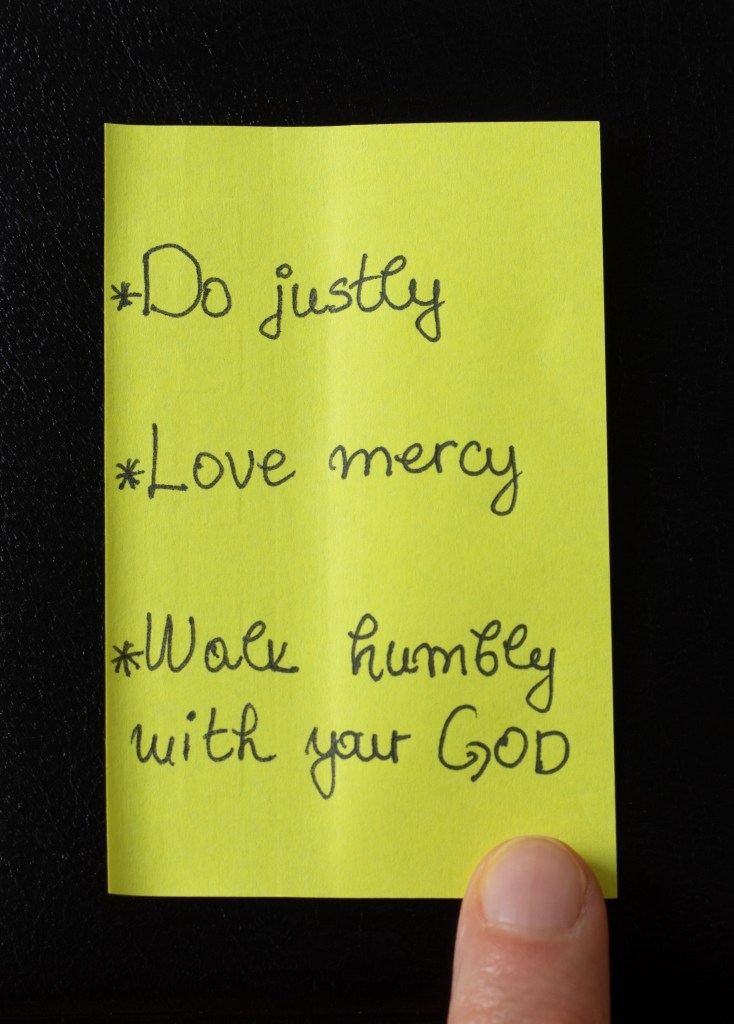
This is what God says is good

But God’s Spirit fills us with justice, strength, and boldness

Micah 2:7, 3:8 Should you talk that way, O family of Israel? Will the Lord’s Spirit have patience with such behavior? If you would do what is right, you would find my words comforting.But as for me, I am filled with power— with the Spirit of the Lord. I am filled with justice and strength to boldly declare Israel’s sin and rebellion.

Micah 6:8 The Lord has told you what is good, and this is what he requires of you: to do what is right [act justly NIV], to love mercy, and to walk humbly with your God.

At our May annual event, Sisters Celebrating Diversity focused on God’s requirements of us in Micah 6:8. Participants were each given a bracelet that says, “Do justice, love mercy, walk humbly.” I wear mine often. It reminds me to walk into any situation I may encounter with those three principles in mind. It reminds me to ask the questions, from God’s perspective, what does justice look like here? Am I conscious of his merciful heart? Is my chief aim that he and his ways be honored, including the lives of anyone I interact with, each one beloved by God?

Can I do this on my own? No way at all. Only through the Holy Spirit’s guidance and grace.

Sometimes acting justly requires naming wrongdoing, that which hurts God’s heart and other people, so that it can be dealt with and injuries healed. Through the Holy Spirit, Micah found the courage, wisdom, and boldness to do this. A difficult task indeed, and no easier now than it was then. The false prophets were the ones saying, “Hey, everything is OK, nothing to worry about—God’s on our side” (Micah 3) while they made decisions based on bribes and twisted justice for their own profit and idolized their own comfort and power and success.

Yet the Spirit kept reminding beleaguered Micah—and through him, us—that God longed to heal his people and restore their land. That was the goal, like an oncologist who must locate and name a cancer to treat it appropriately.

And he reminds us today that no matter what anyone says, these three matter to God: justice, mercy, and humility.

God said to Micah, “My people’s wound is too deep to heal,” (1:9) and devastation was coming. But later, he said, “But you, O Bethlehem Ephrathah … a ruler will come from you. … And he will stand to lead his flock with the Lord’s strength, in the majesty of the name of the Lord his God … and he will be the source of peace” (Micah 5:2-5; Matthew 2:6).

Just out! The Gladness Book: Fun for Kids who Love to Write

I think I know better

But God patiently loves me

Isaiah 40:13 Who is able to advise the Spirit of the Lord? Who knows enough to give him advice or teach him?

Patience.

I’m impressed this morning that this beautiful virtue, one of the fruits the Spirit produces in us, is one of his defining characteristics.

How often I’ve thought, even if I haven’t said out loud to the Lord, “I know better. If I had your power, I wouldn’t allow what’s going on in the life of my beloved one.”

Once while attending a conference in the U.S. after we had lived in Brazil for many years, I greeted the woman ahead of me in line. She asked where I was from, and I told her São Paulo. She said, “Oh, your Spanish must be pretty good.” The rest of the time we were in line, she told me how my husband and I should minister in Brazil.

Had she ever been there? No. She ended as we reached the serving line, with a bright smile, “I’m so glad God put us together this morning, so I could be of help to you.”

As I ate my breakfast, after I finished internally rolling my eyes, I reflected on how God could use her “help” to me: to teach me patience. And humility. And to understand better the disconnect between my world and that of people whose reality I don’t experience.

Thinking a little more deeply, the Spirit nudged me. I’m like her. I think I know, when what I understand is but a tiny slice of what’s going on beyond myself. And some of that tiny slice isn’t even accurate. In Brazil, we speak Portuguese. In the Kingdom of God, the Spirit speaks Love, and my comprehension of that language is dismally inadequate.

Yet I try to tell God how Love should be spoken in the life of a person I care about.

Your will be done, Lord. Your Kingdom come on earth as in heaven.

Shutterstock: MarinelaM

Yikes!!

But God will hold us accountable for our choices

Hosea 8:1, 4, 13; 9:17 My people have broken my covenant and revolted against my law. … By making idols for themselves they have brought about their own destruction. … To me their sacrifices are all meaningless. I will hold my people accountable for their sins. … My God will reject his people because they will not listen or obey.

Strong words from God through a prophet who himself was ordered by God to forgive and welcome back a wife who betrayed him, don’t you think?

And what about God’s words in the last chapters about God’s unfailing love and compassion; his desire to forgive, redeem, and heal his people?

Here’s another question: How DOES God hold together all the dimensions of his nature? His holiness and his mercy. His justice and his compassion. His gracious patience and his truthfulness. His forgiveness and our need for accountability.

Rather than suggesting trite responses, I invite you to sit with these questions.

One resource I recommend again is Jen Wilkin’s books. In a very approachable way, she takes on some of these questions in None Like Him (God’s unique character traits—ways he is different from us) and In His Image (ways we’re called to be like him, to reflect his character).

Why does it matter that we be held accountable for our sins? Can that be considered an act of care for us?

Another resource is what Scripture has to say about God’s discipline, for example in Hebrews 12.

Do we want the supreme Gardener to pluck the weeds from the gardens of our hearts?

Shutterstock: Kostenko Maxim

I would love to hear your thoughts!

“Don’t fret”

But God calls leaders to account for their treatment of the poor, helpless, and oppressed

Hosea 5:1, 4, 5, 7-8, 15 Hear this, you priests. Pay attention, you leaders. … You have led the people into a snare by worshipping idols. … Your arrogance testifies against you. … You have betrayed the honor of the Lord. … Sound the alarm! … Admit your guilt and return to me.

Amos 2:4-7; 5:15, 21, 24 This is what the Lord says: “The people have been led astray by lies. … They sell honorable people for silver and poor people for a pair of sandals. They trample helpless people in the dust and shove the oppressed out of the way. … You twist justice, making it a bitter pill for the oppressed. … You trample the poor. …  Instead, hate evil and love what is good: turn your courts into true halls of justice. … I hate all your show and pretense. … Instead, I want to see a mighty flood of justice, an endless river of righteous living.”

Before I went to sleep, my friend said, “Don’t fret.”

But several times I woke up in distress.

I kept dreaming that I was with friends in a church, or a school, or a home, when ICE came and dragged my friends away. Not criminals. Not illegals. My friends, who had followed all the protocols to enter this country legally. Friends who love the Lord and their families, who work hard and pay taxes, even though they don’t yet receive the benefits of citizenship. Friends who were suddenly jerked away from their children, leaving them in shock and confusion.

Each time, an ICE person yelled, “Sorry, we can’t find enough criminals so we need you to meet our quota!”

Distraught, I went to the Lord. It seemed that current events fit alarmingly well into the prophets I’ve been studying: Hosea and his early contemporary, Amos.

When Hosea and Amos prophesied, King Jeroboam II of Israel had expanded its territory and its trade, making some people very wealthy and many others poor and destitute, ignoring the laws of Moses that would have preserved a level of economic equality. Instead of caring for all people equally, the king and his cronies engaged in and fostered syncretism. They pretended belief in God, while in fact practicing idolatry. They did all kinds of horrible things (including sexual slavery) to keep their god Baal happy, since they credited him with being the source of their prosperity. Instead of protecting needy people through the courts, the needy were “trampled” (Amos 2:7), used and abused and treated unjustly.

Amos preached at Bethel (“House of God”), which Hosea often calls Beth-Aven (“House of Wickedness”) because of the syncretism at this place of worship. Amos was not poor himself: the Hebrew words he uses in calling himself a shepherd denote an owner of sheep and orchards, not a laborer. Yet he anguished over the oppression inherent in the wealth gap of his day. He quotes God as saying, in the words of Eugene Peterson, “I’ve had all I can take of your noisy ego-music … Do you know what I want? I want justice—oceans of it. I want fairness—rivers of it. That’s what I want. That’s all I want” (Amos 5:24, The Message).

Curious about parallels to our time, I discovered that the wealth disparity in the United States has shifted dramatically in the last forty years. “Trickle down” economics hasn’t worked. The most recent figures I found show that the top 10% control 67% of the wealth, whereas the bottom 50% has access to only 2.5%. And this disparity continues to increase, as those with money and power control the laws and the courts to benefit themselves.

Can we expect God’s blessing on us under these conditions?

Interesting in terms of timing: the lesson this week for my international Zoom discipleship group includes Acts 2:42-47 and 4:32-37. “There were no needy people among them” (Acts 4:34), because everyone shared what they had, voluntarily and joyously.

How did this early church portrait become so distorted in practice over time? I know there are still many, many followers of Jesus—we ourselves are supported in missions by these beloved ones—who lovingly and generously share what they have in order to further the work of the Kingdom. Yet I’m left wondering what has happened to the community of believers, that we have supported such a different model nationally.

Don’t fret? “Trust God,” my friend told me. “Everything will work out fine in the end.”

I believe that is true. Ultimately God will bring justice to the world. Come, Lord Jesus. Meanwhile, though, people’s lives, already traumatized, are being smashed to pieces.

I appreciated a song we sang in worship yesterday (God of All Comfort, Resound Worship):

God of all comfort, God of compassion, reveal your mercy through us your church;

Disturb our slumber, move us to action, to show your kingdom on the earth.

Make us like Jesus, full of your Spirit, declaring good news to the poor,

Proclaiming freedom for every captive and the favor of the Lord.

Show us the value of every person, show us your image in every face.

We all are equal, we all are broken, and need the kindness of your grace.

We stand together, here in the margins, here in the hardship and the pain.

We cry for justice and restoration, until the silent sing again.

Advent 2, Peace: in the in-between times

But Jesus’ life can never be destroyed

Hebrews 7:2, 16-17 The name Melchizedek means “king of justice,” and king of Salem means “king of peace.” … Jesus became a priest by the power of a life that cannot be destroyed. And the psalmist [Psalm 110:4] pointed this out when he prophesied, “You are a priest forever in the order of Melchizedek.”

Luke 2:28, 32 Simeon took the baby Jesus in his arms and praised God, saying: … “He is a light to reveal God to the nations.”

Image by my friend Carol Amidi: https://www.carolamidi.net/

Justice?

Peace?

Jesus embracing both, revealing God to the nations?

Where is God in all that’s going on around us? What is he doing? What is his bigger plan?

How can we live from a center of peace, especially when there is chaos and calamity every day in the news and sometimes around us and maybe even in our own lived or family experience?

I would love to know your response to this question. Please take a minute to respond. I’m pondering this question this Advent whenever my mind isn’t occupied by other things. I’d love to profit from your input!

Meanwhile, here’s the link again to the Advent ABC playlist.

Don’t believe everything you think

But God loves fairness

Psalm 103:6 The Lord gives righteousness and justice to all who are treated unfairly.

Litany of Penitence 3:

For our unrighteous anger, bitterness, and resentment

For all lies, gossip, and slander against our neighbors.

Lord, have mercy upon us:

For we have sinned against you.

There are two sides to this confession: our response to those who have hurt us, and our own unjust thoughts, feelings, words, and actions against others.

We need God’s mercy and healing in both. He longs to restore us rather than punish us.

For I, the Lord, love justice. I hate robbery and wrongdoing. I will faithfully reward my people for their suffering … The Sovereign Lord will show his justice to the nations of the world. Everyone will praise him! His righteousness will be like a garden in early spring with plants springing up everywhere (Isaiah 61:8, 11).

Shutterstock: StudioSmart

Be truly glad. There is wonderful joy ahead, even though you have to endure many trials for a little while. … Don’t repay evil for evil. Don’t retaliate with insults when people insult you. Instead, pay them back with a blessing. That is what God has called you to do, and he will bless you for it (1 Peter 1:6, 3:9).

One of Karis’s favorite songs:

Oceans (Where Feet May Fail), Hillsong

Advent ABC: Ruler

Isaiah 9:6-7, Romans 9:5 (Isaiah 32:16, 40:10, 51:6, 60:17-18, Matthew 2:6, Ephesians 1:21-22) The government will rest on his shoulders. … His government and its peace will never end. He will rule with fairness and justice from the throne of his ancestor David for all eternity. … Christ is God, the one who rules over everything and is worthy of eternal praise! Amen.

Jesus’s entire life as recorded in the Gospels shows us his authority: over illness, death, the wind and waves, the enemy, Satan (who is called the ruler of this world), the traditions of people, and on and on. In his last conversation with his followers he said, “I have been given all authority in heaven and on earth” (Matthew 28:18). He didn’t then say, “Now destroy the Romans.” He said, “teach everyone to obey the commands I have given you,” chief among them the command to love (John 13:34-35).

Shutterstock: Jesus Cervantes

I think it’s easy to forget that Jesus’s Kingdom is not of this world. He wants to rule our hearts. He said, “The Kingdom of God is within you” (Luke 17:21). He told Pilate, “My Kingdom is not an earthly kingdom. If it were, my followers would fight …” Paul wrote, “The Kingdom of God … is living a life of goodness and peace and joy in the Holy Spirit.”

Jesus also said the Kingdom belongs to those who are like children (Matthew 19:14), so for fun on this first day of winter, let’s listen to a children’s song.

Jesus is the King, Ben Sams

Mary, Did You Know, by Mark Lowry

Advent ABC: Beloved

Matthew 12:17-21 (Isaiah 42:1-4) This fulfilled the prophecy of Isaiah concerning Jesus: “Look at my Servant whom I have chosen. He is my Beloved, who pleases me. I will put my Spirit upon him, and he will proclaim justice to the nations. He will not fight or shout or raise his voice in public. He will not crush the weakest reed or put out a flickering candle. Finally he will cause justice to be victorious. And his name will be the hope of all the world.

I love this description of Jesus, bringing justice with the gentleness that comes with true strength, a love song the Father sings over his son, whom he sees and profoundly knows. It’s a glimpse into the tender affection shared by the Trinity from before time—a relationship that we, incredibly, are invited into.

Jesus My Beloved, Jonathan Ogden

How can we do it?

But God calls us to demonstrate his righteousness

Isaiah 42:1-8 Look at my servant, whom I strengthen. He is my chosen one, who pleases me. I have put my Spirit upon him. He will bring justice to the nations. He will not shout or raise his voice in public. He will not crush the weakest reed or put out a flickering candle. He will bring justice to all who have been wronged. He will not falter or lose heart until justice prevails throughout the earth. … He gives breath to everyone, life to everyone who walks the earth. And it is he who says, “I, the Lord, have called you to demonstrate my righteousness. I will take you by the hand and guard you … And you will be a light to guide the nations. You will open the eyes of the blind. You will free the captives from prison. … I am the Lord, that is my name! I will not give my glory to anyone else.

Shutterstock: akramalrasny

This photo is from Yemen, but it could be so many other places in the world.

I find this to be one of the most encouraging and the most challenging passages in Scripture. Where would we be without God’s promise to bring justice to the nations, to all who have been wronged? Yet how can we possibly demonstrate his righteousness? We’re not wise enough, good enough, self-giving enough, strong enough, or brave enough for such an assignment.

I don’t manage to consistently reflect God’s priorities even within my small circle of influence. How can we respond as God’s partners in his purpose to make justice prevail throughout the earth, for each person to whom he gives breath and life? Too often v. 19-20 describe me!

If this call from God on our lives doesn’t keep us humble and on our knees, nothing will.

Two phrases from Isaiah 42 give me hope: “I have put my Spirit upon him,” and “I will take you by the hand and guard you.” It’s the Holy Spirit in us who can reflect God accurately, not ourselves. And when God says he will guard us, I think in part that means he will guard us from our own weaknesses, blindness, and inconsistencies as we submit ourselves to him.

God guarded me one day when a young woman dressed in full Sharia-correct garb appeared at Karis’s hospital room door. Karis welcomed her with joy, and the two spent a happy hour together. I, to my shame, sat in a corner struggling with feelings of resentment against her and all that in my mind she represented.

But in his mercy, during that hour, God showed me the deep, compassionate, affectionate love in his heart toward “those people.” He melted away my prejudices and fears. He took my hand and guarded me against myself. I am so very grateful, because I could have gotten in the way of important relationships in Karis’s life, as she poured out the love God had shown me.

I trust you, Lord, to keep on showing me and freeing me from all that does not please and reflect you.

Justice. Hope.

But God is passionately committed to fairness and justice

Isaiah 10:1-2 What sorrow awaits the unjust judges and those who issue unfair laws. They deprive the poor of justice and deny the rights of the needy among my people. …The Lord, the Light of Israel, will be a fire; the Holy One will be a flame. … In that day the Lord will end the bondage of his people. He will break the yoke of slavery and lift it from their shoulders.

Isaiah 9:7 He will rule with fairness and justice from the throne of his ancestor David for all eternity. The passionate commitment of the Lord of Heaven’s Armies will make this happen! [See Matthew 1:1, 4:16, 28:18; Luke 1:32-33, 1 Corinthians 4:24-28]

Romans 8:21 With eager hope, the creation looks forward to the day when it will join God’s children in glorious freedom from death and decay.

Revelation 21:4 God will wipe every tear from their eyes.

How could we endure the daily news if not for the promises of passages like these? I don’t know about you, but for me it’s so overwhelming that I can develop a “thick skin”–compassion fatigue–to protect myself from feeling all the pain.

Yet if we’re aligned with God’s passion for justice, I think each of us has a part to play. A small part, that may feel completely insignificant. But that’s not the point of our obedience to what God calls each of us individually and as congregations to allow into our hearts, our prayers, our pocketbooks, our time and energy.

What is your small part?

Lyrics of Still Will I Love You (A Song for Refugees):

Give me strength, give me hope
And I won’t suffer alone
The God who was and is to come
Break the silence with Your song
Oh, oh, oh, ohh, I can hear You singing
Oh, oh, oh, oh-ohh
Give me justice, give me peace
You are everything we need
The God who made the sky and sea
Of Your goodness, I will sing
Oh, oh, oh, ohh, I can hear You singing
Oh, oh, oh, oh-ohh, no, I won’t stop singing
Oh, oh, oh, ohh, I can hear You singing
Oh, oh, oh, oh-ohh
Still will I love, still will I love
Still will I love You more
Still will I love, still will I love
Still will I love You more