Mary’s song of joy

Mary’s song of joy

But God notices

Luke 1:46-55

Oh, how my soul praises the Lord.

How my spirit rejoices in God my Savior!

For he took notice of his lowly servant girl,

And from now on all generations will call me blessed.

For the Mighty One is holy,

And he has done great things for me.

I saved Mary’s song for this week because the theme of Advent 3 is joy. Few songs in Scripture are as joy-filled as the Magnificat as Mary praises the Lord with her whole being.

When our daughter Karis was thirteen, she imagined what it might be like to be Mary and wrote what she called “Mary’s Diary.” It’s available as a booklet, which I’ll be glad to mail to anyone upon request.

Karis imagined Mary writing:

“I guess that’s when God seems the greatest: when he takes a nobody (like me) and makes something out of them. Oh, thank you, God, for your amazing grace … Oh, even this moment, I praise the Lord. Jehovah gave me a song that I have written down, and I am singing it back to him every day. … Oh, how my soul praises the Lord! All my fears for myself have been put to rest. How amazing is Jehovah.”

What song can you sing to the Lord today, from delight at his work in your life?

Magnificat (with Wexford Carol), Keith and Kristyn Getty

What does obedience look like?

But God’s Spirit teaches us

Ezekiel 36:26-27 [A message from the Sovereign Lord] “I will give you a new heart, and I will put a new spirit in you. I will take out your stony, stubborn heart and give you a tender, responsive heart. And I will put my Spirit in you so that you will follow my decrees and be careful to obey my regulations.”

John 14:15-17, 26 [Jesus told his disciples at the last supper] “If you love me, obey my commandments. And I will ask the Father and he will give you another Advocate, who will never leave you. He is the Holy Spirit, who leads into all truth. … He will teach you everything and will remind you of everything I have told you.”

While waiting in stillness for a worship service to begin, my heart and hands open to what the Lord would offer me that day, God’s Spirit told me clearly, “It’s time to let this go.”

Shutterstock: Wanan Wanan

For years, I had struggled with my relationship with a member of this church. This person had moved away, yet every time I walked into the building, I still automatically steeled myself, still reacted to memories of difficult encounters with that person in this place. In word and intent, I had forgiven her, yet my soul had not released her.

“How do I let this go?” I asked Spirit.

“Give her to me.”

I did, and just like that, the anguish of years lifted and has not returned.

Why did it take so long? Had my deep sense of injury dulled me to Spirit’s prior attempts to free me from this burden? Likely. I don’t know. Perhaps I was just ready to hear and obey Spirit’s prompting to release a root of bitterness in my heart.

We all obey.

The question is who, or what, holds authority over us. Our lives reflect whoever, or whatever, we bow to: our own inclinations and desires and perceived injustices, the influences and pressures of our culture and society, the temptations fashioned to match our individual vulnerabilities by the enemy of our souls, the urge to conform to our peer group …

Or, the King of Love, our Shepherd, creator, redeemer, advocate, and teacher, who wants us to live in freedom and joy.

The King of Love My Shepherd Is, John Rutter (Scroll down for the lyrics of this beautiful Irish hymn.)

Strengthen self-control

But God’s power must be used rightly June 5, 2025

Galatians 5:22-23 But the Holy Spirit produces this kind of fruit in our lives: love, joy, peace, patience, kindness, goodness, faithfulness, gentleness, and self-control. There is no law against these things!

Proverbs 16:32 Better to have self-control than to conquer a city.

Proverbs 25:28 A person without self-control is like a city with broken-down walls.

I’m writing today in lovely Meridian, Idaho, remembering the impact on me of previous experiences in this beautiful state and their influence on Treasure Hunt 1904, book two of the Cally and Charlie historical fiction series. My sister Jan and I are here for a few days visiting our sister Marsha and brother-in-law Vance. I’ve not been here before in June. The flowers are stunning.

Marsha’s roses

The themes of Treasure Hunt 1904 directly relate to the final virtue in Paul’s description of agape, the lovely fruit the Spirit produces in our lives when we give him freedom to garden our hearts.

Self-control, translated “temperance”—moderation, self-restraint—in the KJV, is enkrateia in Greek, derived from the word kratos, which means strength. Like praos (see the last blog about gentleness), enkrateia is a strong word. It calls us to the right use of power. That power, as we know, is the operation of the Spirit of God in our lives, which we will recognize and celebrate this Sunday, Pentecost.

Along with the other virtues, gentleness calls us to choose how we treat others. Enkrateia reminds us we have the ability and responsibility to choose how we manage ourselves, circling us back to “Love others as you love yourself,” as Jesus taught us (Matthew 22:39). The Spirit empowers us to do both with godliness (God-likeness, the God who is love) as we practice agape.

Paul uses enkrateia (as a verb): we must discipline ourselves to win the race of life. Not to win temporary earthly rewards, but an eternal prize: God’s “Well done, faithful servant” (see 1 Corinthians 9:24-27; Philippians 3:12-14; Matthew 25:21).

So, what’s the connection with Treasure Hunt 1904? Using the motifs of a multi-layered treasure hunt and of water (see John 7:38-39), so critically important to transform into fruitfulness the fertile deserts of Idaho, we see Cally grapple with the wounds of trauma in her life (book one), emerging from the grief and paralysis of victimhood into proactive purpose. As she grows into acceptance of the love the Malcomson family offers her, Cally begins to recognize her own power. She can make choices for herself, rather than being controlled, for good or ill, by others.

This book also includes scenes of the devastating, ongoing impact of previous decades of misuse of power, sometimes, tragically, in the name of God, as western settlers and the U.S. government claimed a “manifest destiny” over the lives and territory of native Americans and others. Is not this false equivalence, still plaguing the world today, a breaking of the third commandment and of Jesus’ command to love others as he loves us?

Pentecost Sunday initiates the liturgical season of “ordinary time.” Ordinary, for you and me and all followers of Jesus, means practicing the wonderful fruit of the Spirit, in the agape love of the Father, empowered by Jesus’ conquest of sin and death by his sacrifice on the cross and his resurrection. “Live clean, innocent lives as children of God, shining like bright lights.. your faithful service is an offering to God” (Philippians 2:15-17).

In ordinary time, let’s shine! Let’s bear fruit that adorns the world with joy.

Holy Spirit, today I offer you freedom to grow the good fruit of agape love in my heart, in all its dimensions. Pull out the weeds, heal the wounds, rebuild healthy boundaries, and water the fertile soil of God’s love. Amen.

Whiplash

But Jesus too felt distress  Lenten question #14

John 12:7, 23-28, 32 [Mary, sister of Lazarus, anointed Jesus with expensive perfume and was criticized for doing so.] Jesus replied, “Leave her alone. She did this in preparation for my burial. … Now the time has come for the Son of Man to enter into his glory. … My soul is deeply troubled. Should I pray, ‘Father, save me from this hour?’ But this is the very reason I came! Father, bring glory to your name. … And when I am lifted up from the earth, I will draw everyone to myself.”

Hebrews 4:7-8 While Jesus was here on earth, he offered prayers and pleadings, with a loud cy and tears, to the one who could rescue him from death. And God heard his prayers because of his deep reverence for God. Even though Jesus was God’s Son, he learned obedience from the things he suffered.

Yesterday was “Whiplash Sunday.”

To begin, we waved palms like the crowd welcoming Jesus to Jerusalem, singing hosannas in triumphal procession.

A few minutes later, as performers narrated the events of Holy Week (using Luke’s account this time), we yelled, “Crucify him! Crucify him!”

Whiplash.

Imagine what it was like for Jesus, knowing even as the crowd shouted their Hosannas, that soon exuberant acclamation would turn to hostile condemnation and most bitter suffering and death.

And then, in the great Reversal, the glorious resurrection.

Whiplash.

As we walk through this week, we will probably feel the whole range of emotions. Take extra time to go deeper with Jesus in this eventful week. Ask him to help you understand WHY he chose to walk this road.

Via Dolorosa, Sandi Patty

He makes all things new

But Jesus IS life Lenten question #13

John 11:23-25 Jesus told Martha, “Your brother [Lazarus] will rise again.” “Yes,” Martha said, “he will rise when everyone else rises, at the last day.” Jesus told her, “I am the resurrection and the life. Anyone who believes in me will live, even after dying. Everyone who lives in me and believes in me will never ever die. Do you believe this, Martha?

1 Thessalonians 4:13-14 And now, dear brothers and sisters, we want you to know what will happen to the believers who have died so you will not grieve like people who have no hope. For since we believe that Jesus died and was raised to life again, we also believe that when Jesus returns, God will bring back with him the believers who have died.

Yesterday my husband and I flew from Colorado back home to Pittsburgh, watching the transformation of desert into well-watered spring. I found myself thinking about a similar flight soon after our daughter Karis’s death, gripped by pain sharper than any other I have experienced. Would this grief ever soften into some version of beauty less stark?

I don’t know even how to describe it. A transplant friend, whose son had died a few months earlier, texted me: “Just BREATHE.” For as long as I owned that phone, I looked back often at that text as loss stabbed me yet again.

Jesus, who wept with Mary and Martha at Lazarus’s grave even though he knew he would shortly bring Lazarus back to life, understands that pain. He offers himself, his presence with us, as we grieve.

As intense as this grieving has been, I’ve often wondered, with deep compassion, what it would have felt like if I didn’t have the hope of life after death. I’ve watched people without that hope enter profound despair. What if I didn’t know that Karis’s SELF did not die, but is whole and well? What if I didn’t know I will see her again, healed, released from her suffering, exuberantly alive? Would I have survived the grief? I don’t know.

I love imagining what people who have gone before us are like now, freed from all that hampered and troubled them on earth and face to face with Jesus, who IS life. Death could not keep him in its grip (Acts 2:24 NLT). Because he broke death’s power, we too can know life after death—the truly abundant life for which God created us.

As I hear Jesus asking me today the question he asked Martha, I can say with profound thankfulness, “Yes. I do believe his resurrection makes possible eternal life for us.” Lazarus did eventually die again, yet I know he now celebrates along with his beloved sisters the unlimited joy of forever resurrection.

A friend whose father recently died shared with me this beautiful anthem, All Things New, by Elaine Hagenberg, sung at the funeral. The text is adapted from a 19th c. poem by Frances Havergal. So appropriate as we walk into next week:

Light after darkness, gain after loss

Strength after weakness, crown after cross.

Sweet after bitter, hope after fears

Home after wandering, praise after tears.

Alpha and Omega, beginning and the end

He is making all things new.

Springs of living water shall wash away each tear.

He is making all things new.

Sight after mystery, sun after rain

Joy after sorrow, peace after pain

Near after distant, gleam after gloom

Love after loneliness, life after tomb. (Refrain)

Advent 3, Joy: and darkest night

Hebrews 12:2-3 … keeping our eyes on Jesus, the champion who initiates and perfects our faith. Because of the joy awaiting him, he endured the cross

Hebrews 5:7 While Jesus was here on earth, he offered prayers ad pleadings, with a loud cry and tears, to the one who could rescue him from death. And God heard his prayers because of his deep reverence for God.

Psalm 116:10 I believed in you, SO I said, “I am deeply troubled, Lord.”

My daughter Rachel invited me to a “Darkest Night” gathering at her home tomorrow evening. Here’s part of her invitation:

“As we approach the longest night of the year on 12/21, we remember that in the midst of Christmas joy we also hold distress, loss and longing – sometimes especially at holiday times when there’s a face missing from around the table or we recognize distance from those we love or we realize that there is darkness just outside the candlelight of our world.”

How does joy fit together with grief and trauma?

The first Christmas week after Karis died, I lay on the couch where she had so often rested, trying to get myself together enough to do my part toward making Christmas happy for the rest of my family.

While I still had not managed to overcome my grief enough to pull out the Christmas boxes, a friend came to visit me. She looked around at the absence of decorations in my home, and said, “Debbie, I am so disappointed in you. I always thought you were a woman of faith.”

On that note, she left me. Oppressed by an added layer of guilt and shame, and the sense that I had another loss to grieve—the loss of trust in my friend—I returned to the couch.

In stark contrast, another friend appeared at my home. She quickly discerned my condition, and said, “Debbie, talk to me. Tell me what you’re feeling.” She wasn’t shocked or offended by my outpouring of grief and tears. She didn’t say, “If you only had faith, you would get your act together.”

She said, “What is the most important thing you want to do for Christmas? I have time. I’ll help you do it.”

This friend understood and shared my grief. She didn’t take it on herself, but she walked with me through it.

After she helped me put up my family’s stockings, each with their name, including Karis’s, my friend left me. The comfort of her presence and compassion lifted my spirits enough that I continued decorating my house. Later, my two daughters completed what I didn’t manage to do. I hold their kindness in my heart as the most precious gift of that Christmas.

The invitation to lament, to acknowledge and express grief, can open space in our souls for joy.

Advent 3, Joy: the flip side of peace

But God’s joy is our strength

Hebrews 10:32-37 You suffered … and you accepted it with joy. You knew there were better things waiting for you that will last forever.

Philippians 4:4-9 Rejoice! … Don’t worry about anything; instead, pray about everything. Tell God what you need, and thank him for all he has done. Then you will experience God’s peace. …

Collage by my friend Carol Amidi https://www.carolamidi.net/

Yesterday I confided in a friend some of my worries. Though they hardly qualify as the suffering the author of Hebrews addresses, my friend helped me take my worries to the Lord. I came home with peace and enJOYed the rest of the day. I don’t yet know the outcome of my concerns, but I have a renewed sense of trust in the care of my Father.

On a walk this morning I thought of Habakkuk 3:17-19: the wonderful “Even though … yet” passage with which the prophet concludes his book of complaints. How would you personalize the verses of this song? Here are three of mine:

Even though the date (12/21) is simply unworkable for many people, yet I am confident those who can attend the Campfire Song Stories launch party this Saturday will have a delightful time and I’ll be able to express my gratitude to the artists and their families.

Even though I don’t know whether Karis can “see” the book from Heaven, yet it gives me joy to showcase her sense of humor.

Even though people have judged the book as expensive, yet those who have acquired it for their children have loved it.

Not very “spiritual,” right? But Paul doesn’t tell the Philippians they can only entrust to God their spiritual concerns. And Habakkuk’s list of “Even thoughs” has to do with fears about invaders, and about crops and flocks—his livelihood. This exercise allows him to “wait quietly” to see what God will do (3:16).

Try it out! Make a list of your “Even though” situations and tell God about them. With open hands and thankfulness, receive his peace.  

Then join me in Habbakuk’s song of praise:

Yet I will rejoice in the Lord!

I will be joyful in the God of my salvation!

The Sovereign Lord is my strength!

He makes me as surefooted as a deer,

Able to tread upon the heights.

Habakkuk’s song includes an instruction to the choir director: “to be accompanied by stringed instruments.” So here you go: (Sovereign Lord, by Lantern Music)

Tampa?!

But God walks (and flies and plays and swims and dances) with us

James 4:14-15 How do you know what your life will be like tomorrow? … What you ought to say is, “If the Lord wants us to, we will live and do this or that.”

It was Dave’s and my turn this year to plan our annual family vacation. Our family wanted a beach. As Dave and I scheduled our flight to Orlando, I told him, “We have access to our BnB at 3:00. So, let’s fly early and shop for groceries before we check in. We can prepare dinner before the rest of the family arrives.”

It seemed so simple.

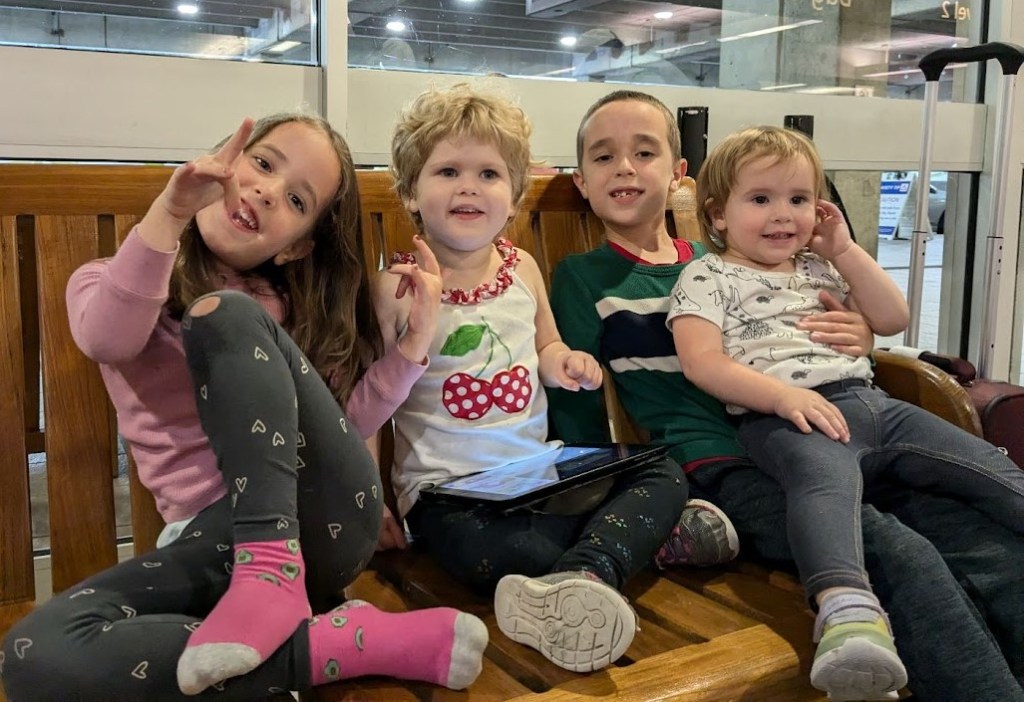
Each of our four family units (totaling seven adults and four children ages 1-6) made their own travel arrangements from Pittsburgh to Florida. To summarize what happened, a story I may write someday as a humor piece, by the end of our travel day, for a variety of reasons, members of our family got stuck in Chicago, Baltimore, Charlotte, and finally, Tampa, before eventually arriving in Orlando.

All the boarding passes Dan received in Charlotte before he finally managed to get on a plane!!

And then each of us had one issue or another with the rental cars we had reserved!

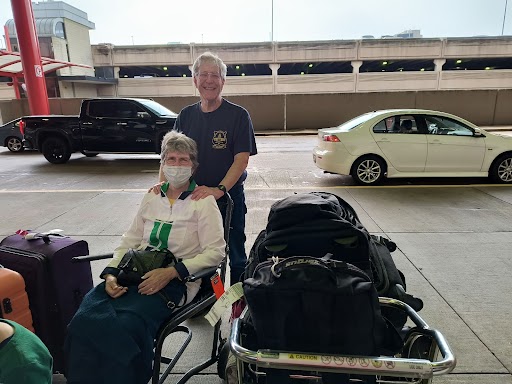
Orlando airport, waiting on rental cars. And waiting. And waiting …

Dave and I arrived at our BnB, without groceries, not at 3:00 p.m. but at around 9:00 p.m. Other family members trickled in after that. Supper was Moes (“So many chips!”), picked up by Rachel on one of her drives between car rental agencies. In a mix-up, before we left the Orlando airport, she handed me to eat on the hour plus drive to the coast the children’s bag (with gluten free options for Caleb) instead of our order. The total list of our comedy of errors deserves a humor tale!

That was Sunday. Monday, our son Dan tested positive for Covid. He spent much of the week in bed. On Friday, which happened to be my 70th birthday, I got sick, though I didn’t test (positive) until we got home to Pittsburgh on Saturday evening after getting up at 3:30 that morning to make our flight in Orlando. That’s another story.

Back in Pittsburgh–wiped out. And so happy about our wonderful vacation!

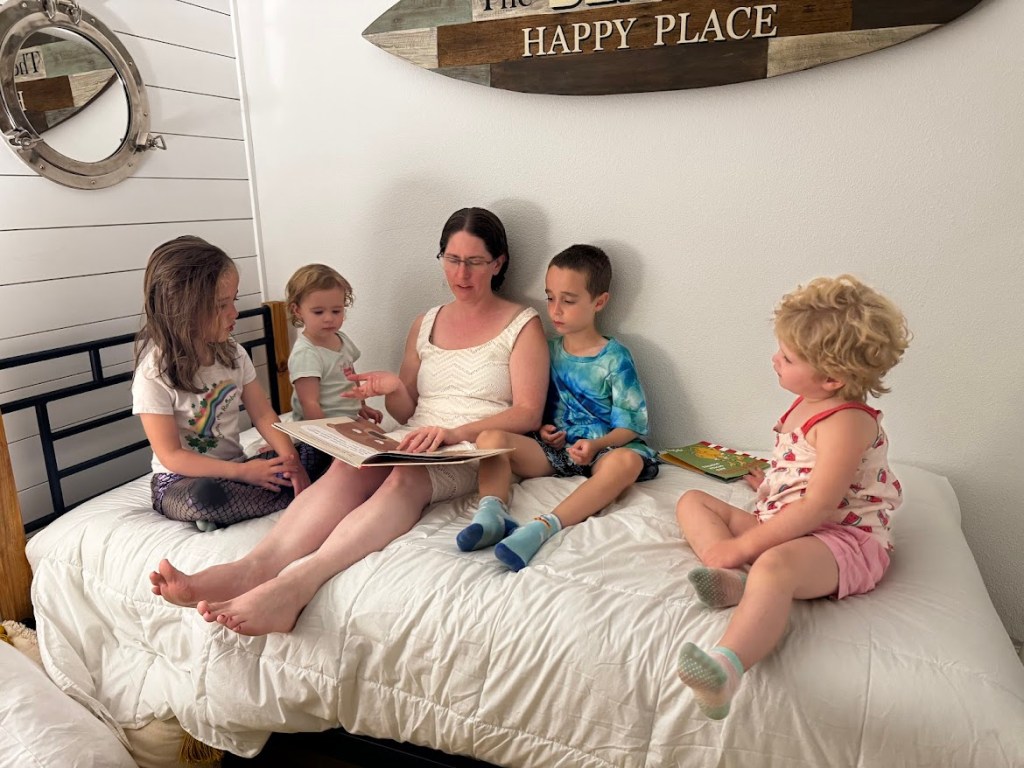
AND I think every member of our family would say we had a marvelous vacation week together. So much joy. Such special memories, including a wonderful dance performed for me for my birthday by Valerie and the kids (including the one-year-old!!) to the song Beloved by Jordan Feliz.

Making memories

So much beauty: the ocean, sunrises and sunsets, the kids advancing in swimming skills, sharing over meals and games … Dave even let me beat him at ping pong. No hurricanes, despite Caleb’s prayers–he thinks Pittsburgh weather is boring. And though we had some injuries, everyone made it home intact.

Back home, between my bed, the couch, and the kitchen table, to the sound of my hacking and blowing, I’m working hard to get everything together to submit Campfire Song Stories to the publisher. It was due, supposedly, August 15. Working with five illustrators, one of them in chaotic Venezuela who hasn’t figured out yet how to get her pictures to me, and one singer, and six stories in one volume, is a bit complex. And pure joy. I am so very grateful for the talents of each of these wonderful people, ages eleven to thirty-something, each one an answer to many prayers and not a little anxiety along the way.

One of Clara’s illustrations for the lullaby that ends Campfire Song Stories. Clara is twelve.

Caleb lost one more front tooth in time for his first day of first grade today. Valerie’s arm injury from a rogue ocean wave will require an MRI. And now Brian has Covid …

Hey, how are you today?

A walk in the woods

But God calls us to grow up with joy July 29, 2024

2 Corinthians 13:11 Be joyful. Grow to maturity. Encourage each other. Live in harmony and peace. Then the God of love and peace will be with you.

“Grammy, I want to walk on a trail.”

“I would love to go with you, Talita. Do you want to invite Caleb and Liliana too?”

“Yes, but Juliana is too little.”

I take a moment to observe my youngest granddaughter, deftly managing a popsicle in one hand and watermelon in the other.

As the three kids and I start down a sun-dappled trail into the woods, we decide they will take turns choosing which path to take each time we come to a “Y.” The chooser will be the leader until we come to another branch in the trail.

“Grammy, Caleb isn’t letting me be the leader!” yells four-year-old Talita as her six-year-old brother whizzes past her. “Caleb, come back!”

“I don’t want to go as slow as Talita. I want to RUN!” pleads Caleb, coming back to us.

I am thrilled with Caleb’s restored energy, now that he’s on the right diet for his newly diagnosed Celiac disease. I want him to celebrate feeling good again.

“Would you like Caleb to be your scout, Talita?” I suggest. “He can run ahead to the next curve and then come back to tell you what he finds out.”

“Good idea!” chimes in their four-year-old cousin Liliana. “When I’m the leader he can be my scout, too.”

“OK,” says Talita reluctantly. “I thought the leader has to always be in front.”

“A leader chooses which way for the group to go. But she needs information about what’s ahead to make a good choice,” I tell her.

“I’ll come back and tell you what I see,” promises Caleb, taking off again.

Liliana races after him. “I’ll be a scout with you, Caleb!”

Talita takes my hand and sighs. “I don’t think they’re letting me be the leader.” She starts singing, then stops. “Sing with me, Grammy!”

“I’m sorry, I don’t know this song.”

“You could learn it on your phone.”

“But then I would be looking at my phone instead of enjoying the pretty flowers and trees.”

“Why did you bring your phone, then?”

“In case one of us gets hurt, or we get lost. I can use my phone to call for help.”

Caleb runs back to us with a lacy white flower.

“There are lots more of these around the bend, Talita. Hurry up so you can see them.”

“Grammy, the flower tickles my mouth when I smell it,” giggles Talita. “Here, try it!”

I take the flower and tickle my mouth as Talita grins. Then I hand the flower back to her and turn to Caleb.

“Thank you for your excellent scouting. The flower is very pretty. But do you remember—there’s a rule in parks. We can’t pick the flowers. We have to leave them for other people to enjoy too.”

Caleb hangs his head. “I forgot. I wanted to show it to Talita.”

“Tell you what. Next time we see pretty flowers we can take a picture. That’s a way of taking it home with us.”

“I saw pink flowers!” yells Lili. “Take a picture of me with them, Grammy.”

“Can I take the picture of Liliana and the pink flowers?” asks Talita.

“Good idea!” says Lili.

We all hurry after her to the site of the photo shoot. After one picture morphs into a series of photos in Talita’s hands as Lili makes funny faces, and of course a selfie, we continue down the trail.

Growing up involves so many skills, I muse. Learning to accept boundaries. Exploring possibilities. Practicing skills of negotiation. Trying different roles. I love these precious times with my littles. Oh— “No, Talita!” I yell. “We’re not walking in the river today!”

“Why not?” the other two ask me, running after their leader to the edge of the creek.

“Your parents agreed to a walk on a trail. Not to a walk in the river. I don’t think they brought clothes for you to change into. We can walk in the river another day.”

“Well, I’m already wet,” says Talita. “And don’t you always tell us we’ll dry?”

“I see a Y up ahead! It’s my turn to be the leader!” yells Lili. “Carry this big stick for me, Grammy, to show Juliana. Do you want to be a scout now, Tata?”

“Don’t call me Tata. No. Caleb can keep being the scout. I’ll walk with Grammy.” Talita comes out of the creek and takes my hand again. “But I’m the photographer, Liliana, so tell me if you want more pictures.”

“Good idea!” says Lili, dashing after her scout.

“Ooo, my shoes are squishy. But—”

“They’ll dry,” Talita and I say together.

Talita starts singing in Portuguese a song I do know, “Alelu, alelu, alelu, aleluia, glórias a Deus.” She picks up a stick to direct me in singing alternate phrases of the song. Then we follow our new leader down the branch of the Y she chooses, this one looping back to where we started our walk in the woods.

Talita glimpses our picnic site, adds her director stick to the collection the kids have asked me to carry to show Juju, and takes off after Caleb and Liliana.

I watch the kids’ reunion with their parents, and their excitement as I arrive with their treasures: dry leaves, one of them “gigantic,” sticks of several sizes, bark that has fallen off a tree trunk, a rock Caleb says is shaped like a gemstone, and the tickly white flower.

As I watch them, I hope I never grow too “mature” to enjoy the woods through the eyes of a child.

And vice versa

But God’s joy is our strength

Nehemiah 8:10 The joy of the Lord is your strength.

Two weeks ago, Dave and I were in Pereira, Colombia (coffee-growing country) speaking at the first Latin American REVER Congress (people came from fourteen countries!).

Dave and I are in there somewhere!

The theme was “Restoring Joy in Difficult Times.” For some reason, the organizers thought Dave and I might have something to say about that topic. They assigned us five 90-minute talks. I also had two two-hour workshops and Dave had two 90-minute sessions with pastors. All in two days!

Our five sessions were “Finding Jesus in the Storm,” based on John 6:16-21, “Restoring Joy in My Difficult Times” (Dave talked about what helped him through his five major depressions), “Finding Joy in Chronic Suffering” (using Karis’s experience as a case study), “Discovering Joy in Marriage and Ministry” (this one was the most challenging for Dave and me to do together—but our intense preparation paid off!), and “Celebrating Joy in the Church in Difficult Times” (Dave’s final address).

For the Chronic Suffering talk, I highlighted five Scriptures that anchored Karis and me through her thirty years. Here’s a story I told in connection with Nehemiah 8:10:

I often heard Karis humming a song, “The Joy of the Lord Is My Strength.” When she sang it, she often inverted the words as well, “The strength of the Lord is my joy.”

“It’s impossible for me to muster enough strength to cope with my situation,” Karis told me. “Admitting this allows me to rest in the strength of the Lord. It relieves me of a lot of stress, not having to be strong myself. I’ve given up trying harder. Instead, I relax into God’s power.”

Friends often visited Karis in the hospital or at home to encourage her. I noticed a pattern: within a minute or two, Karis would redirect the conversation to her visitor’s concerns and would end up praying for them.

One day a friend visiting Karis at home exclaimed, “Karis, explain to me how you manage to deal with your situation.”

“My situation?” asked Karis.

“Yes, all of this.” The friend made a sweeping gesture that encompassed Karis’s TPN pump and IV pole and oxygen that tethered her, the hospital bed, commode, dressings, ostomy supplies, rows of meds, etc. “How can you smile and avoid bitterness when you suffer so much?

“We are the same, you and me,” Karis told her. “You just told me about the problems you face in your life. Your problems are too big for you, and mine are too big for me. We’re both forced to depend on God’s strength and wisdom.”

“True, but… your problems seem much more serious than mine,” the friend replied.

“Well, since both your problems and my problems are greater than our strength, there’s no point in comparing them. What matters is our dependence on the Lord.”

“For example…”

“For example, today when I woke up, before I opened my eyes, I said to God, ‘Ah, Lord, how I wanted to wake up today in Heaven with you. But here I am … You know, Lord, that I do not have the strength to endure this day. So, for whatever reason you still want me here, you have to live this day for me. I absolutely depend on your grace covering my weakness.’ And here we are, you and I, sharing those precious moments together, celebrating the strength and joy of the Lord.”

I witnessed conversations like this many, many times. The joy of the Lord was Karis’s strength. And the strength of the Lord was her deepest joy.

After her death, this friend told me, “Each time I want to complain about what I have on my plate, I think of Karis. God’s strength was big enough for her. It is surely big enough for me, too.”

For you and me also.

Joy of the Lord by Rend Collective