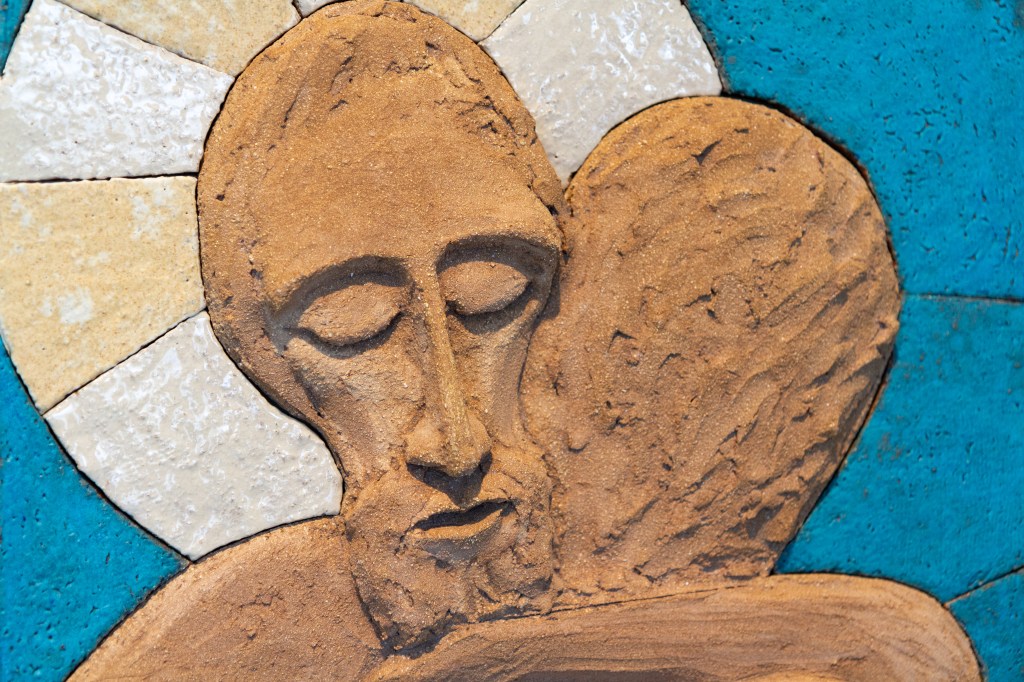
What’s your story?

Lenten question from John #6

John 5:46-47 If you really believed Moses, you would believe me, because he wrote about me. But since you don’t believe what he wrote, how will you believe what I say?

Matthew 5:17 Don’t misunderstand why I have come. I did not come to abolish the law of Moses or the writings of the prophets. No, I came to accomplish their purpose.

As my grandchildren helped me prepare to honor their grandfather on his St. Patrick’s Day birthday, we talked about why I love the shamrock: three hearts linked together, reflecting the love of each member of the Trinity, Father, Son, and Spirit. Since I’m currently writing a book for grade schoolers that I hope will help them understand the Trinity, I’m more alert than usual to these images and to all that I can glean from Scripture about the Three-in-One in world cultures.

There’s a theory in missiology that God has implanted in every culture a witness about Jesus and the redemption story. Bruce Olson wrote about this in his story from Ecuador, Bruchko. Seehttps://www.canaacademy.org/blog/bruchko-renewing-culture-in-the-forbidden-jungle . I LOVE hearing stories about Jesus appearing to Muslims in their dreams, a highly revered way of seeing in their culture.

The writings of Moses and other prophets, of course, held primary religious and cultural authority for the Jewish people of Jesus’s time. Jesus challenges the Jewish leaders, though, about how well they understood and believed the prophecies about himself embedded both implicitly and explicitly in the books of the law. Could they “see” what was there? Or were they more interested in “using” the Scriptures to elevate themselves while they burdened their followers with excessive legalism? Did they miss God’s compassion and grace?

One of my favorite images from Moses’s writings is the Passover Lamb in Exodus, whose blood protects and saves each household as the angel of death “passes over” the doorway of any home painted with the lamb’s blood. What is your favorite Christ image in the books of Moses?

I’m just home from Bogotá, an intense week with 470 people from 23 countries who gathered for the Latin American Discipleship Summit which my husband helped organize along with a dedicated planning team. I kept wishing for time to find out each person’s story, and particularly what about the Gospel story touched them at such a deep level that they dedicated their entire lives to Christ and his church. What did the Spirit use in each one’s life experience and culture and belief system to “click” with their hearts and minds? What’s your story? I would love to know.

Two minutes more of Individual reflection time, followed by group discussion at our tables. “My” table was #14, with people from nine different countries, denominations, ages, and ministries among the ten of us, all strangers who developed deep bonds across the four days of the Summit. What a wonderful experience!

Here’s a link to a collage of images from the first three days of the Summit (there’s a flash of me at my table at 21 seconds):

https://drive.google.com/file/d/1KoPvDMiPUm2c6ztLg4Y5t5jLasF4vu7O/view?usp=sharing

Would you like to get well?

But Jesus looks deeper  Lent 2025 question #5

I’m writing to you today from the wonderful city of Bogotá, Colombia. Dave and I are here along with 470 others from 23 countries for the Latin American Discipleship Summit, which Dave has been preparing for the whole last year. We would appreciate your prayers. If you want more information, please let me know!

John 5:5-7 A man lying there had been sick for thirty-eight years. When Jesus saw him and knew he had been ill for a long time, he asked the man, “Would you like to get well?” “I can’t, sir,” the sick man said.

This fifth one of our twenty questions for Lent from John’s gospel seems rhetorical at first. There’s only one possible answer. Of course he would want to get well. Right?

The man didn’t answer Jesus’s question. He knew his situation was impossible, so what did it matter what he wanted? He had long since given up giving credit to his own desires. He had settled into life as a victim of his circumstances. In certain ways—the specifics aren’t clarified for us (see verse 14)—he had abdicated maturity.

Sometimes giving up on our desires is appropriate. I was amused yesterday when, on an errand with me to the bank, wearing a tutu, my granddaughter Talita informed the teller she wanted to be a ballerina when she grew up. The teller asked her whether she was taking ballet lessons. Talita said, “No, my mom hasn’t found ballet lessons for me. So, I think instead, I want to be an artist. My brother is teaching me.”

At age just-turned-five, Talita’s desires are fluid. She has time to try out all kinds of different aspirations. At this point in my life, though, I’m asking myself what desires I’ve given up on, desires that I once believed God had given me but seem, at age 70, impossible. Perhaps they are. Perhaps it’s time to bite the bullet and admit my limitations.

But to do so in a healthy way, I think I need to answer Jesus’s question—What do I want?—before leaping to the impossibilities. And of course, linked to the question of what I want is the question of what God wants. If he wants me to fulfill one of my dreams, nothing is impossible. The real question becomes, “Am I willing to pay the price to accomplish this? Am I prepared to do my part?”

The man Jesus healed had to face huge adjustments after thirty-eight years as an invalid. He had to learn how to be a responsible adult. How to care for himself. How to navigate peer relationships in which he was no longer a victim but a survivor.

God can be trusted to do his part. Am I prepared to do mine?

Shutterstock AI

Seeing is believing

But Jesus stretches us Lent question #4

John 4:47-50 [A government official’s son was very sick.] When he heard that Jesus had come from Judea to Galilee, he went and begged Jesus to come to Capernaum to heal his son, who was about to die. Jesus asked, “Will you never believe in me unless you see miraculous signs and wonders?” The official pleaded, “Lord, please come now before my little boy dies.” Then Jesus told him, “Go back home. Your son will live!” And the man believed what Jesus said and started home.

John 20:27-29 Jesus said to Thomas, “Put your finger here and look at my hands. Put your hand into the wound in my side. Don’t be faithless any longer. Believe!”

1 Peter 1:8 You love him even though you have never seen him. Though you do not see him now, you trust him; and you rejoice with a glorious, inexpressible joy.

First signs of Spring! Its here!!

Karis was in high school, missing as many school days at her school in Brazil as she was able to attend, increasingly hampered by severe symptoms of bowel dysfunction. Her doctor in the U.S. retired. (Retired! Didn’t he understand how much we depended on him?!) His partner refused to take on Karis’s care, along with a disheartening parade of Brazilian doctors.

And I failed the faith test. When Dr. P disappeared from our lives, I felt like GOD disappeared. I felt abandoned and alone. Because I couldn’t see God caring for Karis, I struggled with belief. For months.

By then, every member of our family was deeply immersed in our life in Brazil. And even if I did take Karis to the U.S., where would I take her? If the doctor who knew Karis best—Dr. P’s partner—thought her case was too perplexing for him, what hope was there that anyone else would take her on? She didn’t have the energy to travel around the U.S. trying to find a doctor who could understand her unique situation. Many people prayed for her healing. Nothing changed.

As I grew more discouraged, it seemed Karis’s faith grew stronger. She trusted her Father, and experienced the joy Peter describes. She gamely visited yet one more physician in São Paulo, submitted to the exams, listened courteously to one more doctor tell her he couldn’t help her, and on the way home did her best to comfort me.

So, I feel great empathy for both the official in John 4 and for Thomas. And eventually, like Thomas, I was able to hear and respond to Jesus telling me, “Don’t be faithless any longer. Believe!”

Remembering that experience strengthened me for later faith challenges—and heightened my appreciation of the times God generously let me see him at work. Pure mercy.

You had to have been there

But Jesus speaks about what he has seen and heard March 17, 2025

One of many rainy days in Ireland, we ate delicious fish pie at the Old Thatch, featured in Horse Thief 1898 and Facing the Faeries 1906. This inn ad bar has fostered community in the small town of Killeagh since 1650. Roaming the emerald isle, we could have used the umbrella Dave received as a birthday gift at his family party yesterday. Dave and I have learned to bundle up enough to walk in subzero weather. Now we can walk together in the rain too! A goal for the rest of 2025: walk outside every day, even if only around the block, once we get home from our trip to Colombia next week..

Happy birthday, Dave! Happy St. Patrick’s Day, everyone! Two years ago today, Dave and I landed in Dublin, with a triple purpose: to celebrate his 70th birthday, to (belatedly) celebrate our 45th wedding anniversary, and to experience and research parts of Ireland for Facing the Faeries 1906, Book 3 of the Cally and Charlie historical fiction series. I had already written this blog, featuring Ghana, when I realized it would be posted on March 17. I could have used Ireland instead, an equally relevant experience to communicate “you had to have been there,” as we consider our Lenten question(s) #3 from the gospel of John. Oh well, here you go …

John 3:7-10 Jesus replied [to Nicodemus], “I assure you; no one can enter the Kingdom of God without being born of water and the Spirit. Humans can reproduce only human life, but the Holy Spirit gives birth to spiritual life.” … “How are these things possible?” Nicodemus asked. Jesus replied, “You are a respected Jewish teacher, and yet you don’t understand these things?If you don’t believe me when I tell you about earthly things, how can you possibly believe if I tell you about heavenly things?

John 3: 31-32 [John the Baptist said] “We are of the earth, and we speak of earthly things, but he [Jesus] has come from heaven and is greater than anyone else. He testifies about what he has seen and heard. … For he is sent by God. He speaks God’s words, for God gives him the Spirit without limit.”

I’d read about Ghana, exchanged emails with Ghanaians, talked with a Ghanaian visitor to Pittsburgh, and even seen videos and documentaries based in Accra. But being there was something else entirely. Those few days enriched and changed me, not only sensorially but spiritually as well. I can try to describe to you, and you can imagine to some degree, but unless you visit Accra and participate in worship there, you’ll have only a shadow of understanding what my words mean: the wonder and joy of full-throated, dancing praise in a dozen languages at the same time, embellished by the blazing colors of Ghanaian fashions. I experienced it as a foretaste of Heaven.

So I empathize with Nicodemus, and I think Jesus does too. I’ve read Jesus’ question, “yet you don’t understand these things?” as a rebuke. But as I read it now, I imagine Jesus saying this with a different tone of voice, one of sympathy and acknowledgement of the limitations of Nicodemus’s experience. For all his learning, Nicodemus can no more understand Heaven than I could accurately imagine Accra. Even now, having been there only once and only for a few days, I know my knowledge of Ghana, vivid as it is in my memory, remains woefully small.

But Jesus lived in Heaven from all eternity. He speaks, John the Baptist says, of what he has seen and heard. When he speaks of the infinitely costly Trinitarian love behind his incarnation, for the sake of saving the world (not condemning it), he knows what he’s talking about. I imagine Jesus’s mind flooded with memories of the divine consensus that resulted in his sitting beside Nicodemus in the darkness of that night, shining eyewitness light into the dimness of this scholar’s third- (fourth-? fifth-? hundredth-?) person understanding of Scripture.

In concert with the Trinity, Jesus had created Earth and humanity. And now, he experienced human emotions, limitations, and frailties firsthand, allowing him to personally connect with Nicodemus’s doubts and questions and needs. Through the Holy Spirit, he does the same with us. Because he became a man, breaking down the barriers between Heaven and Earth, we can walk straight into God’s throne room to share our joys and sorrows, anxieties and hopes with the King of kings, with no fear of recrimination. The same ease, I thought yesterday, with which our grandchildren soak up Dave’s warm affection.

Birthday banner the four grandkids made for Dave yesterday

So then, since we have a great High Priest who has entered heaven, Jesus the Son of God, let us hold firmly to what we believe. This High Priest of ours understands our weaknesses, for he faced all of the same testings we do, yet he did not sin. So let us come boldly to the throne of our gracious God. There we will receive his mercy, and we will find grace to help us when we need it most (Hebrews 4:14-16).

P.S. The planning team for the huge event in Bogotá next week just sent Dave this sweet tribute:

Happy birthday, David.

https://drive.google.com/file/d/14vlyIDml6xHiXzdqW8b1kILvDiRUULxF/view?usp=sharing

Hiding in plain sight

But Jesus asked, “Do you believe this because I saw you?”

John 1:47-50 Jesus said, “Now here is a genuine son of Israel—a man of complete integrity.” “How do you know about me?” Nathanael asked. Jesus replied, “I could see you under the fig tree before Philip found you.” Then Nathanael exclaimed, “Rabbi, you are the Son of God—the King of Israel!” Jesus asked him, “Do you believe this just because I told you I had seen you under the fig tree? You will see greater things than this.

“I see you!” or “I found you!” my granddaughter shouts gleefully. Then it’s her turn to hide, and at age two, she’s not expert in concealing herself. Part of my role is pretending to look in multiple places, detailing my “search” aloud, before I “find” her. A bit younger, she thought that if she couldn’t see me, if her eyes were closed or covered, I couldn’t see her.

Three of our littles, resting after an intense game of hide and seek

“’Hiding’ from God is like this,” I muse. “Even if I want to, I can’t actually hide from him, physically, emotionally, or spiritually.”

If you’ve seen the episode about Nathanael in Season 1 of The Chosen, you remember his turmoil and grief as he sat under that fig tree. In such a moment of despair, doesn’t each of us long to be truly seen, fully understood? There is so much more going on here than physical sight. Jesus sees Nathanael from a great distance, yes. But more than seeing his body, Jesus sees his heart, his soul, his desperate need.

As I’ve thought about Jesus’ earlier question, “What do you want?” highlighted in Monday’s blog, I realized this is what I want most, to be seen by the Lord. And to clearly see him. In all the complexity of life, all the competing desires and motivations, confusion of judgment and action, to be seen and to see truly, to be understood and to understand, feels to me right now to be the greatest gift I could ever desire.

The words “see,” “seen,” “saw,” occur twelve times in John 1, along with many other vision words: light in darkness, recognize, glory, reveal(ed), testimony (eyewitness), look (or behold), find, found. “Come and see,” Jesus invites two men (v. 39), and what he showed them in a few hours—far beyond what they had asked, simply to know where he was staying—convinced Andrew that Jesus was the Christ, the Messiah, the Anointed One for whom every faithful Jew had been waiting for their entire lives, for hundreds of years.

John states explicitly why he wrote his Gospel, some three decades after Matthew, Mark, and Luke had written theirs: “so that you may believe [continue to believe] that Jesus is the Messiah, the Son of God, and that by believing in him you will have life by the power of his name” (20:31).

John’s book is crafted with this purpose in mind, from the first chapter to the twenty-first. I’m intrigued by the names of Jesus John records in chapter one. He is the Word (the Logos, the source and expression of all creation). The true light. The unique One. Consistent with his prophetic insight, John the Baptist calls him the Lamb of God and the Chosen One of God. Andrew tells Simon Peter he has found the Messiah, the Christ.

And in the last few verses of the chapter, John offers us this sequential revelation:

              Philip calls Jesus the son of Joseph (v. 45).

(Not quite right, Philip, but good try. True, he’s the adopted son of Joseph.)

              Nathanael calls Jesus the Son of God (v. 49).

Amazing for him to recognize this on first meeting Jesus.

              Jesus calls himself the Son of Man (v. 51).

For a long time, I’ve puzzled over why “Son of Man” is Jesus’ favorite name for himself. I think now I kind of get it, in an awestruck kind of way. I’m writing a book that is largely set in Heaven. From Heaven’s point of view, the Son has always been Son within the holy Trinity. What is new, incredible, too remarkable to be contained in words, is that the Son of God became a son of mankind, born of a human mother, taking on our humanity, laying aside his glory—too bright for human eyes—so that, in the fullness of the Spirit, he can reveal God to us. Truly, for Nathanael to understand the meaning of “Son of Man” is a “greater thing” for him (and for us) to see (v. 50).

Like when I drive around a corner and a rising or setting sun shines straight into my eyes, I’m blinded to anything else and must shield my eyes to be able to see anything else and drive safely. Jesus shields his glory as Son of God within his human body so that we can look at him and understand the Father.

Shutterstock: CGN089

The name “Son of Man” references the miracle of incarnation, a turn of events the angels could never have imagined. John’s sequence of increasing revelation makes sense. And leaves me with goosebumps.

No one has ever seen God. But the unique One, who is himself God, is near to the Father’s heart. He has revealed God to us (John 1:18).

So, do you believe? Has John’s purpose in writing this Gospel already impacted your life? If so, what have you seen and understood of Jesus that led to this belief?

Or is it the case that he sees you, hiding in plain sight?

Twenty questions

But Jesus asked, “What do you want?”

John 1:35-38 The following day [after his baptism by John the Baptist] John was again standing with two of his disciples. As Jesus walked by, John looked at him and declared, “Look! There is the Lamb of God!  When John’s two disciples heard this, they followed Jesus. Jesus looked around and saw them following. “What do you want?” he asked them.

Have you played the game Twenty Questions? When I was a child, my siblings and I entertained ourselves on long car trips playing this. A person thinks of an object, and the others try to guess it through asking fewer than twenty questions. The first question is, “Animal, vegetable, or mineral?” to narrow the field.

Shutterstock: moloko_vector

Jesus’ first question of two men following him also narrowed the field. They could have responded a zillion ways to the question, “What do you want?”

What do you want?

If Jesus showed up in your living room today asking this question, what would you answer?

Jesus is still, two thousand years later, asking this question. I invite you to take a few minutes to respond. And even to write down your answer. Think about it now. What do you really, really want?

Next time, I’ll share a few of my responses. I would love for you to share too.

The mystery of hope

But God is the only Savior

Hosea 13:4 [The Lord says] You must acknowledge no god but me, for there is no other savior.

And what a Savior! I encourage you to take a few minutes to ponder the words of this wonderful celebration of mystery: the hope we hold even in tumultuous times.

Blossoms in winter: 11 blooms this time.

Come, Behold the Wondrous Myst’ry

Keith and Krysten Getty, Matt Boswell, Matt Papa, Michael Bleeker

Come, behold the wondrous myst’ry in the dawning of the King,

He, the theme of heaven’s praises, robed in frail humanity.

In our longing, in our darkness, now the light of life has come.

Look to Christ, who condescended, took on flesh to ransom us.

Come, behold the wondrous myst’ry, he the perfect Son of Man,

In his living, in his suffering never trace nor stain of sin.

See the true and better Adam, come to save the hell-bound man,

Christ, the great and sure fulfillment of the law, in him we stand.

Come, behold the wondrous myst’ry, Christ the Lord upon the tree.

In the stead of ruined sinners hangs the Lamb in victory.

See the price of our redemption, see the Father’s plan unfold,

Bringing many sons to glory, grace unmeasured, love untold.

Come, behold the wondrous myst’ry, slain by death, the God of life.

But no grave could e’er restrain him: praise the Lor, he is alive!

What a foretaste of deliverance, how unwavering our hope:

Christ in power resurrected, as we will be when he comes.

What a foretaste of deliverance, how unwavering our hope:

Christ in power resurrected as we will be when he comes.

A love song from a broken heart

But God yearns for his people 

Hosea 11:1-4, 7, 8, 11; 12:6 When my people were children, I loved them … I myself taught them to walk, leading them by the hand. But they don’t know or even care that it was I who took care of them. I led them along with my ropes of kindness and love. I myself stooped to feed them. … But my people are determined to desert me. … Oh, how can I give you up? How can I let you go? My heart is torn within me, and my compassion overflows. … Someday, the people will follow me. … And I will bring them home again, says the Lord. … So come back to your God.

In Hosea 10, God spoke like a farmer. In chapter 11, he is a parent, broken over his children’s rebellion against him. A New Testament parallel is Jesus’ parable often called “The Prodigal Son.” In both cases, the father yearns for the return of his beloved, fugitive child, longing for restoration.

Shutterstock: Adam Jan Figel

I may have commented before that when I write stories, the characters themselves tell me what happens to them, and I just write it down. One scene, reminiscent of Luke 15, still brings tears to my eyes.

In Horse Thief 1898, Cally and Teddy went missing because they had been kidnapped by abusive relatives who wanted to use the orphans as farm labor. The loving people who had been caring for them did all they could to find and free them, but it was the children themselves who found their way home.

Nathanael, prepared to attend Ignacy Paderewski’s Carnegie Hall piano concert,

… sat on his porch swing singing an off-key tune to [his baby] Jimmy, waiting for James to bring the brougham. How grand to hear the famous Mr. Paderewski in the new concert hall!

Tobias wandered out holding the hand of his brother Ben, faces scrubbed, hair still wet.

“Father, look! Is that—”

Nathanael leaped to his feet, thrust Jimmy into Tobias’s arms, and ran down the street, his arms open wide.

Cally and Teddy were filthy. It didn’t matter.

Just so, our Father is thrilled when we come home to him. Even when we’re filthy. He is the one who makes us clean again; to quote Curt Thompson, “Seen, soothed, safe, and secure.”

Press on

But God says our love matters more than sacrifices

Hosea 6:1-3, 6 Come, let us return to the Lord. He has torn us to pieces; now he will heal us. In just a short time he will restore us, so that we may live in his presence. Oh, that we might know the Lord! Let us press on to know him. … [The Lord says] I want you to show love, not offer sacrifices. I want you to know me more than I want burnt offerings.

Over the last week and a half, as we marked eleven years since Karis left us, I have re-read Karis: All I See Is Grace. I couldn’t remember which parts of her life—of the three thousand pages of my first draft—had made the editing cut and into the book. I hadn’t remembered how often she referenced this passage from Hosea.

To understand this, it’s necessary to know that Karis had a high view of God’s sovereignty. She believed that NOTHING happened without the permission of God. He, all-powerful and all-knowing, could end or cause anything at any time. Often, she believed, he did not act when he could have because he so honors human free will. He wants us to choose him of our own volition. He wants us to obey him because we love him, not from force or manipulation. He gives us more latitude in our choices than perhaps we are wise enough to handle. Yet we learn from our mistakes. Painful as their consequences may be, God doesn’t usually step in to shield us from the results of what we have chosen. But this doesn’t mean he doesn’t see, or know, or care what we are going through.

A harder concept for me is Karis’s belief that her birth defect, with all its mosaic of positive and negative impacts on her life, was chosen for her by God. That his purposes for her required the suffering she endured. That had she not spent so much time in clinics and hospitals, she would not have met the people with whom she was meant to share God’s love.

I tend to think that Karis was born without functional intestinal nerves not because God so willed, but because we live in a fallen, imperfect world in which this kind of thing can happen. The question for me is whether we allow God to act within our circumstances to accomplish his desire to love others through us.

Either way, it’s clear God longs for us to know him. To personally know his heart of love toward us. To put ourselves intentionally in the way of knowing him better, in every way we can “pressing on” to know him and to love him, not whatever image of him we have inherited or invented. This, for Karis, was her lifelong quest.

Sovereign by Chris Tomlin

“Don’t fret”

But God calls leaders to account for their treatment of the poor, helpless, and oppressed

Hosea 5:1, 4, 5, 7-8, 15 Hear this, you priests. Pay attention, you leaders. … You have led the people into a snare by worshipping idols. … Your arrogance testifies against you. … You have betrayed the honor of the Lord. … Sound the alarm! … Admit your guilt and return to me.

Amos 2:4-7; 5:15, 21, 24 This is what the Lord says: “The people have been led astray by lies. … They sell honorable people for silver and poor people for a pair of sandals. They trample helpless people in the dust and shove the oppressed out of the way. … You twist justice, making it a bitter pill for the oppressed. … You trample the poor. …  Instead, hate evil and love what is good: turn your courts into true halls of justice. … I hate all your show and pretense. … Instead, I want to see a mighty flood of justice, an endless river of righteous living.”

Before I went to sleep, my friend said, “Don’t fret.”

But several times I woke up in distress.

I kept dreaming that I was with friends in a church, or a school, or a home, when ICE came and dragged my friends away. Not criminals. Not illegals. My friends, who had followed all the protocols to enter this country legally. Friends who love the Lord and their families, who work hard and pay taxes, even though they don’t yet receive the benefits of citizenship. Friends who were suddenly jerked away from their children, leaving them in shock and confusion.

Each time, an ICE person yelled, “Sorry, we can’t find enough criminals so we need you to meet our quota!”

Distraught, I went to the Lord. It seemed that current events fit alarmingly well into the prophets I’ve been studying: Hosea and his early contemporary, Amos.

When Hosea and Amos prophesied, King Jeroboam II of Israel had expanded its territory and its trade, making some people very wealthy and many others poor and destitute, ignoring the laws of Moses that would have preserved a level of economic equality. Instead of caring for all people equally, the king and his cronies engaged in and fostered syncretism. They pretended belief in God, while in fact practicing idolatry. They did all kinds of horrible things (including sexual slavery) to keep their god Baal happy, since they credited him with being the source of their prosperity. Instead of protecting needy people through the courts, the needy were “trampled” (Amos 2:7), used and abused and treated unjustly.

Amos preached at Bethel (“House of God”), which Hosea often calls Beth-Aven (“House of Wickedness”) because of the syncretism at this place of worship. Amos was not poor himself: the Hebrew words he uses in calling himself a shepherd denote an owner of sheep and orchards, not a laborer. Yet he anguished over the oppression inherent in the wealth gap of his day. He quotes God as saying, in the words of Eugene Peterson, “I’ve had all I can take of your noisy ego-music … Do you know what I want? I want justice—oceans of it. I want fairness—rivers of it. That’s what I want. That’s all I want” (Amos 5:24, The Message).

Curious about parallels to our time, I discovered that the wealth disparity in the United States has shifted dramatically in the last forty years. “Trickle down” economics hasn’t worked. The most recent figures I found show that the top 10% control 67% of the wealth, whereas the bottom 50% has access to only 2.5%. And this disparity continues to increase, as those with money and power control the laws and the courts to benefit themselves.

Can we expect God’s blessing on us under these conditions?

Interesting in terms of timing: the lesson this week for my international Zoom discipleship group includes Acts 2:42-47 and 4:32-37. “There were no needy people among them” (Acts 4:34), because everyone shared what they had, voluntarily and joyously.

How did this early church portrait become so distorted in practice over time? I know there are still many, many followers of Jesus—we ourselves are supported in missions by these beloved ones—who lovingly and generously share what they have in order to further the work of the Kingdom. Yet I’m left wondering what has happened to the community of believers, that we have supported such a different model nationally.

Don’t fret? “Trust God,” my friend told me. “Everything will work out fine in the end.”

I believe that is true. Ultimately God will bring justice to the world. Come, Lord Jesus. Meanwhile, though, people’s lives, already traumatized, are being smashed to pieces.

I appreciated a song we sang in worship yesterday (God of All Comfort, Resound Worship):

God of all comfort, God of compassion, reveal your mercy through us your church;

Disturb our slumber, move us to action, to show your kingdom on the earth.

Make us like Jesus, full of your Spirit, declaring good news to the poor,

Proclaiming freedom for every captive and the favor of the Lord.

Show us the value of every person, show us your image in every face.

We all are equal, we all are broken, and need the kindness of your grace.

We stand together, here in the margins, here in the hardship and the pain.

We cry for justice and restoration, until the silent sing again.