Paul’s Songs: In Community

But God wants us to worship with understanding

1 Corinthians 14:15-17 I will sing in the Spirit, and I will also sing in words I understand. For if you [a rare singular] praise God only in the Spirit, how can those who don’t understand you praise God along with you? How can they join you in giving thanks when they don’t understand what you are saying? You will be giving thanks very well, but it won’t strengthen the people who hear you.

While writing Three-in-One: The Mysterious Friendship of Derry and Benny, I thought a lot about worship in Heaven. Will the gathered believers from around the world and through all human history each worship in their own language? Will it be like Pentecost in Acts 2, when the Holy Spirit empowered Jesus’ followers to understand and speak languages they had never learned? Will everyone there speak the same language?

If you read Three-in-One,you’ll see how handled these questions for the sake of the story. But of course, I don’t know for sure. As I say in my letter to parents prior to the story, I can’t wait to find out what Heaven is really like.

Here on Earth, Paul thought it important that communities of believers be able to sing together, understanding the words they sang, to encourage and strengthen each other’s faith. I’ve described before my experience of worship in Ghana, where the people who gathered for a conference on discipleship spoke dozens of languages. The worship leader wisely chose songs that had been translated into all these different tongues—and I knew them as well, in English, Spanish, and Portuguese! While not understanding a word of what the people around me sang, we praised God with the same lyrics. The music bound us together in our love for the Lord—a taste of Heaven!

Ghanaian Joy Shutterstock: Sura Nualpradid

The Spirit guides and fills our worship. And understanding each other’s worship enfolds us in a crescendo of praise to our compassionate, all-powerful, all-knowing, incomparable God.

When I discovered Darlene Zschech’s wonderful song Shout to the Lord (All the Earth) sung by Darlene with Ana Paula Valadão, Ingrid Rosario in my three languages, I wept at its beauty.

Paul’s Songs: Steve’s Story – Fear or Confidence? By pastor and artist Steve Easterwood, Kirksville, MO

But God makes you strong March 4, 2026

Romans 16:25, 27 Now all glory to God, who is able to make you strong. … All glory to the only wise God, through Jesus Christ, forever. Amen.

I met Steve in high school, when we both participated in the youth group at our church. He has a particular prayer burden for Ukraine. Pastor Steve is a gifted artist. See more of his work at SteveEasterwood.com. He invites you to email him at SteveEasterwood@gmail.com.

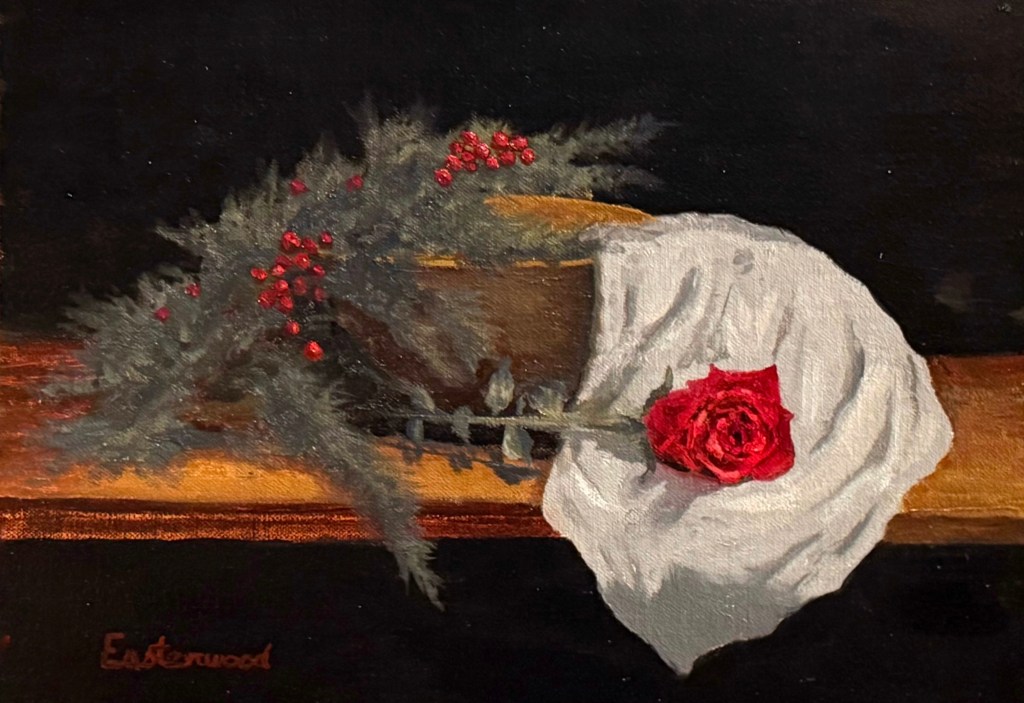
Above: The Christmas Rose, by Steve Easterwood How many symbols representing Jesus can you see in this painting?

Right: Mary, by Steve Easterwood. What stands out to you?

Here is Steve’s story:

Sometimes people who are not yet believers in Jesus ask me, “What difference does Christ make in your life?” He makes all the difference in the world!

In December 2020, I was having some minor swallowing issues, and after a scope, I was told that I had a seven-inch cancerous tumor wrapped around my esophagus.

We all wonder on those sleepless nights how we’ll respond if the diagnosis is cancer. I was no different. There were nights when I wondered the same thing. That night, as was my practice, I prayed and committed my situation to the Lord. I told Him that my life was in His hands and that I trusted Him, whatever His decision about my fate. With that, I fell asleep.

The next morning, I received a notification from my watch that I had experienced the best night of sleep I’d had in four months! How can that happen the night after you receive a serious cancer diagnosis?

I fell asleep absolutely convinced that my situation would have one of three outcomes:

First, God could heal me. I firmly believe that the God of the Bible still heals today.

Second, Jesus could return and take me home.

Third, I could die and, as the Bible says, to be absent from the body is to be present with the Lord (2 Corinthians 5:8). When someone dies, people say, “He lost his battle to cancer.” But where’s the loss? There are only three outcomes, and each one is a win for me!

That’s how you sleep like a baby after you’ve had a cancer diagnosis. So far, God has chosen option number one. He is still Jehovah-Rapha, God the healer.

Recently, I found out that the five-year survival rate for my type and stage of cancer is 0%. Yet, here I am, still alive today. I believe that God still has a mission for me to accomplish. Until that mission is finished, nothing, including cancer, can take my life. When that mission has been accomplished, nothing can keep me alive for another second.

Until the time when God chooses to take me home, I will put all my energy into taking as many people to heaven with me as possible. I’m 71 years old. There’s a party waiting for me soon in heaven. Until that time, I plan to share God’s message of Good News so that people can be confident about where they will spend eternity. My question to you is this: How would you sleep on a cancer diagnosis? If you have faith in God, you won’t have to fear the outcome, and you can sleep like a baby!

Give Thanks by Don Moen

Paul’s songs: Praise for God’s grace to all people

But God loves harmony

Romans 15:5-11 Live in complete harmony with each other, as is fitting for followers of Christ Jesus. Then all of you can join together with one voice, giving praise and glory to God … Accept each other just as Christ has accepted you. … Remember that Christ came as a servant to the Jews … He also came so that the Gentiles might give glory to God for his mercies to them. … “Praise him, all you people of the earth” [Psalm 117:1].

My granddaughter Juliana spent 24 hours with me while her mom and sister Liliana visited Valerie and family in São Paulo, Brazil. She loved watching neighborhood deer eat groundcover on our front slope–nine of them this time!

This second week of Lent, I’m thinking about grace. Grace in relationships.

My husband and I usually attend the 9:00 service at our church. I enjoy opportunities to attend the 11:00 service at our church, though, so I can hear the choir sing. This rarely happens at 9:00. The harmony created by skilled musicians combined with enthusiastic worshipers thrills my heart, as I imagine it does the Lord’s.

I have several close friends in the choir. They tell me it’s about more than singing on Sundays. It’s about community, about sharing their lives, praying for and supporting one another. A usually shy friend feels completely comfortable in that group.

Which type of harmony matters more to the Lord? That’s hard to say. Paul implies that harmony of relationship is necessary for true praise (verses 5-6). I think that applies to all of us—families, friends, colleagues, neighbors—not just to those in a formal grouping like a choir.

Pushing this back a step further: to have harmony with other people, I need first to cultivate personal harmony with the Lord. Do you ever experience a song or psalm of praise welling up in your heart at some random time of the day? That happens to me often. I understand it as the Holy Spirit’s invitation to participate in the praise of Heaven, where people and angels never cease to worship the Lord.

This heart-worship matters to me enough that it helps protect me from discord with other people. When that does happen, I’m highly motivated to resolve the tension, because I don’t want my internal praise interrupted just because I’ve been selfish, insensitive, stubborn, critical, or envious.

When I think about how Christ has accepted me, with all my failures and foibles, how can I reject a brother or sister for whom Jesus shed his blood? In the Body of Christ, “us” and “them” must take a back seat to the fact that we’re all sinners saved by grace. Even if we don’t agree about much of anything else.

How wonderful and pleasant it is when brothers live together in harmony … For harmony is precious … Harmony is refreshing … There the Lord has pronounced his blessing [Psalm 133].

Psalm 117 in a canon Geneva Academy

Psalm 117 Highway to Zion

Paul’s songs: His mercy is more

But God had patience

Romans 4:7-8 [quoting Psalm 32:1-2] “Oh, what joy for those whose disobedience is forgiven, whose sins are put out of sight. Yes, what joy for those whose record the Lord has cleared of sin.”

1 Timothy 1:15-16 Christ Jesus came into the world to save sinners—and I am the worst of them all. But God had mercy on me so that Christ Jesus could use me as a prime example of his great patience with even the worst sinners.

By God’s mercy, joy can become the other side of profound distress.I believe this in my head. In many ways I believe it in my heart as well. But it seems God is calling me today to a deeper experience of this joy.

Karis in 2009 with one of her doctors

Spring, 2009. Overwhelmed. Beyond fatigued. No longer tolerating the unrelenting stress. Teetering on the edge of emotional breakdown.

These words inadequately describe my condition when I made an impulsive decision to get out of Dodge. Or in my case, out of Pittsburgh.

Every other time I left Karis in Pittsburgh, I planned and prepared for weeks. The person (most often my generous sister Jan) who relieved me arrived a week ahead of time to get up to speed with the complexities of Karis care. Complexities that one home health agency after another declared too much for their nurses.

This time, no one could come. Desperate for relief, I patched together a care team of five people who reluctantly agreed to cover a day or two each. I “trained” them for a couple of hours, pointing out pages of written instructions they absolutely must follow. Ignoring my conscience, I got on a plane to Brazil. My home. A place to crash, to be accountable to no one. Precious friends who breathed life and energy back into my parched soul.

The first message came from the hospital. “The paramedics were able to stabilize Karis, but we will keep her here until you return.”

Adrenaline flooded me as I began throwing things back into my suitcase.

The next message was just as cryptic. A telegram from the kind friends who had given us space in their home when we could not afford an apartment: “Come back. Now.”

I went there first. The shouting began when I opened the door to the house. It included phrases like, “If she had died under my roof, I WOULD NEVER FORGIVE YOU! NEVER!” and “You are no longer welcome here.”

A bit at a time, the story emerged. One of the caregivers had given Karis ten times the correct dose of insulin. When the ambulance arrived, her blood sugar was 23.

God was merciful. Karis didn’t die. But this was only one of at least a dozen ways Karis could have died, from mistakes of well-meaning but inadequately prepared and resourced friends.

What on earth had I been thinking? How could I have done what I did, exposing my daughter to such danger—and my friends as well, when Karis’s care at home was deemed too difficult even for trained nurses?

The truth, of course, is that I wasn’t thinking about anything but my own survival. Eventually, with help, I was able to accept God’s forgiveness. My friend’s forgiveness—my friend who had sacrificially opened her home to us—and healing of our broken relationship took quite a bit longer.

This morning, out of the blue, I woke up to the startling question, Have I forgiven myself? Where did that come from? I must have been dreaming about this incident in 2009.

The tears that flooded my eyes bore mute testimony to the challenge in this question.

Yes, God was merciful. Karis did not die from my negligence. Profound mercy.

But finding mercy for myself? That’s … different. I don’t yet know how to get there.

And as I read again Paul declaring himself “the worst of sinners,” I wonder. Was he able to forgive himself?

Four other times in 2009 Karis almost died—not from negligence, but because of the extremity of her medical situation. Each of those times our family gathered from three continents to say goodbye. Each time, we experienced mercy as, beyond hope, God brought Karis back to us.

Today, perhaps, God in mercy invites me to a new level of healing. And of joy.

His Mercy is More Matt Boswell and Matt Papa

Paul’s songs: The Lesson of the Tambourine, by Barbara Alexander, Villers-St-Paul, France

But Jesus receives highest honor

Romans 14:11 [Isaiah 45:23] “As surely as I live,” says the Lord, “every knee will bend to me, and every tongue will confess and give praise to God.”

Philippians 2:9-11 [Isaiah 45:23] God elevated Jesus to the place of highest honor and gave him the name above all other names, that at the name of Jesus every knee should bow, in heaven and on earth and under the earth, and every tongue confess that Jesus Christ is Lord, to the glory of God the Father.

My friend Barb lives in a small village in northern France. She’s very active in this community. Here’s Barb:

Yesterday morning, as is usual for most every Sunday in my life, I went to church. I long ago noted that drums are the only percussion instrument played during the worship time. So, being a musical person myself, I bring my little tambourine-on-a-stick in my purse each week, and I play it appropriately to add to the spirit of the livelier songs.

Shutterstock: Talita Nicolielo

Occasionally one of the little kids in church (who know me from being in our home group together) sidles up to me with a hand outstretched toward my tambourine, ready to play it. Yesterday it was little 5-year-old Paul. So I placed his right hand on the wooden stick, tapping his left palm to the beat of the music, as he’s seen me do. My hands remained on top of his hands to make sure he played the instrument correctly.

We were both enjoying the dinging sound of the tambourine and how it added to the joy of the worship songs as I guided his hands. But every now and then Paul would begin his own rhythm and tapping, and I could feel his resistance to my guidance. When this began happening, I tried to gently encourage him. “Relax, Paul,” I’d say. “Let my hands help you do the rhythm.” After these words, he’d ease up and let me guide him, which kept a better rhythm than he made on his own. And we both enjoyed the sound we heard and were pleased with our contribution to the worship time.

In the midst of this experience, the thought occurred to me that it’s just like what God wants to do in my life. It was as if I heard Him saying, “Relax, my daughter – let My hands – My infinite hands – guide yours, let Me make the music you’re trying to make, and let Me send it through your life to those around you.” Wow! What a message!!

And the more I thought on it, the more it struck me how true it is – He’s got His infinite hands on my finite ones, and if I don’t resist Him, He will guide me to fulfill His perfect will for my life – He’ll make His music – the BEST music – in my life for those around me to hear – His words drawing them to Himself. All because I submitted to Him as my Sovereign Guide to help me “play my tambourine.”

I guess it all boils down to submission, doesn’t it?  Just like little Paul, when he submitted to the guidance of my adult hands covering his childish ones. My prayer now: “Father, help me to see where I’m resisting You in my life, where I’m not letting You make Your music in and through me.  I now submit to Your infinite Lordship.  In Jesus’ Powerful, Almighty Name, Amen.”

Praise him with the tambourine and dancing; praise him with strings and flutes! Psalm 150:4

Paul’s Songs: Praise while suffering

But Jesus changed everything

Acts 16:22-25 The [Philippian] city officials ordered Paul and Silas stripped and severely beaten with wooden rods. Then they were thrown into prison. The jailer was ordered to make sure they didn’t escape. So he put them into the inner dungeon and clamped their feet in the stocks. Around midnight Paul and Silas were praying and singing hymns to God, and the other prisoners were listening.

Last week some friends and I discussed how to deal with anger in our lives. I confessed that almost daily, my first reaction when I see or hear about cruelty and injustice isn’t praise; it’s profound frustration and anger. Frustration because of a feeling of helplessness, and anger because of how wrong it is to mistreat any of God’s beloveds, those for whom Jesus laid down his life. That is, every person. Sometimes I can’t sleep because of worry about who will be targeted next.

You too?

So I’m challenged by Paul and Silas’s reaction when they themselves were victims of cruelty and injustice. You can read the whole story in Acts 16. They suffered for doing good, for freeing a slave girl from bondage to a demon. Her owners lashed out against Paul and Silas because of greed: this girl had earned them a lot of money by telling fortunes.

I realize I’m writing this post primarily to myself! Would I sing and worship in the middle of the night if I were locked in a jail cell, my body aching from severe beating, my feet trapped in stocks making sleep impossible? How could Paul and Silas do this?

Flipping back to Paul’s conversion story in Acts 9, in verse 16 the Lord says, “I will tell Saul [who became Paul] how much he must suffer for my name’s sake.” Paul embraced the Gospel with his eyes wide open. No “health and wealth” promise here. Paul knew what following Jesus would mean for him. The treatment he and Silas received in Philippi was neither a surprise nor an isolated event.

Paul’s writings give us some other clues to why he could sing and worship in such dire circumstances. He considered suffering a privilege; in cahoots with Jesus in this way, he could draw closer to his Lord’s loving heart (2 Corinthians 1:5).

God taught Paul valuable lessons through his suffering:

We were crushed and overwhelmed beyond our ability to endure, and we thought we would never live through it. In fact, we expected to die. But as a result, we stopped relying on ourselves and learned to rely on God … We have placed our confidence in him. … We have lived with a God-given holiness and sincerity in all our dealings. We have depended on God’s grace, not on our own human wisdom (2 Corinthians 1:8-12).

God clarified Paul’s values: My old self has been crucified with Christ. … So I live in this earthly body by trusting in the Son of God, who loved me and gave himself for me (Galatians 2:20).

Singing and praise in the face of injustice and cruelty is above all an expression of trust. God is still sovereign. God is good, though people often are not. He already told us the end of this story: his justice will ultimately defeat evil perpetrated by the present but temporary ruler of this world, the enemy of our souls.

Further, while careful listening to our anger may clarify appropriate action to take in response, the first law of the Kingdom is love (John 13:34). Even for bad actors, as Paul himself was before his “But God” moment as he traveled the road to Damascus to kill the Lord’s followers there (Acts 9:1, 3). Won’t it be fun to hear stories of God’s grace coming out of the world’s present circumstances?

Today, all this is clear to me. I’m praying the Spirit will remind me to trust him and sing in the face of whatever darkness descends tomorrow.

The last song

But God’s faithful love endures forever

Matthew 26:30 Then they sang a hymn and went out to the Mount of Olives.

Psalm 136:1, 23-26

Give thanks to the Lord, for he is good!

His faithful love endures forever.

He remembered us in our weakness.

His faithful love endures forever.

He saved us from our enemies.

His faithful love endures forever.

He gives food to every living thing.

His faithful love endures forever.

Give thanks to the God of heaven.

His faithful love endures forever.

Have you ever wondered what hymn Jesus and his disciples sang at the end of the Last Supper, before they went to the Garden of Gethsemane on the Mount of Olives?

We can’t know for sure, but it’s possible Jesus’ last song was Psalm 136, the “Great Hallel” traditionally sung at the end of the Passover Seder, after the Hallel (Psalms 113-118, the first two sung or recited at the beginning of the meal and the rest toward the end). The custom of ending with other “Songs of Redemption” (about God freeing Israel from Egypt) didn’t begin until at least a couple of centuries later.

Take a moment to read all of Psalm 136 (or listen to it, below), and imagine what this might have meant to Jesus. He had just explained to his disciples that he would be betrayed and arrested, his blood “poured out as a sacrifice to forgive the sins of many” (Matthew 26:28).

His faithful love [mercy, in some translations] endures forever, even through injustice, rejection, shame, mockery, abuse, death.

What does this mean to you, today, with whatever you face?

Psalm 136 Jason Silver

Psalm 136 (Your Mercy Endures) Greg LaFollette

In our hearts

But God’s Spirit inspires us to sing

Ephesians 5:18-19 Be filled with the Holy Spirit, singing psalms and hymns and spiritual songs among yourselves, and making music to the Lord in your hearts.

Revelation 5:9 And they sang a new song, “… You ransomed people for God from every tribe and language and people and nation.”

I’m home from a too-short visit to our daughter Valerie’s family in summertime Brazil in time for the biggest winter storm in recent memory! A bit of the whiplash we experience both directions.

A view of part of São Paulo our “hometown” in Brazil for twenty years. About 22 million people call São Paulo home.

Singing is one of the ways we express our gratitude to the Lord for his “But God” interventions in our lives. Worshiping again in Portuguese with our church in São Paulo last Sunday delighted my heart. Worship feels different to me in every culture and language I’ve been privileged to experience.

Someday we will all worship together before the throne of our Lord, people from every language and culture down through the ages. Try to imagine that incredible moment. I think I’ve touched the edge of that experience, in international settings. But the reality will be breathtaking. I’m already asking God to enlarge my heart’s capacity to hold such enormous emotions, such awe of our Lord. I think part of that training is to engage as fully as I can with worship now.

Following up on our look at the recorded biblical songs related to Jesus’ birth as a human baby, I want to look at the references to songs in the rest of the New Testament. As I’ve studied them, each one has something special to offer us. I’m also asking a friend who regularly writes worship music to tell us what that is like for her, and what inspires her most in using her gifts this way. 

While writing this series, I want to pay more attention to the role and impact of singing and worship in my own life. I invite you to do the same!

Meanwhile, here is one of my favorite worship songs in Portuguese, about the river of life, as Jesus described the work of the Holy Spirit in John 7:38-39. Enjoy!

Águas Purificadoras, by Ana Paula Valadão, Diante do Trono

(We’ve known Ana Paula since she was a child—God used her father to inspire Dave to move to Brazil way back in the 1980s. Because of Karis’s illness, we were only able to move there in 1990.)

If you want more of Diante do Trono, try here and here.

Here’s an English translation of the lyrics:

There is a river, Lord, that flows from your great love
Waters that flow from the throne
Waters that heal, that cleanse,

Wherever the river passes, everything will be transformed
For it carries the life of God Himself
This river flows in this place

I want to drink from your river, Lord
Quench my thirst, cleanse my heart
I want to flow in your waters
I want to drink from your fountain
Fountain of living waters

You are the Spring, Lord.

Simeon’s song: a long wait rewarded

But God kept his promise

Luke 2:25-35 Simeon was righteous and devout and was eagerly waiting for the Messiah … The Holy Spirit was upon him and had revealed to him that he would not die until he had seen the Lord’s Messiah. That day the Spirit led Simeon to the Temple. So, when Mary and Joseph came to present [eight day old] baby Jesus to the Lord as the law required, Simeon was there. He took the child in his arms and praised God, saying,

Sovereign Lord, now let your servant die in peace, as you have promised.

I have seen your salvation

which you have prepared for all people.

He is a light to reveal God to the nations

Shutterstock: Lopolo

Jesus’ parents were amazed … Then Simeon blessed them, and he said to Mary, “This child is destined to cause many in Israel to fall, but he will be a joy to many others. … The deepest thoughts of many hearts will be revealed. And a sword will pierce your very soul.”

What are you “eagerly waiting” for?

On a walk last week, Dave and I discussed what we each feel we must accomplish before we die. Mine is publishing the book Three-in-One. It’s taking much longer than I expected. Several times I’ve thought I had the final version nailed down. And then one of my early readers comes through with valuable suggestions; each revision has made the book better. I’ve learned that the timeline of my readers doesn’t match mine. I’ve had to practice Simeon’s “eager waiting.”

Can you imagine Simeon’s emotions as he held baby Jesus in his arms, while the Spirit whispered to him, “I’ve kept my promise to you. This tiny baby is the one you’ve been waiting for so long! He will reveal God to the nations!

That’s exactly my hope for Three-in-One, that it will reveal God in ways that delight us as we wait for Jesus’ return. If readers experience even a part of what has thrilled my heart as I have written this book, all my investment—all my waiting—will be more than worthwhile.

What are you waiting for?

Pure light for the glory of God. Hope. Mercy. Healing balm. A song of joy. Your name. Your Kingdom, Lord; not an earthly kingdom. Your power for salvation; not earthly power. Your will be done. “Song for the Nations” by Jim Gilbert, two versions:

(with lyrics; choir) Note: there’s a mistake on the second-to-last lyric slide. It should say in the peoples of the earth, not to the peoples of the earth.

(with inspirational pics; women’s voices)

Lord, may your Kingdom come in us. In me. Here. Today.

The angels’ song: glory

But God became human

Luke 2:8-20

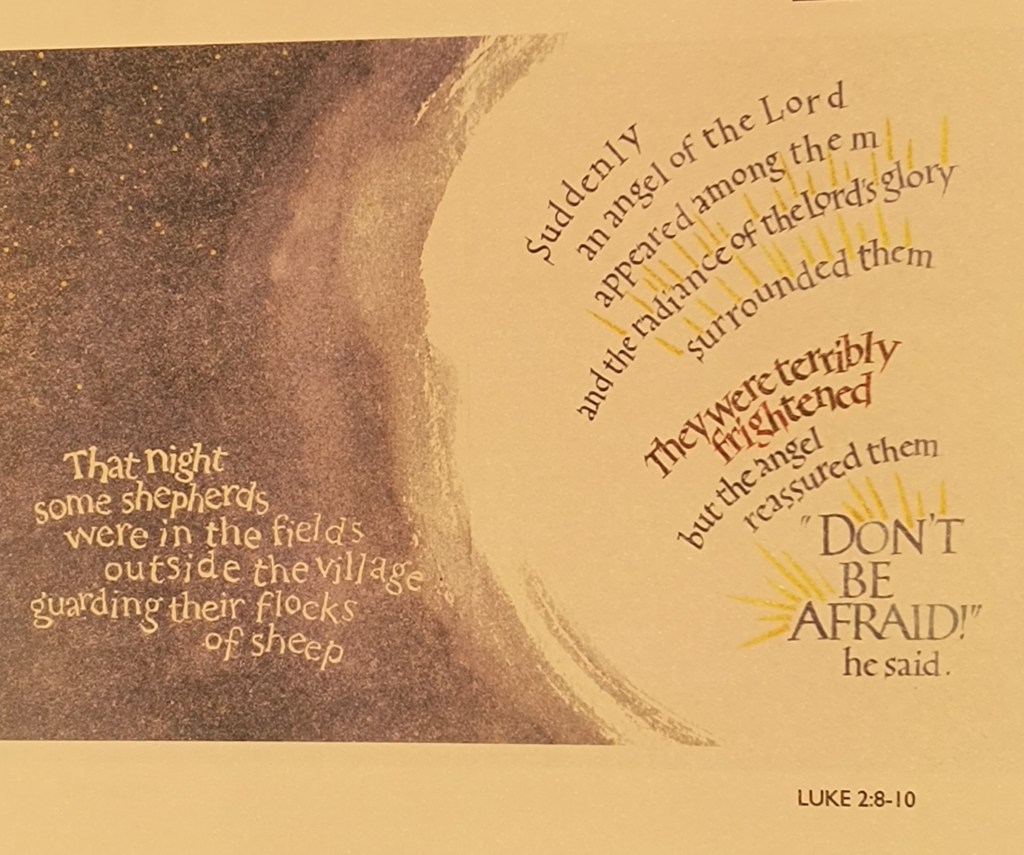
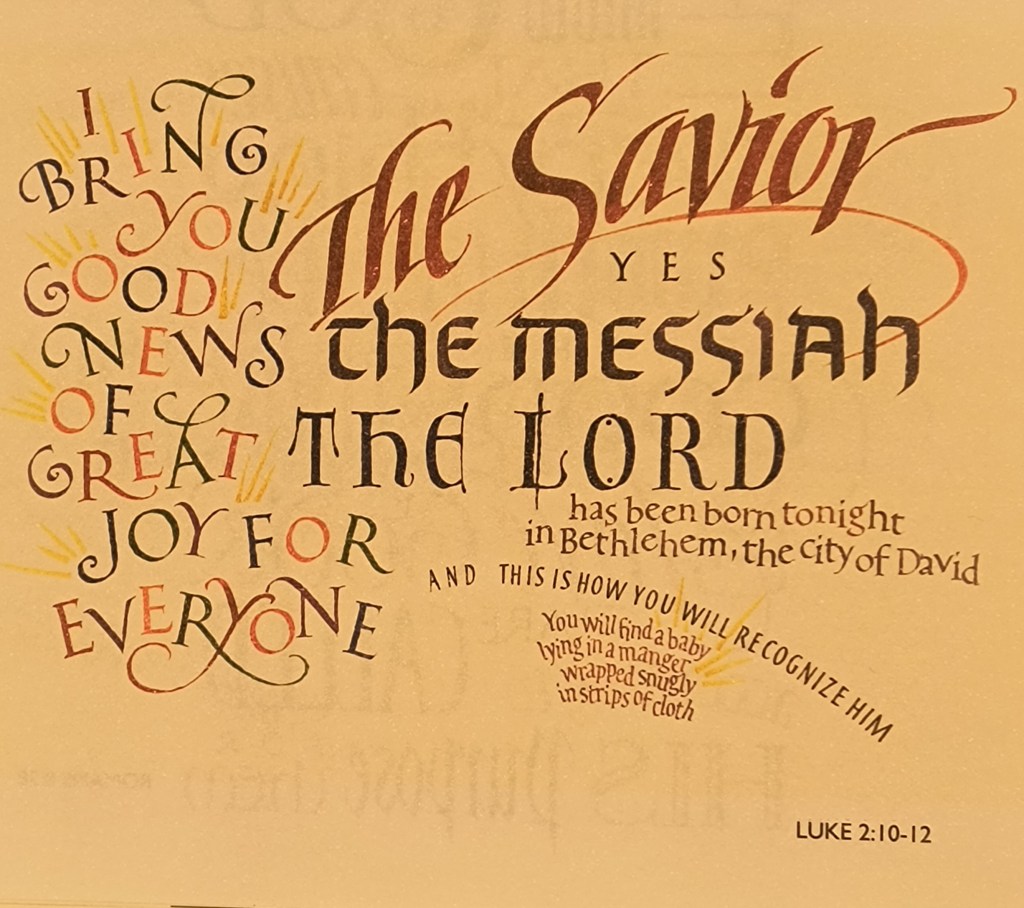
After college, I worked for a time at Tyndale House Publishers. Artist and calligrapher Tim Botts generously designed for Dave and me our wedding invitation and program. He and Handel can tell the story of the angels’ song better than I can. Without doubt, this is one of the most spectacular “But God” moments in history, witnessed by a group of sleepy shepherds in a quiet field outside the village of Bethlehem.

My photos of pages December 22, 23, 24 by Tim Botts, from “Daily Portraits of the Word” calendar published by Inkwell Greetings

Listen: 39:15-43:35 on this recording of Handel’s Messiah by the Academy of Ancient Music and choir of the Queen’s College, Oxford

When the angels had returned to heaven, the shepherds said to each other, “Let’s go to Bethlehem!” … And there was the baby, lying in the manger. After seeing him, the shepherds told everyone what had happened and what the angel had said to them about this child. … The shepherds went back to their flocks, glorifying and praising God for all they had heard and seen (Luke 2:15-20).

I wrestled with this passage, and its tragic aftermath told by Matthew (chapter 2), while writing Three-in-One: The Mysterious Friendship of Derry and Benny, which I hope will be out by Easter. Peace on earth? Good will among men? Fear not?

Like Mary, in quiet moments I ponder the age-old questions. Advent reminds me that we don’t yet know the end of the story. And that God is writing a comedy, a grand romance, not a tragedy.

The ending of Earth’s story will be but the beginning of glory that surpasses even the angels’ song. For the mouth of the Lord has spoken.

10:25-13:15 on this recording of Handel’s Messiah by the Academy of Ancient Music and choir of the Queen’s College, Oxford