A new nature

But God forgives sin; he doesn’t excuse it.

Ephesians 4:21-24 Since you have heard about Jesus and have learned the truth that comes from him, throw off your old sinful nature and your former way of life, which is corrupted by lust and deception. Instead, let the Spirit renew your thoughts and attitudes. Put on your new nature, created to be like God—truly righteous and holy.

Colossians 3:10 [see 3:1-17] Put on your new nature and be renewed as you learn to know your Creator and become like him.

I’ve enjoyed watching a bed of ferns at my daughter Valerie’s house this spring, and wish I had taken pictures of each stage. After frost killed last year’s growth and the dry stems were cut away, the patch looked dry and dead, not at all pretty. Before we traveled in March, tiny green shoots appeared. In April, the ferns looked like balls, with a few beginning to uncurl. Now, the ferns look like this, fresh and lovely in their new life. An analogy for me of renewal and transformation.

Our pastor in Brazil, invited to speak in another church one Sunday, asked his adolescent son to tell him about the sermon Vini had heard at home. Having spent the sermon time messing around with his friends in the balcony, Vini scrambled for an answer and finally responded, “It was about sin!”

“What did the preacher say about sin?” asked Vini’s father.

“He was against it!” replied his resourceful son.

God is too. Because sin harms his beloved children and it harms those around us. Colossians 3 lists the kinds of attitudes and actions God opposes: sexual immorality, impurity, lust, evil desires, greed, idolatry, anger, rage, malicious behavior, slander, dirty language, lying …. (v. 5-9).

In stark contrast, the new nature Christ offers looks like this: tenderhearted mercy, kindness, humility, gentleness, patience, forgiveness, love, harmony, peace, thankfulness, wisdom (v. 12-17).

Which of these takes more strength and courage? Destroying something beautiful is always easier than creating it. Anyone can blow something up, including someone else’s reputation.

Still, God forgives our sin, when we name it, confess, and turn away from it. Jesus gave his life to make this possible.

God doesn’t, however, rationalize, gloss over, condone, excuse, or justify sin, any more than a loving parent would laugh and pat the head of a child getting into trouble, or an oncologist would ignore a cancer in order to not cause pain and distress to his patient. Nor does God say, “It’s OK to do wrong as long as you achieve good ends.” He says, “Don’t be misled—you cannot mock the justice of God. You will always harvest what you plant.” (See the rest of that passage too, Galatians 6:7-10.)

Forgiveness isn’t the same as excusing. It’s costly. It says, “This is wrong, and deserves punishment. I accept the punishment in your place, to free you from sin’s power over you.” That freedom often comes, though, with discipline, through experiencing the consequences of what we’ve done.

During our long trek through the world of transplant, I saw a patient recovering from lung transplant outside the hospital, smoking.

In those years, people waited two to three years for a lung transplant. While waiting, around 20% of them died. (See the statistics here.)

So you can imagine my feelings when I saw this patient. I felt it as a punch in the gut, as a slap in the face of each person still waiting for a lung, or for two lungs, as well as to the family of her donor. As total disregard for the preciousness of the gift she had been given.

Is God unkind and unreasonable when he asks us to honor and nurture our new nature, the new abundant life his Son died to offer us?

P.S. This article prompted some of the thoughts in this post. I have no idea how true the author’s premise is, but the question he addresses is one I hear often from puzzled observers.

Create in Me, The Acappella Company
Real authority

But Jesus came to serve

Mark 1:22 The people were amazed at Jesus’s teaching, for he taught with real authority, quite unlike the teachers of religious law.

Mark 10:42-45 Jesus called his disciples together and said, “You know that the rulers in this world lord it over their people, and officials flaunt their authority over those under them. But among you it will be different. Whoever wants to be a leader among you must be your servant … for even the Son of Man came not to be served but to serve others and to give his life as a ransom for many.”

Philippians 2:5-7, 14 You must have the same attitude that Christ Jesus had. Though he was God, he did not think of equality with God as something to cling to. Instead, he gave up his divine privileges; he took the humble position of a slave and was born as a human being. … Live clean, innocent lives as children of God.

One of my favorite books when I was a child was The Scarlet Pimpernel, published in 1905 by Baroness Orczy. I loved the fact that Sir Percy led a double life, apparently a wealthy fop, but secretly risking his life to save others. The ridicule Percy experienced actually protected him–no one suspected he could be the one carrying out amazing heroic deeds. Orczy wrote this long before Marvel popularized the idea of a superhero who seemed a mild-mannered, ineffectual, or unremarkable person. In fact–just after writing that–I read on Wikipedia that Stan Lee, the Marvel co-creator, read The Scarlet Pimpernel as a boy and has called Sir Percy the first character who could be called a superhero.

I’m not sure I can agree with Stan Lee, and you probably anticipate what I’m going to say. The Gospels show us members of Jesus’s family and his neighbors not thinking there was anything special about Jesus. He was looked down on for his humble place in society, for coming from a nothing place (“Can anything good come from Nazareth?”), for not having wealth or credentials or position. He was killed like a common criminal.

Yet Jesus’s words and acts as a teacher, a healer, a servant, and a redeemer have impacted the world, transforming lives, for two thousand years.

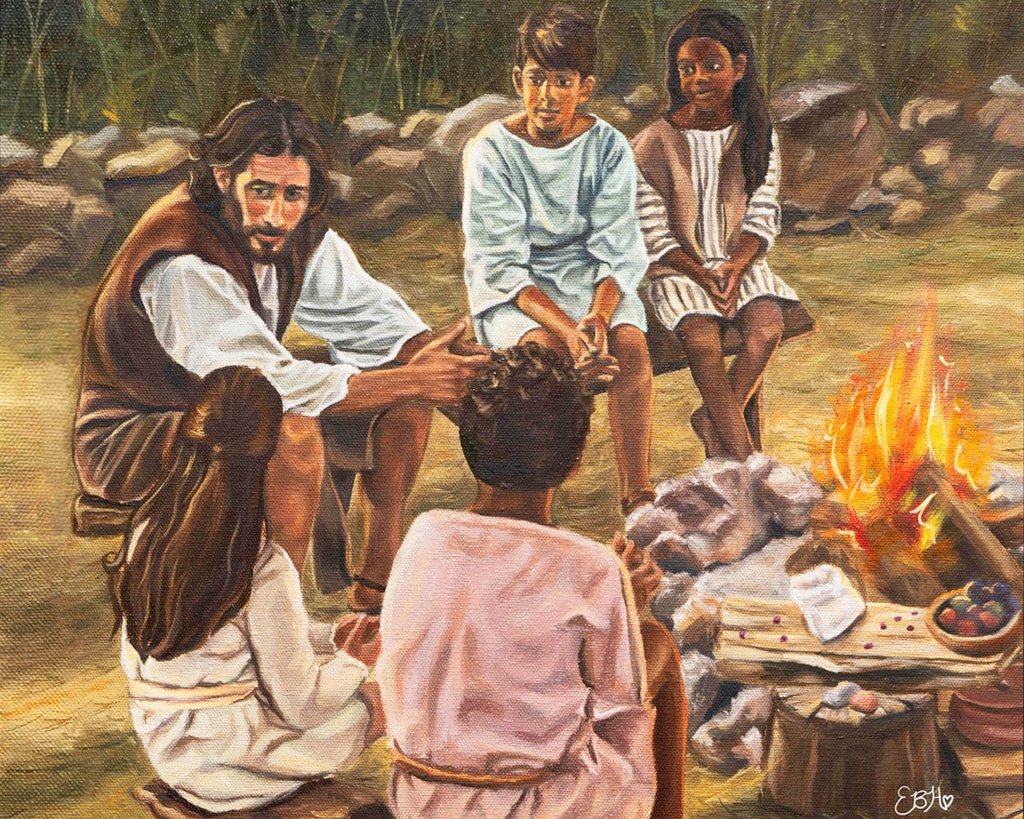
In the current film series “The Chosen,” early episodes show us Jesus playing with children. In the episode about Jesus healing the paralytic let down through the roof, kids watch the spectacle from another roof nearby. OCD Matthew awkwardly climbs up beside them and starts to tell the children who Jesus is. “We know him,” they nod, startling Matthew. We can imagine Matthew’s churning thoughts: Who is this man?

By Allen Hogan. I couldn’t find one of the kids on the wall with Matthew.

Real authority comes not from words alone, but from deeds and attitudes that match the words, done not to garner attention but out of love. It’s called integrity. Some of integrity’s fruits are safety and trustworthiness. I love this passage from Henri Nouwen’s little book, The Inner Voice of Love (pages 49 and 50):

A part of you was left behind very early in your life … it is full of fears. Meanwhile, you grew up with many survival skills. But you want your self to be one. So you have to bring home the part of you that was left behind. That is not easy, because you have become quite a formidable person, and your fearful part does not know if it can safely dwell with you. … Jesus dwells in your fearful, never fully received self. Where you are most human, most yourself, weakest, there Jesus lives. Bringing your fearful self home is bringing Jesus home. As long as your vulnerable self does not feel welcomed by you, it keeps so distant that it cannot show you its true beauty and wisdom. Thus, you survive without truly living. … When you become more childlike, your small, fearful self will no longer feel the need to dwell elsewhere. It will begin to look to you as home. Be patient … Gradually you will become one, and you will find that Jesus is living in your heart and offering you all you need.

Nothing enchants me more than discovering quiet integrity. It’s as thrilling now in real life as it was for me through fiction as a child. And no one embodies this more than Jesus, loving us in the past, the present, and the future.

This is an old song with a still-relevant message.

Love from the center

But God will rise up

Psalm 12:5-8 “I will rise up,” says the Lord, “and will give help to every one who longs for it.” The words of the Lord are pure words. … Preserve us, O Lord, and save us … The ungodly walk on every side when wickedness is exalted among the children of men.

I try to post on Mondays as well as Thursdays, but over Labor Day I was caught up in enjoying these two scallywags so their parents could enjoy a brief getaway. The photo was taken last week when our son Dan visited from DC.

Reconnecting to life outside the delightful Caleb and Talita bubble, I read the Psalms scheduled for Monday in the lectionary. I’ve read the Psalms many times, but I didn’t remember Psalm 12:8 at all. Doesn’t it seem like it was written like, maybe yesterday, not three thousand years ago?

But how do we avoid “exalting wickedness” when it’s already so widespread, including in the halls of power? The starting place is my own heart. Will I let the prevailing sins of our culture contaminate me? How much have I already done so?

While I mulled over Psalm 12, I ran across the following words by Michael Gerson, Director of Speechwriting for President George W. Bush and like me, a graduate of Wheaton College:

Jesus rejected the role of a political messiah. In the present age, He insisted, the Kingdom of God would not be the product of Jewish nationalism. It would not arrive through militancy and violence, tactics that would contribute only to a cycle of suffering. Instead, God’s kingdom would grow silently, soul by soul, “among you” and “within you,” across every barrier of nation or race — in acts of justice, peacemaking, love, inclusion, meekness, humility and gentleness.

 Christians seeking social influence should do so not by joining interest groups that fight for their narrow rights — and certainly not those animated by hatred, fear, phobias, vengeance or violence. Rather, they should seek to be ambassadors of a kingdom of hope, mercy, justice and grace. This is a high calling — and a test that most of us (myself included) are always finding new ways to fail. But it is the revolutionary ideal set by Jesus of Nazareth, who still speaks across the sea of years.

I long to be faithful to this high calling. I want Jesus to so own my heart that I can be an ambassador of a “kingdom of hope, mercy, justice, and grace.”

As I wrote this, I heard my husband reading the following out loud on a Zoom call. Try it yourself! 

“Love from the center of who you are; don’t fake it.

Run for dear life from evil; hold on for dear life to good.

Be good friends who love deeply; practice playing second fiddle.

Don’t burn out; keep yourselves fueled and aflame.

Be alert servants of the Master, cheerfully expectant.

Don’t quit in hard times; pray all the harder.

Help needy Christians; be inventive in hospitality.

Bless your enemies; no cursing under your breath.

Laugh with your happy friends when they’re happy; share tears when they’re down.

Get along with each other.”

(Romans 12:9-16, The Message)

Lord, we long to see you rise up and usher in your kingdom of love and justice and truth. Please help us to trust you more than we fear people and events. Give us confidence and peace in the center of ourselves because we know you. Help us to live as Jesus taught us and modeled for us, never compromising our integrity or supporting those who do so. Be, truly, Lord of our hearts.

Protection for our families from pornography, by Jewel Anita Hendrix, Tauranga, New Zealand

But God shows hostility to the wicked 

Psalm 18:25-26 To the faithful you [God] show yourself faithful; to those with integrity you show integrity. To the pure you show yourself pure. But to the wicked you show yourself hostile.

Psalm 101:2-4 I will be careful to live a blameless life—when will you come to help me? I will lead a life of integrity in my own home. I will refuse to look at anything vile and vulgar. … I will reject perverse ideas and stay away from every evil.

Tuesday night we hosted Rory Birkbank from Safesurfer for our Justice Night on the topic of pornography. A couple good quotes:

“Porn is sex trafficking with a camera rolling.”

“Disrespecting women—that is what porn is, obviously.”

Unfortunately, this isn’t “obvious” to everyone. Rory gave us an excellent presentation of what is happening online, why and how to protect our own families from it, and how to pray against it.

If you have not looked into Safesurfer before, please do. They help with more than porn: social media, gambling, malware, etc.

Honestly, I have been taken aback a bit by Safesurfer. I knew that it was one of the leading internet protection services in the world. … Then I stumbled on their offices, upstairs in the back of one of the local churches here in Tauranga. I thought it must be a different organization with the same name. After all there is a lot of surfing in Tauranga. This group must be about safety while surfing in the ocean, right?

Nope. They are one of the leading global protection services – in this back office of a random church in Tauranga. They’re a small group of genius Christians with such a heart for families. They have set up their systems so none of their staff have to view the objectionable materials. They automatically report child sexual abuse material (CSAM) to global law enforcement. They provide a free service to remove all nudity – from all devices.

Don’t think you need it for your family? One in four kids have seen porn by age 14. Almost 50% of them have seen it by accident, not looking for it at all. They don’t have to be searching with obvious words. It comes up in so many unexpected places.

Let’s join David in Psalm 101, committing ourselves and our families to living with integrity.