2 Corinthians 4:7 We now have the light of Jesus shining in our hearts, but we ourselves are like fragile clay jars containing this great treasure. This makes it clear that our great power is from God, not from ourselves.
At the REVER Congress in Pereira, discussing the theme “Finding Joy in Chronic Suffering,” I shared several ways Karis drew strength from 2 Corinthians 4. The whole chapter was important to her. From verse 7, and from a story her mentor Claudia Limpic told her, she adopted for herself the nickname “Crackpot.”
Claudia’s story, as I heard it, is this:
A farmer carried water on his back in two clay pots to his garden each day. On one side of the path from the well to his garden, flowers sprung up. The other side remained barren.
The farmer puzzled over this until one day he noticed that one of the pots was cracked. Each day as he walked to his garden, water dripped out of the cracked pot, watering one side of the path.
Enchanted by this story, Karis prayed that from the “cracked pot” of her “broken” body, beauty would be created in other people’s lives. That through the cracks in her life, God’s light would shine.
Another “cracked pot” concept has been important enough in REVER to make it onto a T-shirt. Kintsugi is the Japanese art of repairing broken pottery with gold, making it stronger and more beautiful than it was originally. In REVER, this represents God’s healing work in our lives.
GAVS stands for “Support groups for victims and survivors,” for those who have suffered sexual abuse.
As Karis put it, “All I see is grace.” May you and I find that grace in our own cracked places.
John 8:12, 9:5 I am the light of the world. If you follow me, you won’t have to walk in darkness, because you will have the light that leads to life. … While I am here in the world, I am the light of the world.
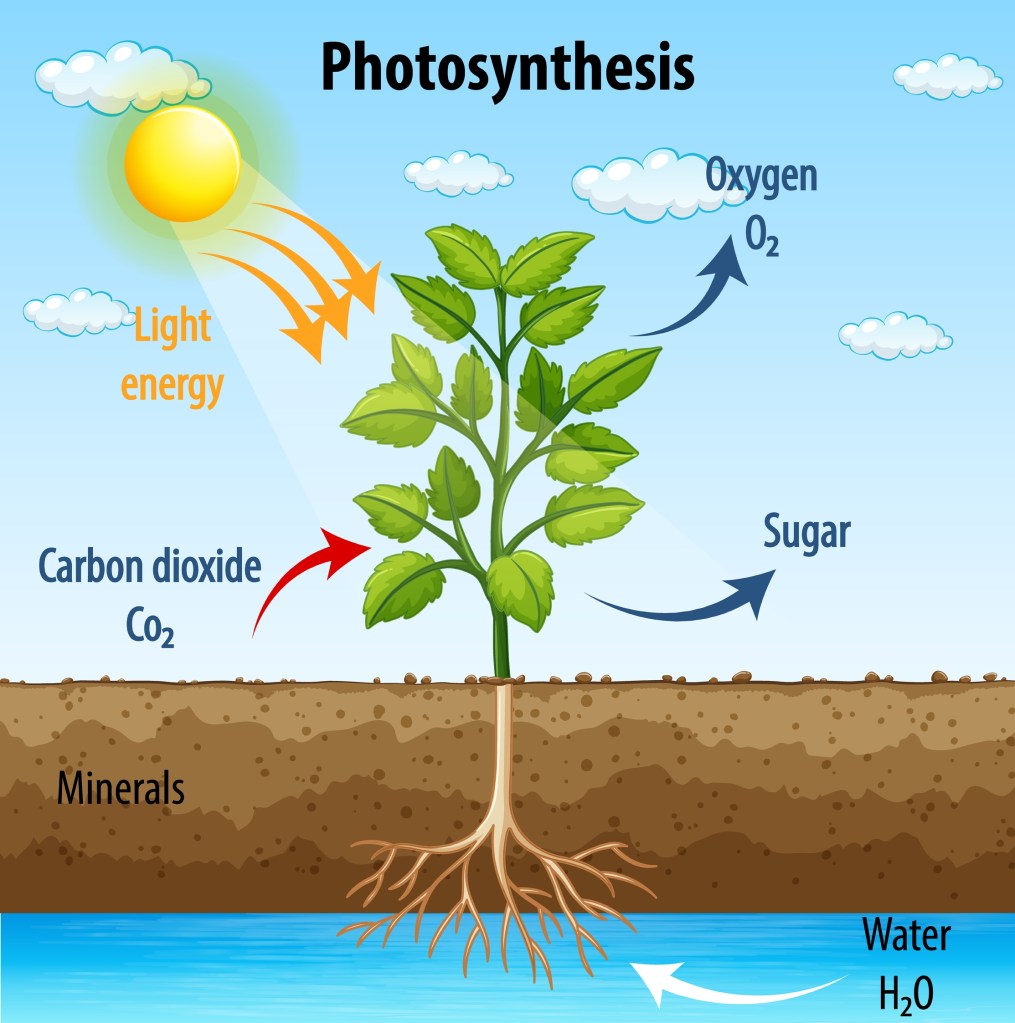
It happens all around us and fuels our lungs and muscles. Photosynthesis is the process by which plants and trees use sunlight, water, and carbon dioxide to create oxygen and energy. Light generates life!
I could so easily get off on the (mostly illegal) destruction of the rain forest, but I’ll spare you the soapbox (except to say one thing: the more beef we eat, the faster the Amazon Forest will be cut down for pasturing methane-belching cows, top of the food chain and doubly injurious to our planet’s health).
Though a description of photosynthesis wasn’t published until 1779, Jesus the Creator, of course, understood it perfectly. As he so often did, he used nature to express spiritual truth. Light is life.
Speaking in the Temple in Jerusalem on the last day of the week-long fall harvest Festival of Sukkot, or Tabernacles, or Booths, or Shelters, Jesus promised living water, another necessary element for life (John 7:37-39)—probably in connection with the daily Sukkot water ceremony, when the priest poured out collected rainwater from the previous season.
And then, sixteen gold bowls in the inner courts of the Temple were filled with oil and lighted. Likely, Jesus stood beneath these lights to declare that he was the Light of the world (John 8:12). The light at the center of Temple worship—but more. Light that could leave the Temple and walk into the world, confronting the darkness found there. Like falsehood, and slavery, and unbelief, and wrong judgment. Some people were so angry they wanted to kill Jesus.
And the intrigue—or offense—intensifies when Jesus repeats the claim of being the light of the world (John 9:5) when on the Sabbath, he heals a man born blind. The intricate interplay of light and darkness in this chapter, of who can see and who can’t, of what is sin and who commits it, challenges all assumptions and the very order and fabric of society.
The man formerly blind who for the very first time can see—imagine!—has the gall to say, “Ever since the world began, no one has been able to open the eyes of someone born blind. If this man were not from God, he couldn’t have done it.” He was thrown out of the synagogue, as people often are who dare to speak truth (Liz Cheney comes to mind). Jesus, who had given the man physical sight, found him and gave him spiritual vision as well.
“If you were blind, you wouldn’t be guilty,” Jesus told the angry leaders. “But you remain guilty because you claim you can see” (John 9:41). In chapter 8, he called people liars. He clearly hadn’t read up on social etiquette. So cringey for this Enneagram 9 who hates conflict and upset apple carts.
Will you and I welcome Jesus’ light shine into the dark corners of our hearts, confronting our sin, healing our blindness, synthesizing new life in us?
Isaiah 25:9 (Isaiah 46:3-4, Malachi 4:2, Romans 5:10-11, Hebrews 4:15, 16, 2 Peter 1:1) In that day the people will proclaim, “This is our God! We trusted in him, and he saved us! This is the Lord, in whom we trusted. Let us rejoice in the salvation he brings.”
Trust isn’t easy, especially when we’ve been betrayed. When someone we have trusted has not just disappointed us, but has deliberately hurt us for their own ends. Because the Three-in-One God understands this, Jesus came, to experience in a body what betrayal is. That’s why we can go to him to find mercy and grace in our time of need. This is our God, not a being far off, but one who draws near, in compassion and full understanding. With healing in his wings.
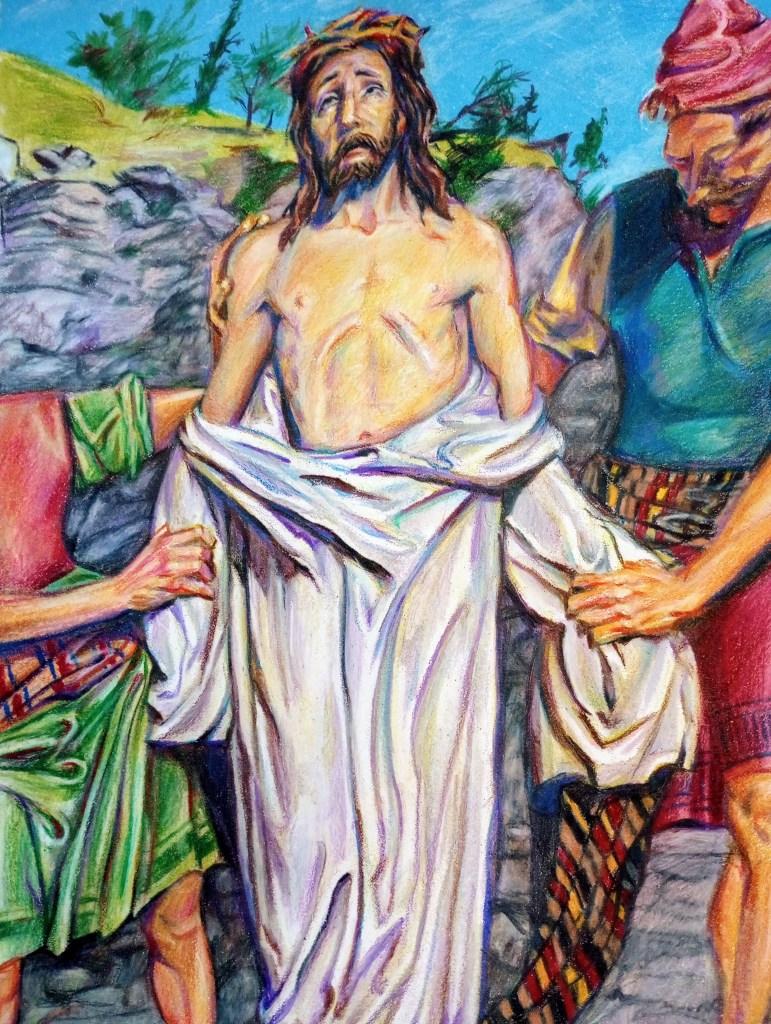
Matthew 27:33-35 They went out to a place called Golgotha (which means “Place of the Skull”). The solders gave Jesus wine mixed with bitter gall … After they had nailed him to the cross, the soldiers gambled for his clothes by throwing dice. This fulfilled the word of the prophet: “They divided my garments among themselves and cast lots for my robe.” (Psalm 22:18)
Station 5: Jesus is stripped of his garments
Suzanne says this about her painting:
“I used bright colors to contrast with the subject matter and to show that he was stripped in broad daylight. As I drew, I contemplated how we use clothing not only to cover our nakedness, but to show social status and wealth, to express ourselves, and to look attractive.
The church and followers of Jesus are often called the body of Christ. I wonder what we need to be stripped of.
I left off the head of the man on Jesus’s left not only because I didn’t have room for it on the page, but also so viewers can put themselves in his place. What have you said or done that has metaphorically stripped Jesus and brought him shame?”
John 21:3-6, 17, 19-22 [After Jesus’s resurrection] Simon Peter said, “I’m going fishing.” “We’ll come, too,” [six other disciples] said. But they caught nothing all night. At dawn Jesus, standing on the beach, called out, “Children, have you caught any fish?” No, they replied. Then Jesus said, “Throw out your net on the right-hand side of the boat.” So they did, and they couldn’t haul in the net because there were so many fish in it. …
Psalm 32:1-2 Oh, what joy for those whose disobedience is forgiven, whose sin is put out of sight! Yes, what joy for those whose record the Lord has cleared of guilt!
[After breakfast] A third time, Jesus asked Peter, “Simon son of John, do you love me?” Peter was hurt that Jesus asked the question a third time. He said, “Lord, you know everything. You know that I love you.” Jesus said, “Then feed my sheep.” … Then Jesus told him, “Follow me.” Peter turned around and saw behind them the disciple Jesus loved. … He asked Jesus, “What about him, Lord?” Jesus replied, “… What is that to you? As for you, follow me.”
Have you ever wondered why Jesus chose this particular setting for his pivotal conversation with Peter after the crucifixion and resurrection, after Peter’s denials warranted a return to the moniker “Simon”?
This miraculous catch of fish is a reprise of Luke 5, offering Peter another chance to recognize and reconnect with Jesus, and with God’s call on his life. A chance to accept forgiveness and to move beyond his failures. A chance to heal his story.
God met me as well, on ensuing visits to the lake. Fast forward from the story I told in the last post. I’m now fourteen, graduated from boarding school, fearful of the future. Sitting alone overlooking the lake, I told the Lord I wasn’t ready to leave Guatemala because I had not yet learned to love. I acknowledged my heart full of resentment and bitterness. I didn’t want to take all that with me into whatever awaited me in my new life in the United States, where my parents would send me for high school. But how could I change? I had confessed my anger and hurt, but it refused to die, rearing its ugly head on a daily basis.
Romans 12:2 was the verse I was considering: “Don’t copy the behavior and customs of this world, but let God transform you into a new person by changing the way you think. Then you will learn to know God’s will for you, which is good and pleasing and perfect.” You’ll have to do it, Lord. I have no idea how to change the way I think. On the surface, nothing (apparently) happened. But it was a place marker, an anchor, an intention, a hope: “Someday, somehow, I will learn how to love other people.”
Shutterstock: Christopher Moswitzer
Fast forward twenty-five or so more years. A different country, a different lake, a different language. A big difference this time because I’m not alone. A dear friend is listening to my despair over Ephesians 5:1-2, “Follow God’s example, therefore, as dearly loved children, and walk in the way of love, just as Christ loved us.”
“For most of my life,” I confessed to my friend, “I’ve begged God to teach me to love him and to love other people. But I don’t know how. I have no idea what it feels like to be a dearly loved child.”
“Then let’s ask him to show you,” she said. What followed was one of the most powerful prayer visions I have ever experienced. It healed a fracture line in my soul. It changed forever the way I knew Jesus and the way I viewed myself and other people. Literally, it saved my life. It was the beginning of learning the Romans 12:2 different way of thinking I had begged God for at fourteen.
Why did this healing take so long? Why did I have to go through so much trauma and drama between fourteen and forty? I’ll probably never know. But I’m grateful, so thankful that it did happen. It was an essential foundation stone in the healing journey that has continued through the almost thirty years since that day.
Tomorrow Dave and I plan to board a plane for Ireland, for a “triple trip,” celebrating our 45th wedding anniversary last August, Dave’s St. Patrick’s Day 70th birthday, and researching Book 3 of the Cally and Charlie series. I have the sense—though I don’t know how, exactly—that the week in Ireland will be another significant step in the healing God continues in my life. I’ll let you know!
Revelation 7:17 For the Lamb on the throne will be their Shepherd. He will lead them to springs of life-giving water. And God will wipe every tear from their eyes.
I invite you to come back with me to the dock by the lake. The sun is dancing off the rippled surface, and the air is just hot enough to make the cool water inviting. I turn around and, with total abandon, fling out my arms and fall backward into the lake. As the water welcomes and envelops me, Jesus gives a loud whoop and dives in beside me. We swim and frolic in the amazing creation that is water. As I float on my back, I delight in the warm sun on my face and am caught by the wonder of the green trees on the shore contrasting with the clear blue sky.
A fog rolls in from the land, dark and sinister, and I suddenly find myself on the dock, wrapped in a wet towel, dripping, cold, and frightened. Jesus pulls himself up onto the dock and, with a smile, takes my hand. As we head up the slope towards the house, he leads me over to a stream I was never aware of before. He invites me to sit with him beside the brook. He puts his arm around me with what I think is a blanket, but then I realize that I am fully clothed and warm and dry. Even my hair is dry!
As we sit in the warm sun, we wrap our arms around our knees and lean into each other as we laugh at the water tumbling over the rocks. “I really love where the deeper water flows smoothly over the rocks, too,” I say. “It makes me want to touch it. It’s like the smooth black stone in the rough sidewalk that I always stop to rub my foot over.” Jesus soaks in my delight at his cleverness in giving even a little stream bed such wonderful variety.
Soon it’s time to go. Jesus pulls me to my feet, and we head up the slope, hand in hand, our arms swinging between us. As we approach the house, a fog like a swarm of bees rushes towards us. Jesus angles his body so that he absorbs the onslaught, and the swarm dissipates into the air. Knowing trouble is waiting for us, Jesus gives me a cheeky grin and a wink.
I find myself at the table, enduring an unending harangue about how horrible I am to have come inside late, but Jesus is in the chair next to me, sitting close in solidarity with me. As the barrage of words overwhelms me, he pulls me onto his lap and starts whispering in my ear about how he loves me and how much fun he had playing in the water with me and how delighted he is by my tender heart.
“I don’t condemn you,” he says. His words soothe me so that I drift off to sleep, curled against his chest. I awaken when I’m instructed to make sandwiches for lunch. I hop off Jesus’s lap. He again takes my hand and asks, “How can I help?” We go together into the kitchen. He knows how much I love working with other people in the kitchen!
As we spread slices of bread across the countertop and mix up tuna salad, our shoulders bump. We laugh as we remember what a fun morning we had. We replay the vision of the sun on the water and the trees against the sky. We delight in the lush green grass of the lawn and the flowering trees outside the kitchen window. We remember the brook as it tripped and fell over stones on its way.
“What about the others?” I ask. “I’m so sad for the pain they feel.”
“Don’t worry,” Jesus comforts me. “I’ve got them. You don’t have to fix them. I’m big enough to love them too. I don’t even have to leave you in order to take care of them. I’m holding each of you. You couldn’t see it, but I gave gifts to them at the table while you slept on my lap. I let your mom know that you were sheltered from the pain of her words, even as she felt powerless to stop them. That comforted her soul. Your dad was reassured that someone bigger and stronger than either of you was there to protect the child he loved. He could rest in my strength.”
“Thank you for caring for all of us,” I say. “Thank you for a lovely morning, and for bringing the joy of the lake into the house, to the table, and into the kitchen. Thank you for delighting in all the beauty with me. Thank you for a wonderful weekend at the lake.”
With a deep sense of peace, we get in the car together and drive away.
Mark 3:1-5 Jesus went into the synagogue again and noticed a man with a deformed hand. Since it was the Sabbath, Jesus’ enemies watched him closely. If he healed the man’s hand, they planned to accuse him of working on the Sabbath. Jesus said to the man with the deformed hand, “Come and stand in front of everyone.” Then he turned to his critics and asked, “Does the law permit good deeds on the Sabbath, or is it a day for doing evil? Is this a day to save life or destroy it?” But they wouldn’t answer him. He looked around at them angrily and was deeply saddened by their hard hearts.
Ephesians 4:26 Don’t sin by letting anger control you. Don’t let the sun go down while you are still angry.
Hebrews 12:15 Look after each other so that none of you fails to receive the grace of God. Watch out that no poisonous root of bitterness grows up to trouble you, corrupting many.
James 3:14-15 If you are bitterly jealous and there is selfish ambition in your heart, don’t cover up the truth with boasting and lying. For jealousy and selfishness are not God’s kind of wisdom.
All my life I’ve been afraid of anger, because in my experience anger was linked to emotional and physical violence. So when I came to this story in Mark, my first instinct was to skip over it in favor of something more positive and cheerful. I could write, for example, about the stunning rainbow that hovered over Pittsburgh Wednesday afternoon …
But God didn’t let me get away with that. In the background of my thoughts, I kept wrestling with the issue of anger and how I would just shrivel up or melt into a puddle on the floor if I perceived Jesus was angry with me.
I am in no way an expert on dealing with anger. Far from it! But here are a few simple guidelines that seem helpful to me at this moment in my journey.
Anger is an emotion we all feel—unless we’re in denial. Ignoring it doesn’t make it go away. If we don’t give it proper attention, it may instead turn inward and become a “secondary” emotion, hurting us and others through depression, bitterness, apathy, resentment, unhealed grief, or other emotional states. When anger settles in, as part of our emotional furniture, it becomes harmful. Hence the wisdom of Ephesians 4:26.
If we feel anger, we need to pay attention to it. “Primary” emotions, I’m told, surge and then recede in our bodies in about 90 seconds. Until the emotion has passed through, we shouldn’t take any action. But once the emotion has dissipated, we can ask ourselves questions: What was the source of the anger? Against what or whom was it directed? Was it appropriate, i.e. did its intensity match the severity of the provocation? What did I want to do while I was feeling the emotion? Is that action appropriate, i.e. will it reduce or escalate the perceived threat? What else is going on in my life that could intensify the feeling of anger (fear, fatigue, stress, the sense of repeated offense, a feeling of impotence, a narrative I am telling myself about this person or situation …)? Anger can show us a lot about ourselves and the condition of our souls.
Anger is our body’s response to the perception that something is wrong. We need to pay attention to this and decide what to do about it. There is always something we can do about perceived injustice, even if it is “only” relinquishing our pain to God and praying for those who have offended or hurt us. The Scriptures are full of references to God’s justice and the wisdom of entrusting to him those situations we are not properly positioned to do anything about. But often there is something positive we can do, contributing to God’s purposes of healing and redemption, rather than harm and destruction.
The energy of anger propels us to act. This can be a good thing, or it can be terrible. Good actions can be carried out calmly. The impulse of the feeling of anger, though, can often be harmful. Self-control includes hanging in there with the seemingly interminable 90 seconds so we can then evaluate possible actions with our rational brain engaged, not just our impulsive brain. If I yell and hit back when my child yells and hits, for a moment I may feel relief, but the fruit of those actions will damage my child and his or her trust in me.
Thinking about all this took me back to the story in Mark 3, and to the other references cited above. One thought I had (and I would love to hear yours!) is that Jesus’s frustration with the religious leaders opened a window of opportunity for them to see things differently. They placed enforcement of their (mis)interpretation of the law ahead of the wellbeing of one of their congregants. Had their hearts been in tune with God’s loving heart, they could have seen grace in what Jesus did, and wonderful rejoicing could have strengthened all present. Instead, they went away to plot how they could kill Jesus.
Jesus was not for one second out of control of himself and his actions. The religious leaders’ offense had become engrained. Not even Jesus could “make” them change their minds and hearts. Yet he offered them an invitation, through bringing to light the condition of their hearts. An opportunity to repent, to change, to grow. To respond positively to truth.
Mark 1:34, 41; 2:11 Jesus healed many people who were sick with various diseases … Moved with compassion, Jesus reached out and healed the leper. “I am willing,” he said. “Be healed!” … Then Jesus turned to the paralyzed man and said, “Stand up, pick up your mat, and go home.”
2 Corinthians 12:8-9 Three different times I begged the Lord to take it away [a tormenting “thorn” in Paul’s body]. Each time he said, “My grace is all you need. My power works best in weakness.”
How can a loving father with power to heal, NOT heal his beloved daughter?
Karis took this vexing question to the Lord again and again during her life. At age 11, she chose 2 Corinthians 12:8-9 as her life verses. She referred to them often in journals when she details her intimate conversations with God. Another frequent phrase is, “Don’t ask why. Ask what for.” Her high view of God’s sovereignty, combined with her absolute trust in his love for her, led her to look constantly for what he was doing through her difficult circumstances. I came to expect this question when we were once again in crisis and on the way to the hospital: “I wonder who’s there this time who needs to see God’s love?”
I mentioned on the last blog that the conversation between Jesus and Little James in the second episode of Season 3 of The Chosen could have been lifted from Karis’s journals. Here’s my transcript. It’s not complete but most of the conversation is there, in case you want to refer back to it later.
Jesus has just instructed the twelve disciples to go out two by two in different directions, giving them the authority to heal, as they have seen him heal many people. Lame Little James asks Jesus for a conversation afterwards.
James: How can I heal others when you haven’t healed me?
Jesus: Do you want to be healed?
James: Yes. Why haven’t you?
Jesus: Because I trust you.
James: What?
Jesus: Precious Little James, listen carefully. Within the Father’s will, I could heal you right now, and you would have a good story to tell.
James: That you do miracles.
Jesus: Yes. That’s a good story to tell. But there are already dozens who can tell that story, and there will be hundreds more, even thousands. But think of the story that you have if I don’t heal you. That you still praise God in spite of this [disability]. That you know how to focus on all that matters so much more than the body. That you show people you can be patient with your suffering her on earth, because you know you can spend eternity with no suffering. Not everyone can understand that. How many people do you think the Father and I trust this with? Not many.
James: But the other disciples—they’re so much more …
Jesus: Are you fast, impressive when you walk? Maybe not. But these are things the Father doesn’t care about. You are going to do more for me than most people ever dream. So many people need healing in order to believe in me … That doesn’t apply to you. And many are healed or not healed because the Father has a plan for them which may be a mystery. And we remember what Job says, “The Lord gives and the Lord takes away.”
James joins Jesus saying: “Blessed be the name of the Lord.”
Jesus: When you pass from this earth and you meet your Father in heaven, Isaiah promises you will leap like a deer. Your reward will be great. So hold on a little longer. And when you discover yourself finding true strength because of your weakness, and when you do great things in my name in spite of this [your lameness], the impact will last for generations. Do you understand?
James, with tears: Yes. Thank you, Master.
Jesus: A man like you healing others. Oh, what a sight! I can’t wait to hear your stories.
Jesus starts to walk away after they bless each other but turns back.
Jesus: And James, you will be healed. It’s only a matter of time.
Karis’s famous smile … on a Christmas day in the hospital
Mark 6:7, 12-13 Jesus called his twelve disciples together and began sending them out two by two, giving them authority to cast out evil spirits [and to heal all diseases, Luke 9:1]. … So the disciples went out, telling everyone they met to repent of their sins and turn to God. And they cast out many demons and healed many sick people, anointing them with olive oil.
I’m skipping ahead in Mark today, because of something that happened last night. We had an evening without other commitments, and Dave suggested we watch the second episode of the new Season 3 of The Chosen (we haven’t managed to accompany the episodes as they’ve been released). The episode is called “Two by Two.” It dramatizes this passage in Mark, Luke 9, and Matthew 13.
After Jesus gives his instructions to the disciples and is walking away, the “other James” follows Jesus and asks for a conversation. In Mark 15:40, this James is referred to by a word that means least, less, little, small. English versions translate this variously as James the young, the younger, the youngest, the less, the lesser, the little. In The Chosen, he is called Little James, and James the brother of John is called Big James. Additionally, Little James is cast in The Chosen as a man with a lame leg.
As I listened to the conversation between Jesus and Little James, I had goosebumps. I watched with my mouth open. Because the conversation could have been lifted straight from the pages of Karis’s journals. Clearly the script was written by someone who has been there, who has asked God the question, “Why haven’t you healed me? How can I heal others like—like this?” Jesus’s response is exactly what Karis records God saying to her, multiple times from her adolescence on.
To understand more deeply the impact of this for me, it may be helpful to know that all her life, since being born with a severe intestinal anomaly, Karis, Dave and I, and our family have been challenged by Christians who believe God only doesn’t heal because of sin and/or lack of faith. Therefore, Dave and I, and later Karis as she grew up, were exhorted again and again to confess the sin for which she/we were being punished, to confess our lack of faith, and to live our lives out of the belief she had been healed (i.e., stop seeking medical help for her, especially when her life was at risk, as “proof” of our faith). Make her get out of bed. Make her see this illness is not real; what is real is the health God promises every believer.
All of this is one of the main reasons Karis cites in her journals for wanting her story written down. She wanted believers to understand the deeper grace God offers when he chooses not to heal someone physically. “If God heals me—gives me a brand-new intestine—that story will make a big splash,” she wrote. “For a little while, many people will be excited. But quickly it will become old news. Instead, for as many days or years God gives me, I want to show people a different kind of grace—the grace that allows me to praise God even through my pain. The doors that open for me exactly because I am disabled. The compassion God has given me for all who suffer, with any kind of pain, whether physical, emotional, social, or mental. The joy greater than my circumstances that wells up from the Spirit inside me. That’s what I want people to see when they look at my life: not a ‘big splash,’ but the daily faithfulness of God, available to everyone, everywhere, in any condition of life.”
Karis’s journals, from age 9 until the week before her last coma, age 30
So, imagine how intrigued I was to hear Jesus’s words to Little James on the screen last night. You’ll find the conversation at 53:12-59:44 on Episode 2 of The Chosen Season 3, called “Two by Two.” I’ve transcribed it, but will wait until the next post to quote part of the conversation for you. I hope meanwhile you’ll take the time to watch it.
In fact, God did perform miracles in Karis’s life. Huge miracles that restored her again and again when the doctors told us (again) that this time there was no hope, from infancy on. But never “the big miracle,” the big splash. Her story is both bigger and deeper than that, to the glory of God.
At the end of the conversation, Jesus starts to walk away. Then he turns back and says to Little James, “Your healing will come. It’s just a matter of time.”










 Debra Kornfield