But the Spirit grieves when we hurt ourselves or others
Isaiah 30:1 “What sorrow awaits my rebellious children,” says the Lord. “You make plans that are contrary to mine. You make alliances not directed by my Spirit, thus piling up your sins.”
Isaiah 63:10 But they rebelled against the Lord and grieved his Holy Spirit.
Ephesians 4:30 And do not grieve (bring sorrow to) God’s Holy Spirit by the way you live.
[Note: I’m posting this now because I’m traveling tomorrow.]
My breath caught. “Don’t do it!” I screamed inwardly as from too far away to intervene I saw my angry grandson pick up and hurl a small stone.
The injury caused by the small stone connecting with his sister’s arm ruined river play for all three of us. But the pleasure of our outing had already been spoiled.
My granddaughter had kicked her brother’s carefully balanced tower of rocks while he went downriver to search for more flat stones.
Why had she demolished his tower? Because she wanted him to play with her, concocting what they called “river soup,” stirring together an assortment of sticks, leaves, and pebbles into “the best soup in the whole world!” That day, her older brother preferred his solitary tower building.
At two and four, the present moment is everything, patience is still developing, and diversion from an anticipated delight (making the soup like they “always” did at the river) may only be effective for a short time. That did not excuse what either of them did to hurt the other. The consequent immediate end to river fun grieved us all.
Isn’t it true that we’re capable of hurting the most those whom we most deeply love?
I believe that the one most grieved that day was the Holy Spirit. Because he passionately wants our best. He sorrows when we hurt ourselves and one another. The context of these verses in both Isaiah and Ephesians is relationship: the call to care for each other with compassion. In Isaiah 30, the Spirit is sad because Israel has committed to a relationship that will prove harmful to them. In Isaiah 63, at issue is Israel’s relationship with the Lord himself.
And in Ephesians 4 and 5, Paul’s concern is the Ephesian believers’ relationships with each other.
Get rid of all bitterness, rage, anger, harsh words, and slander, as well as all types of evil behavior. Instead, be kind to each other, tenderhearted, forgiving one another, just as God through Christ has forgiven you. Imitate God, therefore, in everything you do, because you are his dear children. Live a life filled with love, following the example of Christ (Ephesians 4:31-5:2).
The last couple of months have been intense, and I’ve gotten behind on a long series of responsibilities and projects. Until I catch up–especially with a book I need to complete–I’ll be posting here only once a week, aiming for Wednesdays.
One part of the challenge was the decision our daughter Valerie and her husband Cesar made to move back to Brazil–with just six weeks before Val would have to start work there. They accomplished a major move, including participation in our Elliott family reunion and a trip to New York to secure documents they needed, in that short time. Truly amazing! We will miss them. And we rejoice with them, for all the goodness they will experience “back home.”
Here they are on the airplane; destination: a new chapter of life in São Paulo.
They did it!! Girls and guys: Back row Luciene (Cesar’s mom), Valerie, Talita. Front row Cesar Sr., Cesar Jr., Caleb. Lu and Cesar Sr., who came to visit before the Brazil decision was made, worked incredibly hard to make this move possible, including preparing the house for sale. Anyone looking for a cute house to purchase in Pittsburgh?
I asked you to pray for my sister. Thank you. She’s doing better, for which we are so grateful. And she has a long road ahead.
It’s helpful to me right now to know that the Holy Spirit understands grief. This blog considers a particular kind of grief, not the separation of loved ones moving to another continent, but the rupture caused by our sin, when we harm ourselves and others.
But the Holy Spirit grieves
Psalm 51:10-12 Create in me a clean heart, O God. Renew a loyal spirit within me. Do not banish me from your presence, and don’t take your Holy Spirit from me. Restore to me the joy of your salvation and make me willing to obey you.
Ephesians 4:30 Do not bring sorrow to[grieve, offend, vex, sadden]the Holy Spirit by the way you live. Remember, he has identified [put his seal on] you as his own, guaranteeing that you will be saved on the day of redemption.
1 Thessalonians 5:19 Do not stifle[quench, suppress, smother, hold back, try to stop] the Holy Spirit.
Grief. It touches each of us sooner or later, to a greater or lesser degree.
Grief even touches the Holy Spirit. Why? Because he expects us to obey a random set of arbitrary rules or face capricious anger and punishment from God?
No. God deeply loves each of us. What hurts him is our unnecessary suffering because we do what is not lifegiving and harm ourselves and others, whom he loves just as profoundly.
In Psalm 51 King David records his anguished cry of repentance after the prophet Nathan confronted him with seducing Bathsheba and murdering her husband. David rightly fears that God will take the Holy Spirit from him as he did with David’s predecessor, King Saul (1 Samuel 16:14). God’s Spirit is holy; he cannot associate himself with rebellion and evil. And in the Old Testament, pre-Pentecost, the Spirit was given to particular people in select circumstances. Not, as Paul stated to the Ephesians, to all believers as a guarantee of our salvation.
God’s Spirit is all about life, health, growth, creativity, blessing, fruitfulness, beauty. When we choose to harm ourselves or others, we limit his power and effectiveness in our lives. And we grieve him.
The way back to joy is exactly what David did: admit and confess our wrongdoing; no excuses. There still will be consequences. Saying “I’m sorry; I was wrong” does not bring a murdered person back to life or make adultery OK. David and Bathsheba’s firstborn died.
But the relationship with God can be repaired, and often (not always) ruptures with other people can heal.
Restoration begins with humility and honesty. Repentance opens the door once more to the Holy Spirit’s wonderful work in our lives.
The sacrifice you desire is a broken spirit. You will not reject a broken and repentant heart, O God (Psalm 51:17).
And the Holy Spirit helps us in our weakness. … The Holy Spirit prays for us with groanings which cannot be expressed in words (Romans 8:26).
But Jesus will turn sadness into joy Lenten question #17 April 17
John 16:16-22 [Jesus said] “In a little while you won’t see me anymore. But a little while after that, you will see me again.” The disciples asked each other, “What does he mean? … We don’t understand.” Jesus realized they wanted to ask him about it, so he said, “Are you asking yourselves what I meant? … I tell you the truth, you will weep and mourn over what is going to happen to me, but the world will rejoice. You will grieve, but your grief will suddenly turn to wonderful joy. … I will see you again; then you will rejoice, and no one can rob you of that joy.”
Our Lenten roses, in full bloom
This will be the last twenty questions post until after Easter, since Jesus asked the last three questions after his resurrection. As Jesus forewarned his disciples about the grief they would feel at his crucifixion, he also told them that horrific event would not be the end of the story.
Soon they would experience their world falling apart. Despite all of Jesus’ warnings along the way, the disciples reacted to Jesus’s arrest, judgment, and death as any of us do to threat and trauma: by “freeze” (their paralysis in the Garden of Gethsemane), by trying to fight (Peter), and by flight (most of them). In his fear, Peter denied knowing Jesus. All of them felt a combination of guilt and despair. Judas killed himself. Others went back to what was safe and familiar (fishing). Thomas lacked the courage to believe the good news when it came. Like Peter and John, he had to see it for himself.
The women, though—including Jesus’s mother—stuck by him. Along with John, they pushed through the mocking crowd close enough to the cross to converse with Jesus as he hung in agony. They witnessed his death.
Did the women remember and believe what he had said, that they would see him again, in great joy? We’re not told. But, like Mary of Bethany (Mark 14:8), they did what they could; they embraced the positive action that was available to them. Still wanting to serve and care for Jesus, they went to his tomb on Sunday, as soon as they could after observing the Sabbath.
Imagine the thrill of the angel, the stone rolled back, the empty tomb, their next task (“Go and tell his disciples”)—and then Jesus, alive! meeting Mary Magdalene in the garden.
Let’s allow ourselves to take part in the narrative, to feel what they felt on that Passover weekend, as the Lamb of God was sacrificed so that his shed blood would protect us from death. With the women and John, let’s find the courage to stand by Jesus at the cross.
And let’s remember it’s OK to ask our questions. Whatever hard place you are in right now, draw near and share your grief and doubts and fears and confusion with the Lord. He understands and welcomes us. We may not be capable of understanding, yet.
John 12:7, 23-28, 32 [Mary, sister of Lazarus, anointed Jesus with expensive perfume and was criticized for doing so.] Jesus replied, “Leave her alone. She did this in preparation for my burial. … Now the time has come for the Son of Man to enter into his glory. … My soul is deeply troubled. Should I pray, ‘Father, save me from this hour?’ But this is the very reason I came! Father, bring glory to your name. … And when I am lifted up from the earth, I will draw everyone to myself.”
Hebrews 4:7-8 While Jesus was here on earth, he offered prayers and pleadings, with a loud cy and tears, to the one who could rescue him from death. And God heard his prayers because of his deep reverence for God. Even though Jesus was God’s Son, he learned obedience from the things he suffered.
Yesterday was “Whiplash Sunday.”
To begin, we waved palms like the crowd welcoming Jesus to Jerusalem, singing hosannas in triumphal procession.
A few minutes later, as performers narrated the events of Holy Week (using Luke’s account this time), we yelled, “Crucify him! Crucify him!”
Whiplash.
Imagine what it was like for Jesus, knowing even as the crowd shouted their Hosannas, that soon exuberant acclamation would turn to hostile condemnation and most bitter suffering and death.
And then, in the great Reversal, the glorious resurrection.
Whiplash.
As we walk through this week, we will probably feel the whole range of emotions. Take extra time to go deeper with Jesus in this eventful week. Ask him to help you understand WHY he chose to walk this road.
John 11:23-25 Jesus told Martha, “Your brother [Lazarus] will rise again.”“Yes,” Martha said, “he will rise when everyone else rises, at the last day.” Jesus told her, “I am the resurrection and the life. Anyone who believes in me will live, even after dying. Everyone who lives in me and believes in me will never ever die. Do you believe this, Martha?”
1 Thessalonians 4:13-14 And now, dear brothers and sisters, we want you to know what will happen to the believers who have died so you will not grieve like people who have no hope. For since we believe that Jesus died and was raised to life again, we also believe that when Jesus returns, God will bring back with him the believers who have died.
Yesterday my husband and I flew from Colorado back home to Pittsburgh, watching the transformation of desert into well-watered spring. I found myself thinking about a similar flight soon after our daughter Karis’s death, gripped by pain sharper than any other I have experienced. Would this grief ever soften into some version of beauty less stark?
I don’t know even how to describe it. A transplant friend, whose son had died a few months earlier, texted me: “Just BREATHE.” For as long as I owned that phone, I looked back often at that text as loss stabbed me yet again.
Jesus, who wept with Mary and Martha at Lazarus’s grave even though he knew he would shortly bring Lazarus back to life, understands that pain. He offers himself, his presence with us, as we grieve.
As intense as this grieving has been, I’ve often wondered, with deep compassion, what it would have felt like if I didn’t have the hope of life after death. I’ve watched people without that hope enter profound despair. What if I didn’t know that Karis’s SELF did not die, but is whole and well? What if I didn’t know I will see her again, healed, released from her suffering, exuberantly alive? Would I have survived the grief? I don’t know.
I love imagining what people who have gone before us are like now, freed from all that hampered and troubled them on earth and face to face with Jesus, who IS life. Death could not keep him in its grip (Acts 2:24 NLT). Because he broke death’s power, we too can know life after death—the truly abundant life for which God created us.
As I hear Jesus asking me today the question he asked Martha, I can say with profound thankfulness, “Yes. I do believe his resurrection makes possible eternal life for us.” Lazarus did eventually die again, yet I know he now celebrates along with his beloved sisters the unlimited joy of forever resurrection.
A friend whose father recently died shared with me this beautiful anthem, All Things New, by Elaine Hagenberg, sung at the funeral. The text is adapted from a 19th c. poem by Frances Havergal. So appropriate as we walk into next week:
Light after darkness, gain after loss
Strength after weakness, crown after cross.
Sweet after bitter, hope after fears
Home after wandering, praise after tears.
Alpha and Omega, beginning and the end
He is making all things new.
Springs of living water shall wash away each tear.
Hebrews 12:2-3 … keeping our eyes on Jesus, the champion who initiates and perfects our faith. Because of the joy awaiting him, he endured the cross
Hebrews 5:7 While Jesus was here on earth, he offered prayers ad pleadings, with a loud cry and tears, to the one who could rescue him from death. And God heard his prayers because of his deep reverence for God.
Psalm 116:10 I believed in you, SO I said, “I am deeply troubled, Lord.”
My daughter Rachel invited me to a “Darkest Night” gathering at her home tomorrow evening. Here’s part of her invitation:
“As we approach the longest night of the year on 12/21, we remember that in the midst of Christmas joy we also hold distress, loss and longing – sometimes especially at holiday times when there’s a face missing from around the table or we recognize distance from those we love or we realize that there is darkness just outside the candlelight of our world.”
How does joy fit together with grief and trauma?
The first Christmas week after Karis died, I lay on the couch where she had so often rested, trying to get myself together enough to do my part toward making Christmas happy for the rest of my family.
While I still had not managed to overcome my grief enough to pull out the Christmas boxes, a friend came to visit me. She looked around at the absence of decorations in my home, and said, “Debbie, I am so disappointed in you. I always thought you were a woman of faith.”
On that note, she left me. Oppressed by an added layer of guilt and shame, and the sense that I had another loss to grieve—the loss of trust in my friend—I returned to the couch.
In stark contrast, another friend appeared at my home. She quickly discerned my condition, and said, “Debbie, talk to me. Tell me what you’re feeling.” She wasn’t shocked or offended by my outpouring of grief and tears. She didn’t say, “If you only had faith, you would get your act together.”
She said, “What is the most important thing you want to do for Christmas? I have time. I’ll help you do it.”
This friend understood and shared my grief. She didn’t take it on herself, but she walked with me through it.
After she helped me put up my family’s stockings, each with their name, including Karis’s, my friend left me. The comfort of her presence and compassion lifted my spirits enough that I continued decorating my house. Later, my two daughters completed what I didn’t manage to do. I hold their kindness in my heart as the most precious gift of that Christmas.
The invitation to lament, to acknowledge and express grief, can open space in our souls for joy.
But God’s power works through our weakness July 15, 2024
2 Corinthians 12:7-10 I was given a thorn in my flesh … Three different times I begged the Lord to take it away. Each time he said, “My grace is all you need. My power works best in weakness.” So now I am glad to boast about my weaknesses, so that the power of Christ can work through me. … For when I am weak, then I am strong.
I’m sure you’ve had the experience, as I did last week, of injuring a finger on the thorn of a rose and then asking “Why? Why do beautiful roses have such sharp thorns?”
Shutterstock: Albatros-Design
And you may have noticed, as I’ve been working my way through 2 Corinthians on this blog, that I skipped the best-known part of chapter 12. I did that because I’ve written about it so many times as the theme of Karis’s life. This began when she was eleven, when she asked her father and me not to pray any longer for her healing, and instead to pray that she would understand and fulfill God’s purposes for her life.
This theme prompted her to write in her journal at age sixteen, “All I see is grace,” the phrase I chose for the subtitle of her book. Perhaps you have read Karis: All I See Is Grace and understand from her life a bit more about God’s love extended to us through suffering and loss. (I just noticed in looking up this link that it’s on sale right now on Amazon.)
So why am I doubling back to this passage today? I just listened to a sermon on it by Lauren Scharf at our church on July 7, a day we were away. I want you to take time to listen to it, because she expresses so well what Karis learned and what she lived out: Our intimacy with Jesus is enhanced when we go through grief and suffering because he, the Man of Sorrows, acquainted with deepest grief (Isaiah 53:3), knows from his own personal experience what it’s like. He understands. He walks with us through the deep valleys (Psalm 23), offering us grace to help us when we need it most (Hebrews 4:15-16).
Whatever your “thorn” is, whatever you are struggling with, you are not alone. Jesus is with you. Please take a few minutes to listen to Lauren’s sermon. It might be the best thing you do all week!
But God’s authority builds up; it doesn’t tear down July 1, 2024
2 Corinthians 10:8, 17, 11:3 Our authority builds you up; it doesn’t tear you down. … As the Scriptures say, “If you want to boast, boast only about the Lord.” … I fear that somehow your pure and undivided devotion to Christ will be corrupted.
I am grieving today. After a devastating aneurysm and stroke last week, our dear friend Donna left us yesterday. We will miss her so much.
At the same time, we KNOW where Donna is now, and that we’ll see her again (1 Thessalonians 4:13). God’s Spirit hovered over her and her family in precious ways these last sacred days. I hope, as I always do, that Karis was there to meet her and help orient her to the wonders of her new Home, face to face with her beloved Savior.
Another thing happened yesterday, before we knew it would be Donna’s Homegoing day. I was chatting with a friend in the hallway after the early service when she noticed a bunny in the church’s meditation garden. SOOO cute!
As we watched, the wee rabbit attacked one of the flowers. Suddenly it didn’t look quite as cute, even though it was simply acting according to its nature. My mind flipped to the morning I looked outside to see two rabbits devouring my flowers, and my grandson saying, “We should have looked for rabbit-resistant, not just deer-resistant.”
How did that bunny get into the completely enclosed “courtyard” garden at church? No idea.
Sooo cute — until it started attacking the flowers
I kept thinking about the bunny while participating in a discussion of a book by Michael Wear called The Spirit of Our Politics, in which the author calls us back to loyalty to God in first place, rather than allowing politics to usurp our Lord’s place in our hearts. Politics, Wear says, while important for the betterment of our society, is penultimate, not ultimate. It is prudential and conditional, not absolute. He calls us to daily growth in character, so we can become the people who faithfully live out the way of Jesus in every area of our lives, including politics. The fruit of the Spirit—love, joy, peace, patience, kindness, goodness, faithfulness, gentleness, and self-control—will be evident as we seek to serve our communities.
So, I wondered, how did the rabbit of self-interest get into the enclosed garden of our hearts, trampling and consuming the beautiful fruit the Spirit wants to grow there? How is it possible that we look to politics to meet our heart-needs? How can we justify allowing the precious, holy name of Christ to be associated with a political “brand,” while behaving nothing like him? How do othering, aversion, and misplaced moralism advance the Gospel (Wear’s terms—you’ll have to read the book)?
I’m grateful for the shining life of our friend Donna, who showed us so consistently the beautiful fruit of the Spirit.
Almighty God, your truth endures from age to age. Direct in our time, we pray, those who speak where many listen and write what many read; that they may speak your truth to make the heart of this people wise, its mind discerning, and its will righteous, to the honor of Jesus Christ our Lord. Amen. BCP 51
Joel 2:12-13 That is why the Lord says, “Turn to me now, while there is time. Give me your hearts. Come with fasting, weeping, and mourning. 13 Don’t tear your clothing in your grief, but tear your hearts instead.” Return to the Lord your God, for he is merciful and compassionate, slow to get angry and filled with unfailing love. He is eager to relent and not punish.
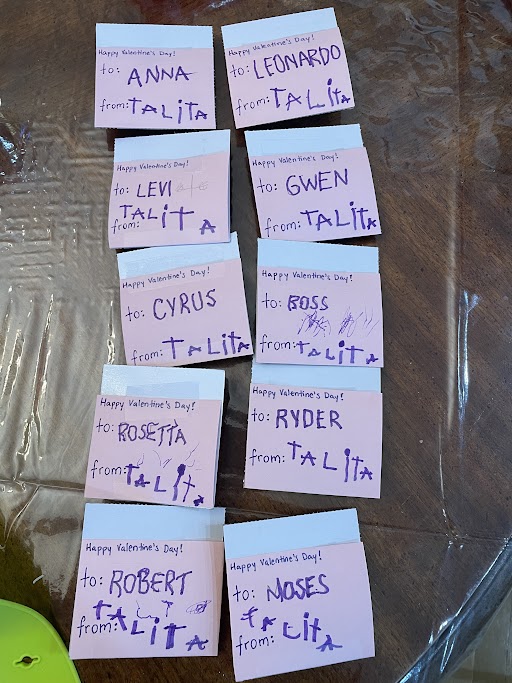
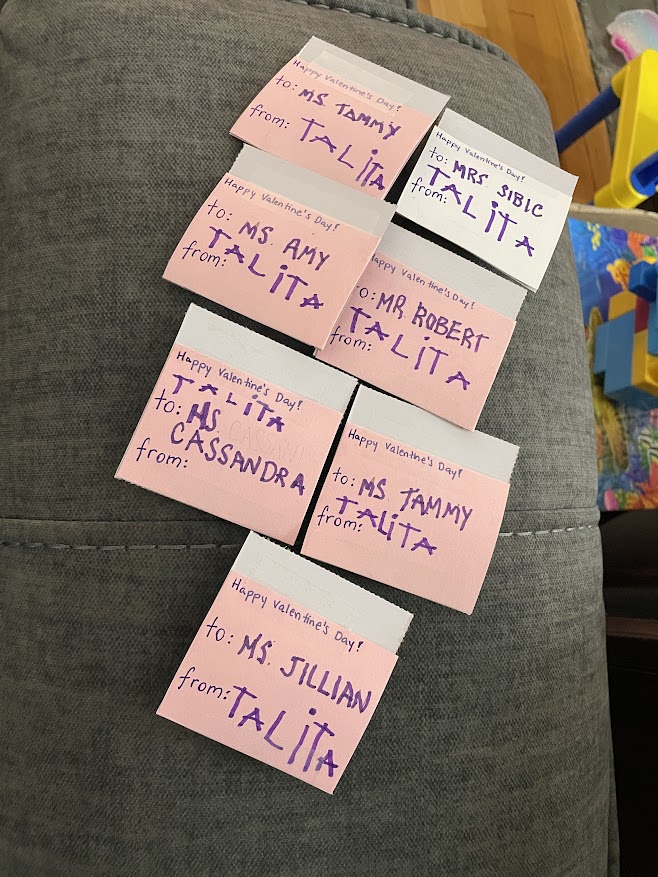
Today and tomorrow, I’m helping get Caleb and Talita to school and home again because their dad is traveling for work and their mom is a nurse who leaves home early and gets back late. The kids have spent hours laboring over their valentines for their classmates and teachers. Caleb wrote his greetings by himself.
Valerie “dotted” the names for almost-four Talita to trace, and she wrote her name by herself on all these cards:
So much effort to communicate friendship and appreciation!
I’ve been musing over how to combine Valentine’s Day with Ash Wednesday. The prophet Joel gave me the answer. God’s heart is full of unfailing love for us, and he wants us to love him back. He wants to repair his broken relationship with us. He can do so if we turn back to him, admitting and grieving what we’ve done that hurts him.
Our “valentine” for him is humility, and honesty, and a desire to hear and honor his heart of love.
And there’s no better source of love for those we care about than his Spirit, free to flow within and through us (John 7:37-39). That’s why I’ve chosen a flowing river as an image for Lent. The Spirit wants to cleanse us and grow and water his fruit in the garden of our hearts. Starting with love.
Shutterstock: Liinna Lilli
The Holy Spirit produces this kind of fruit in our lives: love, joy, peace, patience, kindness, goodness, faithfulness, gentleness, and self-control (Galatians 5:22-23).








 Debra Kornfield