Galatians 5:22-23 But the Holy Spirit produces this kind of fruit in our lives: love, joy, peace, patience, kindness, goodness, faithfulness, gentleness, and self-control. There is no law against these things!
Luke 6:35-36 [Jesus said] Love your enemies! Do good to them. … Then you will truly be acting as children of the Most High, for he is kind to those who are unthankful and wicked. You must be compassionate, just as your Father is compassionate.
An act or word of kindness, especially when undeserved or unexpected, can instantly move me to tears.
It can be as thoughtful as my husband washing and putting away the dishes to ease my way when I came home exhausted from an intense day.
It can be as generous as a friend paying me for work I would have been delighted simply to do for her, meeting a need I had expressed to no one.
It can be as compassionate as a friend saying, “Of course you feel this way today,” instead of judging me for a wave of grief for my daughter triggered by a certain date on the calendar.
It can be as merciful as the judge in traffic court reducing my penalty for speeding.
It can be as gentle as my five-year-old granddaughter placing her hand on my shoulder as I lay on the couch on her home with a migraine, saying “I hope you feel better soon, Grammy.”
It can be as gracious as a friend speaking well of me to a new acquaintance.
All of these expressions fit within chrestotes, the characteristic of love in Galatians 5:22 most often translated kindness or gentleness.
When have you most recently experienced or practiced chrestotes?
Critical, unkind judgments and words seem to appear frequently in our political and social discourse. What if we Christ-followers intentionally turn this around? Might our Spirit-kindled kindness spark more gentleness in each one of our spheres of influence?
An old song comes to mind. Perhaps you remember this! Here’s more info about this 1912 song.
2 Corinthians 9:5-8 But I want it [the Corinthians’ gift to the needy church of Jerusalem] to be a willing gift, not one given grudgingly. … You must each decide in your heart how much to give. Don’t give reluctantly or in response to pressure. … And God will generously provide all you need. Then you will always have everything you need and plenty left over to share with others.
2 Corinthians 8:12-13 Whatever you give is acceptable if you give it eagerly. And give according to what you have, not what you don’t have. Of course, I don’t mean your giving should make life easy for others and hard for yourselves.
“Work harder.” “Give more.” “Give until it hurts.”
Does that sound like God’s voice?
Sometime, maybe so. Paul commends the Macedonian church: “I can testify that they gave not only what they could afford, but far more” (8:3). He hastens to say, though that they did it joyfully, of their own free will. Not because of manipulation or pressure or guilt.
When famine hit the church in Jerusalem, Paul asked for aid from believers who had more at that time. He encouraged the Corinthians to consider a donation, saying “I only mean that there should be some equality. Right now, you have plenty and can help those who are in need. Later, they will have plenty and can share with you when you need it” (8:13-14).
I grew up in a small Mayan village in Guatemala where people lived at “subsistence” level. Our family lived humbly by North American standards—a family of ten in a house with two bedrooms (once Dad set up his study in the garage so he and Mom could move out of the living room), for which Dad paid $25/month rent, out of our $200 missionary income. We had books, and a few toys and games, and a small refrigerator. By comparison with our neighbors, we were wealthy, and our family generously shared what we had, receiving so much more in return of friendship and richness of culture and place.
When I came to the U.S. on furloughs as a child, I was overwhelmed by the extravagance of all that I saw around me. I struggled deeply with the question, “How can people live like this, when so many in the world barely have enough to eat?” I felt an obligation to work hard, to meet not just my own simple needs but to share with others. I gave sometimes from nothing, skipping meals to make up what lacked, and it was a joy to do so. Money has never caused me anxiety. I see this as a gift from God that has eased tensions when, for example, Dave and I struggled to make ends meet. I found it easy to believe God would provide what we needed financially. And we could always cut back, whether with groceries or in other ways.
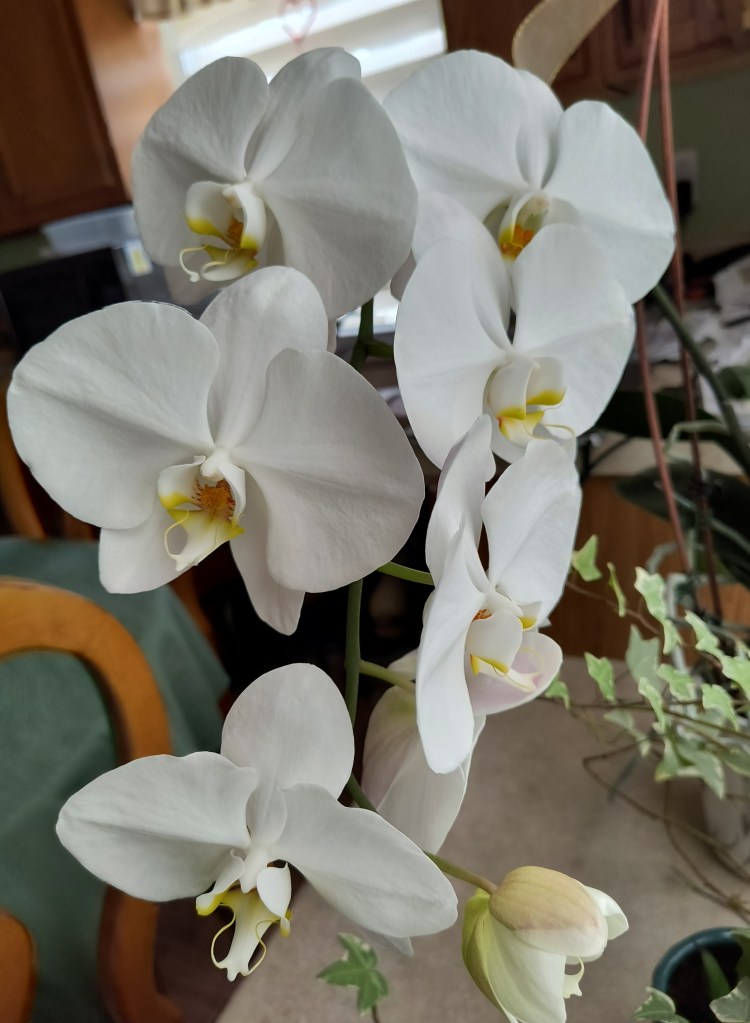
On June 4 there were just two blossoms. God’s generosity blooms right in front of me.
It’s taken me a lifetime, though, to understand that saying “no” to service—the overextension of another kind of giving, my time and energy—can be an act of faith. Saying no acknowledges my smallness and God’s bigness; my creaturely limitations. Can I trust God to care for others through different means and people when my own resources—including emotional ones—have run dry? When I just want to crawl in a hole for a while and hide? Can I acknowledge my own needs for rest as being legitimate? That has been a much bigger struggle, and of course there’s more to it than what I’ve said here.
I’m sure I’ve made mistakes trying to live out this kind of faith, when obedience actually means saying no. Sometimes I’ve given when I shouldn’t have. Sometimes I haven’t when I should have, missing out on the special joy of sharing what God has given me.
In both cases, though, God’s love is bigger than my poor powers of discernment. Would God care for the people of Jerusalem some other way if the Corinthians pulled back on what they had promised to give? What do you think? I would love to know!!
I admire caring people who can take a careful look at their own situation and decide without guilt or self-recrimination to trust God with a given circumstance. Especially when I see them at other times give generously with enthusiasm and joy. They don’t think they have to respond to every need that comes their way. Yet they love to share when they can, when God has blessed them with more than they need. I see these people living simply, stewarding their resources because they so delight in giving to others.
Paul says two things result when we give in this way: people’s needs are met (sometimes through me; more often through others), and God receives praise (9:12). Later, he also says that the recipients of the gift will pray for the giver with deep affection. It’s a win-win; “overflowing grace” in both directions (9:14). I’m still learning to practice this grace-filled way of living.
P.S. I really would love to know your thoughts on my question a couple paragraphs back!
2 Corinthians 8:2-3, 5, 9 The churches in Macedonia are being tested by many troubles, and they are very poor. But they are also filled with abundant joy, which has overflowed in rich generosity [to the suffering church in Jerusalem]. For I can testify that they gave not only what they could afford, but far more. And they did it of their own free will … for their first action was to give themselves to the Lord. … You know the generous grace of our Lord Jesus Christ. Though he was rich, yet for your sakes he became poor, so that by his poverty he could make you rich.
I think these verses describe well many pastors and leaders to whom God has given a passion for discipleship and disciplemaking across Latin America. They inspire us daily.
If those terms sound strange or antiquated to you, here’s a simple definition of discipleship and disciplemaking: a commitment to grow and to help others grow into being more like Jesus.
What then does “being more like Jesus” look like? For me, it’s a blue butterfly. More on that below.
This isn’t the blue butterfly in my vision, but enough to give you the idea
The best summary of being like Jesus is his own: “Love each other. Just as I have loved you, you should love each other. Your love for one another will prove to the world that you are my disciples” (John 13:34-35).
“Just as I have loved you.” Until we personally experience Jesus’ love for us, we can’t love others in the same way. As Paul puts it: First, we give ourselves to the Lord.
And when we feel dry, we return to him. We offer our needy hearts to him again.
Maybe because I grew up “poor” by some standards, I tend to feel uncomfortable and insecure around people for whom wealth is a value. I know I will fall short in every direction when judged by their standards.
Perhaps that’s why Jesus’ choice to live as a poor man means so much to me. I can approach him without that paralyzing feeling of unacceptability. I know he values what matters to me: people’s selves, their souls.
One time God blessed me with a vision of myself as a child, playing in a beautiful meadow with Jesus and a lovely blue butterfly. This is the scene I return to when I feel needy of a fresh experience of his rich, unhurried, unpressured, uncomplicated love.
And when we feel his love so filling us that it spills over to others, we return to him, in thanksgiving. As noted in the last blog, “we ourselves are like fragile clay jars containing this great treasure. This makes it clear that our great power is from God, not from ourselves” (2 Corinthians 4:7).
I know, and you know, the Source of anything good in our lives. I invite you to join me today in taking time to relax in his presence, opening our hearts to his great love. Then—be amazed at what he chooses to do through the overflow to others of his richly generous love.
1 Corinthians 3:3-4, 6-7, 16-17, 21-23 You are still controlled by your sinful nature. You are jealous of one another and quarrel with each other…Aren’t you acting just like people of the world? … I planted the seed in your hearts, and Apollos watered it, but it was God who made it grow. … Don’t you realize that all of you together are the temple of God and that the Spirit of God lives in you? … God’s temple is holy, and you are that temple. … So don’t boast about following a particular human leader. For everything belongs to you—whether Paul or Apollos or Peter, or the world, or life and death, or the present and the future. Everything belongs to you, and you belong to Christ, and Christ belongs to God.
My sister Linda has an interesting perspective of the various expressions of the Christian church. Having experienced a variety of them firsthand, she notes that each one seems to have a specific gift to offer the whole Body of Christ—like the gifts described in 1 Corinthians 12, Romans 12, and Ephesians 4, but at a denominational level instead of individual.
I love that perspective. It fits well with this third chapter of 1 Corinthians. All the fulness of the Holy Spirit was in Jesus, and when he ascended to Heaven and then sent the Spirit to the church on Pentecost, he distributed spiritual gifts—like light shining through a prism, diffracting and making visible all its beautiful colors. We need each other, because no single person, church, or denomination contains all the gifting of the Spirit. God fully lives in all of us together.
And here’s the truly wonderful thing: What God gives to you, he gives to me, too. What he gives to me is meant to bless you. “Everything belongs to you,” Paul told the Corinthians, and that “you” is plural. If we are jealous, critical, or rejecting of other parts of the Body of Christ, we lose a part of what God wants to give us. And when we think we are the ones who have it all, we lose too through not sharing.
I’m reminded again of the story I told in the last post. Eight children, eight fun gifts for Christmas. But many of those gifts weren’t fun to play with alone. Games and toys and puzzles are designed to be shared. And if just one or two of my sisters and I tried to play Monopoly by ourselves, we missed out on our brother Steve’s ingenuity. He always managed to make play time more fun by creating new rules and strategies. (He even got us girls to wash dishes when it was his turn, by reading Jeeves to us while we worked. Humdrum tasks filled with laughter when Steve was part of them.)
All was not joy and laughter in our home, though. We’ve all struggled with “zero-sum” thinking: there’s not enough to go around, so if I gain, you lose; if you gain, I lose. That’s a big topic for another time. But listen to what Paul says: Everything belongs to you! To all of you! All of us collectively as well as individually. There’s no need for envy or fighting or squashing you so I can get ahead or stay in power. God’s upside-down Kingdom is marked by the magic of abundance, generosity, and service, not stinginess or hoarding or manipulation. In Christ small becomes big, enough for everyone. A boy’s lunch, a widow’s penny, a flask of perfume, a man’s donkey, a mustard seed of faith, a rich man’s tomb . . . Because when given back to God, he makes our small offerings grow into something much greater than what they would be if kept to ourselves.
P.S. I wrote other thoughts about 1 Cor 3:6 on August 2, 2018. Check it out: Karis and a life-giving story from “Aunt” Claudia!