What does obedience look like?

But God’s Spirit teaches us

Ezekiel 36:26-27 [A message from the Sovereign Lord] “I will give you a new heart, and I will put a new spirit in you. I will take out your stony, stubborn heart and give you a tender, responsive heart. And I will put my Spirit in you so that you will follow my decrees and be careful to obey my regulations.”

John 14:15-17, 26 [Jesus told his disciples at the last supper] “If you love me, obey my commandments. And I will ask the Father and he will give you another Advocate, who will never leave you. He is the Holy Spirit, who leads into all truth. … He will teach you everything and will remind you of everything I have told you.”

While waiting in stillness for a worship service to begin, my heart and hands open to what the Lord would offer me that day, God’s Spirit told me clearly, “It’s time to let this go.”

Shutterstock: Wanan Wanan

For years, I had struggled with my relationship with a member of this church. This person had moved away, yet every time I walked into the building, I still automatically steeled myself, still reacted to memories of difficult encounters with that person in this place. In word and intent, I had forgiven her, yet my soul had not released her.

“How do I let this go?” I asked Spirit.

“Give her to me.”

I did, and just like that, the anguish of years lifted and has not returned.

Why did it take so long? Had my deep sense of injury dulled me to Spirit’s prior attempts to free me from this burden? Likely. I don’t know. Perhaps I was just ready to hear and obey Spirit’s prompting to release a root of bitterness in my heart.

We all obey.

The question is who, or what, holds authority over us. Our lives reflect whoever, or whatever, we bow to: our own inclinations and desires and perceived injustices, the influences and pressures of our culture and society, the temptations fashioned to match our individual vulnerabilities by the enemy of our souls, the urge to conform to our peer group …

Or, the King of Love, our Shepherd, creator, redeemer, advocate, and teacher, who wants us to live in freedom and joy.

The King of Love My Shepherd Is, John Rutter (Scroll down for the lyrics of this beautiful Irish hymn.)

Find freedom in faith

But God’s faithfulness never ends May 29, 2025

Galatians 5:22-23 But the Holy Spirit produces this kind of fruit in our lives: love, joy, peace, patience, kindness, goodness, faith [many translations say faithfulness instead of faith], gentleness, and self-control. There is no law against these things!

Lamentations 3:22-23 The faithful love [hesed] of the Lord never ends! His mercies never cease. Great is his faithfulness; his mercies begin afresh each morning.

“Great is Thy Faithfulness,” we sang at my dad’s funeral, his favorite hymn. “Morning by morning, new mercies I see.” God’s faithfulness anchored him through incredible challenges and trials, even through failures.

And Dad’s death was just the beginning of his story. After his death, we sibs let our imaginations fly as we pictured him in Heaven with all the time in the world to indulge his many passions and interests. Why could we do this? Because God’s faithfulness is ETERNAL. It doesn’t stop here.

“One day at a time” has been my instinctive response when people ask me how I survived the Karis years. “Sometimes one hour at a time. Counting on God’s faithfulness, his manna for this one day.” Thinking about an elusive “tomorrow” was too overwhelming. I gripped God’s faithfulness for this moment, this challenge. And then the next one. I lived this way for 30+ years.

Karis’s move to Heaven–I’m so curious about what she’s been up to there in her ongoing experience of God-s faithfulness!–didn’t automatically change me. Living intensively in the present, without margin in my life for worrying about the future, became so habitual that for better or worse, it’s with me still. I’m able to engage with this morning, or today—maybe that stretches out now to thinking about this week. But I plan for and set personal longer term objectives in only the vaguest of terms, such as “I want to publish three books this year, so I’ll have them to take to homeschool conventions next spring.”

(Unless I see that my lack of planning will negatively impact others. That somehow feels different, requiring more detailed attention to “how” something could be done.)

“How exactly will you accomplish this?” my husband asks of my vague desires. He wants a Plan, as do our mission leaders. I’m immediately flooded with stress and a compulsion to retreat, to give the whole thing up. I think, “If God wants me to do this, he’ll show me how.” But my ideas about what I want to do aren’t the most important thing. I need to stay flexible to understand what God is asking of me on any given day.

Is that the kind of faith Paul is talking about? Or is it irresponsibility; just an excuse handily available (principally to myself) if I don’t reach my “goals”? The jury is out.

Vine’s says pistis, the word Paul uses in Galatians 5:22, is used in the New Testament always of faith in God or Christ. It’s not faith in myself or faith in other people or circumstances. It’s not even faith in God’s promises. It’s persistent trust in God’s faithfulness, rooted in personal surrender to him, himself.

For me, this is freedom. It’s not all up to me. The weight of the world is on HIS shoulders, not mine. I just have to do my wee part.

Here’s the cool thing: even faith in God’s faithfulness is not something I have to generate. It’s something the Spirit produces in me.

My part is giving him space in my soul to do his work. And then letting his faithfulness motivate me to live faithfully.

Faith and Wonder, Meredith Andrews

Loving shame more than honor

But God grieves over us

Hosea 4:1, 3, 6, 7, 12, 18 The Lord has brought charges against you, saying: “There is no faithfulness, no kindness, no knowledge of God in your land … That is why your land is in mourning. … My people are being destroyed because they don’t know me. … They have exchanged the glory of God for the shame of idols. … Longing after idols has made them foolish. … They love shame more than honor.

Nearly three thousand years ago, long before writers like John Bradshaw and Brené Brown helped us understand shame, the prophet Hosea linked it with not knowing God, not understanding his compassion and love, his yearning for a close relationship with his beloved people.

Instead, in Hosea’s day, both leaders and ordinary people turned to idols [anything that takes God’s place in our hearts], pleasures, addictions, violence, unfaithfulness in relationships, sexual depravity, cheating, and other forms of robbery.

Has anything changed in the last three thousand years?

The Hebrew word Hosea uses is gâlôwn, translated shame in most English versions. Associated words are disgrace, confusion, dishonor, ignominy [public disgrace], reproach. This shame is vile, base, and despicable.

“My people are being destroyed because they don’t know me,” laments the Lord (Hosea 4:6, 2:20). “Oh, that we might know the Lord,” cries Hosea (6:3).

The kind of shame Hosea describes is extremely painful. Why would we choose shame rather than honor? Perhaps we fear God’s judgment? Fear the loss of things we’ve come to love? Fear rejection by others if anyone detects our true struggles? As Brené Brown often points out, shame thrives in secrecy, in darkness, in isolation. Shame flees when brought into the light. Yet we fear exposing our shame to God, to others, and even to ourselves, even though that’s the best way to be free from it.

A friend recently described to me her cycle of shame. She feels lonely, or disappointed, or betrayed. To ease those feelings, she escapes into her addiction, soothing herself with a temporary pleasure. When she comes out of that, she’s embarrassed and frustrated with herself that she gave in to a temptation that she knows is harmful to her health. When she’s alone, those feelings are so uncomfortable that she again buries them with her addiction. And on and on her cycle of shame spirals. When she’s with other people, her shame prevents her from indulging, and prevents her from finding help, because she doesn’t want to expose her struggle and become an object of pity or of disdain or of judgment.

Every one of us can relate. Each of us has our own way of trying to escape painful feelings. If we realize it’s not just us, maybe we can become more willing to let an understanding friend listen to our struggle. And go with us into the presence of God, who longs to heal us and show us his compassion—as my friend courageously did with me. And I with her.

This high priest of ours [Jesus] understands our weaknesses, for he faced all the same testings we do, yet he did not sin. So let us come boldly to the throne of our gracious God. There we will receive his mercy, and we will find grace to help us when we need it most (Hebrews 4:15-16).

Advent 1, HOPE: Let go. Look up!

Advent ABC playlist

But God gave each of us a race to run

Hebrews 12:1-2 Since we are surrounded by such a huge crowd of witnesses to the life of faith, let us strip off every weight that slows us down, especially the sin that so easily trips us up. And let us run with endurance the race God has set before us. We do this by keeping our eyes on Jesus, the champion who initiates and perfects our faith …

Luke 21:34 Be on guard so that your hearts are not weighed down with … the worries of this life, and that day [Christ’s return] catch you unexpectedly (NRSVA).

Image by my friend Carol Amidi https://www.carolamidi.net/

On Monday evenings, I meet on Zoom with women from Argentina, Chile, and Venezuela who are leaders in their churches and denominations. This week we are memorizing Hebrews 12:1-2 (in Spanish, of course). I realized yesterday how fitting this passage is for Advent, this interesting time in the year when we anticipate Christ’s return in glory while preparing to celebrate his first coming as an infant.

This year in particular my heart has been weighed down with many concerns. (Yours too?) I asked a prayer team for intercession yesterday about how to handle high stress and at the same time focus on the hope Advent offers us. As our pastor Peter reminded us, Advent hope is rooted in the fact that we know Jesus is good. We know him, his tenderness and compassion, his faithfulness and gentleness—this One who will return one day as a mighty warrior, defeating all evil, to reign in justice. We’ll be able to look into his eyes and know that he is the one who has been our friend and companion all our lives.

My main takeaway from the wonderful prayer offered on my behalf is that I am to live from a center of peace, daily entrusting to Jesus my burdens and worries, both those over which I have a measure of control and those I can’t control at all.

Let go and look up. Accept the support of those whom God has placed around me, and cheer each of them on in their own God-designed races.

Hope. All will be well.

Since he himself has gone through suffering and testing, he is able to help us when we are being tested. … So let us come boldly to the throne of our gracious God. There we will receive his mercy, and we will find grace to help us when we need it most (Hebrews 2:18, 4:16).

I invite you to savor again the wonderful music (5 hours!!) on my Advent ABC playlist:

Happy Juneteenth!

But God sets captives free

Luke 4:17-19 Jesus unrolled the scroll of Isaiah the prophet and found the place [Isaiah 61:1-2] where this was written: “The Spirit of the Lord is upon me, for he has anointed me to bring Good News to the poor. He has sent me to proclaim that captives will be released, that the blind will see, that the oppressed will be set free, and that the time of the Lord’s favor has come.” … Then Jesus began to speak to them. “The Scripture you’ve just heard has been fulfilled this very day!”

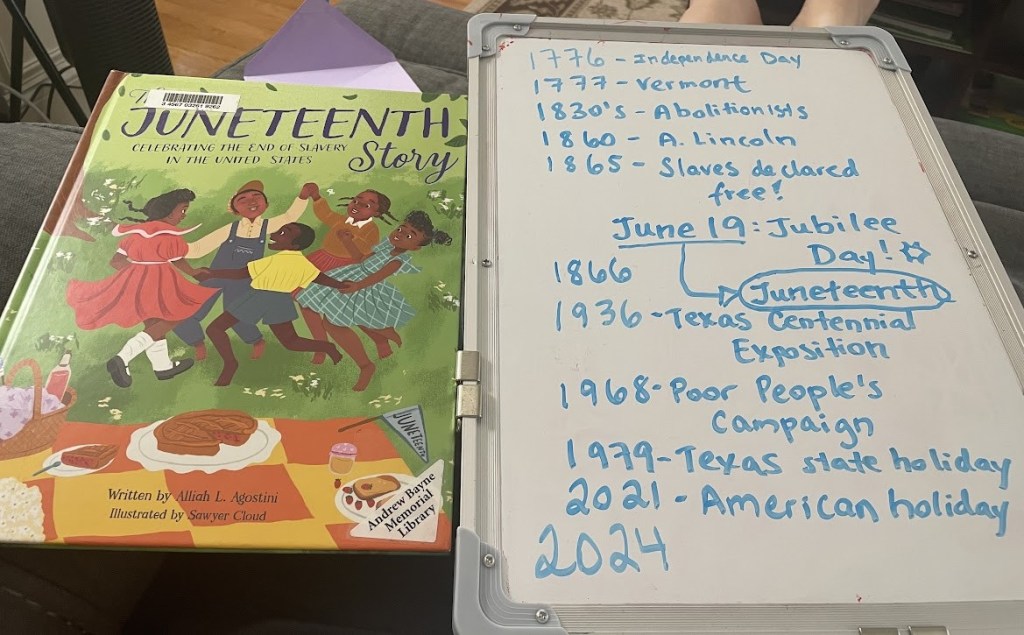
On Juneteenth we celebrate the emancipation of slaves in the United States. The story of the slaves in Texas learning about this, months after it became true, will be told many times today.

Sadly, true freedom has taken—is taking—much longer to experience, because the other part mentioned by Isaiah in this passage, that Jesus applied to himself, is that the blind will see. John shows us in John 9 how many different types of blindness there are, especially of those who think they can see, those who hold power to bless others or to harm them (um, that would be each of us, right?).

My daughter Valerie teaching her kids about Juneteenth

Today, I pray that God will heal my blindness. Especially in areas where I think I can see. And I pray blessing on all those whom God is using to heal the racial wounds within the Body of Christ. Be the Bridge. Here in Pittsburgh, Sisters Celebrating Diversity. You can fill in those working for healing where you live.

My granddaughter Liliana (Rachel’s daughter) at a Juneteenth parade.

As an aside, I will mention that June 19 is an important date for me in other ways too. My beloved older brother Steve was born on June 19. It’s the day our family, the kids sweating under long sleeves and pants to cover up their chickenpox, arrived in São Paulo, Brazil in 1990. On June 19 exactly one year later we moved into the house that would be our home for nineteen more years.

And it’s the day I have before me right now, in which to rejoice in the many ways God has set me free and to pray for those who still find themselves in bondage and oppression.

For the Lord is the Spirit, and wherever the Spirit of the Lord is, there is freedom (2 Corinthians 3:17).

Sounds of Blackness – Juneteenth Celebration https://www.youtube.com/watch?v=WH3a_xtjzZg

Our God, Open the Eyes that are Blind, Chris Tomlin

Hide and seek

Hide and seek

But God’s work is revealed in his light

John 3:19-21 God’s light came into the world, but people loved the darkness more than the light, for their actions were evil. All who do evil hate the light and refuse to go near it for fear their sins will be exposed. But those who do what is right come to the light so others can see God at work in what they are doing.

I just spent a weekend with my grandchildren. They love, love, love playing hide and seek, from the baby to the six-year-old. The two three-year-olds can’t bear for long the tension of being hidden: “Here I am! I’m here!” The six-year-old can wait a long time in his increasingly inventive hiding places.

Shutterstock: A3pfamily

In the course of their play, this six-year-old knocked his sister to the ground. Immediately he said, “I’m sorry, I’m sorry” and rushed to help her get up. I noticed, though, that minutes after she was happily off chasing her cousin, my grandson stood in place, tears pooling in his eyes. When I asked him what was wrong, the tears overflowed.

“I didn’t want to hurt Talita,” he sobbed. “I did something bad.”

I had a choice: Try to convince him that accidents happen and not to worry about it; Talita was fine. Or honor his sense of wrongdoing. “Sweetheart,” I said, “there’s something we can do when we’ve done wrong.”

“What?” he asked, wiping his eyes on his sleeve.

“We can tell God what we did and ask him to forgive us. When we do that, he promises to make our hearts clean. Would you like to do that?”

After doing so, he stood for a moment looking at the floor, then gave me a brilliant smile and ran to find his sister and cousins.

And I had the joy of seeing God at work, lifting my grandson’s distress from his shoulders.

You and I have the same opportunity: to bring our wrongdoing to the light so we can receive forgiveness and restoration of our joy and freedom. Often this requires restitution as well for the way we have hurt someone.

We may think we’re protecting ourselves when we hide our sin, but in fact we’re internalizing the harm we did, thus dimming our internal light, making it harder to see our own hearts clearly. We need the Holy Spirit to shine his light, to seek and find and deal with what is hurting us inside.

If we claim we have no sin, we are only fooling ourselves and not living in the truth. But if we confess our sins to God, he is faithful and just to forgive us our sins and to cleanse us from all wickedness (1 John1:8-9).

Advent ABC: Jesus (Savior)

Matthew 1:21 (Isaiah 43:11, 62:11) [Gabriel told Joseph] “Mary will have a son, and you are to name him Jesus, ‘The Lord saves,’ for he will save his people from their sins.”

After posting Advent ABC: Holy One early last Sunday (the second Sunday of Advent), I was surprised to find holiness the theme of our service when I got to church. Kevin Antlitz preached a deeply moving sermon, clarifying many misconceptions about the holiness of God and what it means for us to pursue holiness: “It’s not about perfection. It’s about direction.” Jesus shows us that holiness is a human being fully alive; motivated by love, not by fear as we wait to see him again.

And we sang “Lord I Need You” by Matt Maher:

Where sin runs deep, your grace is more;

Where grace is found is where you are;

And where you are, Lord, I am free.

Holiness is Christ in me.

A Thousand Hallelujahs, Brooke Ligertwood

What are you “no” to?

But Jesus said “No!”

Matthew 4:1-4 Then Jesus was led by the Spirit into the wilderness to be tempted there by the devil. For forty days and forty nights he fasted and became very hungry. During that time the devil came and said to him, “If you are the Son of God, tell these stones to become loaves of bread.” But Jesus told him, “No! The Scriptures say, ‘People do not live by bread alone, but by every word that comes from the mouth of God.’”

Matthew 5:37 Just say a simple, “Yes I will,” or “No, I won’t.”

In her book Saving Grace (Convergent, 2021), Kirsten Powers tells her painful story of trauma recovery and ways she is learning to live by grace. In her chapter about boundaries, she says “I am a ‘no’ to contempt, cruelty, disrespect, shaming, judging, bad-faith accusations, bullying, gaslighting, demonizing, dehumanizing, lying, both-sides-ism (creating false equivalency between the behavior of different people or groups), and any and all forms of bigotry. I am a no to having conversations with people who are committed to misunderstanding me.” She continues by identifying practical ways she has learned to say “no,” so she has space in her life to say “yes” to grace.

Shutterstock: Kastoluza

Saying “no” can be painful. And we love avoiding or minimizing pain—at least I do. But in her wonderful Transfiguration sermon on Sunday, Jess Bennett linked suffering with glory, inviting us to explore that connection during this season of Lent. And Jonathan Millard in his Ash Wednesday sermon told us fasting (saying “no” to whatever enthralls us) intentionally creates space for us to draw close to God and to discover he is kind and gracious, not angry and vindictive. Jonathan challenged us to let the cravings we feel when we say “no” stir in us our longing for our Father. Most of all, fasting in secret challenges our “approval addiction,” setting us free from our desperate need for the approval and affirmation of others.

I’m working on my “no” list. Then I’ll move on to my “yes” list. Will you join me? And then use this Lent to explore ways to make your “no’s” stick?

During these forty days, I’m deep-diving into Matthew and Hebrews. So I’ll close with this encouragement from Hebrews 12:10-12:

Our earthly fathers disciplined us for a few years, doing the best they knew how. But God’s discipline is always good for us, so that we might share in his holiness. No discipline is enjoyable while it is happening—it’s painful! But afterward there will be a peaceful harvest of right living for those who are trained in this way. So take a new grip with your tired hands and strengthen your weak knees. Mark out a straight path for your feet so that those who are weak and lame will not fall but become strong.

But God brought them out

Acts 5:16-20, 32, 40-41 Crowds came from the villages around Jerusalem, bringing their sick and those possessed by evil spirits, and they were all healed. The high priest and his officials were filled with jealousy. They arrested the apostles and put them in the public jail. But an angel of the Lord came at night, opened the gates of the jail, and brought them out. Then he told them, “Go to the Temple and give the people this message of life!” … [When they were arrested again] Peter replied to the high priest, “God raised Jesus from the dead … We are witnesses of these things and so is the Holy Spirit, who is given by God to those who obey him.” … The high council had them flogged. Then they ordered them never again to speak in the name of Jesus, and they let them go. The apostles left the high council rejoicing that God had counted them worthy to suffer disgrace for the name of Jesus.

What imprisons you?

For me, as I mentioned in the last blog, it can be fear, or worry that I’m not capable of doing things “right,” in a way that will bless other people. Sometimes I’m paralyzed by anger at human injustice, deception and manipulation, and the suffering people endure at the hands of others, rather than using the energy of that anger to try to make a difference. Old messages from childhood can creep up and cripple me. The enemy of our souls knows where we’re vulnerable.

But God frees and heals me as I turn to him. He longs to free and heal you, too.

In Brazil, my husband Dave started a ministry of emotional healing called REVER. The acronym means “to see again,” or “to take a second look.” It stands for “restoring lives, equipping restorers.” Our kids grew up in the context of healing prayer ministry in our home and in our church. We watched God do one miracle of release and healing after another, as dramatic as the physical healings in Acts 5. Our church doubled, tripled, quadrupled in size as people met Jesus and experienced his love for them. Under Brazilian leadership, REVER has spread across Brazil and is active now in several Spanish-speaking countries. The Holy Spirit is alive and well!

Take a risk. Show God your shackles and your wounds. Ask him to release and heal you. If you know someone who loves God, ask him or her to support you in this prayer. Find people who can walk with you as you grow into freedom and health. Discover for yourself the joy of God’s care for you, the message of life he is speaking just for you.

I want to share with you one of Karis’s favorite songs: