Hebrews 2:17 Therefore, it was necessary for him [Jesus] to be made in every respect like us, his brothers and sisters, so that he could be our merciful and faithful High Priest before God.
John 1:14 So the Word became human and made his home among us. He was full of unfailing love and faithfulness.
In Chapter 7 of her book In His Image, Jen Wilkin identifies the written word of God, the Bible, as “our great Ebenezer, a memorial stone to the faithfulness of God. … Between its covers a glorious truth is repeated for our great benefit: God is worthy of our trust” (pages 100-101).
What does she mean by calling the Bible a “great Ebenezer”? 1 Samuel 7:12 says, “Samuel then took a large stone and placed it between the towns of Mizpah and Jeshanah. He named it Ebenezer (which means “the stone of help”), for he said, “Up to this point the Lord has helped us!” Samuel did this to memorialize a time when God intervened with a mighty thunderstorm to save his people from an invading army.
The Bible is full of wonderful “But God” stories of God’s faithfulness, to encourage us in our own hard times. Jen continues, “When we spend time in the Bible, our lives begin to bear witness to its faithful message. We ourselves become stones of remembrance for those around us, giving faithful testimony that God is worthy of our trust, no matter what (page 101).
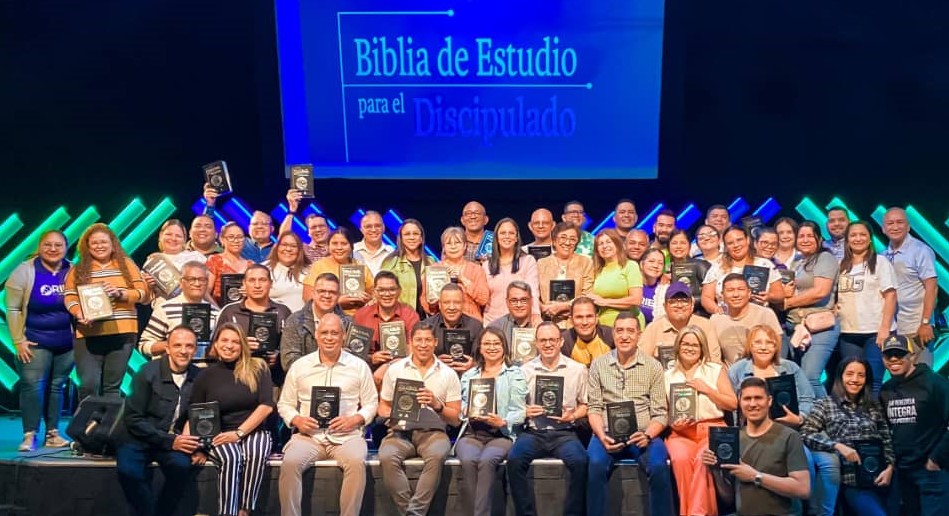
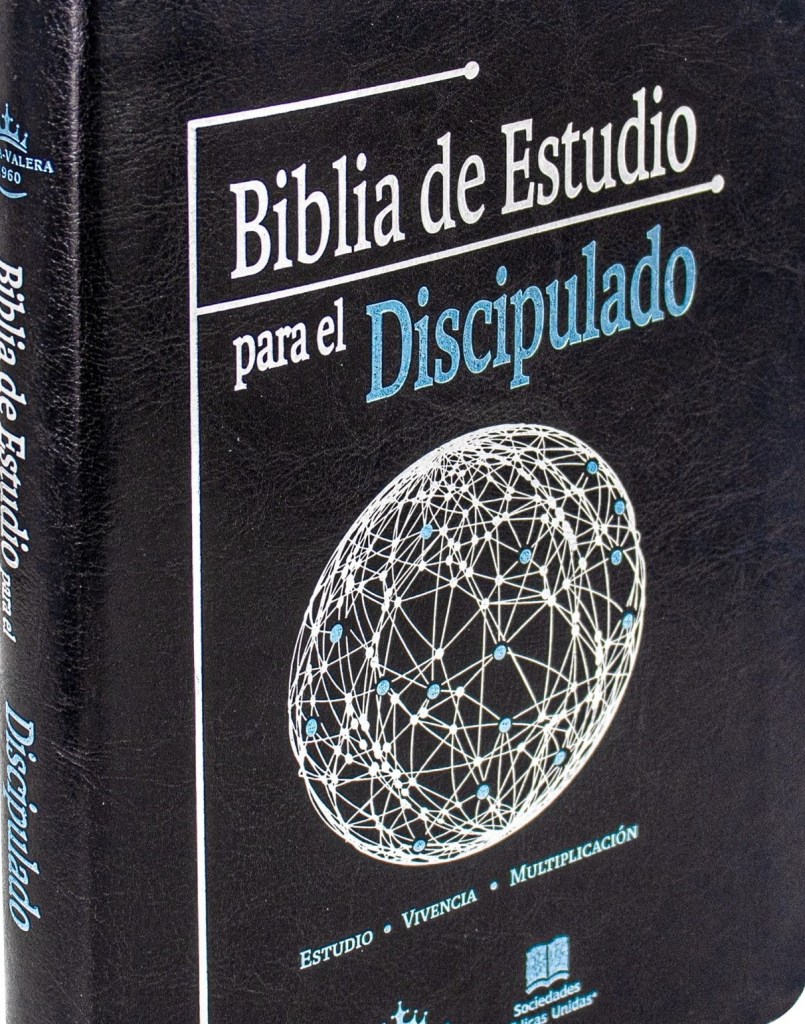
Yesterday, Dave showed me this picture of fifty pastors and leaders in Venezuela who had just been gifted with the Biblia de Estudio para el Discipulado (Discipleship Bible).
The picture triggered a memory of God’s faithfulness to Dave. For six years after Karis and I came to Pittsburgh for intestinal transplant, Dave and I lived on two different continents, always expecting Karis to get well enough for me to go home to Brazil. Finally, Dave realized Karis wasn’t going to get better, so he needed to move to Pittsburgh.
This felt to Dave like a punch in the gut. He was 100% engaged in ministry in Brazil. What would he do in Pittsburgh? Yet in agony of spirit, he took the necessary steps over the next year to obey what he knew God was asking him to do: give up Brazil and join Karis and me here.
But God had a plan. The week before he left São Paulo, Dave received a call from the Brazilian Bible Society asking him to write a Discipleship Bible in Portuguese.
Had Dave stayed in Brazil, he would never have found the time to write. In Pittsburgh, though, this work became his great joy, an eight-year project into which he could pour all that God had planted in him about being and making disciples of Jesus: 450 small group studies, notes for disciples of Jesus on every page, highlighting practical applications, introductions to each book noting what it had to offer disciplers, and a comprehensive index and cross-reference system.
The Discipleship Bible was published in 2018 in Brazil, and last year in Spanish, in multiple printings already.
Dave was faithful to what he understood God was telling him to do, though the cost to him was great. God was faithful in giving Dave a project he could work on in the “foreign land” of Pittsburgh. All so people across Latin America and Brazil who want to walk closely with Jesus, open themselves to transformation by his Word, and help others do this also, could have access to the years of experience and all the passion and wisdom about disciplemaking God had poured into Dave across his lifetime.
What tough thing is God asking of you? Can you trust his faithfulness, even though you can’t yet see it?
All the Lord does is just and good, and all his commandments are trustworthy. They are forever true, to be obeyed faithfully and with integrity.
But God had other plans: He knew what lay under the desert land
Ephesians 3:17 Christ will make his home in your hearts as you trust in him. Your roots will grow down into God’s love and keep you strong.
Hebrews 10:24 Let us think of ways to motivate one another to acts of love and good works.
I (Debbie) was fascinated by the story my Wheaton College classmate Sue Long told in their last newsletter and am excited to share it with you. It coordinates with the “God Most Loving” chapter in Jen Wilkin’s book, In His Image, which calls us to agape love like God’s: holy, infinite, and costly. “For agape, there is no such category as “unlovable” (page 41).
Here’s Sue:
SIM (at that time Sudan Interior Mission; now SIM International) entered Niger in 1924. Terry and I and my brother Jack will return to Niger in December to celebrate this centennial. SIM’s initial work concentrated on trekking and nomadic outreach. After a decade, SIM asked the French government in Niger for property to establish a surgical hospital among the poorest of the poor in the vast rural areas of the Sahara Sahel. Finally, following 15 years of vigorous discussion, the French ceded to SIM what looked like a wasteland on which to build. It seemed a mockery: “You can try, but you won’t succeed.” But God had other plans!
In July 1950, after a year of French study in Paris, Sue’s parents, Dr. Burt and Ruth Long, landed on a desolate stretch of runway, having leapfrogged across the mighty Sahara Desert to this isolated destination. With two young sons in tow, they reached their new home in a small village scalding in the heat of brilliant sunshine. They would add four more children to the family over the next years.
The village was called Galmi, located far from anywhere, with scrubby bushes, hard, stony ground, lonely thorn (acacia) trees upon which camels chewed, no electricity, and limited water. And HOT. Burt and Ruth had agreed to open the hospital in Galmi as a channel for the gospel and a beacon of hope in a seemingly godforsaken place. Thousands of people lived in scattered villages of the Sahel with no access to medical help and no knowledge of a Savior who offers forgiveness of sins and eternal salvation.
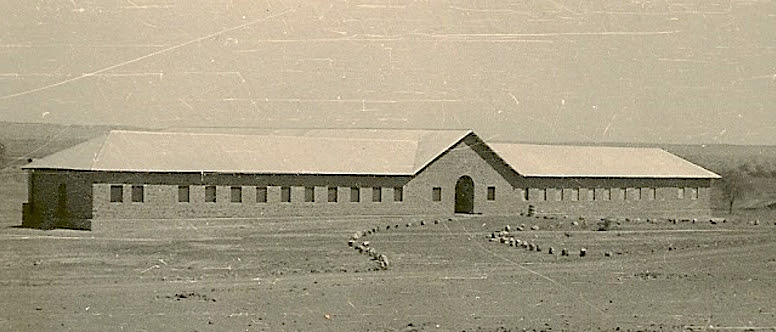
Others had come before them. Two houses and a few other buildings, built with rocks, mud, cement, and tin-pan roofs stood ready to receive the first permanent mission workers. Way down the path from the houses stood the completely empty T-shaped hospital, with cement floors and metal shutters over screened windows.
Galmi became an oasis in the desert after a lake of water was discovered under the property in 1980. God knew the value of the French gift!
You can read the rest of the story in A Family Living under the Sahara Sun, by Sue’s mother Ruth Long, available on Amazon.
Debbie: I’ve just ordered the book. Imagine those thirty years of faithful love and service by the Long family before the underground lake was discovered. Sue says her roots grew down deep into Galmi’s hard soil. Even there, she discovered God’s wonderful love, which propelled her and her husband Terry into a lifetime of service in Nigeria.
Does the soil of your heart feel hard? Your roots growing into his love will make you strong.
Hebrews 4:16 So let us come boldly to the throne of our gracious God. There we will receive his mercy, and we will find grace to help us when we need it most.
Colossians 4:6 Let your conversation be gracious and attractive.
Between travel and illness, I haven’t managed to post for the last couple of weeks. If you’ve been tracking, though, you know I’ve been studying the book of Hebrews. I’m also reading Jen Wilken’s In His Image: Ten Ways God Calls Us to Reflect His Character. I intend to use Jen’s categories over the next few weeks, probably in the order she presents them.
Yesterday, though, I was impressed so much by Kamala Harris’s concession speech that I decided to skip ahead to Jen’s chapter 6: God Most Gracious. I’m not good at it yet, but I want to become a gracious person. I’m always on the lookout for role models in “real life,” people who can show me what being gracious looks like. So, Kamala’s speech and attitude and manner caught my attention.
No matter who you voted for, I think you can profit from taking twelve minutes to watch this:
I’ve done so three times already and will probably watch it again.
Graciousness requires humility. It requires caring more about others than about oneself. As Jen says, what people tend to want is not to be treated fairly, but to be treated preferentially. Our love of preferential treatment displays itself in a thousand ways, wanting the best for ourselves. But,
“Christians should have a reputation for playing favorites with everyone except ourselves. As those who have received abundant grace, we do good in abundance. … We should be known as the people who respond to ‘I hate you’ with ‘I love you,’ and as the people who respond to ‘I love you’ with ‘I love you more’” (pages 94-95).
Do everything without grumbling or arguing, so that you may become blameless and pure, children of God without fault in a warped and crooked generation. Then you will shine among them like stars in the sky as you hold firmly to the word of life (Philippians 2:14-16).
Hebrews 13:21 I fervently ask God to create in you the desire to please Him by doing all kinds of good, accomplishing through your daily activities the things which only Jesus, God’s Appointed One, can equip you for. Such things are especially pleasant in His eyes, for the glory He receives through them endures through all eternity. May it be so in you! (“Consider How the Son Shines!” translation of Hebrews by Ray Elliott)
Last Sunday, October 20th, would have been my dad’s 100th birthday. Thinking about him, I wrote, with contributions from my siblings, a brief synopsis of his adventurous and remarkable life.
Raymond Leroy Elliott, October 20, 1924-November 12, 2008
Birth through age 10, 1924-1934: Born in Independence, Kansas, the second of four boys (Richard, Raymond, Roland, Roger), my father and his family experienced two bitter losses during his first decade of life. First was the death by accident of their baby sister. Second was the loss of their house, foreclosed by their bank for lack of $3.70 to pay their mortgage one month. This sounds unbelievable now. In those years of the Great Depression, the family never fully recovered from the loss of their home.
In his teens, 1934-1944: Dad was a quiet boy, deeply involved in pursuing several interests and hobbies. He couldn’t decide whether he wanted to become a printer or a professional musician or a photographer. In high school, he fell in love with my mom, two years younger. One of her earliest memories of Dad was seeing him stretched out on the floor of his living room eating a huge bowl of popcorn, so immersed in the book he was reading he was oblivious to the high-energy chaos generated by his three brothers and their friends. Dad was 17 when Japan attacked Pearl Harbor. The army refused his service because he had clear vision in only one eye. He decided the best way he could serve people would be as a pastor and began a course of study at Phillips University in Enid, Oklahoma. Mom followed him there after graduating early from high school.
In his 20s, 1944-54: Dad married Helen Ruth Belcher June 10, 1945; he was 20 and she was 18. They took on an interim pastor role for the summer in a small church in the Oklahoma panhandle. To their surprise, that summer they together came to understand the Gospel for the first time (an amazing story). They returned to Enid, OK, where Dad worked and Mom birthed her first baby, Linda, as they prayed for direction. During that year they learned about and moved to Wheaton, Illinois to attend Wheaton College. Both graduated, Dad completed an M.A. in theology, and gained another daughter, Marsha. He and Mom became interested in Bible translation, initially in China, and when those doors closed, in Guatemala.
Back in Independence, a son, Stephen, was born and Dad’s father died. Dad and Mom joined Wycliffe Bible Translators and completed linguistic training. After “jungle camp” in Mexico—training in living in rustic conditions—they moved to Nebaj, a Mayan Ixil village nestled in the Cuchumatanes mountains of Guatemala, where no other white foreigner lived at that time. I was born a year later, in the middle of a CIA-sponsored revolution against the government of Guatemala, two months before Dad turned 30.
In his 30s, 1954-64: Many stories have been told of how Dad and Mom overcame cultural barriers and fear, won acceptance by the Ixil people, and learned their language, which had never been written down. Dad creatively made a tiny two-bedroom home livable, devised an Ixil alphabet, began figuring out Ixil grammar and syntax, ventured into early translation efforts, and fathered two more daughters, Janice and Sharon. Mom offered emergency medical care in a village which had none. Dad transmitted his love of classical and marching band music and singing to his children through LP recordings. One by one, we children left home to study at a boarding school about four hours away on rough roads. Parents were allowed to visit once each semester and had their children at home only for summer vacation and Christmas.
On a furlough in 1961 in Independence, my younger brother, Daniel was born, and Linda moved to Colorado for high school. Back in Guatemala, our youngest sister, Karen, completed the family. Because Dad and his two sons were born in the same hospital in Independence, and all six daughters elsewhere, we joked that if only Mom and Dad had stayed in Independence, perhaps they would have had more sons and fewer daughters.
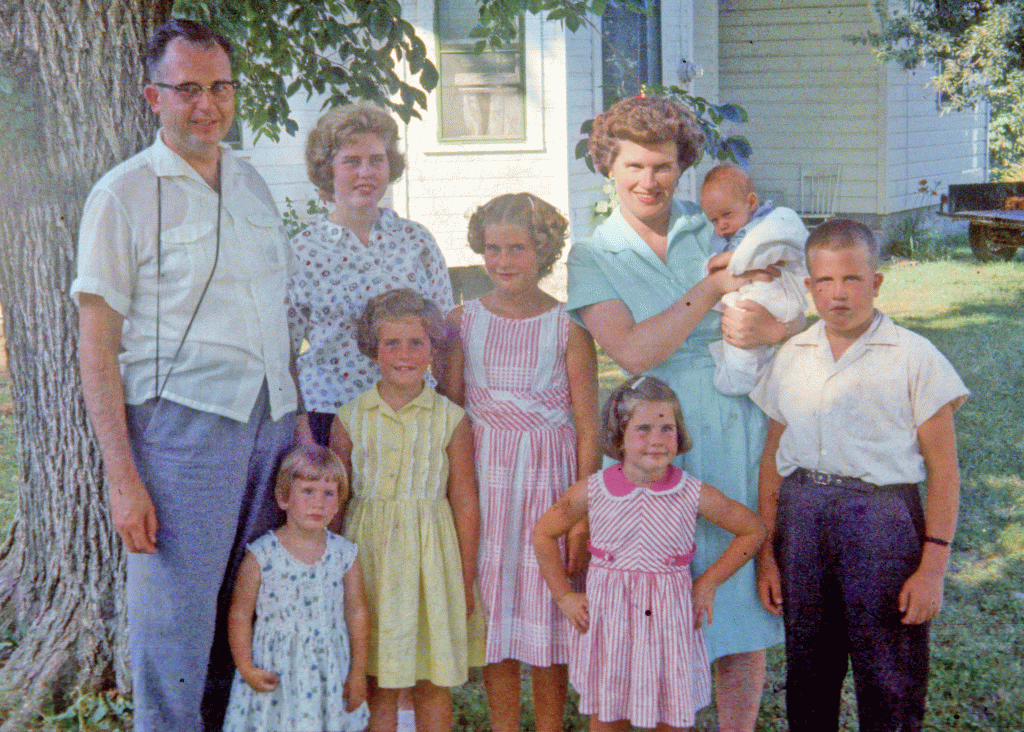
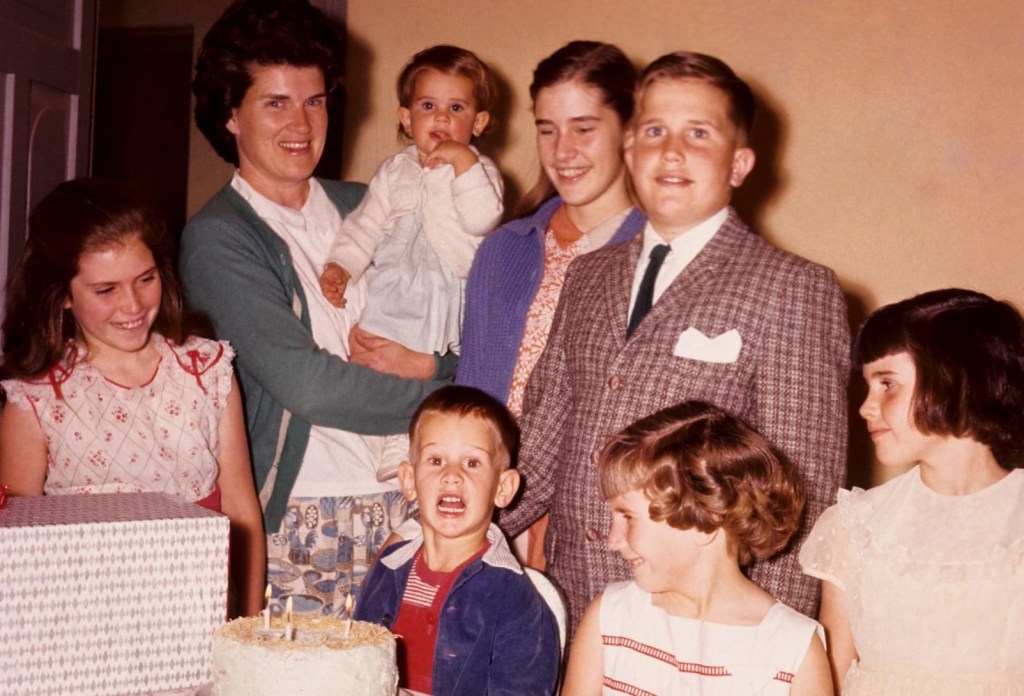
Dad with his family in Independence, KS 1961 (I’m in the yellow dress.)
Just missing Karen …
By God’s grace and with careful nursing, almost thirteen-year-old Marsha survived a severe case of nephritis, but her recovery was slow. Linda took a semester off from college to help the family through this time, since Karen was a toddler and Danny a preschooler. Dad moved the family to a house across the street from our boarding school for a few months so Marsha could continue studying and graduate from eighth grade with her class.
Guatemala, May 1965
Danny’s 3 year old birthday: Karen 1; Linda in the US for high school. Dad taking the photo.
In his 40s-60s, 1964-94: Dad was asked to become the director of Wycliffe’s Guatemala branch, which required living in Guatemala City more than in Nebaj for a few years and hindered his own Ixil translation work. Dad cultivated his hobby of photography and designed his own needlepoint creations as a way to get through long meetings.
A second furlough, 1965-66, took us to Wheaton, so Dad could complete an M.A. in linguistics at the University of Chicago. Marsha and Steve stayed on in Wheaton for high school. One by one as we in turn graduated from boarding school in Guatemala, the rest of us transitioned to various cities in the U.S. Dad continued Ixil translation work while Mom focused on designing literacy materials and teaching people to read and then train others. Mom invested in building a school in another Ixil village, Salquil, which continues teaching children today. Some years, both of them taught in Wycliffe’s Summer Institute of Linguistics. A brutal civil war (1960-1996) deeply affected the Ixil region of Guatemala in the 1980s, forcing Mom and Dad to spend time in Guatemala City while contributing to relief efforts for the suffering Ixil people.
In his 70s-early 80s, 1994-2008: Dad had a very hard time acknowledging Mom’s early-onset Alzheimer’s. A family intervention when we were together in California for a grandson’s wedding in 1999 forced Dad to accept that he could not safely take Mom back to Guatemala. After some time living with Dan and his family in Wheaton, Dad and Mom moved to a retirement center, Go Ye Village, in Tahlequah, Oklahoma. Finding the silver lining, Dad said, “Helen laughs at my jokes no matter how many times I repeat them.” Dad cared for Mom until his neglect of a leg wound resulted in gangrene (Dad was diabetic). He did not lose his leg, but while he was in the hospital, Mom was moved into a memory care unit and did not live at home again.
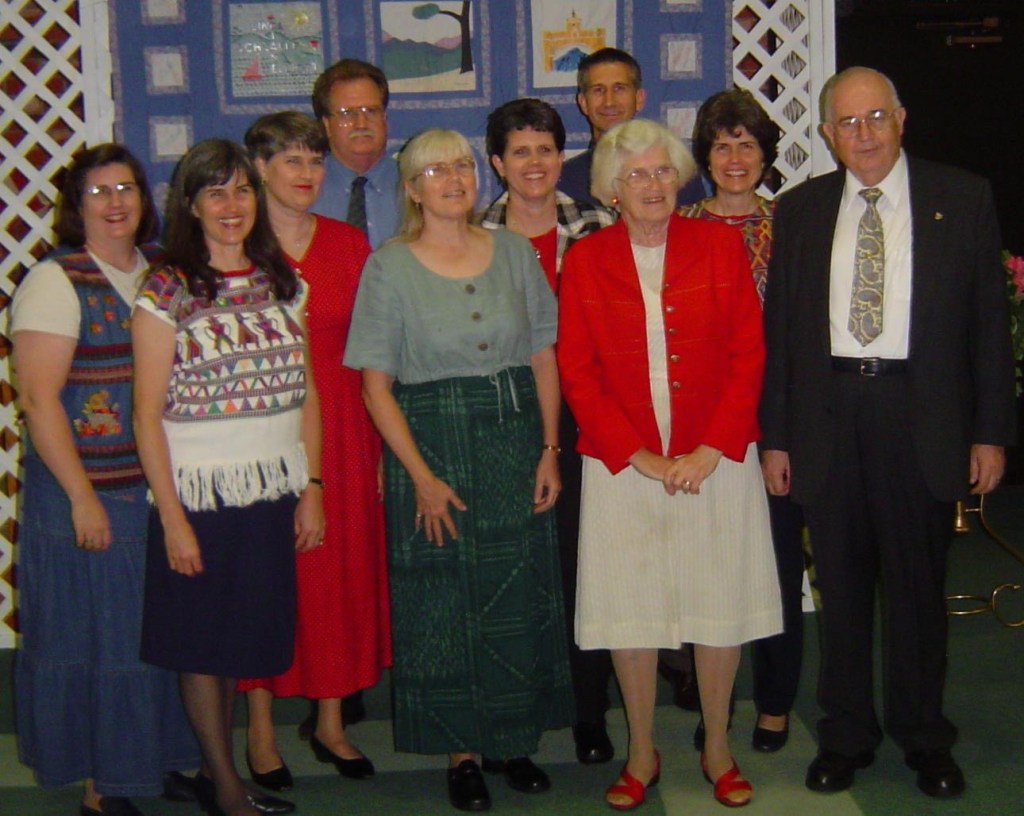
Tahlequah, OK 2004 Dad, Mom, and their eight children on his 80th birthday
With a new lease on his own life after convalescing, Dad began traveling to visit his children and twenty-five grandchildren and participated in a large family reunion in Iowa, where he entertained the kids with his creative whittling. Every day, he called his granddaughter Karis, in and out of hospitals, to encourage her.
In August of 2008, the translation of the New Testament into Ixil was finally published. All eight of Dad’s children, most of his sons- and daughters-in-law and seventeen of his grandchildren joined him in Guatemala for this wonderful celebration. Dad did not feel well while in Guatemala, but attributed this to the travel, joyful stress, and different food of the reunion. On his 83rd birthday two months later, he was diagnosed with metastatic cancer. His eight children and our daughter Karis gathered around him for his last weeks of life, while Dad protested that he had too much to do to take time out for being sick.
Just three weeks after his diagnosis, in the early hours of November 12, with Steve at his bedside, Dad died. Karen had gone home to attend to needs there, escorting Karis back to the hospital in Pittsburgh on her way. The other seven of us sat around his bed for hours talking about our father’s life. We felt he had been snatched away from us too soon. None of us were prepared to lose him. We were just beginning to restore our relationships with him after his years of devotion to Mom, who was too advanced in Alzheimer’s to understand what had happened.
As family and friends, including Karen and her family, gathered for Dad’s funeral a few days later, among many other attributes, we remarked on his sense of humor and love of puns, his resilience, his inventiveness, his thoughtfulness and kindness, and his delight in singing in a barbershop quartet at Go Ye Village.
We are grateful for all Dad gave to us and to the Ixil people through his remarkable life and faithful obedience, and his deep love of Scripture.
1 Peter 1:23 (Titus 3:5) Praise be to the God and Father of our Lord Jesus Christ! In his great mercy he has given us new birth into a living hope through the resurrection of Jesus Christ from the dead.
Romans 6:18-19 It is impossible for God to lie. Therefore, we who have fled to him for refuge can have great confidence as we hold to the hope that lies before us. This hope is a strong and trustworthy anchor for our souls.
So, I’m curious: Have you tried the “new song” idea from my last blog—applying praise to whatever is going on in your life today? I would love to know! I sang a “new song” as I found reasons to praise God as our family absorbs the reality and implications of our six-year-old grandson’s Celiac Disease diagnosis.
I’m quite excited about this understanding of “new song,” in part because it takes me back to a vow I made to the Lord while Karis and I were jetting to Pittsburgh from South Bend in the middle of the night in response to the first intestinal transplant call she was ready to consider.
I vowed to find something to praise God for every day of this upcoming adventure. I had no idea at the time how life- and hope-giving that practice would be. Keeping that vow forced me back to the Lord time after time when otherwise I could have floundered in the excruciating disappointments and reversals we experienced. Hope became for me–for us–a lifeline, an anchor, a safety rail, a source of strength for not giving up as Karis faced death day after day after day. I am deeply grateful to the Holy Spirit for prompting me to make that vow.
There are so many wonderful references to hope in the New Testament that I had trouble choosing, even from the book of Hebrews. The Greek words translated as hope are elpis (noun) and elpizo (verb), from the root elpo. They mean to anticipate (usually with pleasure), to trust, and to expect with confidence (and the corresponding nouns).
Peter emphasizes the fact that our hope is rooted in the resurrection of Jesus, whose victory over his own death extends to us in ours. That’s why we don’t grieve when a loved one dies or in thinking about our own mortality with the same despair as those without the hope of new life after death (1 Thessalonians 4:13).
In thinking about this, I remember Karis’s brilliant smile after she wrote in big scrawly letters with her left hand, “I love ____” each one of us. At the end she wrote, “Call the doctor. I can’t breathe,” just as a team burst into her ICU room to induce her last coma to give time for the antiviral to work (it didn’t, but this gave our family time to gather and to prepare ourselves as well as we could for her death). I believe Karis knew she was going Home, which we learned later through her journals she had been pleading with God to allow her to do.
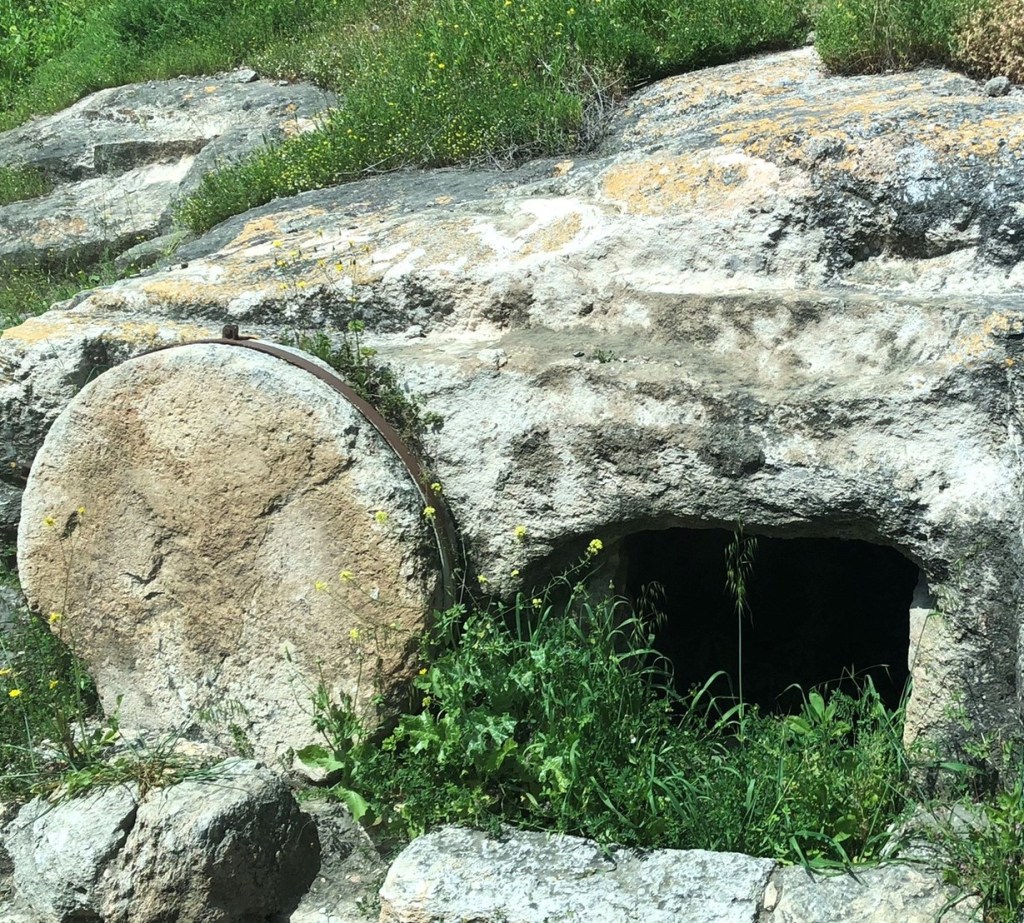
This isn’t Jesus’s tomb, but it is a preserved tomb and round stone from the first century, like his might have been. Thanks to Marilyn Chislaghi for permission to use her photo taken in Israel.
Living hope: an empty tomb. A brilliant smile. An anchor for our souls through terrible times.
But Jesus’ light can’t be extinguished by darkness
John 1:1-18 In the beginning the Word already existed. … The Word gave life to everything that was created, and his life brought light to everyone. The light shines in the darkness, and the darkness can never extinguish it. … So the Word became human and made his home among us. He was full of unfailing love and faithfulness. And we have seen his glory, the glory of the Father’s one and only Son. … Jesus Christ has revealed God to us.
I’ve missed you! And I’ve enjoyed focusing on other things, like vacation. And the details of publishing Facing the Faeries 1906.
I’m returning to this blog halfway through the season of Epiphany, which ends with the beginning of Lent on February 14. The readings for this season have included the Gospel of John, with his emphasis on Christ as the Light of the world.
Epiphany began on January 6, the day selected by early church fathers to remember the magi visiting baby Jesus in Bethlehem and bringing him gifts. The magi were not Jewish, hence the connection with Jesus bringing light to theworld, not just to the people God chose to be his earthly family and lineage. The wise men illustrate for us the fulfillment of God’s promise to Abraham that through him and his descendants, all the earth would be blessed (Genesis 22:18).
Returning to twice weekly postings on this blog, I have four opportunities to think about John’s view of Jesus as the Light of the world before we enter Lent. It seems John can hardly wait to get into this theme. As one of Jesus’ disciples, walking with him for at least three years, John was well positioned to tell us what he personally saw and experienced of what he calls Jesus’ glory, the divine light of unfailing love and faithfulness shining through him.
John was no pushover. Jesus called him and his brother James “Sons of Thunder” (Mark 3:17). They wanted to call fire from heaven to burn up a Samaritan village that didn’t accept Jesus (Luke 9:52-54). Yet in John’s writings (he’s the most prolific New Testament writer after Paul), his emphasis is on love. His life was transformed by the light of Jesus shining into his personal darkness, gentling him and dramatically changing his perspective on the “others” in his world.
For us, you and me, grappling daily with the darkness, violence, and brokenness of the world, John’s introduction to his Gospel is tremendously encouraging. “The light shines in the darkness, and the darkness can never extinguish it.” Think about that. Isn’t it good news, solid rock on which to place our feet, a promise we can count on no matter how dark things get? We don’t see it yet, but the ending of the story will be glorious!
Tucked inside my fortune cookie!Isn’t that cool?
Thinking about this promise, I feel my anxiety for the world dissipate like air leaking from a balloon. My thoughts turn to my small role in shining his light into the darkness around me, beginning in my own heart. What a relief to know I’m just a minor character in this huge story God is writing. He has the whole thing figured out! Hallelujah!
Matthew 1:21 (Isaiah 43:11, 62:11) [Gabriel told Joseph] “Mary will have a son, and you are to name him Jesus, ‘The Lord saves,’ for he will save his people from their sins.”
After posting Advent ABC: Holy One early last Sunday (the second Sunday of Advent), I was surprised to find holiness the theme of our service when I got to church. Kevin Antlitz preached a deeply moving sermon, clarifying many misconceptions about the holiness of God and what it means for us to pursue holiness: “It’s not about perfection. It’s about direction.” Jesus shows us that holiness is a human being fully alive; motivated by love, not by fear as we wait to see him again.
Isaiah 54:5 (Acts 3:25) For the Lord is the God of all the earth.
I’ve been invited to write a chapter for a book on patriotism. Perhaps because I was born and grew up in Guatemala, have lived in several countries and have visited many others, when I think of patriotism, I first think of Jesus saying the Gospel would preached to every nation.
The Lord is God of all the earth, with sons and daughters in every country who are my brothers and sisters. This makes every war feel to me like a civil war. Does this impact my sense of patriotism? Of course, it does. One day the “artificial” boundaries between countries that matter so much to the world today will no longer divide us. Advent helps us anticipate that day.
Isaiah 33:5-6 Though the Lord is very great and lives in heaven … he will be your sure foundation, providing a rich store of salvation, wisdom, and knowledge. The fear of the Lord will be your treasure.
Last night Dave and I put together a jigsaw puzzle while listening to music on Youtube. Hillsong’s “Oceans” randomly came on and made me teary. It was one of Karis’s favorite songs, an articulation of her lifelong treasure hunt: to find God in the circumstances she faced each day, no matter how painful or challenging or disappointing or rewarding.
You call me out upon the waters The great unknown where feet may fail And there I find You in the mystery In oceans deep my faith will stand
And I will call upon Your Name And keep my eyes above the waves When oceans rise My soul will rest in Your embrace For I am Yours and You are mine
Your grace abounds in deepest waters Your sovereign hand will be my guide Where feet may fail and fear surrounds me You’ve never failed and You won’t start now
Spirit lead me where my trust is without borders Let me walk upon the waters Wherever You would call me Take me deeper than my feet could ever wander And my faith will be made stronger In the presence of my Saviour
I will call upon Your Name Keep my eyes above the waves My soul will rest in Your embrace I am Yours and You are mine
Matthew 24:7-14, 20, 25 Nation will go to war against nation … There will be famines and earthquakes in many parts of the world. But all this is only the first of the birth pains, with more to come. Then you will be arrested, persecuted, and killed. You will be hated all over the world because you are my followers. And many will turn away from me and betray and hate each other. And many false prophets will appear and will deceive many people. Sin will be rampant everywhere, and the love of many will grow cold. But the one who endures to the end will be saved. … See, I have warned you about this ahead of time.
One reason Karis cites in her journals for wanting her story told is the prevalence in some places of a “health and wealth gospel,” the idea that if you have “enough” faith, God will make you prosperous and free of suffering. A message Jesus neither modeled nor taught. Karis reacted passionately against the implied judgment of this belief on many of her friends who were neither healthy nor wealthy but lived their lives of hardship in deep faith and joy in God’s love for them, measured not in gifts of the world but in gifts of the heart.
Karis’s journals, written over twenty years in her tiny script
One time when Karis was hospitalized as a teenager, suffering from uncontrollable diarrhea and dehydration that led to several months on TPN (nutrition through her blood stream), “chained,” as she said, to an IV pump, a woman we didn’t know showed up in her hospital room. The woman told me she had crossed Brazil by bus to deliver a message from God to Karis. She then turned to Karis, who was too weak at the time to stand, and demanded she confess her sins of unbelief, get out of that bed, and live the triumphant life of faith. “You are a disgrace to the Gospel and to God,” she shouted at Karis. “Shame on you! Shame on your family, pretending to be ministers of the Lord. Look at you, wasting resources on hospitals and machines and medicines. Unbelievers! This money should go to the churches!”
She walked over to Karis and yanked her arm. “Down on your knees now, you hypocritical sinner! Confess your unbelief! Then stand up and walk and end this charade!”
By then, of course, I was loosening the woman’s grip on Karis and escorting her to the door. “I have been obedient! I have delivered God’s message! The rest is up to you!” She was still shouting as I closed the door and ran to Karis, who heaved with sobs.
Later, when she was stronger, Karis spoke to me about the woman’s visit, with an intensity I had not seen in her before. “Mama,” she said, “that woman blasphemed my Lord. I can’t bear it.” She began crying again. “It’s not what she said about me—I can handle that. I know I need to grow in faith, especially in faith to trust him when I’m weak and in pain. It’s what she said about who God is, as if he hasn’t walked with me and loved me and comforted me and provided for me with such gentle tenderness all my life. As if his words to me every day—words of love and encouragement—are not true. That hurt me to my core. Mama, please don’t let such a thing happen again. I can’t bear it. It’s like a sword piercing my heart.”
Then her smile broke out. “Maybe that woman doesn’t know about the thousands of people praying for me around the world. They can’t all be as deficient in faith as us, right?” She giggled. “Well, I’m in cahoots with God. From now on, I’m going to pray for God to heal whatever has wounded her. I’m going to pray she can know how extravagantly her Father loves her.”
Perhaps in Heaven Karis has been privileged to know the result of her prayers for this woman whose name we never learned. Lord, if she’s still alive, please care for her.
Reading Matthew 24—which sounds all too sadly familiar, doesn’t it?—this is what caught my attention. “Many will turn away from me … and the love of many will grow cold.”
Love God and love each other (John 13:34-35). Isn’t that Jesus’ central message? A direct contrast to “betray and hate each other.”
When we turn toward Jesus, our love for him and for people grows. When we turn away from Jesus, the natural consequence is hatred and slander.
Let’s turn toward Jesus. Whatever the circumstances of our lives.