Luke 20:35-36, 38 [Matthew 22:32; Mark 12:27] Jesus said, “In the age to come, those raised from the dead will never die again. … They are children of God and children of the resurrection.… He is the God of the living not the dead, for they [Abraham, Isaac, and Jacob] are all alive.“
Romans 8:10-11, 14, 17 The Spirit of God, who raised Jesus from the dead, lives in you. … For all who are led by the Spirit of God are children of God. … And since we are his children, we are heirs of God’s glory.
Did you know it’s still Easter?
In the ancient church calendar, Easter is celebrated for fifty days, until Pentecost, when the Holy Spirit was poured out on the early believers. Forty days into Easter (this year, on May 29), always therefore on a Thursday, comes Ascension Day, when the church remembers Jesus leaving Earth and returning to his Father in Heaven, while promising: He will come back! And the Holy Spirit of God keeps that promise alive within us.
It’s a wild, joyful, sacred dance choreographed by the Trinity, for us, his children, heirs of his glory.
The season of Easter—not just one day, but seven weeks—gives us the chance to soak in, to absorb, the mystery of life overcoming death. Time to ask and to ponder, What does it mean to be children of the resurrection, heirs of God’s glory?
What does this mean to you, today?
And what does Paul mean by this breathtaking sentence: The Spirit of God, who raised Jesus from the dead, lives in you?
We’re each part of the story shared by humanity on this May 13, 2025, a story in which one man’s name dominates the news that we in this part of the world wake up to each morning. A story in which, as Paul puts it, we groan over the impact of death and decay, sin and suffering—the “bondage of corruption” as it’s translated in the KJV (Romans 8:20-23).
At the same time, we’re part of a much bigger and more important story, a story with a gloriously happy ending.
And just as we’re breathing a sigh of satisfaction as we turn the last page of this story, that everything has come right, we’ll realize that ending is just the beginning of an even bigger story, one imbued with freedom and joy and life.
So, one thing being a child of the resurrection means to me today is that I’m not a victim, neither of my own challenging circumstances or of anyone else’s attitudes or actions. What the world is going through, matters. Especially for those whose around the world whose very lives and livelihood are under threat, it matters a lot. Sooner or later, perpetrators of bullying and abuse will be held accountable for the suffering they have inflicted. It matters.
Yet this is not the end of the story. You and I are not victims. We’re heirs of God’s glory!
Last Sunday, the 4th Sunday of Easter, was Good Shepherd Sunday. I invite you to listen to Lauren’s encouraging sermon.
But Jesus touches our deepest needs Lenten/Easter question #18
John 20:15 “Dear woman, why are you crying?” Jesus asked Mary. “Who are you looking for?”
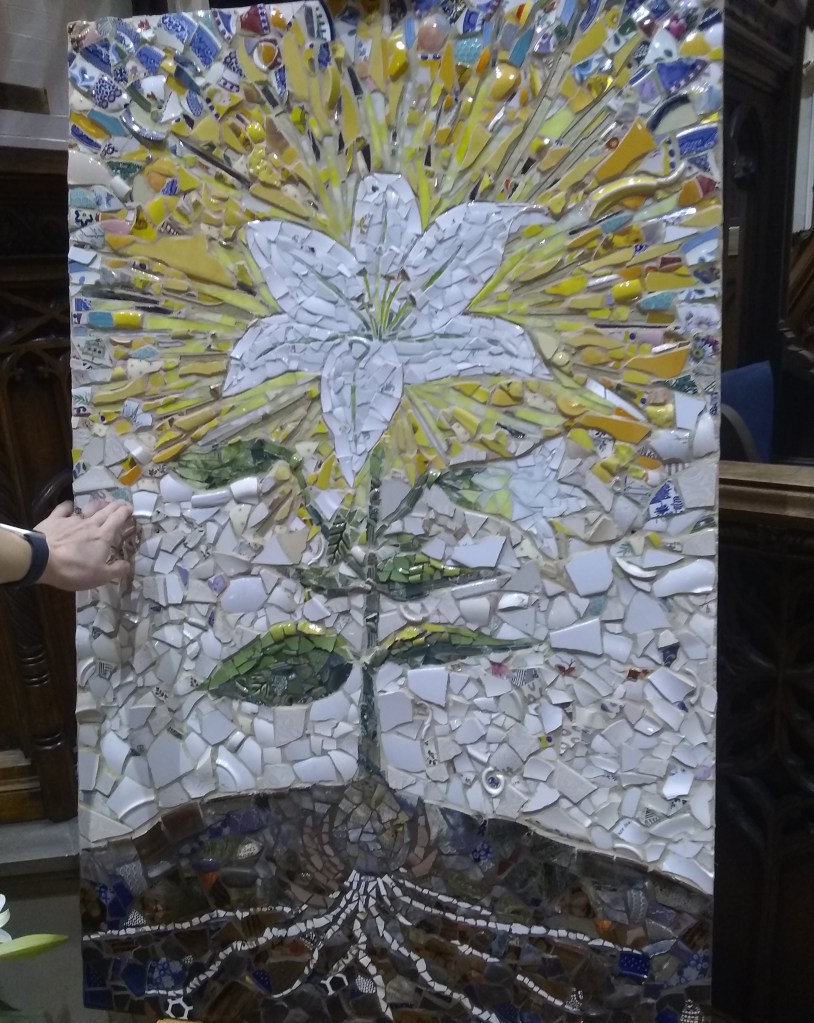
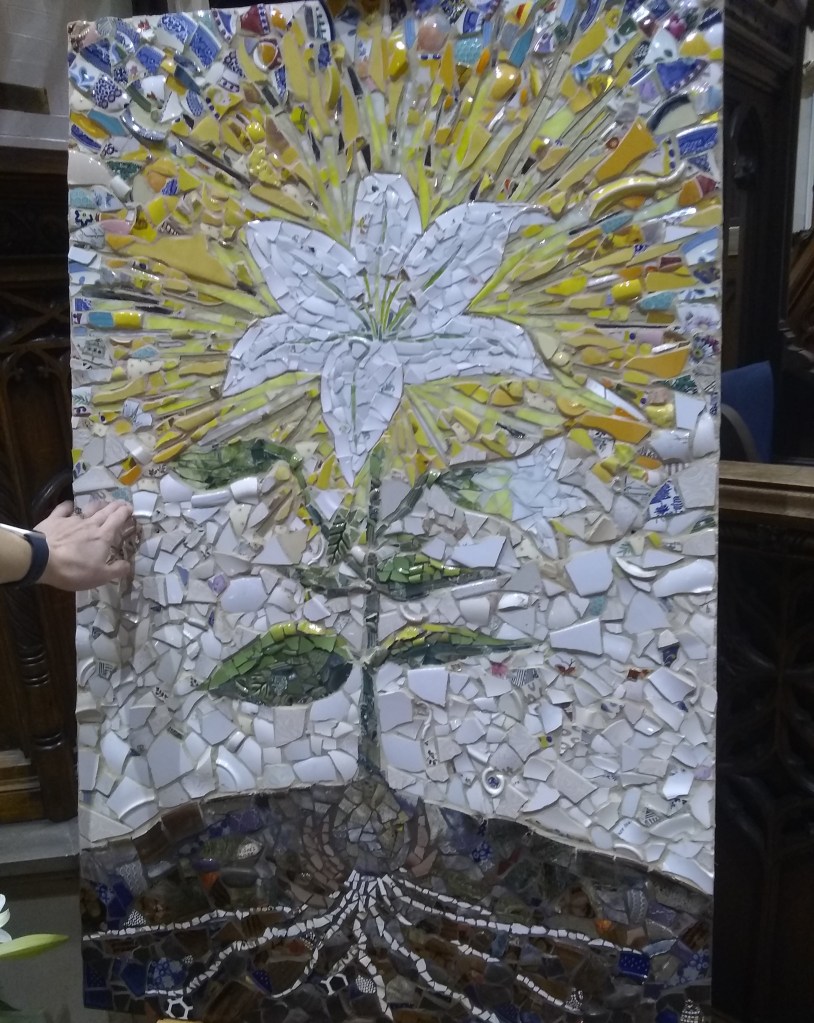
Finding a piece of my cup, among those shattered to create this gorgeous Easter mosaic.
When we lived in Brazil, a pastor’s wife courageously wrote a book called “No Place to Cry,” which directly related to our vision in mission: to care for pastors and their families. In Brazil (and perhaps this is true in other places too), pastors were put on pedestals, a lonely place to live. Pastors and their spouses were expected to care for everyone else, 24/7. They were not supposed to have needs of their own. As my husband often said, “Pastors have a hundred or more ‘kids’ [the members of their congregations]. Their own families are sacrificed on the altar of the church.”
Dave developed mutual support groups for pastors and their spouses, where they could ask each other questions like the ones Jesus asked Mary in the garden after his resurrection. The “safest” groups were interdenominational, because there was little fear what they shared would be gossiped among their peers or superiors or congregations. This had the surprising benefit of breaking down barriers between denominations, as pastors became friends based not on a particular doctrinal emphasis or history, but because of their common experience and needs. Dave’s teachings, summarized in his book “The Leader Who Shines,” helped them accept and practice concepts like boundaries, acknowledging and dealing with their own fears and traumas and complex histories, and developing ministry teams in their churches, rather than trying to do everything themselves. In small, committed groups, they could deeply hear and care for each other. They found a place where they could cry.
John records a series of very personal encounters between Jesus and individual followers after the resurrection. Mary. Thomas. Peter. We can add the two disciples on the road to Emmaus, a story recorded by Luke. This blesses me so much. Even while Jesus sacrificed his life for the world, in the short space of time he spent on earth before his ascension to heaven, he deeply loved and cared for specific people he loved, aware of their unique needs. And within the safety developed over time within the circle of disciples, they could hear and care for each other after he was gone.
Jesus asked Mary, “Who are you looking for?” Obviously, she was looking for him. And that’s true for us, too: the first person we should seek each morning is our Lord. Anchored in relationship with him, whatever happens in our days will be different than if we head into them alone. It occurs to me that in second place, the person we are looking for is our own selves. In the rush of life, we need space to recognize what’s taking place in our own souls. Even a few minutes of quiet with the Lord can help us do this.
Why are you and I crying today, whether we shed tears or stuff it down? Responding to this question is a great way to get in touch with ourselves. Then we can practice Philippians 4:6-7 and experience God’s peace.
But Jesus will turn sadness into joy Lenten question #17 April 17
John 16:16-22 [Jesus said] “In a little while you won’t see me anymore. But a little while after that, you will see me again.” The disciples asked each other, “What does he mean? … We don’t understand.” Jesus realized they wanted to ask him about it, so he said, “Are you asking yourselves what I meant? … I tell you the truth, you will weep and mourn over what is going to happen to me, but the world will rejoice. You will grieve, but your grief will suddenly turn to wonderful joy. … I will see you again; then you will rejoice, and no one can rob you of that joy.”
Our Lenten roses, in full bloom
This will be the last twenty questions post until after Easter, since Jesus asked the last three questions after his resurrection. As Jesus forewarned his disciples about the grief they would feel at his crucifixion, he also told them that horrific event would not be the end of the story.
Soon they would experience their world falling apart. Despite all of Jesus’ warnings along the way, the disciples reacted to Jesus’s arrest, judgment, and death as any of us do to threat and trauma: by “freeze” (their paralysis in the Garden of Gethsemane), by trying to fight (Peter), and by flight (most of them). In his fear, Peter denied knowing Jesus. All of them felt a combination of guilt and despair. Judas killed himself. Others went back to what was safe and familiar (fishing). Thomas lacked the courage to believe the good news when it came. Like Peter and John, he had to see it for himself.
The women, though—including Jesus’s mother—stuck by him. Along with John, they pushed through the mocking crowd close enough to the cross to converse with Jesus as he hung in agony. They witnessed his death.
Did the women remember and believe what he had said, that they would see him again, in great joy? We’re not told. But, like Mary of Bethany (Mark 14:8), they did what they could; they embraced the positive action that was available to them. Still wanting to serve and care for Jesus, they went to his tomb on Sunday, as soon as they could after observing the Sabbath.
Imagine the thrill of the angel, the stone rolled back, the empty tomb, their next task (“Go and tell his disciples”)—and then Jesus, alive! meeting Mary Magdalene in the garden.
Let’s allow ourselves to take part in the narrative, to feel what they felt on that Passover weekend, as the Lamb of God was sacrificed so that his shed blood would protect us from death. With the women and John, let’s find the courage to stand by Jesus at the cross.
And let’s remember it’s OK to ask our questions. Whatever hard place you are in right now, draw near and share your grief and doubts and fears and confusion with the Lord. He understands and welcomes us. We may not be capable of understanding, yet.
1 Peter 1:23 (Titus 3:5) Praise be to the God and Father of our Lord Jesus Christ! In his great mercy he has given us new birth into a living hope through the resurrection of Jesus Christ from the dead.
Romans 6:18-19 It is impossible for God to lie. Therefore, we who have fled to him for refuge can have great confidence as we hold to the hope that lies before us. This hope is a strong and trustworthy anchor for our souls.
So, I’m curious: Have you tried the “new song” idea from my last blog—applying praise to whatever is going on in your life today? I would love to know! I sang a “new song” as I found reasons to praise God as our family absorbs the reality and implications of our six-year-old grandson’s Celiac Disease diagnosis.
I’m quite excited about this understanding of “new song,” in part because it takes me back to a vow I made to the Lord while Karis and I were jetting to Pittsburgh from South Bend in the middle of the night in response to the first intestinal transplant call she was ready to consider.
I vowed to find something to praise God for every day of this upcoming adventure. I had no idea at the time how life- and hope-giving that practice would be. Keeping that vow forced me back to the Lord time after time when otherwise I could have floundered in the excruciating disappointments and reversals we experienced. Hope became for me–for us–a lifeline, an anchor, a safety rail, a source of strength for not giving up as Karis faced death day after day after day. I am deeply grateful to the Holy Spirit for prompting me to make that vow.
There are so many wonderful references to hope in the New Testament that I had trouble choosing, even from the book of Hebrews. The Greek words translated as hope are elpis (noun) and elpizo (verb), from the root elpo. They mean to anticipate (usually with pleasure), to trust, and to expect with confidence (and the corresponding nouns).
Peter emphasizes the fact that our hope is rooted in the resurrection of Jesus, whose victory over his own death extends to us in ours. That’s why we don’t grieve when a loved one dies or in thinking about our own mortality with the same despair as those without the hope of new life after death (1 Thessalonians 4:13).
In thinking about this, I remember Karis’s brilliant smile after she wrote in big scrawly letters with her left hand, “I love ____” each one of us. At the end she wrote, “Call the doctor. I can’t breathe,” just as a team burst into her ICU room to induce her last coma to give time for the antiviral to work (it didn’t, but this gave our family time to gather and to prepare ourselves as well as we could for her death). I believe Karis knew she was going Home, which we learned later through her journals she had been pleading with God to allow her to do.
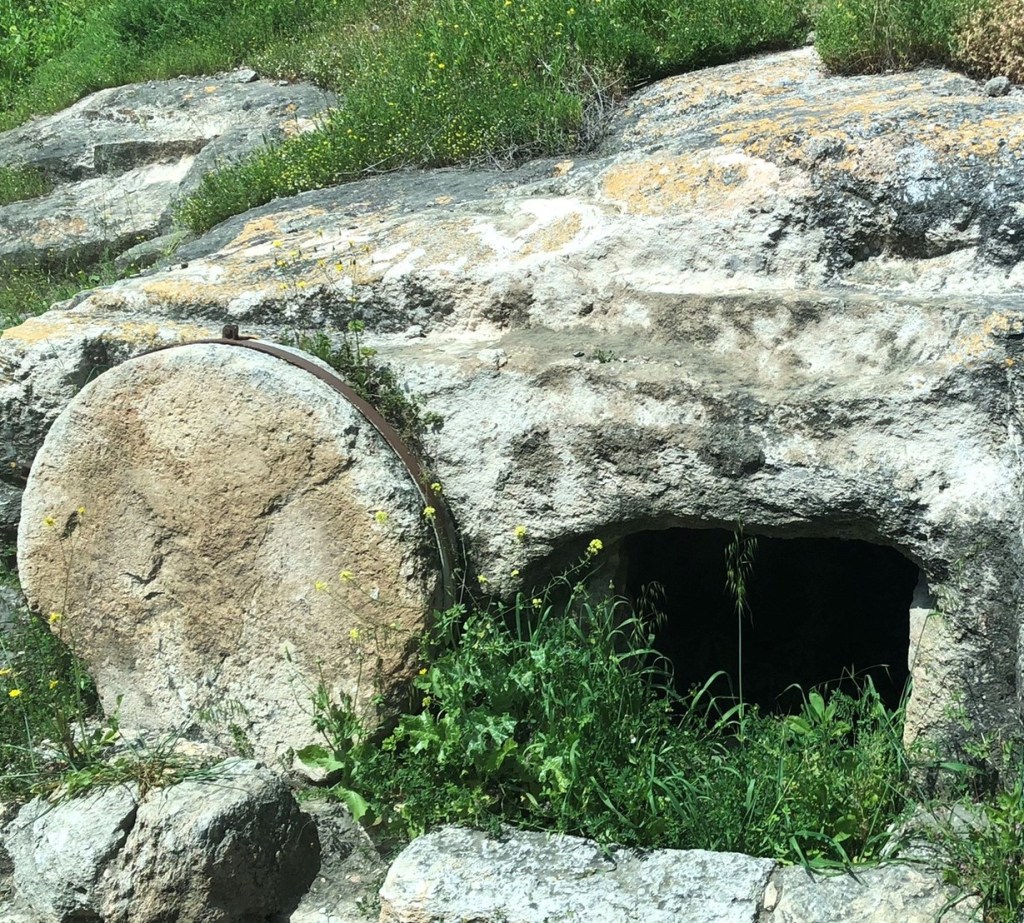
This isn’t Jesus’s tomb, but it is a preserved tomb and round stone from the first century, like his might have been. Thanks to Marilyn Chislaghi for permission to use her photo taken in Israel.
Living hope: an empty tomb. A brilliant smile. An anchor for our souls through terrible times.
Hebrews 10:19-20 We can boldly enter heaven’s Most Holy Place because of the blood of Jesus. By his death, Jesus opened a new and life-giving way through the curtain into the Most Holy Place.
Mark 15:37-38 Then Jesus uttered another loud cry and breathed his last. And the curtain in the sanctuary of the Temple was torn in two, from top to bottom.
Our Lenten roses are still blooming, reminding me that the confessional life we practiced during Lent is meant to be not a fad but a lifestyle.
“Grammy, if it’s spring, why is it snowing?” asked six-year-old Caleb when he got off his school bus a couple of weeks ago.
“Caleb, we’re going to look for signs of spring!” his four-year-old sister Talita told him. “Come on!”
They didn’t stop at ten, the number I had suggested. They found sixteen signs of spring in their yard. And each time since that I’ve gone to their house, they’ve shown me more.
In this hemisphere, spring is associated with Easter. It’s a natural fit: the celebration of new life. In Brazil, though, Easter comes as fall begins to ease the heat of summer. Jesus is truly a man for all seasons.
Since I’m in Pittsburgh, though, I’ve been thinking about new things. A quick survey of the New Testament revealed references to 33 new things (plus repeated references) in the NLT New Testament. For this brief Easter season (which ends with Pentecost on May 19), I’m going to choose a few of those to highlight, beginning today with one of the consequences of Jesus’ death and resurrection: direct access to God.
This was a completely new concept for Jews steeped in God’s holy inaccessibility. God’s Presence filled a small space in the Temple protected by a thick curtain (9cm/3 ½ inches thick, according to Jewish tradition). Hebrews 9:7-8 reminds us that “only the high priest ever entered the Most Holy Place, and only once a year … the entrance to the Most Holy Place was not freely open as long as the Tabernacle and the system it represented were still in use.” (See Luke 1 for a story about this. The chosen priest entered the Most Holy Place with a cord tied around his ankle, so his body could be pulled out in case he was struck dead by the holiness of God.)
I find the tearing of this 3 ½ inches-thick curtain, from top to bottom, one of the most startling and intriguing collateral events associated with Jesus’ death. Clearly, no human could have done this. Hebrews tells us that now we can “come boldly to the throne of our gracious God” for his help and mercy (4:16). And Paul says our own bodies are now the Temple of God, where Christ dwells in us through the Holy Spirit (1 Corinthians 3:16, 6:19-20, 2 Corinthians 6:16). Think about that next time you’re tempted to abuse or misuse your body!
Jesus, through his incarnate life, brought God close to us. Through his death, he ended the separation between us and his Father. And in his resurrection and ascension, he left his Spirit to indwell, teach, nurture, guide, convict, gift, and empower us, growing beautiful fruit in our souls (Galatians 5:22-23).
What signs of new life do you find in the garden of your heart?
Show favor to your people, O Lord, who turn to you in weeping, fasting, and prayer.
For you are a merciful God, full of compassion, long-suffering, and abounding in steadfast love.
You spare when we deserve punishment,
And in your wrath, you remember mercy.
Spare your people, good Lord, spare us;
In the multitude of your mercies, look upon us and forgive us,
Through the merits and mediation of your blessed Son Jesus Christ our Lord, Amen.
Sorry I didn’t post this on Saturday! It’s wonderful to be on the “other side” of Lent now, celebrating Jesus’s resurrection. May his life-giving Spirit continue to flow through our lives as we live into Easter.
1 John 5:19-20 The world around us is under the control of the evil one. And the Son of God has come, and he has given us understanding so that we can know the true God. … He is eternal life.
My heart is so full of the blessing of yesterday–I want to share a few of many special moments with you. Dave and I love attending the sunrise service at 6:00 a.m. The service begins in total darkness as we review God’s work leading up to this day. We are each handed a candle, and the first half of the service is conducted by candlelight.
Before I go on, a bit of context:
On Thursday evening, at the end of the footwashing service, the altar had been stripped of every decoration as the light gradually lowers until the pastor ends with the reading by candlelight of Luke 22:39-53. Verse 53 ends with, “But this is your hour, and the power of darkness.” As he says “the power of darkness,” the pastor blows out his candle. At the same instant, all remaining light in the sanctuary is extinguished. We sit in silence in the darkness, and when we’re ready, leave in the same way.
On Friday, from noon until 3:00, in various ways, including art works from people in the congregation, we shared in Jesus’s suffering on the cross, suffering for each of us. We are invited to write our sins and burdens and walk forward to leave our folded papers in a basket at the foot of the rough wooden cross, bearing a crown of thorns, at the front of the church. At the end of the service, these are taken outside and burned, to symbolize Christ bearing them for us.
On Easter morning, as we enter the dark sanctuary, we have in our minds the stripped altar and the cross. But at a certain moment in the service, the lights and the choir explode, and we see the sanctuary full of flowers. Madly ringing bells we have brought from home for this moment, the congregation joins the choir in wholehearted praise.
This year, when the lights came on, we also saw an amazing mosaic at the front of the church. This also requires a bit of context, going back to Ash Wednesday, Feb. 22. We were invited to bring to that service a piece of pottery from home, which we placed in a big metal tub and smashed with hammers at the end of the service, to illustrate our brokenness.
An artist, with the help of anyone from the church who wished to participate, took those broken pieces and created beauty from them. People crowded around after the service to admire it and to identify pieces from their own broken cup or bowl or pitcher. Many of us were in tears at this visual, visceral symbol of God’s transformation and healing offered us through Jesus’s sacrifice on the cross. The photo I managed to capture:
The mosaic reminded me of the last chapter of Suffering and the Heart of God. Diane Langberg waxes poetic as she describes Jesus on the cross, and then restored to life, healing our brokenness. Here’s part of what she says:
The cross is a place of death and evil; decay and wrath. It is a pace of darkness, thirst, isolation, rejection, abandonment, and bondage. It is the absence of God and all that is good. It is hell itself.
And whom do we see there? The Lily of the Valley, the Rose of Sharon. We see the fairest of ten thousand, the beauty of God incarnate. We see purity, holiness, infinite love, compassion, and eternal glory. …
Death and evil seemed to have won. But God had so much more up his sleeve:
What happened that third day? Decay was transformed into glory. Death was swallowed up by life. Evil was transfigured into holiness, and the wrath of men into praise. Darkness was changed to light, and hell defeated by heaven. Thirst is transformed into living water and brokenness into the bread of life. Alienation led to restored relationship and bondage led to freedom.
If garbage can be transformed into beauty on such a scale as this, then surely it can happen in my small life and in the lives of others. … The cross, a thing of beauty? Yes, for it is at the cross that we behold all of the beauties of Christ in perfection. All of his love is drawn out there. All of his character expressed. The wounds of Jesus are far more fair than all the splendor of this world. …
Children of God in a world controlled by the Evil One. I fear the odds are against us. Our wits are too slow, our understanding finite and our strength too frail. But, glorious but, “the Son of God has come … to transform garbage into beauty, first in our lives and then in those we serve. … So we fix our eyes not on what is seen, but on what is unseen (2 Corinthians 4:18). And what is it that is unseen? The Lord of Glory, the Lord of all Beauty, who wears the appearance of a slain Lamb as his court dress. …
May we count Him alone as worthy and all else as rubbish. May we desire one thing—to gaze upon the beauty of the Lord and to seek his beautiful face. And then may the beauty of our Lord be upon us. May he establish the work of our lives.
I invite you to enjoy our choir’s Easter anthem, called “Glad of Heart,” written in 1568, here (start at 1:39:50) Of course, you can watch any of the rest of the live stream you wish–or either of the other two services. The worship during communion begins at 1:59:23. Here is the text:
Now glad of heart be everyone! The fight is fought, the battle won, the Christ is set upon his throne, alleluia, alleluia!
Who on the wood was crucified, who rose again, as at this tide, in glory to his Father’s side, alleluia, allelluia!
Who baffled death and harrowed hell and led the souls that loved him well, all in the light of lights to dwell: alleluia, alleluia!
To him we lift our heart and voice and in his paradise rejoice with harp and pipe and happy noise. Sing alleluia, alleluia!
Then rise all Christian folk with me and carol forth the One in Three that was, and is, and is to be, alleluia, alleluia!
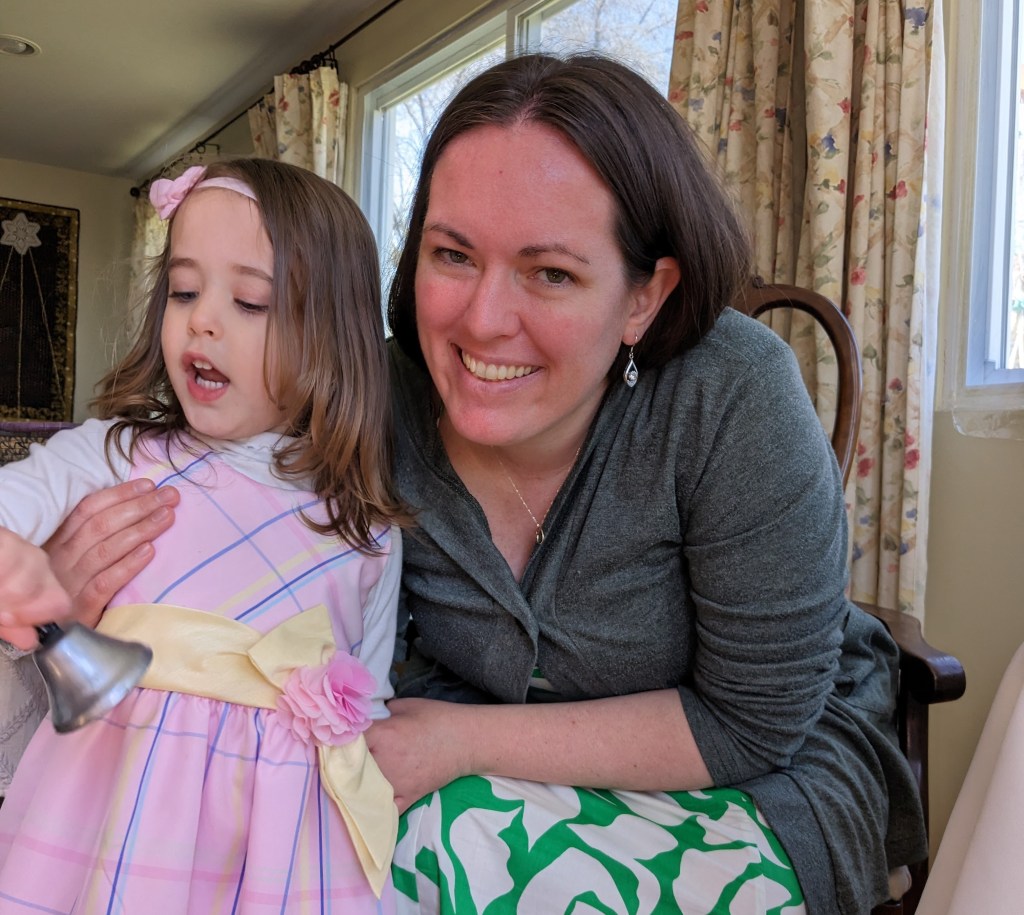
Though this has become a long post, I want to share one more thing, related to verse 4 of this anthem. Several weeks ago I started practicing with my grandchildren a simple piece of music (“Allelu, allelu, allelu, alleluia, Praise ye the Lord) to share with their parents at our Easter brunch, accompanied by a variety of simple instruments. The adults at the table each had an instrument as well, to join in the song after the children “taught” it to them. “Happy noise” indeed! It was such fun that we sang and “played” other songs as well, ending, at Talita’s request, with “Twinkle, twinkle, little star.” Since the morning sermon had referenced Jesus as the Morning Star, each of us to reflect his glory, this seemed oddly appropriate!
Matthew 28:5-6 Then the angel spoke to the women. “Don’t be afraid!” he said. “I know you are looking for Jesus, who was crucified. He isn’t here! He is risen from the dead, just as he said would happen.”
Hebrews 1:4 The Son radiates God’s own glory and expresses the very character of God, and he sustains everything by the mighty power of his command. When he had cleansed us from our sins, he sat down in the place of honor at the right hand of the majestic God in heaven.
1 Corinthians 2:7-12 The wisdom we speak of is the mystery of God—his plan that was previously hidden, even though he made it for our ultimate glory before the world began. But the rulers of this world have not understood it; if they had, they would not have crucified our Glorious Lord. That is what the Scriptures mean when they say, “No eye has seen, no ear has heard, and no mind has imagined what God has prepared for those who love him.” But it was to us that God revealed these things by his Spirit. For his Spirit shows us God’s deep secrets…so we can know the wonderful things God has freely given us.
In the 1950s or 1960s, if you climbed into a Jeep or Carryall and drove for hours over rutted, one-track muddy roads over two ranges of mountains and then down into a verdant valley and wound through a Mayan village with dogs and half-naked children chasing after your vehicle–one of only two in that village–you would reach a small adobe house which by local standards was a mansion.
A view of the valley last time I was there (2008), the village now a small city
Inside that house, on a designated evening before Christmas, the children were put to bed early in the single bedroom which cradled them all. Under the narrow door into the living room a sliver of light shone, and mysterious sounds tantalized the children’s imaginations. For their father had rolled into the living room from its resting place in the garage the Christmas barrel, that round bastion of steel opened only once each year, on this night. Who knew what treasures were hidden inside?
Every child’s ear strained to detect some clue to what wonders were being wrapped on the other side of that door. Sure enough, gifts nested beneath the Christmas tree when they awoke, two for each child. They knew one would be something practical: socks, or underwear. But the other could be anything—a toy, a game, a puzzle—selected from the barrel especially for him or her. Those gifts were shaken, prodded, examined from all angles. The tension of anticipation grew with each day until finally, on Christmas morning, with a fire roaring in the fireplace (the only time each year Dad kindled it in the daytime), the secrets were revealed, one by one, in order of age of the four—then five, six, seven, eight children.
I can still feel the tingle of wonder at receiving something brand new, chosen just for me. My name on the package. Gifts selected (or donated to our family) years ahead of time, loaded onto the trailer we pulled behind our vehicle from Illinois or Kansas, through the agony of customs at the Mexican border, all those long sweaty miles south through Mexico and over the mountains into that Mayan village, finally to be sealed into the waterproof Christmas barrel to await their wondrous revelation.
No eye has seen, no ear has heard, and no mind has imagined what God has prepared for those who love him. … For who can know the Lord’s thoughts? (v. 16)
Because of Easter, we can know. His secrets are all about love.
1 Corinthians 1:20, 23-25, 30 God has made the wisdom of this world look foolish … So when we preach that Christ was crucified, the Jews are offended and the Gentiles say it’s all nonsense. But Christ is the power of God and the wisdom of God. This foolish plan of God is wiser than the wisest of human plans, and God’s weakness is stronger than the greatest of human strength … For our benefit God made Christ Jesus to be wisdom itself. Christ made us right with God; he made us pure and holy, and he freed us from sin.
Church of the Ascension 2021 Station of the Cross 6by Amy Foster. See them all.
I had read it before, for another Zoom discussion on racial reconciliation. But when my small group decided to read and discuss Jemar Tisby’s The Color of Compromise and I read it again in the context of Lent, Jemar’s comments at the end of chapter six on the cross as the lynching tree, I felt punched in the gut. Jemar’s point is that lynching could not have continued had the white church not kept silent. I feel like Nehemiah, crying out to the Lord on behalf of his people and their sins. Thousands of people cruelly tortured for the slightest of offenses, real or imagined, their ravaged bodies hung on trees for anyone to gawk at. And the Lord’s people either participating, viewing the lynching like a spectator sport (think of the ancient Roman’s and the Coliseum), or simply doing—nothing. Oh God. Have mercy on us, your people. Sinners.
I am overwhelmed by the wisdom of the cross. I’ve often thought about it in relation to survivors of sexual abuse, for Jesus too was stripped, mocked, violated, shamed. By choice. Out of love. For us. He knows.*
He knows, too, the horror of lynching. He was lynched by an irrational, prejudiced crowd led by people wanting desperately to preserve their power. Tortured. Ravaged. Stripped. Shamed. And hung on a tree.
The wisdom of God is humility. Sacrifice. Powerlessness.
Forgiveness.
Love.
The enemy thought he had won. BUT . . . !
Understanding more about the cross makes Jesus’ resurrection even more precious. As I seek with Gerard Manley Hopkins (thank you, Elaine!) to “let him Easter” in me, “be the Dayspring to my dimness,” I don’t want to be silent about the enemy’s assaults in my own generation. Even while longing for the day when there will be no more death or sorrow or crying or pain, the day when every tear will be wiped from our eyes, I want to use my voice to say “No!” to injustice. And to say “Yes!” to the healing, forgiveness, and reconciliation the cross makes possible.
*Diane Langberg writes eloquently about the meaning of the cross in Suffering and the Heart of God and other books and articles. The work of Be the Bridge is based on the cross. Check it out. The “colors of compromise” in Tisby’s vision are green for greed, red for blood shed in every kind of suffering, and white for complicity. Read his book. It will change you. It will Easter you.






 Debra Kornfield