
But God’s power must be used rightly June 5, 2025
Galatians 5:22-23 But the Holy Spirit produces this kind of fruit in our lives: love, joy, peace, patience, kindness, goodness, faithfulness, gentleness, and self-control. There is no law against these things!
Proverbs 16:32 Better to have self-control than to conquer a city.
Proverbs 25:28 A person without self-control is like a city with broken-down walls.
I’m writing today in lovely Meridian, Idaho, remembering the impact on me of previous experiences in this beautiful state and their influence on Treasure Hunt 1904, book two of the Cally and Charlie historical fiction series. My sister Jan and I are here for a few days visiting our sister Marsha and brother-in-law Vance. I’ve not been here before in June. The flowers are stunning.
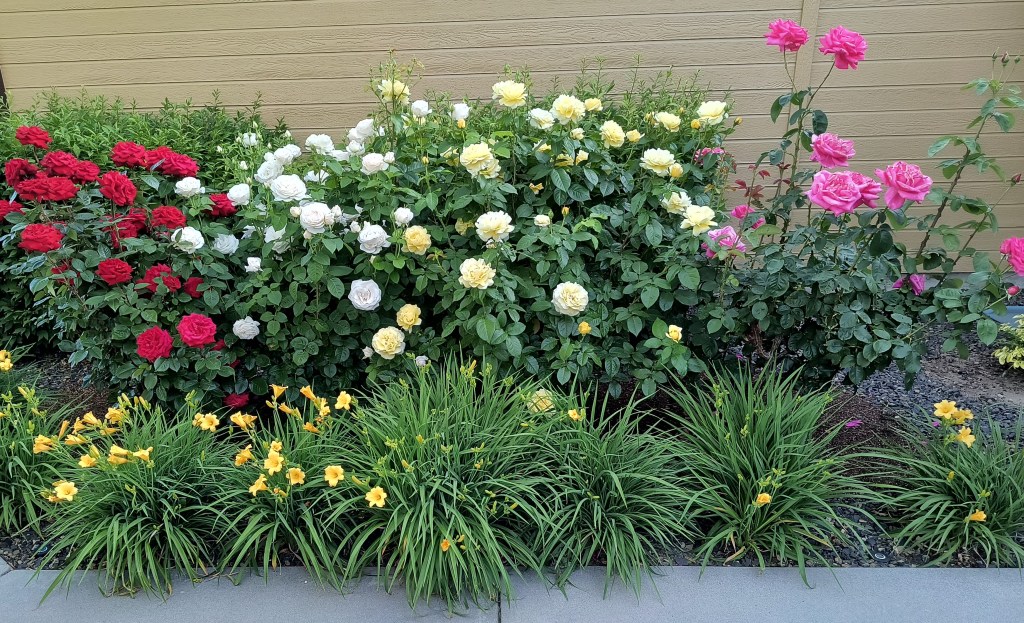
Marsha’s roses
The themes of Treasure Hunt 1904 directly relate to the final virtue in Paul’s description of agape, the lovely fruit the Spirit produces in our lives when we give him freedom to garden our hearts.
Self-control, translated “temperance”—moderation, self-restraint—in the KJV, is enkrateia in Greek, derived from the word kratos, which means strength. Like praos (see the last blog about gentleness), enkrateia is a strong word. It calls us to the right use of power. That power, as we know, is the operation of the Spirit of God in our lives, which we will recognize and celebrate this Sunday, Pentecost.
Along with the other virtues, gentleness calls us to choose how we treat others. Enkrateia reminds us we have the ability and responsibility to choose how we manage ourselves, circling us back to “Love others as you love yourself,” as Jesus taught us (Matthew 22:39). The Spirit empowers us to do both with godliness (God-likeness, the God who is love) as we practice agape.
Paul uses enkrateia (as a verb): we must discipline ourselves to win the race of life. Not to win temporary earthly rewards, but an eternal prize: God’s “Well done, faithful servant” (see 1 Corinthians 9:24-27; Philippians 3:12-14; Matthew 25:21).
So, what’s the connection with Treasure Hunt 1904? Using the motifs of a multi-layered treasure hunt and of water (see John 7:38-39), so critically important to transform into fruitfulness the fertile deserts of Idaho, we see Cally grapple with the wounds of trauma in her life (book one), emerging from the grief and paralysis of victimhood into proactive purpose. As she grows into acceptance of the love the Malcomson family offers her, Cally begins to recognize her own power. She can make choices for herself, rather than being controlled, for good or ill, by others.
This book also includes scenes of the devastating, ongoing impact of previous decades of misuse of power, sometimes, tragically, in the name of God, as western settlers and the U.S. government claimed a “manifest destiny” over the lives and territory of native Americans and others. Is not this false equivalence, still plaguing the world today, a breaking of the third commandment and of Jesus’ command to love others as he loves us?
Pentecost Sunday initiates the liturgical season of “ordinary time.” Ordinary, for you and me and all followers of Jesus, means practicing the wonderful fruit of the Spirit, in the agape love of the Father, empowered by Jesus’ conquest of sin and death by his sacrifice on the cross and his resurrection. “Live clean, innocent lives as children of God, shining like bright lights.. your faithful service is an offering to God” (Philippians 2:15-17).
In ordinary time, let’s shine! Let’s bear fruit that adorns the world with joy.
Holy Spirit, today I offer you freedom to grow the good fruit of agape love in my heart, in all its dimensions. Pull out the weeds, heal the wounds, rebuild healthy boundaries, and water the fertile soil of God’s love. Amen.
 Debra Kornfield