Afraid to ask?

But Jesus will turn sadness into joy Lenten question #17 April 17

John 16:16-22 [Jesus said] “In a little while you won’t see me anymore. But a little while after that, you will see me again.” The disciples asked each other, “What does he mean? … We don’t understand.” Jesus realized they wanted to ask him about it, so he said, “Are you asking yourselves what I meant? … I tell you the truth, you will weep and mourn over what is going to happen to me, but the world will rejoice. You will grieve, but your grief will suddenly turn to wonderful joy. … I will see you again; then you will rejoice, and no one can rob you of that joy.”
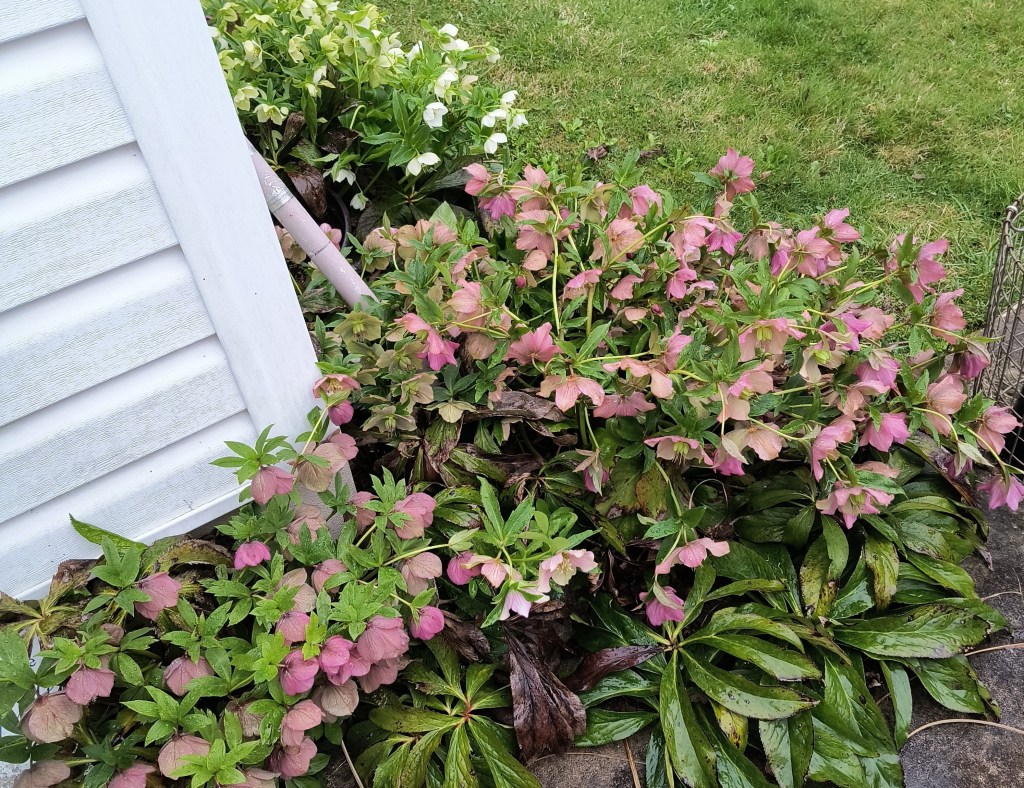
Our Lenten roses, in full bloom

This will be the last twenty questions post until after Easter, since Jesus asked the last three questions after his resurrection. As Jesus forewarned his disciples about the grief they would feel at his crucifixion, he also told them that horrific event would not be the end of the story.

Soon they would experience their world falling apart. Despite all of Jesus’ warnings along the way, the disciples reacted to Jesus’s arrest, judgment, and death as any of us do to threat and trauma: by “freeze” (their paralysis in the Garden of Gethsemane), by trying to fight (Peter), and by flight (most of them). In his fear, Peter denied knowing Jesus. All of them felt a combination of guilt and despair. Judas killed himself. Others went back to what was safe and familiar (fishing). Thomas lacked the courage to believe the good news when it came. Like Peter and John, he had to see it for himself.

The women, though—including Jesus’s mother—stuck by him. Along with John, they pushed through the mocking crowd close enough to the cross to converse with Jesus as he hung in agony. They witnessed his death.

Did the women remember and believe what he had said, that they would see him again, in great joy? We’re not told. But, like Mary of Bethany (Mark 14:8), they did what they could; they embraced the positive action that was available to them. Still wanting to serve and care for Jesus, they went to his tomb on Sunday, as soon as they could after observing the Sabbath.

Imagine the thrill of the angel, the stone rolled back, the empty tomb, their next task (“Go and tell his disciples”)—and then Jesus, alive! meeting Mary Magdalene in the garden.

Let’s allow ourselves to take part in the narrative, to feel what they felt on that Passover weekend, as the Lamb of God was sacrificed so that his shed blood would protect us from death. With the women and John, let’s find the courage to stand by Jesus at the cross.

 And let’s remember it’s OK to ask our questions. Whatever hard place you are in right now, draw near and share your grief and doubts and fears and confusion with the Lord. He understands and welcomes us. We may not be capable of understanding, yet.

But today is not the end of the story.

Why can’t I hear?

But Jesus speaks truth Lenten question from John #10

We’re only halfway through Jesus’s twenty questions recorded by John! To get through all of them during Lent, we’ll have to pick up our pace—and that means spending more time with the Lord–making room in our hearts for what he wants to tell us. This is what Lent is all about. Let’s not lose the blessings God has for us as we head toward Holy Week.

John 8:36-37, 43, 47 [Jesus replied] “If the Son sets you free, you are truly free. … Some of you are trying to kill me because there’s no room in your hearts for my message. … Why can’t you understand what I am saying? It’s because you can’t even hear me! … Since I am telling you the truth, why don’t you believe me? Anyone who belongs to God listens gladly to the words of God.

I couldn’t hear her.

A person I dearly love spoke words of truth that lacerated my heart and triggered all my defenses.

One thing I understood clearly: I was no longer safe or welcome in her home. I had to get out, as quickly as possible.

I couldn’t, at that time, “listen gladly.” It took me years, literally, to acknowledge and begin to deal with what she said to me. I couldn’t do it by myself. I needed the support and insights of a skilled and compassionate counselor to allow myself to accept and grow from the sharp stab of truth.

The instinctive response of the people in John 8 to the devastating truths Jesus told them (read verses 42-47) was to free themselves by attempting to kill him. Hate the message? Get rid of the messenger.

Remember the disciples’ reactions later on, when Jesus is arrested? They ran away. Peter denied even knowing Jesus. It’s easy to judge them, but in their situation, what would you and I do? In my life, will I stand firm with Jesus, even if this proves costly?

As we approach the time of year when we remember the significance of the crucifixion, John calls us to find the courage to listen to Jesus, and find the wisdom to distinguish his voice from the many others clamoring for our attention, some of them claiming to be his voice yet not producing the fruits of truth and love.

What is blocking me from hearing God’s words to me today? What defenses are triggered in unhealed and fearful places in my mind and my heart? How can I reach the place of listening gladly to his words? Do I need to talk this over with someone whom I trust to help me understand?

Does it matter?

But God bids us stand for the truth

2 Corinthians 13:8 For we must always stand for the truth.

First, a special request for prayer: Venezuela has the best opportunity for change in decades, through presidential elections this Sunday, July 28. The lead-up has been fraught with disappearances, thefts, and intimidation by the current government against the opposition. Yet an army of citizens are planning to risk everything by monitoring voting sites (see this article). PLEASE PRAY for their protection and for change in Venezuela that will allow millions of refugees to go back home to help rebuild their country. Thank you.

Back to my post:

I’ve done it, and perhaps you have too. An alarming email shows up in my Inbox, or a social media post catches my attention, and I forward or share it without checking the source or the information’s veracity. And later someone lets me know that it’s false. It’s misinformation, and I’ve become part of the web of lies circulating through our society.

I’ve learned, through chagrin and embarrassment, to stop long enough to check before I believe. To pause and verify before I forward.

This simple statement as we come to the end of 2 Corinthians, “We must always stand for the truth,” has challenged me to recommit to more responsible citizenship.

I invite you to consider doing this as well. In this age of “my truth” and “your truth,” let’s reaffirm our belief in truths that don’t shapeshift according to someone’s agenda. Let’s commit to being trustworthy.

Does it matter? Scripture says yes.

Here’s an interesting truth, that perhaps can serve as our starting place:

In the NIV, the word “truth” shows up 137 times; the word “lie” 226 times. This doesn’t count alternate ways of expressing these concepts. In the KJV, those numbers are “truth” 224 times; “lie” 280 times.

Does God care about truth?

Twisting the truth is nothing new. In John 8, Jesus uses the strongest possible language to condemn lying (John 8:44-46), yet people responded by claiming, repeatedly, that he was possessed by a demon. As you read Scripture, notice how often something like this happens. Wrongdoing is not very creative—it just changes its camouflage across time.

In the wake of the assassination attempt on President Trump, I mentioned to a friend I was fact-checking, since rumors and false statements were running rampant on social media. She asked me how to do that. There are many nonpartisan organizations whose people work hard to check facts for us. I usually go to FactCheck.org, AP, Reuters, PolitiFact, Snopes, or Washington Post, but there are others.

No single fact checking organization has time to cover everything. So, if you want to check a news article or a social media post or a speech, Google the headline or main content and see which fact checkers are working on that claim. You can also compare different fact-checking sites to see what they say.

One other practice I follow: If I discover that something I’ve passed on as truth is false, I let people to whom I sent it know that I found out it’s not true. That’s good, but how many of them already passed it on to their contacts? Much better to check BEFORE I send.

Another thing I do is read a variety of news sources: Newsmax AND the Washington Post AND historian Heather Cox Richardson’s daily Letter from an American, for example. I don’t want to get stuck in an information bubble, running the risk of being brainwashed by one angle on things or by the conspiracy theories so rampant on social media.

Why do I go to all this trouble? Because my first loyalty is to the Kingdom of God, who bids me always stand for the truth. We must be careful with whom and with what we align his holy name.

P.S. I expect pushback; that’s OK as long as it’s respectful and you fact check first. (Sigh. I’m an Enneagram 9, so conflict and confrontation are hard for me—including this post.)

A new heaven and new earth

But God says, “Make every effort”

2 Peter 3:13 But we are looking forward to the new heavens and new earth God has promised, a world filled with his righteousness. And so, dear friends, while you are waiting for these things to happen, make every effort to be found living peaceful lives that are pure and blameless in his sight.

The most memorable statement in the sermon about Jesus’ ascension yesterday, I think, was “Jesus decided to work from home.”

One day, we’ll share his Home (Revelation 21). Meanwhile, the Holy Spirit, first poured out to the believers on the day we celebrate next Sunday, Pentecost, joins us in the trenches as we stay the course, faithfully pursuing “long obedience in the same direction,” as Eugene Peterson so famously put it.

Like perennials, Jesus will come back!

Jesus warned us there would be bumps and bruises along the way. “Here on earth, you will have many trials and sorrows” (John 16:33). Why are we surprised and resentful when this proves to be true? Could it be that we’re seduced by the idea that this is all there is, that life ends with death?

I had the interesting experience Saturday of attending a memorial service immediately followed by a birthday party. Funerals, of course, always make me think of Karis. Perhaps that’s why I found myself telling someone at the birthday party that Karis longed to go Home. In her last year of journaling, she wrote repeatedly, “Father, I can’t do this anymore. Please take me Home. Please.”

So in our sorrow and missing her, we know Karis is exactly where she wanted to be, living her best life. Glimpsing ahead of time the “new heavens” promised to us.

The writer of Hebrews tells us the heroes of faith “agreed that they were foreigners and nomads here on earth. … they were looking for a better place, a heavenly homeland” (11:13, 16).

I think the promise of a new heaven and new earth, where there will be no more death or sorrow or crying or pain (Revelation 21:4) gives us perspective on our trials and motivation to make the most of our time here, doing with the energy the Spirit gives us whatever God has asked us to do. Peter and other New Testament writers liked the phrase “make every effort,” or “work hard” as some versions translate the phrase:

Make every effort to respond to God’s promises (2 Peter 1:5—see also 1:10, 1:15).

Make every effort to live in peace with everyone (Hebrews 12:14).

Make every effort to keep the unity of the Spirit in the bond of peace (Ephesians 4:3).

Make every effort to do what leads to peace and mutual edification (Romans 14:19). … Never pay back evil with more evil … If it is possible, as far as it depends on you, live at peace with everyone (Romans 12:17-18).

Some versions use the word “harmony” instead of peace. Peace, of course, begins in our own hearts. Worth thinking about, for as long as we’re on this side of the story.

This World Is Not My Home, by Albert Brumley, sung by Jim Reeves.

But God said, “Don’t be afraid”

Acts 18:5-10 Paul testified to the Jews that Jesus was the Messiah. But when they opposed and insulted him, Paul shook the dust from his clothes and said, “From now on I will preach to the Gentiles.” … One night the Lord spoke to Paul in a vision and told him, “Don’t be afraid! Speak out! Don’t be silent! For I am with you.”

I have a strong streak of cowardice. So I empathize with my grandson Caleb when he says, “I want to do it with you, Grammy.” Some things are just plain scary, especially if you’ve tried before and things didn’t go well.

Caleb’s first time kayaking was a bit scary at first.

It means so much to hear God say “Don’t be afraid. I’m with you.” Even Paul needed that encouragement. It was hard for him to be insulted and slandered, as it would be for any of us.

I wrote the content that became Vítima, Sobrevivente, Vencedor (Victim, Survivor, Victor) first as my thesis for my family counseling program. Several people encouraged me to publish it, but I realized what I had written was largely theory. I lacked experience. I believed in what I wrote, but I hadn’t adequately put it into practice.

My counselor friend Gloria, however, had lots of experience. Perhaps she would be willing to co-write the book! I floated the idea to her, and she liked it. We scheduled a time to discuss details. The day before we were to meet, though, Gloria suddenly died from a pulmonary embolism. Instead of conversing with her the next day, I attended her funeral. (In Brazil, burials generally take place within twenty-four hours.)

In my grief at the loss of my friend, I set aside the book idea. A few months later, though, I had to decide: Would I face into my fear of publishing the book alone? Would I speak out for abuse victims, breaking long-held cultural taboos?

Long story short: the book was published in Brazil in 2000. A new edition came out in 2012, much improved by the experience I and many others gained “in the trenches” as we applied the concepts of recovery in small groups. Faithful, passionate women and men have continued this work, offering hope, love, and practical restoration to abuse victims, most of whom had never told their stories to anyone before.

The first version
The second version

Last week I received a text from Brazil, telling me a national-level training would be held last weekend by Zoom using Vítima, Sobrevivente, Vencedor. I rejoiced later to hear it had gone well. If you think of it, pray for the new teams taking this courageous step toward speaking out.

Don’t be afraid. I am with you. In what area do you need this encouragement from the Lord?