
But God calls us to sail together
Ephesians 4:16 Christ makes the whole body fit together perfectly. As each part does its own special work, it helps the other parts grow, so that the whole body is healthy and growing and full of love.
How do you sail against the wind?
Here’s a visual answer.
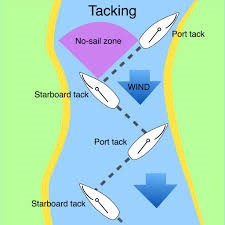
The sailboat needs to zigzag. The most efficient tack is at a 45-degree angle. The wind pushes off the back of the sail, moving the sailboat forward. With more than a 45-degree angle, the boat will move forward much slower. With less than a 45-degree angle, it will move faster, but not in the direction you really want to go. After tacking at a 45-degree angle, you need to bring the boat around 90 degrees. However, you need to be careful because the sail will swing across the boat as you turn. The boom, the bottom of the sail, could knock you into the water if you don’t duck.
Bob Mumford back in the eighties wrote about the Christian life using this image. Whether as an individual, a church or a denomination, we often find ourselves needing to go against the wind. This applies to following the will of God when you can’t simply go directly against the wind. You tack. You move forward on an angle.
The problem comes when we forget that we’re tacking. We slide into thinking the tack is the right way to go. New denominations often start by someone saying, “Hey, we’re missing something important. We need to change in a major way!” The veterans who started the denomination are likely to resist because in their day, they began the denomination exactly because it responded to a need that others were missing. And so, another division happens and there are now two denominations with a great deal in common, but some fundamental differences. This happened in the charismatic renewal in Brazil in a big way. Almost every major non-Pentecostal denomination birthed a charismatic version in the seventies and eighties.
What we forget is that whatever version we embrace, we are on a tack. We always need to be ready to change in a major way again, whether in our individual lives, our church or our denomination.
This happened in my life in a big way in 2020 with the advent of COVID. My ministry shifted profoundly from pastoring of pastors to discipling and pastoring of pastors (DPP) in Latin America. There was some resistance, but we gradually shifted—some more quickly, some more slowly. Around 2022 I tacked again. Our ministry’s outcome was no longer healthy pastors but rather healthy, disciple-making churches. Again, some resisted, especially those who hadn’t made the first change.
Now I’m tacking a third time, creating consternation among some DPP leaders.
The great dechurching in Latin America is forcing us to recognize, though, that we can’t just make adjustments. We need profound changes. And we need to make them in cooperation with other churches and para church ministries. In addition to the motivation of the Great Commandment (Mt 22.34-40) and the strategy of the Great Commission (Mt 28.16-20), we need a Great Collaboration (Jn 17.20-24).
This is the heart of the call to the Latin American Disciplers’ Summit planned for March 2025 in Bogotá, Colombia, which seeks to draw fifty principal leaders from each country. Its intent is not to be “an event,” but rather a call to cooperative action across the Spanish-speaking world.
I am convinced that nothing less than working together, across denominations and ministries, will reverse the great dechurching. The challenges we face require revival and renewal of the whole Body of Christ.
For good reasons, some DPP leaders are slow to commit to this. I’ve noticed four variables that affect people’s ability to change, to tack into the wind on a new ninety-degree angle.
- Fatigued vs energized. Those who are in chronic fatigue, some level of burnout or overwhelmed naturally resist change. This can include those who are dealing with future shock – too many changes too quickly. Those who are inspired by the new vision, however will be energized by the proposed change.
- Personality or temperament. According to the DISC model, D’s (direct, decisive, dominant) are likely to embrace change while S’s (secure, stable, solid) are more likely to resist it.
- Commitment to earlier changes. Those who feel comfortable with earlier commitments will fear losing them. This can include deep-seated fear of losing something valuable and unnegotiable.
- Innovators, early adopters, early majority, late majority, and laggards (best described by American sociologist Everett Rogers). In some ways this model summarizes the variables we’ve already listed.

Isaiah 43.18-19 challenges me this year as I consider the new tack I believe God is calling us to:
“Forget about what’s happened;
don’t keep going over old history.
Be alert, be present. I’m about to do something brand-new.
It’s bursting out! Don’t you see it?
There it is! I’m making a road through the desert,
rivers in the badlands.
(The Message, Is 43:18-19)
May God give us both vision and the experience of His doing a new thing in our midst. May revival and renewal of the Church extend even beyond Latin America as we together follow the orders of the Captain of our ship.
Captain, by Hillsong United


 Debra Kornfield