Tacking against the wind, by David Kornfield, OC International

But God calls us to sail together

Ephesians 4:16 Christ makes the whole body fit together perfectly. As each part does its own special work, it helps the other parts grow, so that the whole body is healthy and growing and full of love.

How do you sail against the wind?

Here’s a visual answer.
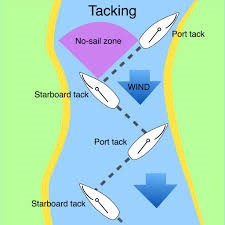
The sailboat needs to zigzag. The most efficient tack is at a 45-degree angle. The wind pushes off the back of the sail, moving the sailboat forward. With more than a 45-degree angle, the boat will move forward much slower. With less than a 45-degree angle, it will move faster, but not in the direction you really want to go. After tacking at a 45-degree angle, you need to bring the boat around 90 degrees. However, you need to be careful because the sail will swing across the boat as you turn. The boom, the bottom of the sail, could knock you into the water if you don’t duck.

Bob Mumford back in the eighties wrote about the Christian life using this image. Whether as an individual, a church or a denomination, we often find ourselves needing to go against the wind. This applies to following the will of God when you can’t simply go directly against the wind. You tack. You move forward on an angle.

The problem comes when we forget that we’re tacking. We slide into thinking the tack is the right way to go. New denominations often start by someone saying, “Hey, we’re missing something important. We need to change in a major way!” The veterans who started the denomination are likely to resist because in their day, they began the denomination exactly because it responded to a need that others were missing. And so, another division happens and there are now two denominations with a great deal in common, but some fundamental differences. This happened in the charismatic renewal in Brazil in a big way. Almost every major non-Pentecostal denomination birthed a charismatic version in the seventies and eighties.

What we forget is that whatever version we embrace, we are on a tack. We always need to be ready to change in a major way again, whether in our individual lives, our church or our denomination.

This happened in my life in a big way in 2020 with the advent of COVID. My ministry shifted profoundly from pastoring of pastors to discipling and pastoring of pastors (DPP) in Latin America. There was some resistance, but we gradually shifted—some more quickly, some more slowly. Around 2022 I tacked again. Our ministry’s outcome was no longer healthy pastors but rather healthy, disciple-making churches. Again, some resisted, especially those who hadn’t made the first change.

Now I’m tacking a third time, creating consternation among some DPP leaders.

The great dechurching in Latin America is forcing us to recognize, though, that we can’t just make adjustments. We need profound changes. And we need to make them in cooperation with other churches and para church ministries. In addition to the motivation of the Great Commandment (Mt 22.34-40) and the strategy of the Great Commission (Mt 28.16-20), we need a Great Collaboration (Jn 17.20-24).

This is the heart of the call to the Latin American Disciplers’ Summit planned for March 2025 in Bogotá, Colombia, which seeks to draw fifty principal leaders from each country. Its intent is not to be “an event,” but rather a call to cooperative action across the Spanish-speaking world.

I am convinced that nothing less than working together, across denominations and ministries, will reverse the great dechurching. The challenges we face require revival and renewal of the whole Body of Christ.

For good reasons, some DPP leaders are slow to commit to this. I’ve noticed four variables that affect people’s ability to change, to tack into the wind on a new ninety-degree angle.

  • Fatigued vs energized. Those who are in chronic fatigue, some level of burnout or overwhelmed naturally resist change. This can include those who are dealing with future shock – too many changes too quickly. Those who are inspired by the new vision, however will be energized by the proposed change.
      • Personality or temperament. According to the DISC model, D’s (direct, decisive, dominant) are likely to embrace change while S’s (secure, stable, solid) are more likely to resist it.
      • Commitment to earlier changes. Those who feel comfortable with earlier commitments will fear losing them. This can include deep-seated fear of losing something valuable and unnegotiable.
      • Innovators, early adopters, early majority, late majority, and laggards (best described by American sociologist Everett Rogers). In some ways this model summarizes the variables we’ve already listed.

      Isaiah 43.18-19 challenges me this year as I consider the new tack I believe God is calling us to:

      “Forget about what’s happened;

      don’t keep going over old history.

      Be alert, be present. I’m about to do something brand-new.

      It’s bursting out! Don’t you see it?

      There it is! I’m making a road through the desert,

      rivers in the badlands.

      (The Message, Is 43:18-19)

      May God give us both vision and the experience of His doing a new thing in our midst. May revival and renewal of the Church extend even beyond Latin America as we together follow the orders of the Captain of our ship.

      Captain, by Hillsong United

      But the Holy Spirit redirected

      Acts 16:6-10 [For Paul’s second missionary journey, Silas joined him in place of Barnabas. After revisiting Derbe and Lystra and picking up Timothy] Paul and Silas traveled through the area of Phrygia and Galatia, because the Holy Spirit prevented them from preaching the word in the province of Asia at that time. Then, coming to the borders of Mysia, they headed north for the province of Bithynia, but again the Spirit of Jesus did not allow them to go there … That night Paul had a vision: A man from Macedonia in northern Greece stood there, pleading with him, “Come over to Macedonia and help us!” So we [Luke joined Paul] decided to leave for Macedonia at once, having concluded that God was calling us to preach the Good News there.

      Not Brazil, Pittsburgh. Not our plan, God’s.

      We expected to spend the rest of our lives—including our retirement—in São Paulo. I imagined receiving my grown and married children and their children in our house there—maybe once a year, maybe for Christmas.

      Pittsburgh was a tough switch for both Dave and me. I was pulled out mid-stride, to go to a place where I knew not a single person. I remember telling the 100-plus participants in REVER (restoration ministry) at our church in January 2004, “I’ll be back in time to celebrate the end of this course with you in August.” August turned out to be the month Karis had her first transplant. And then rejection. And then Legionnaire’s …

      Shutterstock: 1 plus 1 trips From one adopted city (São Paulo) …
      To another (Pittsburgh). Shutterstock: Mihai_Andritoiu

      More than ten years later, I finally made a special trip for an attempt at closure in Brazil. I miss our friends there and the joy of living in Brazil. Sometimes the grief of leaving sweeps over me still.

      Dave took six years to realize he had to leave, and finally saying “yes” to the Lord required repentance on his part for making Brazil into sort of an idol. “What on earth will I do in Pittsburgh?” he asked me.

      But God …  In the Lord’s incredible grace, that was when the Brazilian Bible Society asked Dave to write the Discipleship Bible. So between trips, he had a huge, fascinating project—one he would never have found time for while living in Brazil. The Discipleship Bible is impacting people across the huge nation of Brazil, and the Bible Society expects to publish it in Spanish next year. Dave considers it his legacy.

      Meanwhile, God expanded Dave’s work into Spanish-speaking Latin America. Again, he would never have found time to invest in this way while living in Brazil.

      And me? Though I miss my friends in Brazil terribly, I have the pleasure of my children’s and grandchildren’s company on a regular basis, a joy I never, ever expected, since neither Dave nor I grew up relating to our grandparents. And God took me into writing as a major investment of my time, something I did not anticipate. It surprises me still. Really, Lord? Have you grown me up enough yet for this?

      What about you? Where has God shut doors in your life and led you on a path you didn’t expect or plan for? And how have you seen him walk with you, one step and then the next?

      Thinking about Paul, and his rupture with Barnabas: he wasn’t perfect. He was immature in some areas. But God used him anyway. Take heart.

      But God removed and replaced

      Acts 13:1-3, 9, 22-23, 46, 52 One day as the leaders of the church at Antioch of Syria were worshiping the Lord and fasting, the Holy Spirit said, “Dedicate Barnabas and Saul for the special work to which I have called them.” … Saul, also known as Paul, was filled with the Holy Spirit … But God removed Saul and replaced him with David … And it is one of King David’s descendants, Jesus, who is God’s promised Savior … Then Paul and Barnabas spoke out boldly and declared, “It was necessary that we first preach the word of God to you Jews. But since you have rejected it and judged yourselves unworthy of eternal life, we will offer it to the Gentiles. … And the believers were filled with joy and with the Holy Spirit.

      My parents believed God was sending them to translate the Scriptures into one of the languages of a remote part of China. As they prepared to leave, China closed its doors, and in time, Mom and Dad went to Guatemala instead. I might have grown up in China instead of Guatemala!

      As Dave and I prepared to move to Brazil, our mission asked us to consider Mexico instead. Our kids might have grown up in Mexico instead of Brazil!

      We thought we would live out our lives in Brazil, seeing our grandchildren once or twice a year. Instead, because of Karis’s transplants, here we all are in Pittsburgh, where I see Caleb, Talita, and Liliana once or twice a week.

      Turning points. This chapter is full of them—you’ll have to read the whole thing for yourself. Barnabas and Saul are sent out. They go. The governor of Cyprus believes in Jesus. Elymas the sorcerer is blinded. Saul’s name changes to Paul. John Mark leaves Paul and Barnabas and returns home (we learn later Paul took this very hard). The news about Jesus’ resurrection (But God raised him from the dead, v. 30) generates conflict in Antioch of Pisidia. Paul and Barnabas respond by turning from the Jews to the Gentiles, who accept the Gospel joyfully.

      Shutterstock: Tang Yan Song

      Paul preached about a different Saul, one whom a thousand years before God removed from being king. But in his own life, the arrogant Saul who once tried to destroy the church has been replaced by one who dedicates his whole being to build it up. Luke was a careful writer. I don’t think it’s accidental that Paul’s name change appears in the same chapter where he preaches about the replacement of the ancient Saul (representing the old system of law), with David, whose descendant Jesus introduced the age of grace. Continue to rely on the grace of God, Paul and Barnabas told the believers (v. 43).

      What turning points have you experienced? How has your life been different because of them? Are you facing a moment of decision right now? Continue to rely on the grace of God.