Rebellious

But the Spirit grieves when we hurt ourselves or others

Isaiah 30:1 “What sorrow awaits my rebellious children,” says the Lord. “You make plans that are contrary to mine. You make alliances not directed by my Spirit, thus piling up your sins.”

Isaiah 63:10 But they rebelled against the Lord and grieved his Holy Spirit.

Ephesians 4:30 And do not grieve (bring sorrow to) God’s Holy Spirit by the way you live.

[Note: I’m posting this now because I’m traveling tomorrow.]

My breath caught. “Don’t do it!” I screamed inwardly as from too far away to intervene I saw my angry grandson pick up and hurl a small stone.

The injury caused by the small stone connecting with his sister’s arm ruined river play for all three of us. But the pleasure of our outing had already been spoiled.

My granddaughter had kicked her brother’s carefully balanced tower of rocks while he went downriver to search for more flat stones.

Why had she demolished his tower? Because she wanted him to play with her, concocting what they called “river soup,” stirring together an assortment of sticks, leaves, and pebbles into “the best soup in the whole world!” That day, her older brother preferred his solitary tower building.

At two and four, the present moment is everything, patience is still developing, and diversion from an anticipated delight (making the soup like they “always” did at the river) may only be effective for a short time. That did not excuse what either of them did to hurt the other. The consequent immediate end to river fun grieved us all.

Shutterstock: AshleeStock

Isn’t it true that we’re capable of hurting the most those whom we most deeply love?

I believe that the one most grieved that day was the Holy Spirit. Because he passionately wants our best. He sorrows when we hurt ourselves and one another. The context of these verses in both Isaiah and Ephesians is relationship: the call to care for each other with compassion. In Isaiah 30, the Spirit is sad because Israel has committed to a relationship that will prove harmful to them. In Isaiah 63, at issue is Israel’s relationship with the Lord himself.

And in Ephesians 4 and 5, Paul’s concern is the Ephesian believers’ relationships with each other.

Get rid of all bitterness, rage, anger, harsh words, and slander, as well as all types of evil behavior. Instead, be kind to each other, tenderhearted, forgiving one another, just as God through Christ has forgiven you. Imitate God, therefore, in everything you do, because you are his dear children. Live a life filled with love, following the example of Christ (Ephesians 4:31-5:2).

Good words for me today. You too?
Why and who?

But Jesus touches our deepest needs Lenten/Easter question #18

John 20:15 “Dear woman, why are you crying?” Jesus asked Mary. “Who are you looking for?”

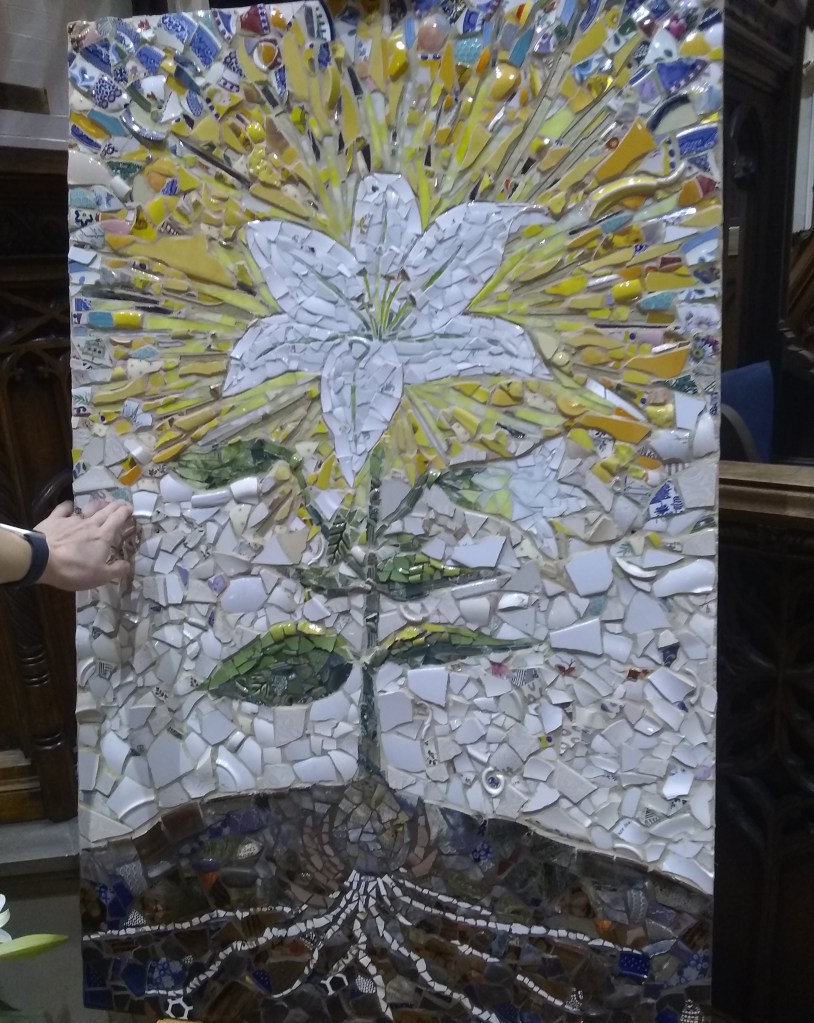
Finding a piece of my cup, among those shattered to create this gorgeous Easter mosaic.

When we lived in Brazil, a pastor’s wife courageously wrote a book called “No Place to Cry,” which directly related to our vision in mission: to care for pastors and their families. In Brazil (and perhaps this is true in other places too), pastors were put on pedestals, a lonely place to live. Pastors and their spouses were expected to care for everyone else, 24/7. They were not supposed to have needs of their own. As my husband often said, “Pastors have a hundred or more ‘kids’ [the members of their congregations]. Their own families are sacrificed on the altar of the church.”

Dave developed mutual support groups for pastors and their spouses, where they could ask each other questions like the ones Jesus asked Mary in the garden after his resurrection. The “safest” groups were interdenominational, because there was little fear what they shared would be gossiped among their peers or superiors or congregations. This had the surprising benefit of breaking down barriers between denominations, as pastors became friends based not on a particular doctrinal emphasis or history, but because of their common experience and needs. Dave’s teachings, summarized in his book “The Leader Who Shines,” helped them accept and practice concepts like boundaries, acknowledging and dealing with their own fears and traumas and complex histories, and developing ministry teams in their churches, rather than trying to do everything themselves. In small, committed groups, they could deeply hear and care for each other. They found a place where they could cry.

John records a series of very personal encounters between Jesus and individual followers after the resurrection. Mary. Thomas. Peter. We can add the two disciples on the road to Emmaus, a story recorded by Luke. This blesses me so much. Even while Jesus sacrificed his life for the world, in the short space of time he spent on earth before his ascension to heaven, he deeply loved and cared for specific people he loved, aware of their unique needs. And within the safety developed over time within the circle of disciples, they could hear and care for each other after he was gone.

Jesus asked Mary, “Who are you looking for?” Obviously, she was looking for him. And that’s true for us, too: the first person we should seek each morning is our Lord. Anchored in relationship with him, whatever happens in our days will be different than if we head into them alone. It occurs to me that in second place, the person we are looking for is our own selves. In the rush of life, we need space to recognize what’s taking place in our own souls. Even a few minutes of quiet with the Lord can help us do this.

Why are you and I crying today, whether we shed tears or stuff it down? Responding to this question is a great way to get in touch with ourselves. Then we can practice Philippians 4:6-7 and experience God’s peace.

Clearing a path

But God doesn’t want what we have. He wants us. July 8, 2024

2 Corinthians 12:14-15, 19 I don’t want what you have—I want you. After all, children don’t provide for their parents. Rather, parents provide for their children. … I will gladly spend myself and all I have for you. Everything we do is to strengthen you.

1 John 3:1, 16; 5:3, 21 See how very much our Father loves us, for he calls us his children. … We know what real love is because Jesus gave up his life for us. … Loving God means keeping his commandments, and his commandments are not burdensome.

My young grandchildren often give me things. A drawing (rainbows predominate these days). A dandelion, carefully tucked in a buttonhole or behind my ear. A bite of a cookie. A song.

These offerings are sweet because of the love that infuses them. At the same time, I need to remind them from time to time, what really shows me that you love me is your obedience. What I ask of you is not for myself—it’s for you, to help make your lives orderly and peaceful and happy. And the same is true for your mommy and daddy. You often tell me that you love them. Don’t just say it; show it—by obeying them, by doing cheerfully the simple things they ask of you.

Love and generosity are meant to be a two-way street. But that’s not what everyone experiences, and it’s hard—and not safe—to give our hearts and our obedience to those who aren’t trustworthy. In REVER (the restoration ministry Dave started in Brazil in the ‘90s), we talk about a “father wound” and a “mother wound.” So many people resonate with these concepts. They were hurt, rather than loved appropriately by their fathers and/or their mothers. This wounding made them profoundly vulnerable to abuse by other people. Often, they struggled with loving God, their parents, and other people, because in their formative years, they did not feel generously loved and cared for by the most important people in their lives.

Our heavenly Father, out of his profound, pure, self-giving love, can and longs to heal these soul wounds. Jesus said, “Let the little ones come to me.” I think that’s each one of us. His heart breaks when he sees abuse carried out in his name, throwing up barriers to him rather than a helping hand.

I’m reminded to be careful of my own heart, words, and actions. I want to open a way to the Father, not clutter it with pitfalls or align God’s pure name with harmful words and behavior.

Where I grew up, this was a common way to clear a path. Shutterstock: n_defender

If someone asks you about your Christian hope, always be ready to explain it. But do this in a gentle and respectful way … Let them see the good life you live because you belong to Christ. … who died to bring us safely home to God (1 Peter 3:15-16, 18).

Advent ABC: Shepherd

Isaiah 40:11 (49:9-10) The Lord will feed his flock like a shepherd. He will carry the lambs in his arms, holding them close to his heart. He will gently lead the mother sheep with their young.

Karis was ten. We were in Detroit for surgery on her intestine. The rest of our family was at home in São Paulo, Brazil. (I learned later that eight-year-old Rachel had started a fire in the kitchen trying to cook for her siblings while Dave was out. A neighbor “happened” by, put out the fire, took my children to her house to feed them, and later had words with their father. But that’s another story…)

Before she was taken through the double doors into the surgery suite, I overheard Karis tell a new friend at the hospital that she wasn’t afraid, for herself or for me, because of Isaiah 40:11. The Holy Spirit shot that assurance straight into my heart, puncturing an expanding balloon of worry. Every time I hear Jesus referred to as Shepherd, I flash back to that precious moment.

Our Brazilian friend Roseli painted this for Rachel.

Turn to your Shepherd, the Guardian of your souls … The Lamb on the throne will be your Shepherd. He will lead you to springs of life-giving water and wipe every tear from your eyes (1 Peter 2:25, Revelation 7:17).

The Lord’s My Shepherd, Stuart Townend

Advent ABC: Deliverer

2 Timothy 4:16-18 (Isaiah 51:1-3) The first time I was brought before the judge, no one came with me. Everyone abandoned me. But the Lord stood with me and gave me strength … and he rescued me from certain death. Yes, and the Lord will deliver me from every evil attack and bring me safely into his heavenly Kingdom.

What deliverance do you need today? Take it to the Lord. He stands with you.

I arise today, through
God’s strength to pilot me,
God’s might to uphold me,
God’s wisdom to guide me,
God’s eye to look before me,
God’s ear to hear me,
God’s word to speak for me,
God’s hand to guard me,
God’s shield to protect me,
God’s host to save me
From snares of devils,
From temptation of vices,
From everyone who shall wish me ill,
afar and near.

I arise today
Through a mighty strength, the invocation of the Trinity,
Through belief in the Threeness,
Through confession of the Oneness
of the Creator of creation.

                             From “St Patrick’s Breastplate”

My Deliverer, Rich Mullins

God held my hand, by Meredith Dobson, Pittsburgh (Muddy Boots in the Hallway)

But God’s unfailing love supported me

Psalm 94:18-19 I cried out, “I am slipping!” but your unfailing love, O Lord, supported me. When doubts filled my mind, your comfort gave me renewed hope and cheer.

How did summer go by so fast??

Today I decided to take Uber to a doctor’s appointment. I waited outside my building in the rain, watching my phone for his arrival. I saw a car pull into the circle in front of our building the wrong way and immediately thought it must be my Uber driver. It was getting late and I was nervous, in part, because the doctor’s office had provided a same-day appointment and I was already afraid of being late.

When I got in the car, I was very nervous because I was seeing an unfamiliar doctor about a condition I was frightened to learn about and I was alone in doing this. I am 84 years old, I live alone, and get fearful of unknown things I have to do alone. I was rude and voiced admonishment to the driver for entering the driveway the wrong way and another car also let him know how much he was at fault. When he got in the car, I told him I was late already and to go fast that I needed to get there. This prompted a harsh response from him about his not wanting traffic violations and how he had to drop someone off and did I know my way around the city and he was as loud and abusive as I had been. Finally, I said I was already upset about a doctor visit and I didn’t want to talk about it anymore. In my mind, I thought of how I would rate him as a driver with a big old “O” and add a comment about rudeness.

As we got closer to the area, I gave him the actual address since I thought it was a medical building, not the actual hospital. He said, in a very calm, polite voice, he would take me wherever I needed to go. Then I said that I was sorry I had been so rude to him when I first got in. I said that I had talked to him in a way that was not called for, that I was way out of line, and I was sorry. He said he was sorry also and it was all OK. I briefly said that I was going to see a doctor I had never seen before about a condition I was really frightened about and being nervous about all that probably made me speak to him in a way I shouldn’t have. He said, Oh that’s OK. I’m sorry to hear that.  Then he added, “Do you want me to wait here to be sure you are in the right place? I will gladly do that.” I told him no, that I was pretty sure this was the right place. I said something about how things change and I hardly recognize it.

God was present with me all along. God was the one sitting beside me as we rode through the rain drops and the water splashing against the car. God held my hand in the back seat and gently whispered to me about forgiveness and speaking with the spirit of Love. God reminded me that this driver did not have an easy job and he was doing me a service. I was grateful I did not have to park or drive or bother with umbrellas or anything. I became grateful sitting there beside God and I wanted the driver to know.