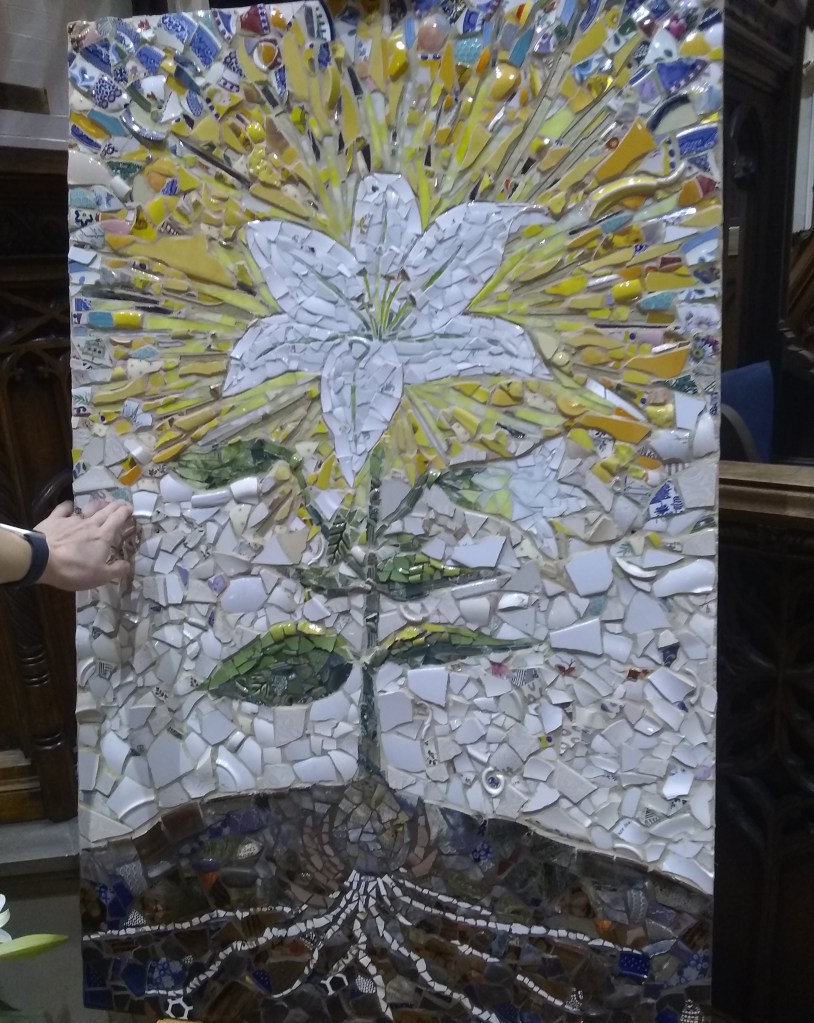
Counter-cultural humility

But Jesus took on the role of a slave Lenten question #15 April 15, 2025

John 13:3-5, 12-17 Jesus knew that the Father had given him authority over everything and that he had come from God and would return to God. So he got up from the table, took off his robe, wrapped a towel around his waist, and poured water into a basin. Then he began to wash the disciples’ feet, drying them with the towel he had around him. … After washing their feet, he put on his robe again and sat down and asked, “Do you understand what I was doing? … Since I, your Lord and Teacher, have washed your feet, you ought to wash each other’s feet. … I tell you the truth, slaves are not greater than their master.”

Philippians 2:6-8 Though Jesus was God, he did not think of equality with God as something to cling to. Instead, he gave up his divine privileges; he took the humble position of a slave and was born as a human being. When he appeared in human form, he humbled himself in obedience to God and died a criminal’s death on a cross.

I’ve always loved books like The Prince and the Pauper and The Scarlet Pimpernel and Zorro, in which a person appears ordinary, concealing the fact that he or she is playing a grand role in a lifesaving, history-changing endeavor. The bumbling Clark Kent, aka Superman, is another example, as is Rand (the Dragon Reborn) in The Wheel of Time. Do you have favorite stories with this theme?

Perhaps my fascination with these characters stems from the ways they mirror the greatest story of all: Jesus, King of kings, giving up the privileges of Heaven to live as a man from a poor family, raised in an obscure village as a carpenter’s son, with the scandal of his mother’s premarital pregnancy hanging over his head.

In the narrative of John 13, which we will commemorate on Thursday, Jesus knowing the Father had given him authority over everything washed his disciples’ feet, usually the task of a slave. And then he challenged his disciples to serve as he had served them.

Shutterstock: imaagio stock

Knowing we are beloved by the Father, we are called to care as he cared. I love this quote from Mother Teresa: “If you are humble nothing will touch you, neither praise nor disgrace, because you know what you are.”

After asking “Do you understand what I was doing?” Jesus told his disciples, “Slaves are not greater than their master.” What our master was willing to do for us is so much greater than anything we can ever do. Let’s not let pride get in the way of whatever our Lord asks of us. May the Spirit daily grow his love in us.

Whiplash

But Jesus too felt distress  Lenten question #14

John 12:7, 23-28, 32 [Mary, sister of Lazarus, anointed Jesus with expensive perfume and was criticized for doing so.] Jesus replied, “Leave her alone. She did this in preparation for my burial. … Now the time has come for the Son of Man to enter into his glory. … My soul is deeply troubled. Should I pray, ‘Father, save me from this hour?’ But this is the very reason I came! Father, bring glory to your name. … And when I am lifted up from the earth, I will draw everyone to myself.”

Hebrews 4:7-8 While Jesus was here on earth, he offered prayers and pleadings, with a loud cy and tears, to the one who could rescue him from death. And God heard his prayers because of his deep reverence for God. Even though Jesus was God’s Son, he learned obedience from the things he suffered.

Yesterday was “Whiplash Sunday.”

To begin, we waved palms like the crowd welcoming Jesus to Jerusalem, singing hosannas in triumphal procession.

A few minutes later, as performers narrated the events of Holy Week (using Luke’s account this time), we yelled, “Crucify him! Crucify him!”

Whiplash.

Imagine what it was like for Jesus, knowing even as the crowd shouted their Hosannas, that soon exuberant acclamation would turn to hostile condemnation and most bitter suffering and death.

And then, in the great Reversal, the glorious resurrection.

Whiplash.

As we walk through this week, we will probably feel the whole range of emotions. Take extra time to go deeper with Jesus in this eventful week. Ask him to help you understand WHY he chose to walk this road.

Via Dolorosa, Sandi Patty

He makes all things new

But Jesus IS life Lenten question #13

John 11:23-25 Jesus told Martha, “Your brother [Lazarus] will rise again.” “Yes,” Martha said, “he will rise when everyone else rises, at the last day.” Jesus told her, “I am the resurrection and the life. Anyone who believes in me will live, even after dying. Everyone who lives in me and believes in me will never ever die. Do you believe this, Martha?

1 Thessalonians 4:13-14 And now, dear brothers and sisters, we want you to know what will happen to the believers who have died so you will not grieve like people who have no hope. For since we believe that Jesus died and was raised to life again, we also believe that when Jesus returns, God will bring back with him the believers who have died.

Yesterday my husband and I flew from Colorado back home to Pittsburgh, watching the transformation of desert into well-watered spring. I found myself thinking about a similar flight soon after our daughter Karis’s death, gripped by pain sharper than any other I have experienced. Would this grief ever soften into some version of beauty less stark?

I don’t know even how to describe it. A transplant friend, whose son had died a few months earlier, texted me: “Just BREATHE.” For as long as I owned that phone, I looked back often at that text as loss stabbed me yet again.

Jesus, who wept with Mary and Martha at Lazarus’s grave even though he knew he would shortly bring Lazarus back to life, understands that pain. He offers himself, his presence with us, as we grieve.

As intense as this grieving has been, I’ve often wondered, with deep compassion, what it would have felt like if I didn’t have the hope of life after death. I’ve watched people without that hope enter profound despair. What if I didn’t know that Karis’s SELF did not die, but is whole and well? What if I didn’t know I will see her again, healed, released from her suffering, exuberantly alive? Would I have survived the grief? I don’t know.

I love imagining what people who have gone before us are like now, freed from all that hampered and troubled them on earth and face to face with Jesus, who IS life. Death could not keep him in its grip (Acts 2:24 NLT). Because he broke death’s power, we too can know life after death—the truly abundant life for which God created us.

As I hear Jesus asking me today the question he asked Martha, I can say with profound thankfulness, “Yes. I do believe his resurrection makes possible eternal life for us.” Lazarus did eventually die again, yet I know he now celebrates along with his beloved sisters the unlimited joy of forever resurrection.

A friend whose father recently died shared with me this beautiful anthem, All Things New, by Elaine Hagenberg, sung at the funeral. The text is adapted from a 19th c. poem by Frances Havergal. So appropriate as we walk into next week:

Light after darkness, gain after loss

Strength after weakness, crown after cross.

Sweet after bitter, hope after fears

Home after wandering, praise after tears.

Alpha and Omega, beginning and the end

He is making all things new.

Springs of living water shall wash away each tear.

He is making all things new.

Sight after mystery, sun after rain

Joy after sorrow, peace after pain

Near after distant, gleam after gloom

Love after loneliness, life after tomb. (Refrain)

Miracles

But Jesus’ good works foreshadow the greatest miracle of all Lenten question #12

John 10:30-42 [Jesus said] “The Father and I are one.” Once again the people picked up stones to kill him. Jesus said, “At my Father’s direction I have done many good works. For which one are you going to stone me? … Why do you call it blasphemy when I say, ‘I am the Son of God’? … If I do the Father’s work, believe in the evidence of the miraculous works I have done, even if you don’t believe me. Then you will know and understand that the Father is in me, and I am in the Father.” … And many who were there believed in Jesus.

Have you experienced miracles in your life? I have. I wrote about several of them in Karis: All I See Is Grace. And there are many others. God is constantly at work in our world and in our lives.

But all the miracles we have heard about in Scripture or in other people’s lives or experienced ourselves pale before the greatest miracle of all, which we will celebrate in just a few days: the miracle of Jesus’ resurrection from the dead. This is the great historical pivot when death was swallowed up in victory (1 Corinthians 15:54), when HOPE became possible, when the joy at the center of the universe broke through despair. We sorrow, yes. But we know that our griefs are not the end of the story. We live in a comedy, not a tragedy.

First, though, we’ll walk with Jesus through the multilayered injustices of slander, rejection, mocking, shame, abuse, cruelty, abandonment by those closest to him, and the horrible suffering of death by crucifixion. We’ll hear Jesus say in the midst of all that, “Father, forgive them, for they don’t know what they are doing.”

And because Jesus walked that road, we know there is nothing we experience which he cannot relate to. “He was beaten so we could be whole. He was whipped so we could be healed” (Isaiah 53:5).

May the Lord give each of us deeper insight these next days into these mysteries of grace and love.

Choose your own adventure

But Jesus heals our vision Lenten question from John #11

John 9:32-38[The formerly blind man told the Jewish leaders] “Ever since the world began, no one has been able to open the eyes of someone born blind. If this man were not from God, he couldn’t have done it.” “You were born a total sinner!” they answered. “Are you trying to teach us?” And they threw him out of the synagogue. When Jesus heard what had happened, he found the man and asked, “Do you believe in the Son of Man?” The man answered, “Who is he, sir? I want to believe in him.” “You have seen him,” Jesus said, “and he is speaking to you!” “Yes, Lord, I believe!” the man said. And he worshiped Jesus.

Hmm. Deflecting a legitimate perspective by using contempt. Where have we seen that before?

My seven-year-old grandson recently received from his uncle a set of “choose your own ending” stories. My husband spent an hour with him a few nights ago exploring all the possible conclusions to one set of scary circumstances before finding the one happy ending that could allow Caleb to sleep in peace.

Shutterstock: Sarayut Sridee

I’ve written before on this blog about John 9, one of the most carefully crafted, intriguing chapters in the whole Bible with its intricate word play on the concept of blindness and vision. Since John doesn’t tell us what happened next in the formerly blind man’s life, we can imagine a number of possible outcomes of his rejection by the Jewish leaders when he naively (it seems) spoke truth to power. His vision went far beyond his new experience of physical sight.

  • Did his parents continue to reject him, to preserve their status in the synagogue?
  • Did the newly sighted man join the disciples in following Jesus around the countryside? If so, what did this lead to? Successful integration in the church birthed at Pentecost? Martyrdom? A mission to some other country?
  • What skills other than begging and dormant abilities and passions did he develop?
  • Did he meet a wonderful woman to marry and create his own family?

Hey, you could start with John 9, invent a past and a future for this man based on historical research, give him relationships with intriguing events and people and write a novel! The theme to explore: What did it mean for a man blind from birth, assumed to be paying the consequence of his own sin (in the womb??) or his parents’ to respond affirmatively to Jesus’ question: Do you believe in the Son of Man?

And what does this question mean to you today, in your circumstances, with your history, your relationships, your fears and expectations for your future? John’s entire Gospel compels our response to this question. What adventure will you choose?

Why can’t I hear?

But Jesus speaks truth Lenten question from John #10

We’re only halfway through Jesus’s twenty questions recorded by John! To get through all of them during Lent, we’ll have to pick up our pace—and that means spending more time with the Lord–making room in our hearts for what he wants to tell us. This is what Lent is all about. Let’s not lose the blessings God has for us as we head toward Holy Week.

John 8:36-37, 43, 47 [Jesus replied] “If the Son sets you free, you are truly free. … Some of you are trying to kill me because there’s no room in your hearts for my message. … Why can’t you understand what I am saying? It’s because you can’t even hear me! … Since I am telling you the truth, why don’t you believe me? Anyone who belongs to God listens gladly to the words of God.

I couldn’t hear her.

A person I dearly love spoke words of truth that lacerated my heart and triggered all my defenses.

One thing I understood clearly: I was no longer safe or welcome in her home. I had to get out, as quickly as possible.

I couldn’t, at that time, “listen gladly.” It took me years, literally, to acknowledge and begin to deal with what she said to me. I couldn’t do it by myself. I needed the support and insights of a skilled and compassionate counselor to allow myself to accept and grow from the sharp stab of truth.

The instinctive response of the people in John 8 to the devastating truths Jesus told them (read verses 42-47) was to free themselves by attempting to kill him. Hate the message? Get rid of the messenger.

Remember the disciples’ reactions later on, when Jesus is arrested? They ran away. Peter denied even knowing Jesus. It’s easy to judge them, but in their situation, what would you and I do? In my life, will I stand firm with Jesus, even if this proves costly?

As we approach the time of year when we remember the significance of the crucifixion, John calls us to find the courage to listen to Jesus, and find the wisdom to distinguish his voice from the many others clamoring for our attention, some of them claiming to be his voice yet not producing the fruits of truth and love.

What is blocking me from hearing God’s words to me today? What defenses are triggered in unhealed and fearful places in my mind and my heart? How can I reach the place of listening gladly to his words? Do I need to talk this over with someone whom I trust to help me understand?

Judge correctly

But Jesus looks beneath the surface Lenten question from John #9

John 7: 23-24 [Jesus said] Why should you be angry with me for healing a man on the Sabbath? Look beneath the surface so you can judge correctly.

1 Samuel 16:7 The Lord doesn’t see things the way you see them. People judge by outward appearance, but the Lord looks at the heart.

Have you ever been judged or dissed for doing something right, or for the way you look, or by a decision you make? By people you love or look up to and whose opinion matters to you?

It hurts.

“Judging by outward appearance” is endemic on social media and has been particularly harmful to kids, teens and young people, for whom social acceptance is even more important than for adults. I loved seeing this positive one-year report on Australia’s phone ban in schools, giving children freedom to just be kids. My own fast from Facebook this Lent has given me a sense of freedom that makes me unsure whether I’ll go back—though I miss tracking people I care about.

Shutterstock: Sascha Burkard

Failure to look beneath the surface harms adults as well. We’re so conditioned to make snap judgments about people based on one or two factors we’ve been told defines them as “bad” or objectionable. We too easily write off a person’s entire life—all that they’ve done and been that’s been good in the world—when we learn they’ve broken one norm we believe to be sacrosanct.

Like the Jewish leaders did to Jesus when he healed a man on the Sabbath. They cared more about their definition of proper behavior than about celebrating Jesus’ ability to free a man from an illness which had derailed his life for 38 years (John 5).

Like deciding a tattoo brands a person as being a member of Tren de Aragua and thus treating him like a criminal, despite all other evidence to the contrary—even though tattoos have never been used by Tren de Aragua to identify its members.

Like shunning people visiting our churches who don’t fit our norms of dress and appearance.

And so much more. I’m sure you can list examples too, because we notice these things in other people.

The question for today is: How am I seeing and judging people based on appearances? Where do I need to look beneath the surface?

It’s so easy to see this in others. Yet I know I can be blind to this tendency in myself. Here’s an idea that may take some courage to implement: Ask people who know me where they have observed me doing this, judging too quickly, failing to see as God sees—not just people who would naturally share my biases, but people who stretch me outside my comfort zone.

Scary. I need to be prepared to hear things that are painful. And can help me grow to be more like Jesus.

Dark valleys

But Jesus never leaves us Lenten question from John #8 April 5, 2025

John 6:58-69 [Jesus said] “I am the true bread that came down from heaven. Anyone who eats this bread will not die as your ancestors did.” … Many of his disciples said, “This is very hard to understand. How can anyone accept it?” Jesus was aware that his disciples were complaining, so he said to them, “Does this offend you? Then what will you think if you see the Son of Man ascend to heaven again? The Spirit alone gives eternal life. Human effort accomplishes nothing. And the very words I have spoken to you are spirit and life.” … At this point many of his disciples turned away and deserted Jesus. Then Jesus turned to the Twelve and asked, “Are you also going to leave?” Simon Peter replied, “Lord, to whom would we go? You have the words that give eternal life. We believe, and we know you are the Holy One of God.”

Proverbs 3:5-8 Trust in the Lord with all your heart; do not depend on your own understanding. … Don’t be impressed with your own wisdom. Instead, fear the Lord and turn away from evil. Then you will have healing for your body and strength for your bones.

Many times during our daughter Karis’s thirty year history, I questioned and doubted that God knew and cared about what she was going through. It’s tough to watch your child in unrelenting pain and loss and to feel helpless to protect and provide for her and to ease her suffering.

God didn’t explain himself to me. The consistent message I received was that I was free to walk away from him. But then I wouldn’t know his Presence, his comfort, or his guidance. I would likely become angry and bitter, and miss his many, many good gifts along the way. Life would become hollow and hopeless. I would be a mess emotionally and have little to offer to my family.

Even if we walk away from the Lord in our tough times, he will never leave us Shutterstock: Mike Ver Sprill

This passage from John is theologically complex. I’m not going to get into that. What stands out to me is how easy it is to doubt God and walk away from him when something happens that we don’t understand.Have you had this experience?

I know that many people, including myself, are tempted by this kind of despair right now, as events and decrees across our country threaten the wellbeing of people we love in myriad ways. Yesterday I talked with a friend who said, “They are deliberately trying to exterminate people like me.” She has solid justification for this deep fear. If Karis were still alive, I would have the same fear for her life.

What do we do with this kind of distress? “Bandaid” answers don’t help, like “Don’t worry; everything will be OK” or “Just trust God—obviously you’re anxious because you don’t have enough faith.” All they do is show the one in distress you want out—you don’t want to feel what she feels. These responses make the one in fear feel more isolated and alone than they already were.

How can we respond? First, listen deeply to our own hearts and to others. Then, acknowledge our distress to God. Tell him exactly how we feel and why. Entrust our fears to the Lord. Ask him to take our burden of fear and anxiety, as he has already done on the cross. Open our hearts to receive his peace, peace that doesn’t depend on understanding our circumstances, but rather, on trusting him and his love for us. And do this again, every time fear and anxiety stir in us once more. Several times a day if needed.

The things we fear can actually happen. Our faith does not make us immune. Jesus assures us that we will not walk through tough times alone. He has promised to walk with us, to bear our burdens, to NEVER leave or forsake us. That’s what we depend on. We may not understand what we’re going through. But our Lord does understand us and how much we need his presence with us, his encouragement and his strength.

We are not alone. Even in dark valleys where nothing seems to make sense.

Bread

But God nourishes both body and soul Lenten question #7

John 6:5-7 Jesus saw a huge crowd of people coming to look for him. Turning to Philip, he asked, “Where can we buy bread to feed all these people?” … Philip replied, “Even if we worked for months, we wouldn’t have enough money to feed them!”

John 4:31-34 The disciples urged Jesus, “Rabbi, eat something.” But Jesus replied, “I have a kind of food you know nothing about. … My nourishment comes from doing the will of God, who sent me, and from finishing his work.”

Do you remember the end of The Last Battle when the children were sailing to the end of the world, so filled with wonder and spiritual sustenance that they weren’t hungry for physical food? I wonder whether C.S. Lewis got that idea from these passages in John. As we know, Jesus performed one of his most spectacular miracles after his interchange with Philip, multiplying a young boy’s five barley loaves and two fish to feed an enormous crowd. The men alone numbered about 5,000 (v. 10). This is one of the few events recorded by all four evangelists, though only John tells us the loaves and fish were provided by a young boy, who apparently shared that information with Andrew.

Shutterstock: ArtMari

I’m intrigued by Jesus’s concern in verse 12 that nothing be wasted. If you had the power to feed thousands of people from one lunch, would you be worried about the scraps left over? On the assumption that everything Jesus did and said was purposeful, what do you think this means? And the fact that the leftovers filled twelve baskets? What do you think the disciple did with the twelve baskets of scraps? I would love to know your thoughts!/

I remember my shock when as a teenager, I heard a sermon in which the preacher claimed this incident wasn’t really a miracle of multiplication, but rather a miracle of generosity—that the young boy’s gift shamed others into sharing the food they had brought along. The preacher believed this was as much a miracle—the softening of people’s hearts into concern for their neighbors—as Jesus literally feeding a multitude from five small loaves and two small fish would have been.

Except this isn’t what the text tells us. In each of the four Gospels, we read about Jesus multiplying the food. John says, “When the people saw Jesus do this miraculous sign, they exclaimed, ‘Surely, he is the Prophet we have been expecting!” (6:14). The people weren’t congratulating each other for their generosity. All eyes were on Jesus, the one who, as Matthew 14, Mark 6, and Luke 9 tell us, had spent the day healing the sick and teaching them about the Kingdom of God—ministering to their bodies and their souls—even while carrying a burden of grief for his beloved beheaded cousin, John the Baptist. And before he calmed the storm after Peter’s attempt to walk to him on the turbulent waves.

In ourselves, we never have enough for the needs of others, no matter how much we share and sacrifice. We can’t be enough. Yes, we are asked to share what we have been given. It was the disciples who walked around through that huge crowd serving the people. But the Source of nourishment is God’s overflowing heart of love, for both our bodies and our souls.

The Love of God by Frederick Martin Lehman, sung by Mercy Me

What’s your story?

Lenten question from John #6

John 5:46-47 If you really believed Moses, you would believe me, because he wrote about me. But since you don’t believe what he wrote, how will you believe what I say?

Matthew 5:17 Don’t misunderstand why I have come. I did not come to abolish the law of Moses or the writings of the prophets. No, I came to accomplish their purpose.

As my grandchildren helped me prepare to honor their grandfather on his St. Patrick’s Day birthday, we talked about why I love the shamrock: three hearts linked together, reflecting the love of each member of the Trinity, Father, Son, and Spirit. Since I’m currently writing a book for grade schoolers that I hope will help them understand the Trinity, I’m more alert than usual to these images and to all that I can glean from Scripture about the Three-in-One in world cultures.

There’s a theory in missiology that God has implanted in every culture a witness about Jesus and the redemption story. Bruce Olson wrote about this in his story from Ecuador, Bruchko. Seehttps://www.canaacademy.org/blog/bruchko-renewing-culture-in-the-forbidden-jungle . I LOVE hearing stories about Jesus appearing to Muslims in their dreams, a highly revered way of seeing in their culture.

The writings of Moses and other prophets, of course, held primary religious and cultural authority for the Jewish people of Jesus’s time. Jesus challenges the Jewish leaders, though, about how well they understood and believed the prophecies about himself embedded both implicitly and explicitly in the books of the law. Could they “see” what was there? Or were they more interested in “using” the Scriptures to elevate themselves while they burdened their followers with excessive legalism? Did they miss God’s compassion and grace?

One of my favorite images from Moses’s writings is the Passover Lamb in Exodus, whose blood protects and saves each household as the angel of death “passes over” the doorway of any home painted with the lamb’s blood. What is your favorite Christ image in the books of Moses?

I’m just home from Bogotá, an intense week with 470 people from 23 countries who gathered for the Latin American Discipleship Summit which my husband helped organize along with a dedicated planning team. I kept wishing for time to find out each person’s story, and particularly what about the Gospel story touched them at such a deep level that they dedicated their entire lives to Christ and his church. What did the Spirit use in each one’s life experience and culture and belief system to “click” with their hearts and minds? What’s your story? I would love to know.

Two minutes more of Individual reflection time, followed by group discussion at our tables. “My” table was #14, with people from nine different countries, denominations, ages, and ministries among the ten of us, all strangers who developed deep bonds across the four days of the Summit. What a wonderful experience!

Here’s a link to a collage of images from the first three days of the Summit (there’s a flash of me at my table at 21 seconds):

https://drive.google.com/file/d/1KoPvDMiPUm2c6ztLg4Y5t5jLasF4vu7O/view?usp=sharing