Matthew 27:33-35 They went out to a place called Golgotha (which means “Place of the Skull”). The solders gave Jesus wine mixed with bitter gall … After they had nailed him to the cross, the soldiers gambled for his clothes by throwing dice. This fulfilled the word of the prophet: “They divided my garments among themselves and cast lots for my robe.” (Psalm 22:18)
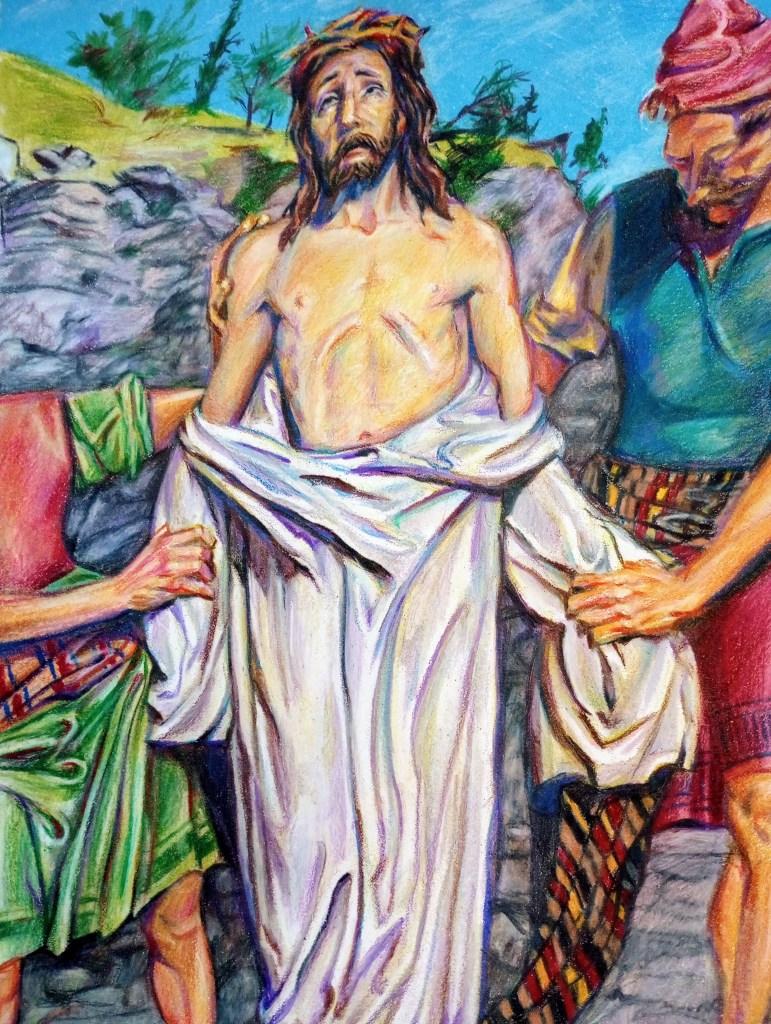
Station 5: Jesus is stripped of his garments
Suzanne says this about her painting:
“I used bright colors to contrast with the subject matter and to show that he was stripped in broad daylight. As I drew, I contemplated how we use clothing not only to cover our nakedness, but to show social status and wealth, to express ourselves, and to look attractive.
The church and followers of Jesus are often called the body of Christ. I wonder what we need to be stripped of.
I left off the head of the man on Jesus’s left not only because I didn’t have room for it on the page, but also so viewers can put themselves in his place. What have you said or done that has metaphorically stripped Jesus and brought him shame?”
Luke 23:27-28 A large crowd trailed behind, including many grief-stricken women. But Jesus turned and said to them, “Daughters of Jerusalem, don’t weep for me, but weep for yourselves and for your children. … Those who plant in tears will harvest with shouts of joy. They weep as they go to plant their seed, but they sing as they return with the harvest (Psalm 126:5-6).
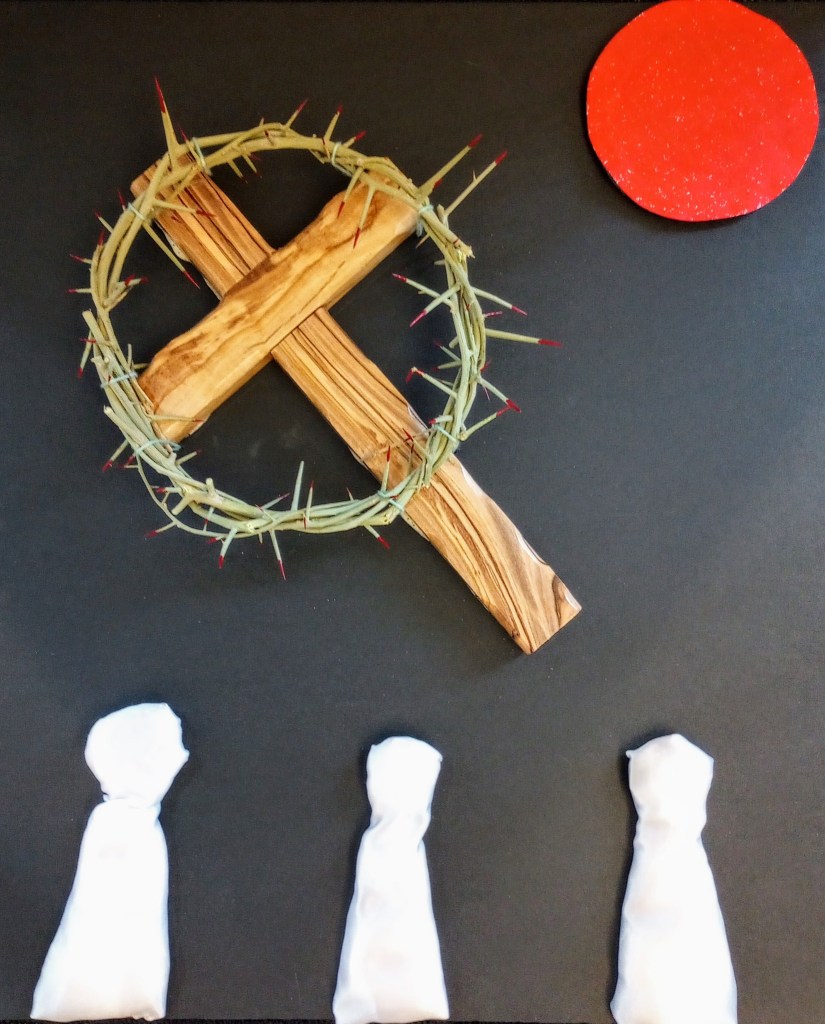
Station 4: Jesus meets the women of Jerusalem
Millicent says of her artwork:
“I made the women in white silk to show tears. They are together, witnessing the same scene, yet each individually bears her own grief. Isaiah 53 says Jesus bears our griefs and carries our sorrows.
Here is a recent example of Jesus noticing my tears and turning to care for me:
On the evening of Sunday, December 11, 2022, my downtown apartment building was on fire. I walked down the fire escape with two elderly ladies and when we got outside, we could see the flames shooting out the windows of one of the apartments. As I stood at the corner, a stranger, slightly inebriated, kept patting my shoulders and asking if I was okay. I said yes and then he said to me, “I’m not a religious person, but I think we should pray.” He cupped his hands and held them out to me. He waited for me to take hold of his hands, which I did. I thought he was going to start praying but realized he was waiting for me to pray. I prayed for the safety of all who were involved in the fire. After thanking this stranger, I walked away thanking God for sending me an Angel who helped me get centered on what was needed at that moment.
Because we weren’t allowed back into the apartment building due to water damage, I was given a choice to call a friend or family member to come get me, or sleep on a cot in the Convention Center. I prayed and asked God to give me a name to call. I called my friends who live on the Northside, and even though it was 12:45 a.m., the husband came to get me while his wife made up the couch. I stayed with them for two nights. When I found out I still couldn’t get into the apartment building on the third day, another friend said I could stay with her. She offered me her bed while she slept on the floor.
On Wednesday, December 14th, the landlord sent those tenants who still had no place to stay to a hotel on the Northside. I was able to stay at the hotel for several night until the apartment building manager came to the hotel to inform us that Tuesday, December 20th, would be the last night they would pay for us to stay at the hotel. We were also informed that we could not go back to the apartment building to live, because all leases were cancelled. On December 21st, a third friend extended hospitality to me. I stayed with her and her husband until I was ready to move.
The next day I looked at an apartment a few blocks from church and filled out an application. While waiting for approval, I received my security deposit in the mail along with December’s rent, prorated. That evening I got word that my application was approved, and the apartment was mine. I was able to use the check I had just received that afternoon as my security deposit for the new apartment. On Friday, December 30th, I moved into my new home. Prayer and praise turned a devastating situation into an experience of joy.”
Note: This article was originally published in The Ascent, a monthly publication of Church of the Ascension, Pittsburgh. Used with Millicent’s permission.
Psalm 92:1-4, 13-15 It is good to praise the Lord and make music to your name, O Most High, proclaiming your love in the morning and your faithfulness at night. … You make me glad by your deeds, Lord; I sing for joy at what your hands have done … Planted in the house of the Lord, the righteous will still bear fruit in old age. They will stay fresh and green proclaiming, “The Lord is upright; he is my Rock, and there is no wickedness in him.”
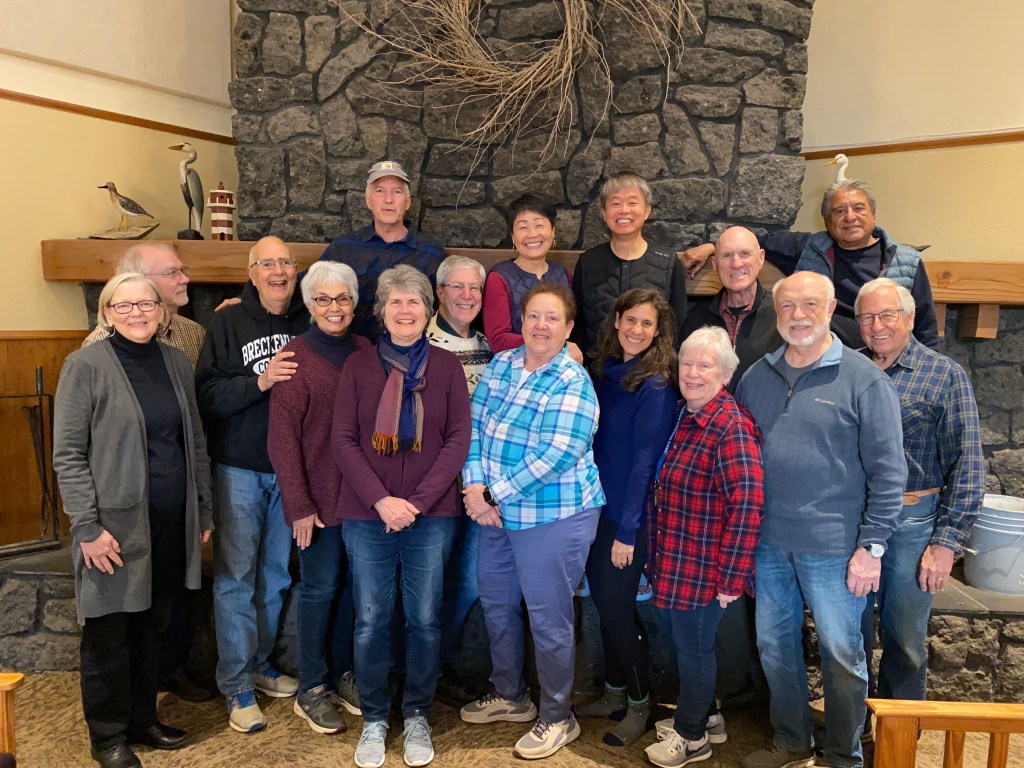
Dave and I have just enjoyed a few days on the coast of Oregon at a lovely camp founded by Quakers almost a hundred years ago. Twice a year we reconnect with the International Ministry Team (IMT), our place to “belong” within OC International.
Don’t you love the duck on Edwin’s head?
It’s a diverse, experienced team working literally all around the world, led by the former president of OCI. It’s a privilege to profit from the wisdom gleaned from years of committed cross-cultural impact across a spectrum of ministry genres. We soak in marvelous stories of God’s love and faithfulness through often-harrowing circumstances.
My favorite part of these gatherings is worshiping the Lord with these lovely people. Half the team is older than we are. They model for us the words of Psalm 92. Rather than just getting old and crotchety and self-centered, they passionately proclaim the worthiness of the Lord to receive our praise. And believe me, their experiences in life have been anything but easy. They have made choices along the way—hundreds, maybe thousands of choices—to seek and find the Lord through their tough times. They have planted their feet on the Rock and found him to be their solid foundation through every storm.
Mid-week, we take a break from meetings to explore a local attraction of the place where we’ve gathered. This time we toured a cheese factory—Tillamook Creamery, a few miles down the coast. Our team leader, Greg, challenged me to write a blog applying something from this tour to our spiritual lives. So here we go:
Entrance to Tillamook Creamery, Tillamook, Oregon
Cheese, like wine, is valued according to how long it has aged.
Of course, good cheese requires good ingredients and a careful process of separation of the curds from the whey. But the time comes when it just needs to rest. Nothing more can be done for the cheese than to leave it alone and let the rennet do its thing, “cheddaring” (further acidifying) the cheese.
Cutting and packaging cheese that has been aging for months!
I didn’t know “cheddar” is a verb! While the cheese is resting, cheddaring is going on, enhancing the flavor and hardness of the cheese.
How often do I rest and let the special ingredient in me, the Holy Spirit, refine me and enhance my “flavor”?
The answer to that question may determine whether, in my old age, I still have something positive to offer those around me, instead of getting grumpy and gripey. Because GOD is faithful, I want to sing for joy until the end of my days. Don’t you?
1 John 5:19-20 The world around us is under the control of the evil one. And the Son of God has come, and he has given us understanding so that we can know the true God. … He is eternal life.
My heart is so full of the blessing of yesterday–I want to share a few of many special moments with you. Dave and I love attending the sunrise service at 6:00 a.m. The service begins in total darkness as we review God’s work leading up to this day. We are each handed a candle, and the first half of the service is conducted by candlelight.
Before I go on, a bit of context:
On Thursday evening, at the end of the footwashing service, the altar had been stripped of every decoration as the light gradually lowers until the pastor ends with the reading by candlelight of Luke 22:39-53. Verse 53 ends with, “But this is your hour, and the power of darkness.” As he says “the power of darkness,” the pastor blows out his candle. At the same instant, all remaining light in the sanctuary is extinguished. We sit in silence in the darkness, and when we’re ready, leave in the same way.
On Friday, from noon until 3:00, in various ways, including art works from people in the congregation, we shared in Jesus’s suffering on the cross, suffering for each of us. We are invited to write our sins and burdens and walk forward to leave our folded papers in a basket at the foot of the rough wooden cross, bearing a crown of thorns, at the front of the church. At the end of the service, these are taken outside and burned, to symbolize Christ bearing them for us.
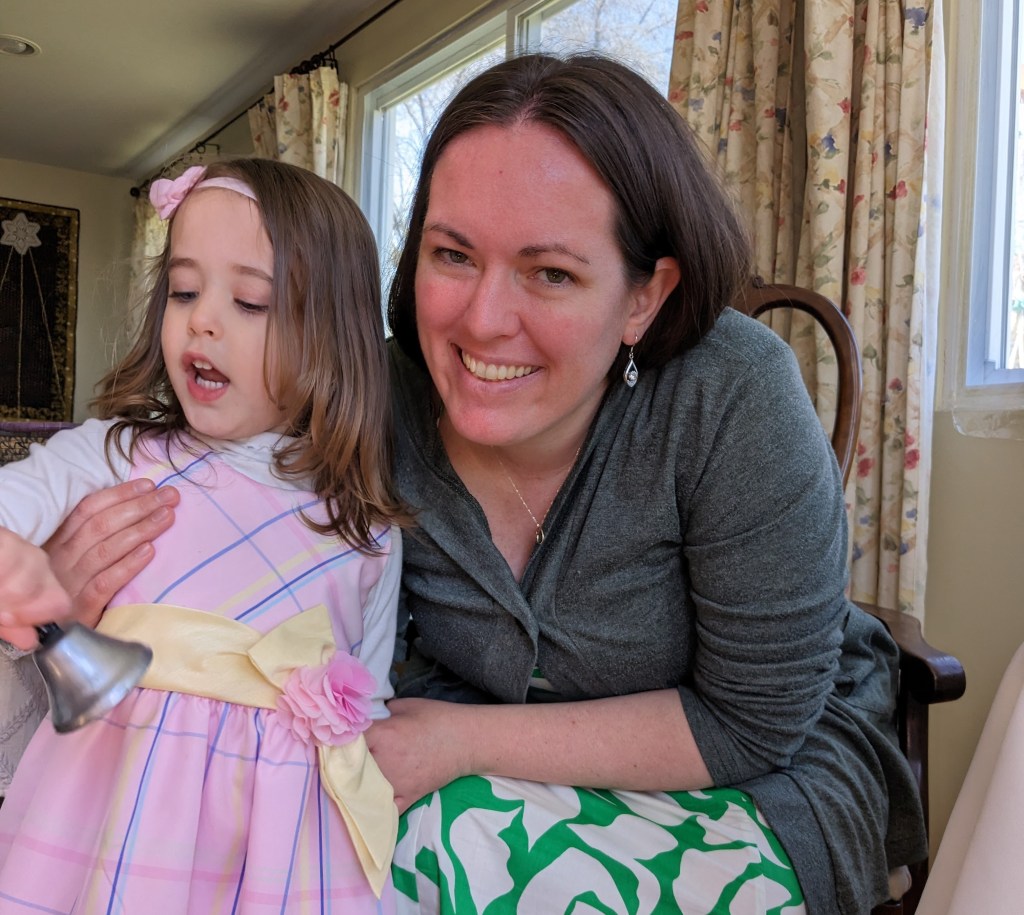
On Easter morning, as we enter the dark sanctuary, we have in our minds the stripped altar and the cross. But at a certain moment in the service, the lights and the choir explode, and we see the sanctuary full of flowers. Madly ringing bells we have brought from home for this moment, the congregation joins the choir in wholehearted praise.
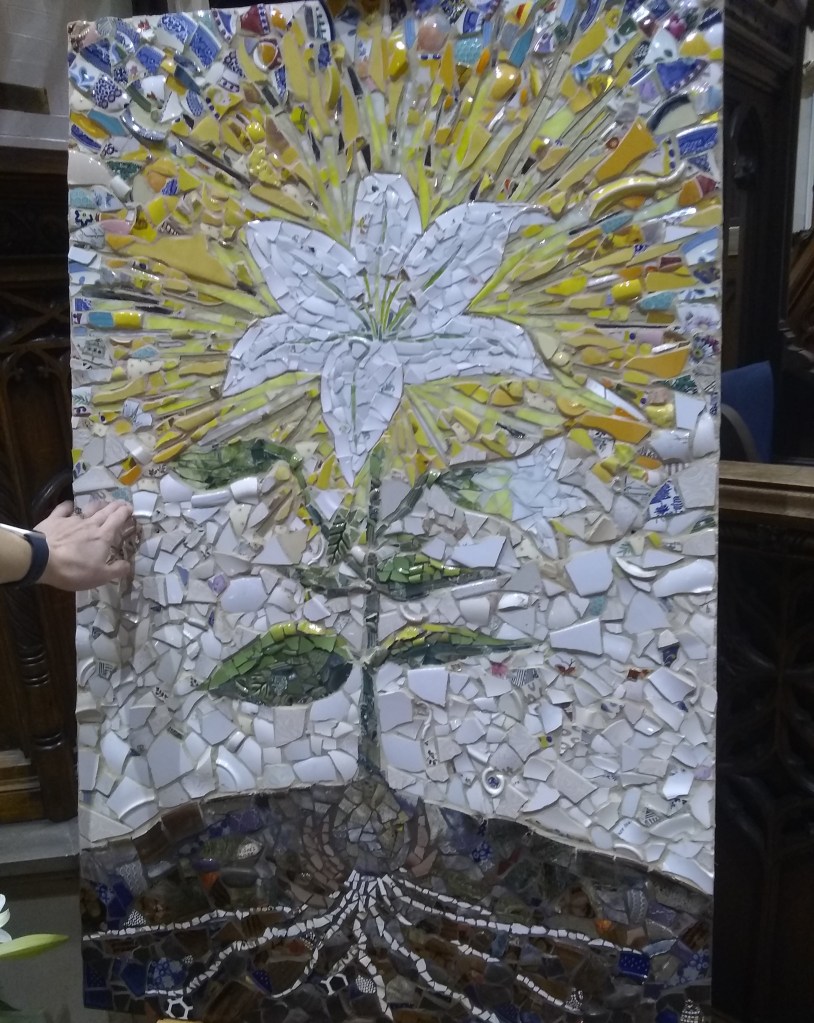
This year, when the lights came on, we also saw an amazing mosaic at the front of the church. This also requires a bit of context, going back to Ash Wednesday, Feb. 22. We were invited to bring to that service a piece of pottery from home, which we placed in a big metal tub and smashed with hammers at the end of the service, to illustrate our brokenness.
An artist, with the help of anyone from the church who wished to participate, took those broken pieces and created beauty from them. People crowded around after the service to admire it and to identify pieces from their own broken cup or bowl or pitcher. Many of us were in tears at this visual, visceral symbol of God’s transformation and healing offered us through Jesus’s sacrifice on the cross. The photo I managed to capture:
The mosaic reminded me of the last chapter of Suffering and the Heart of God. Diane Langberg waxes poetic as she describes Jesus on the cross, and then restored to life, healing our brokenness. Here’s part of what she says:
The cross is a place of death and evil; decay and wrath. It is a pace of darkness, thirst, isolation, rejection, abandonment, and bondage. It is the absence of God and all that is good. It is hell itself.
And whom do we see there? The Lily of the Valley, the Rose of Sharon. We see the fairest of ten thousand, the beauty of God incarnate. We see purity, holiness, infinite love, compassion, and eternal glory. …
Death and evil seemed to have won. But God had so much more up his sleeve:
What happened that third day? Decay was transformed into glory. Death was swallowed up by life. Evil was transfigured into holiness, and the wrath of men into praise. Darkness was changed to light, and hell defeated by heaven. Thirst is transformed into living water and brokenness into the bread of life. Alienation led to restored relationship and bondage led to freedom.
If garbage can be transformed into beauty on such a scale as this, then surely it can happen in my small life and in the lives of others. … The cross, a thing of beauty? Yes, for it is at the cross that we behold all of the beauties of Christ in perfection. All of his love is drawn out there. All of his character expressed. The wounds of Jesus are far more fair than all the splendor of this world. …
Children of God in a world controlled by the Evil One. I fear the odds are against us. Our wits are too slow, our understanding finite and our strength too frail. But, glorious but, “the Son of God has come … to transform garbage into beauty, first in our lives and then in those we serve. … So we fix our eyes not on what is seen, but on what is unseen (2 Corinthians 4:18). And what is it that is unseen? The Lord of Glory, the Lord of all Beauty, who wears the appearance of a slain Lamb as his court dress. …
May we count Him alone as worthy and all else as rubbish. May we desire one thing—to gaze upon the beauty of the Lord and to seek his beautiful face. And then may the beauty of our Lord be upon us. May he establish the work of our lives.
I invite you to enjoy our choir’s Easter anthem, called “Glad of Heart,” written in 1568, here (start at 1:39:50) Of course, you can watch any of the rest of the live stream you wish–or either of the other two services. The worship during communion begins at 1:59:23. Here is the text:
Now glad of heart be everyone! The fight is fought, the battle won, the Christ is set upon his throne, alleluia, alleluia!
Who on the wood was crucified, who rose again, as at this tide, in glory to his Father’s side, alleluia, allelluia!
Who baffled death and harrowed hell and led the souls that loved him well, all in the light of lights to dwell: alleluia, alleluia!
To him we lift our heart and voice and in his paradise rejoice with harp and pipe and happy noise. Sing alleluia, alleluia!
Then rise all Christian folk with me and carol forth the One in Three that was, and is, and is to be, alleluia, alleluia!
Though this has become a long post, I want to share one more thing, related to verse 4 of this anthem. Several weeks ago I started practicing with my grandchildren a simple piece of music (“Allelu, allelu, allelu, alleluia, Praise ye the Lord) to share with their parents at our Easter brunch, accompanied by a variety of simple instruments. The adults at the table each had an instrument as well, to join in the song after the children “taught” it to them. “Happy noise” indeed! It was such fun that we sang and “played” other songs as well, ending, at Talita’s request, with “Twinkle, twinkle, little star.” Since the morning sermon had referenced Jesus as the Morning Star, each of us to reflect his glory, this seemed oddly appropriate!
John 1:29 The next day John saw Jesus coming toward him and said, “Look! The Lamb of God who takes away the sin of the world!”
Ephesians 4:10 And the same one who descended is the one who ascended higher than all the heavens, so that he might fill the entire universe with himself.
Since I sat down to write, the silhouette of a giant blue spruce has slowly emerged against the lightening sky through my kitchen window. I knew the tree was there, but I couldn’t see it until light eased in around it. Over the last few minutes, though I still don’t see color, details of contour and depth are becoming clearer.
This day, Saturday, Sabbath day for Jesus’s mother Mary and the others who gathered around his cross, was a day of darkness and grief, of shock and despair, a day of blind belief that the Light of their lives had been cruelly extinguished. If you’ve lost someone close to you, you have the shadow of understanding of what they might have been experiencing.
Did any of them, that Saturday, remember Jesus telling them he would rise again on the third day? Matthew and Luke record Jesus telling them repeatedly this would be the case. From their initial disbelief the next day, it seems they did not remember. They apparently didn’t have even this amount of light shining into their darkness, increasingly illuminating the true nature of His sacrifice, as I can now see individual branches of the spruce.
John the Evangelist tells us his xará John the Baptist (Brazilians affectionately call a person with the same name or birthday their xará) “was not the light; he was simply a witness to tell about the light,” (v. 8), the true light (v. 9), who reveals God the Father to us (v. 18). By the time the Evangelist cites John the Baptist as recognizing Jesus as the Lamb of God, the Chosen One (v. 34), he has already described Jesus as the eternal Word, the world-Creator, the Life-giver, the unextinguishable Light, the status- and family-sharer (v. 12), the enabler of new beginnings (v. 13), the ultimate boundary-crosser and cultural contextualizer, full of unfailing love and faithfulness (or grace and truth, depending on your translation, v. 14 and 17), the revealed glorious only Son (the rest of God’s children are adopted), the one who is “far greater” (v. 15), the unstinting Giver of one blessing after another, the unique One who is himself God, near to the Father’s heart.
It will take us the rest of our lives to absorb all this. We won’t see all the shades and details clearly until the full light of the Father’s glory shines on Jesus, when we’re with him face to face. Don’t you feel a bit jealous of those who are already there?
And then John the Baptist brings us back to earth with a thump. Jesus is the Lamb of God. My emotional reaction is similar to what I feel reading John the Evangelist’s description in Revelation 5: And I saw a strong angel, who shouted with a loud voice: “Who is worthy to break the seals on this scroll and open it? But no one in heaven or on earth or under the earth was able to open the scroll and read it. Then I began to weep bitterly because no one was found worthy to open the scroll and read it. But one of the twenty-four elders said to me, “Stop weeping! Look, the Lion of the tribe of Judah, the heir to David’s throne, has won the victory! He is worthy to open the scroll and its seven seals.”
From bitter weeping to the thrill of victory! But then the twist: Then I saw a Lamb that looked as if it had been slaughtered.
No! No! No! How can you kill the king, the eternal one, the creator, the life-giver?
I want to linger in the glory. But John (both Johns) drive us forward, force us to our knees, back to tears, our faces on the ground. The Lion becomes the lamb, the sin of the world is my sin, the gracious, loving, faithful Truth-teller reveals to me more than I can bear. And so he bears it for me, both the hard truth and its inevitable consequence.
Do I really want the light? John asks. Because to live in light requires practicing truth. It requires confessing my sins and my need for his cleansing, the cleansing only possible because Jesus the King, the one who is life itself, became the Lamb of God, offering his life in my place (1 John 1:1-9).
Come. See.
Behold the beauty of the Lamb. The glorious one whom death could not defeat.
Isaiah 61:1-2 The Spirit of the Sovereign Lord is upon me, for the Lord has anointed me to bring good news to the poor. He has sent me to comfort the brokenhearted and to proclaim that captives will be released and prisoners will be freed. He has sent me to tell those who mourn that the time of the Lord’s favor has come.
Why must we walk with Jesus his path to the cross? Why can’t we skip directly to Easter?
Dr. Diane Langberg thinks deeply about what it means to share the anointing Jesus claimed as his own (Luke 4:20). Here is a selection from “The Fellowship of His Sufferings,” Chapter 5 of her book Suffering and the Heart of God (emphasis mine):
These verses [Isaiah 61:1-3] bring us comfort, but if we are to follow Jesus we must walk into poverty, brokenness, prisons, darkness, mourning, and despair. These are not places we desire to go. … He has called us to live and serve him in this dark place of death, this world, moving among those who are dead in their trespasses and sins, calling them to light and life.
It is not the kind of invitation most of us like to receive. He is the Man of Sorrows and familiar with suffering. He was despised and rejected. He took up our griefs and carried our sorrows. He was crushed for our sins, oppressed, judged, and cut off from the land of the living. And you and I, as the servants of God, are called to complete in our lives what is lacking in regard to Christ’s suffering, for the sake of his body.
The call to share in the fellowship of his sufferings is preceded by the call to worship, the call to truly know him as he is. … Unless we begin from the pace of worship, we will not have power to descend to the places of suffering. … God is on his throne and is our eternal refuge. Worship must come first or we will exalt ourselves and think that the drab drudgery of the rubble is not meant for us. …
God must permeate your being if you are to bring life to dead places. … We must first allow the Spirit of God to bring his power to bear in the dark and dead places of our own lives. We must begin on our knees. He has borne our selfishness, our complacency, our love of success, and our pride. There is no part of any tragedy that he has now known and carried.
God will use the suffering of others to drive you to himself for more of him. Such darkness would overwhelm and lead to despair were there not a treasure there. The treasure in the darkness is the Crucified Christ. To enter into the fellowship of his sufferings is to find him.
Psalm 25:1, 4-5 In you, Lord my God, I put my trust. … Show me your ways, Lord. Teach me your paths. Guide me in your truth and teach me, for you are God my Savior, and my hope is in you all day long.
[Debbie] On this last day of Lent, Kaiti invites us to ask God for encounters with him. This morning, I read in Suffering and the Heart of God: How Trauma Destroys and Christ Restores this word from Diane Langberg: “God has sent you to walk the way of the cross, obedient to his Word, serving with humility, governed by his Spirit and bowing to his authority over every aspect of your life.” We’ll consider more of what Diane teaches us as we walk the way of the cross with Jesus next week.
Here’s Kaiti:
A couple of months ago at our church, we had an ordination service for two of our deacons. During the sermon, the bishop encouraged them in their ministry, while also tangentially encouraging the rest of us in our various ministries/life stages. One of the big points he made was that in ministry, it’s our encounters with the living God that empower us. Not anything we can do, not our own skills, but only encountering the living God. That really got me thinking. I didn’t feel like I really had anything like that, at least not in a way that felt tangible to me at that moment.
Not too long after this, I realized that I generally did not feel like I had a very close, personal relationship with God, and I felt sad about this. A friend encouraged me to start praying for encounters with God. I hesitated, feeling like it was unfair of me to ask. Certainly, I thought, I had encountered God many times in my life and just wasn’t remembering. But when I expressed this, my friend said, “Well, yeah, it is unfair. But God invites us to ask anyway.” So I started to pray that I would encounter God.
Pretty much immediately after this conversation, I saw that one of my Bible readings for the next day was Psalm 25. This was significant because God had used Psalm 25 in another situation months before to speak to me—one of the encounters my friend and I had just discussed on the phone. So there I was, having not even brought the issue directly to God yet He was already starting to answer my prayer.
Not only that, but when I got to my Bible Study for the next morning, the other part of my reading included Exodus 33, where Moses asks God if he can see His glory, and God shows up to Him. Moses asked for an encounter with God, and God said yes. To me, this was a clear “Yes, Kaiti, you can ask. And I will answer.” So I decided to keep asking.
After a week or so, I realized I had already forgotten to keep praying for closeness with God, and I was struggling once again with feeling distant from Him. So I picked it back up. A day or two later, as I walked past the Catholic school right next to my dorm building, I saw a little booklet of papers flying across the sidewalk towards the road. Curious, assuming it was from the school, I picked it up. It was a bulletin from the ordination service!
That’s strange, I thought. The church is only a block from my dorm, but how, almost two weeks after the service, did it show up here? I pulled out my phone to take a picture to express my surprise to friends from church. But then I noticed there was writing on the back of the bulletin. And it hit me. It was my bulletin from the service!!
After the service two weeks before, I had walked back to my dorm, realized I had forgotten something at church, left the bulletin on a table outside my building to go back, and then forgot about it. And here I was, almost TWO WEEKS later, and here was my bulletin, busted up and dirty, and yet with my pen-inked notes perfectly intact, quite literally blowing across my path at the perfect moment. If I had walked by thirty seconds earlier or later, I would’ve missed it.
It wasn’t until I called my brother about it (someone had to know!) that I even remembered what the sermon had been about. This dirty busted up bulletin I was holding, which so conveniently flew across my path two days after praying for encounters with God, had a note on it from two weeks before that read, “it’s our encounters w/ the living God that empower us.”
I was like, alright God, I hear you. That’s pretty clear. Can’t really pretend that didn’t happen. To further solidify this as an encounter with God, two days later, I attended a women’s retreat led by Debbie, in which one of the talks was literally called “God Encounters.” We had the opportunity to share our own God Encounters. It seemed a perfect opportunity, and a bit of a wink from God that that’s really what this was—an encounter with the living God.
So this bulletin has become an Ebenezer for me—a rock of remembering. It’s a tangible reminder that God is real, He’s listening, and He is very present in my life.
Note from Debbie: We’re just home from Ireland, a bit jet lagged–more about that soon. While we were there, our dear “transplant friend” Carissa went to her True Home. Meanwhile, a Pittsburgh friend sent me this “But God” experience. Thank you, Susannah. We travel today to participate in Carissa’s memorial service tomorrow.
But God’s light overcomes darkness
John 1:5 The light shines in the darkness, and the darkness can never extinguish it.
In 2015 my older sister Jessica was diagnosed with Stage IV Brain Cancer. She was 36 years old and had two daughters, aged 9 months and three years old. After her first operation to remove the biggest part of her brain tumor, my sisters and I went to visit her. In her darkened recovery room, my sister Shelley said, “Jess, you know we would all take this from you in a heartbeat.”
Jessica responded, “Oh, no. I’m glad it’s me because I couldn’t bear it if it were any of you.” She then revealed to us that she had lost her faith in God many years before, and instead of trying to find Him, she was waiting for God to find her. But if she died, which the doctors said she most likely would, she hoped He would find her before then.
Jessica’s brain cancer progressed quickly, and by Thanksgiving she was in Hospice at home. She was fading quickly, growing weak and frail. Her head was swollen and she lost sight in her left eye.
By Christmas, her cognitive functions were failing, and she could barely understand what was happening around her. She still recognized us, but time was running out. Her husband, who is Catholic, begged her to see a priest and join the Catholic church to receive communion before her death. She agreed, and on the morning of Christmas Eve a priest came to give her communion.
We gathered around Jessica’s bed, and he anointed her. The room was very dark because it was cloudy outside. She was propped up in bed, staring to the side as he tried to talk to her. Her eyes began to droop and for a moment we thought she might be falling asleep. But after the priest finished praying, she looked up suddenly. She was alert and clearly recognized us—her siblings—standing around her.
Each member of my family remembers a little differently what happened next. I saw the room fill with sunlight. My sister Shelley said Jessica’s face was glowing. Regardless, the room was no longer dark. Jess said softly in surprise, “Oh. It’s so light in here. You have no idea how dark it’s been.” She looked around at each of us with a weak smile of relief.
The priest said, “That’s the light of Christ, Jessica.”
She said, “Oh…I’m hungry. Let’s have bacon and eggs!”
We lost Jessica less than two weeks later, on January 6th, 2016. She had multiple military honors at her funeral and was buried with the American Flag draped over her coffin.
The night before her passing Shelley and I had the same dream that a lion (much like Aslan) was guiding a dark-haired girl into the trees, her hand resting on his mane as they walked.
John 21:3-6, 17, 19-22 [After Jesus’s resurrection] Simon Peter said, “I’m going fishing.” “We’ll come, too,” [six other disciples] said. But they caught nothing all night. At dawn Jesus, standing on the beach, called out, “Children, have you caught any fish?” No, they replied. Then Jesus said, “Throw out your net on the right-hand side of the boat.” So they did, and they couldn’t haul in the net because there were so many fish in it. …
Psalm 32:1-2 Oh, what joy for those whose disobedience is forgiven, whose sin is put out of sight! Yes, what joy for those whose record the Lord has cleared of guilt!
[After breakfast] A third time, Jesus asked Peter, “Simon son of John, do you love me?” Peter was hurt that Jesus asked the question a third time. He said, “Lord, you know everything. You know that I love you.” Jesus said, “Then feed my sheep.” … Then Jesus told him, “Follow me.” Peter turned around and saw behind them the disciple Jesus loved. … He asked Jesus, “What about him, Lord?” Jesus replied, “… What is that to you? As for you, follow me.”
Have you ever wondered why Jesus chose this particular setting for his pivotal conversation with Peter after the crucifixion and resurrection, after Peter’s denials warranted a return to the moniker “Simon”?
This miraculous catch of fish is a reprise of Luke 5, offering Peter another chance to recognize and reconnect with Jesus, and with God’s call on his life. A chance to accept forgiveness and to move beyond his failures. A chance to heal his story.
God met me as well, on ensuing visits to the lake. Fast forward from the story I told in the last post. I’m now fourteen, graduated from boarding school, fearful of the future. Sitting alone overlooking the lake, I told the Lord I wasn’t ready to leave Guatemala because I had not yet learned to love. I acknowledged my heart full of resentment and bitterness. I didn’t want to take all that with me into whatever awaited me in my new life in the United States, where my parents would send me for high school. But how could I change? I had confessed my anger and hurt, but it refused to die, rearing its ugly head on a daily basis.
Romans 12:2 was the verse I was considering: “Don’t copy the behavior and customs of this world, but let God transform you into a new person by changing the way you think. Then you will learn to know God’s will for you, which is good and pleasing and perfect.” You’ll have to do it, Lord. I have no idea how to change the way I think. On the surface, nothing (apparently) happened. But it was a place marker, an anchor, an intention, a hope: “Someday, somehow, I will learn how to love other people.”
Shutterstock: Christopher Moswitzer
Fast forward twenty-five or so more years. A different country, a different lake, a different language. A big difference this time because I’m not alone. A dear friend is listening to my despair over Ephesians 5:1-2, “Follow God’s example, therefore, as dearly loved children, and walk in the way of love, just as Christ loved us.”
“For most of my life,” I confessed to my friend, “I’ve begged God to teach me to love him and to love other people. But I don’t know how. I have no idea what it feels like to be a dearly loved child.”
“Then let’s ask him to show you,” she said. What followed was one of the most powerful prayer visions I have ever experienced. It healed a fracture line in my soul. It changed forever the way I knew Jesus and the way I viewed myself and other people. Literally, it saved my life. It was the beginning of learning the Romans 12:2 different way of thinking I had begged God for at fourteen.
Why did this healing take so long? Why did I have to go through so much trauma and drama between fourteen and forty? I’ll probably never know. But I’m grateful, so thankful that it did happen. It was an essential foundation stone in the healing journey that has continued through the almost thirty years since that day.
Tomorrow Dave and I plan to board a plane for Ireland, for a “triple trip,” celebrating our 45th wedding anniversary last August, Dave’s St. Patrick’s Day 70th birthday, and researching Book 3 of the Cally and Charlie series. I have the sense—though I don’t know how, exactly—that the week in Ireland will be another significant step in the healing God continues in my life. I’ll let you know!
Luke 5:4-10 Jesus said to Simon, “Now go out where it is deeper, and let down your nets to catch some fish.” “Master,” Simon replied, we worked hard all last night and didn’t catch a thing. But if you say so, I’ll let the nets down again.” This time the nets were so full of fish they began to tear! … When Simon Peter realized what had happened, he fell to his knees before Jesus and said, “Oh, Lord, please leave me—I’m too much of a sinner to be around you.” … Jesus replied to Simon, “Don’t be afraid.”
Romans 8:1-2 So now there is no condemnation for those who belong to Christ Jesus. … The life-giving Spirit has freed you from the power of sin. … Letting the Spirit control your mind leads to life and peace.
The sun grew warm as I built a sandcastle with my brother and sisters. I took off my sweater and laid it on a rock. After a while, we ran to the lake to splash in the waves lapping the shore. When I returned, my sweater was gone.
My seven-year-old heart was terrified to tell my mother I had lost my sweater. I delayed returning to our vacation house for as long as I could. Thus I was doubly in trouble, not only for my carelessness but for not showing up in time to help with lunch. I was denied lunch and grounded for the remaining day and a half of our vacation. But what hurt most were the words my mother poured out on me, and the tone of those words. I’m not sure I learned to be more responsible. I do know my fear of her dug even deeper roots into my soul.
It’s natural for a child to project that experience of fear onto God, to assume God is like our parents or other authority figures who haven’t known how to support and encourage us. The breakthrough, healing moments (I’ll tell about one of them in the next post) come from discovery that Jesus isn’t like them. That’s what Simon learned.
“The Chosen” depicts Simon in BIG trouble over his debt to the Roman government. The miraculous catch of fish more than paid Simon’s taxes. It freed him to give up fishing and follow Jesus.
But Simon had an even bigger debt, the debt of his sin, which made him ashamed to come close to the Holy One. Dane Ortlund in his precious book Gentle and Lowly: The Heart of Christ for Sinners and Sufferers, points out in almost every chapter that the only safe thing to do with ourselves when we recognize our sin is to go straight to Jesus. Remember the story in John 8 of the woman caught in adultery? (No mention is made of the man … apparently, she was committing adultery by herself.) Jesus said to her, “Neither do I condemn you. Go and sin no more.”
Compassion. That’s what we’ll find when we go to Jesus in our sin. He weeps over the wounding that takes place within us and in others when we sin. He wants to free us from sin’s devastating impact.
Ortlund says (page 174), “His love is great because it surges forward all the more when the beloved is threatened, even if threatened as a result of its own folly.” I wish for courage this Lent, for you and for me, to trust Jesus’s heart of love, his compassion, his gentleness, his longing to connect with us, to free and heal us. Hear him say to you as he did to Simon, “Don’t be afraid.”