Ideas for me?

Ideas for me?

But God is three in one

Galatians 4:6 And because we are his children, God has sent the Spirit of his Son into our hearts, prompting us to call out, “Abba, Father.”

One of the big differences between Christians and our monotheistic cousins, Muslims, is our understanding and experience of God as three-in-one, Trinitarian.

This central tenet of our faith, I find personally, is easier to experience than to explain. And now I’m wrestling with the best way to express the Trinity to children.

I’ve written a draft of a book for kids about this topic, but I’m not satisfied with it. I showed it to a theologian, who told me I emphasized too much their diversity at the expense of their unity.

So, I thought of reaching out to you who read this blog. How have you explained or illustrated the nature of the Trinity to your children?

Please email me your ideas or write them in the Comments. I would really appreciate your thoughts.

Just for fun, here’s a hilarious clip of St. Patrick explaining the Trinity.

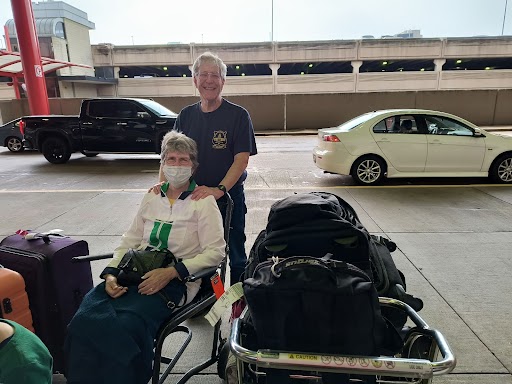
Thanks so much! I’m headed back to Pittsburgh this evening after a week with my sister and brother-in-law in Meridian, Idaho.

In other book news, we’re coming up to the deadline for turning in all the materials for Campfire Song Stories to EA Books, to be available before Christmas. I’m excited about this book, a bringing to life of six of the stories Karis and I imagined together during long days in hospitals, to commemorate ten years since she left us. I have five young illustrators (one of them 12!) and one young vocal artist (11) working hard—I know you and your kids will love their work! Please pray for them as they each complete their assignments. Thank you.

This I Believe (The Creed)

Pity party or thankfulness?

But God doesn’t want us to live in fear August 1, 2024

2 Corinthians 13:11 Live in harmony and peace. Then the God of love and peace will be with you.

2 Timothy 1:7 For God has not given us a spirit of fear and timidity, but of power, love, and self-discipline.

Wow. August already. Does it seem to you too that time is just flying by?

I love the way Paul concludes his second letter to the Corinthians, “Live in harmony and peace.” Yes! He’s speaking my language! I love harmony and peace (no surprise that I identify as an Enneagram 9).

I’m in Idaho visiting my sister and remembering how she and her husband drove me all over southern Idaho to research Treasure Hunt 1904. This is the view from my window in their home.

Is it possible, though, to obey Paul’s instruction, when there is so much chaos and conflict in the world? When fear might seem a more “rational” response, how can we so center ourselves in the God of love and peace that we live in harmony with God, with ourselves, and with others?

Yesterday while chatting with friends, I recalled Karis’s radical trust in God’s sovereignty, even when she faced incredibly difficult circumstances. On her way to the hospital, if she was well enough to speak, she would say, “I wonder who God has for me in the hospital this time?”

As soon as she was strong enough to get out of bed, she would be out on the unit visiting other patients, encouraging and praying with them. Their nationality, gender, politics, etc. were simply points of interest in loving them better. What she saw was a person going through a hard time, in need of understanding and comfort. A person whom God, who was always with her, could love through her.

It’s not that God was with Karis more than with anyone else—he promises to be with all of us, always. I think her trust and her need for him simply made her more aware of his presence with her.

Karis’s radical belief in God’s sovereignty included a conviction that nothing happened to her by accident. In every situation, she believed, God had a purpose. Her job was to discern that purpose and cooperate with it. This kept her focus on others’ needs rather than on her own suffering and losses. She allowed herself occasionally to indulge in a “pity party,” as she called it. But soon she would laugh, shake it off, say “OK, enough of that,” and start listing the things and people she had to be grateful for. This practice (perhaps it fits under Paul’s word to Timothy, “self-discipline”) made it possible for her to say, “All I see is grace.

Karis could have let herself be paralyzed by fear. Instead, she used the challenges she faced to help her empathize with others. She didn’t get there automatically. She made choices every single day. And she allowed other people to help her with this intention. She knew her challenges were too big for her alone. She knew the value of transparency and community.

When I grow up, I want to be like Karis.

It occurs to me to mention, in this context of love and harmony, an organization committed to bridging the gap in America between the right and the left, called Braver Angels. At every level of their leadership, they maintain equal numbers of “reds” and “blues” who have learned to respect, listen to, and build friendships with each other. Here’s a quote from their website:

“As we separate into groups that increasingly do not even know, or interact with, people of differing opinions, we lose trust in our institutions, eroding the ability to govern ourselves and lowering the caliber of citizenship. This growing trend coarsens public debate, produces policy gridlock, shrinks our capacity for goodwill, and harms our family and personal relationships. Effective self-government depends precisely on what this type of polarization destroys. We believe the American Experiment can survive and thrive for every American who contributes to the effort. Where we go from here is up to us. This is the driving force that fuels our mission.”

Check it out!

I’m reading Tasha Cobbs Leonard’s story, Do It Anyway. So here’s one of her songs to encourage us today, “Gracefully Broken.”

A walk in the woods

But God calls us to grow up with joy July 29, 2024

2 Corinthians 13:11 Be joyful. Grow to maturity. Encourage each other. Live in harmony and peace. Then the God of love and peace will be with you.

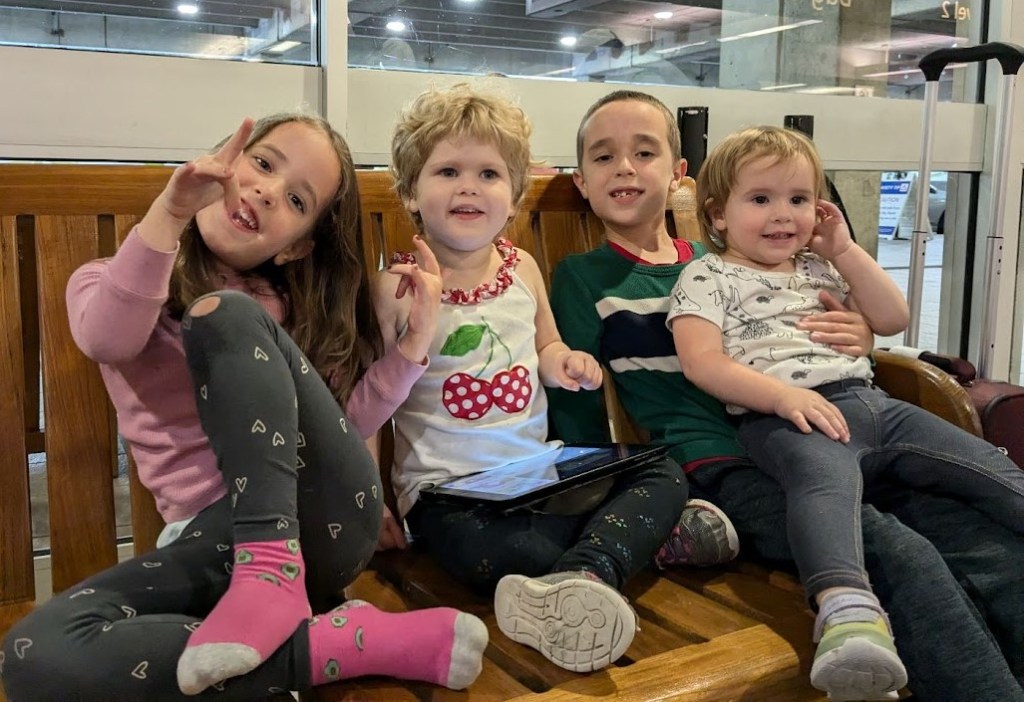
“Grammy, I want to walk on a trail.”

“I would love to go with you, Talita. Do you want to invite Caleb and Liliana too?”

“Yes, but Juliana is too little.”

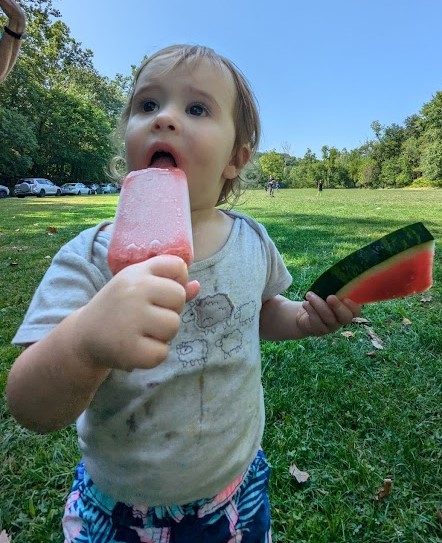
I take a moment to observe my youngest granddaughter, deftly managing a popsicle in one hand and watermelon in the other.

As the three kids and I start down a sun-dappled trail into the woods, we decide they will take turns choosing which path to take each time we come to a “Y.” The chooser will be the leader until we come to another branch in the trail.

“Grammy, Caleb isn’t letting me be the leader!” yells four-year-old Talita as her six-year-old brother whizzes past her. “Caleb, come back!”

“I don’t want to go as slow as Talita. I want to RUN!” pleads Caleb, coming back to us.

I am thrilled with Caleb’s restored energy, now that he’s on the right diet for his newly diagnosed Celiac disease. I want him to celebrate feeling good again.

“Would you like Caleb to be your scout, Talita?” I suggest. “He can run ahead to the next curve and then come back to tell you what he finds out.”

“Good idea!” chimes in their four-year-old cousin Liliana. “When I’m the leader he can be my scout, too.”

“OK,” says Talita reluctantly. “I thought the leader has to always be in front.”

“A leader chooses which way for the group to go. But she needs information about what’s ahead to make a good choice,” I tell her.

“I’ll come back and tell you what I see,” promises Caleb, taking off again.

Liliana races after him. “I’ll be a scout with you, Caleb!”

Talita takes my hand and sighs. “I don’t think they’re letting me be the leader.” She starts singing, then stops. “Sing with me, Grammy!”

“I’m sorry, I don’t know this song.”

“You could learn it on your phone.”

“But then I would be looking at my phone instead of enjoying the pretty flowers and trees.”

“Why did you bring your phone, then?”

“In case one of us gets hurt, or we get lost. I can use my phone to call for help.”

Caleb runs back to us with a lacy white flower.

“There are lots more of these around the bend, Talita. Hurry up so you can see them.”

“Grammy, the flower tickles my mouth when I smell it,” giggles Talita. “Here, try it!”

I take the flower and tickle my mouth as Talita grins. Then I hand the flower back to her and turn to Caleb.

“Thank you for your excellent scouting. The flower is very pretty. But do you remember—there’s a rule in parks. We can’t pick the flowers. We have to leave them for other people to enjoy too.”

Caleb hangs his head. “I forgot. I wanted to show it to Talita.”

“Tell you what. Next time we see pretty flowers we can take a picture. That’s a way of taking it home with us.”

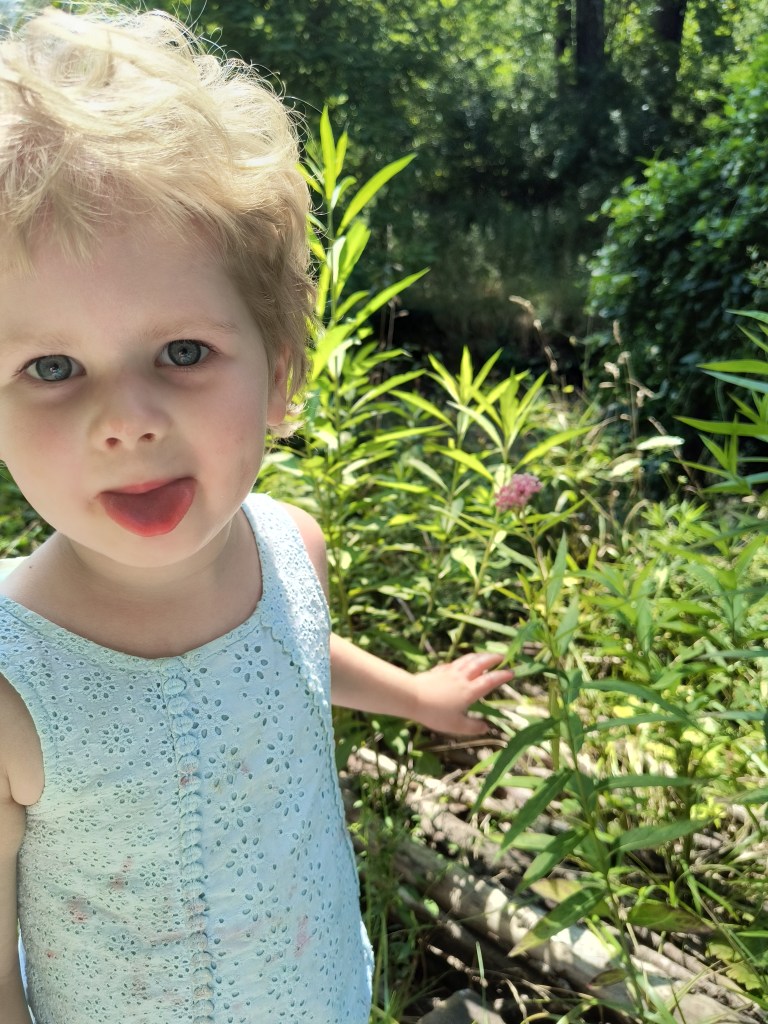
“I saw pink flowers!” yells Lili. “Take a picture of me with them, Grammy.”

“Can I take the picture of Liliana and the pink flowers?” asks Talita.

“Good idea!” says Lili.

We all hurry after her to the site of the photo shoot. After one picture morphs into a series of photos in Talita’s hands as Lili makes funny faces, and of course a selfie, we continue down the trail.

Growing up involves so many skills, I muse. Learning to accept boundaries. Exploring possibilities. Practicing skills of negotiation. Trying different roles. I love these precious times with my littles. Oh— “No, Talita!” I yell. “We’re not walking in the river today!”

“Why not?” the other two ask me, running after their leader to the edge of the creek.

“Your parents agreed to a walk on a trail. Not to a walk in the river. I don’t think they brought clothes for you to change into. We can walk in the river another day.”

“Well, I’m already wet,” says Talita. “And don’t you always tell us we’ll dry?”

“I see a Y up ahead! It’s my turn to be the leader!” yells Lili. “Carry this big stick for me, Grammy, to show Juliana. Do you want to be a scout now, Tata?”

“Don’t call me Tata. No. Caleb can keep being the scout. I’ll walk with Grammy.” Talita comes out of the creek and takes my hand again. “But I’m the photographer, Liliana, so tell me if you want more pictures.”

“Good idea!” says Lili, dashing after her scout.

“Ooo, my shoes are squishy. But—”

“They’ll dry,” Talita and I say together.

Talita starts singing in Portuguese a song I do know, “Alelu, alelu, alelu, aleluia, glórias a Deus.” She picks up a stick to direct me in singing alternate phrases of the song. Then we follow our new leader down the branch of the Y she chooses, this one looping back to where we started our walk in the woods.

Talita glimpses our picnic site, adds her director stick to the collection the kids have asked me to carry to show Juju, and takes off after Caleb and Liliana.

I watch the kids’ reunion with their parents, and their excitement as I arrive with their treasures: dry leaves, one of them “gigantic,” sticks of several sizes, bark that has fallen off a tree trunk, a rock Caleb says is shaped like a gemstone, and the tickly white flower.

As I watch them, I hope I never grow too “mature” to enjoy the woods through the eyes of a child.

Does it matter?

But God bids us stand for the truth

2 Corinthians 13:8 For we must always stand for the truth.

First, a special request for prayer: Venezuela has the best opportunity for change in decades, through presidential elections this Sunday, July 28. The lead-up has been fraught with disappearances, thefts, and intimidation by the current government against the opposition. Yet an army of citizens are planning to risk everything by monitoring voting sites (see this article). PLEASE PRAY for their protection and for change in Venezuela that will allow millions of refugees to go back home to help rebuild their country. Thank you.

Back to my post:

I’ve done it, and perhaps you have too. An alarming email shows up in my Inbox, or a social media post catches my attention, and I forward or share it without checking the source or the information’s veracity. And later someone lets me know that it’s false. It’s misinformation, and I’ve become part of the web of lies circulating through our society.

I’ve learned, through chagrin and embarrassment, to stop long enough to check before I believe. To pause and verify before I forward.

This simple statement as we come to the end of 2 Corinthians, “We must always stand for the truth,” has challenged me to recommit to more responsible citizenship.

I invite you to consider doing this as well. In this age of “my truth” and “your truth,” let’s reaffirm our belief in truths that don’t shapeshift according to someone’s agenda. Let’s commit to being trustworthy.

Does it matter? Scripture says yes.

Here’s an interesting truth, that perhaps can serve as our starting place:

In the NIV, the word “truth” shows up 137 times; the word “lie” 226 times. This doesn’t count alternate ways of expressing these concepts. In the KJV, those numbers are “truth” 224 times; “lie” 280 times.

Does God care about truth?

Twisting the truth is nothing new. In John 8, Jesus uses the strongest possible language to condemn lying (John 8:44-46), yet people responded by claiming, repeatedly, that he was possessed by a demon. As you read Scripture, notice how often something like this happens. Wrongdoing is not very creative—it just changes its camouflage across time.

In the wake of the assassination attempt on President Trump, I mentioned to a friend I was fact-checking, since rumors and false statements were running rampant on social media. She asked me how to do that. There are many nonpartisan organizations whose people work hard to check facts for us. I usually go to FactCheck.org, AP, Reuters, PolitiFact, Snopes, or Washington Post, but there are others.

No single fact checking organization has time to cover everything. So, if you want to check a news article or a social media post or a speech, Google the headline or main content and see which fact checkers are working on that claim. You can also compare different fact-checking sites to see what they say.

One other practice I follow: If I discover that something I’ve passed on as truth is false, I let people to whom I sent it know that I found out it’s not true. That’s good, but how many of them already passed it on to their contacts? Much better to check BEFORE I send.

Another thing I do is read a variety of news sources: Newsmax AND the Washington Post AND historian Heather Cox Richardson’s daily Letter from an American, for example. I don’t want to get stuck in an information bubble, running the risk of being brainwashed by one angle on things or by the conspiracy theories so rampant on social media.

Why do I go to all this trouble? Because my first loyalty is to the Kingdom of God, who bids me always stand for the truth. We must be careful with whom and with what we align his holy name.

P.S. I expect pushback; that’s OK as long as it’s respectful and you fact check first. (Sigh. I’m an Enneagram 9, so conflict and confrontation are hard for me—including this post.)

For what is yet to be, by Ted Loder, author of Guerrillas of Grace

I (Debbie) wrote a post for today, but find I don’t yet have courage to post it.

This morning I had the privilege of sharing with a group of chaplains-in-training some of our hospital experience with Karis. I was flooded all over again with how much our story–and Karis’s story–is all about grace.

And when I left, one of the participants handed me two poems about grace. This one strikes me as better for today than what I had written. Thank you, Leslie!

Wondrous Worker of Wonders,

I praise you

not alone for what has been,

or for what is,

but for what is yet to be,

for you are gracious beyond all telling of it.

I praise you

that out of the turbulence of my life

a kingdom is coming.

is being shaped even now

out of my slivers of loving,

my bits of trusting,

my sprigs of hoping,

my tootles of laughing,

my smidgens of worshipping;

that out of my songs and struggles,

out of my griefs and triumphs,

I am gathered up and saved,

for you are gracious beyond all telling of it.

I praise you

that you turn me loose

to go with you to the edge of now and maybe,

to welcome the new,

to see my possibililties,

to accept my limits,

and yet begin living to the limit

of passion and compassion

until,

released by joy,

I uncurl to other people

and to your kingdom coming,

for you are gracious beyond all telling of it.

Guerrillas of Grace

Tacking against the wind, by David Kornfield, OC International

But God calls us to sail together

Ephesians 4:16 Christ makes the whole body fit together perfectly. As each part does its own special work, it helps the other parts grow, so that the whole body is healthy and growing and full of love.

How do you sail against the wind?

Here’s a visual answer.

The sailboat needs to zigzag. The most efficient tack is at a 45-degree angle. The wind pushes off the back of the sail, moving the sailboat forward. With more than a 45-degree angle, the boat will move forward much slower. With less than a 45-degree angle, it will move faster, but not in the direction you really want to go. After tacking at a 45-degree angle, you need to bring the boat around 90 degrees. However, you need to be careful because the sail will swing across the boat as you turn. The boom, the bottom of the sail, could knock you into the water if you don’t duck.

Bob Mumford back in the eighties wrote about the Christian life using this image. Whether as an individual, a church or a denomination, we often find ourselves needing to go against the wind. This applies to following the will of God when you can’t simply go directly against the wind. You tack. You move forward on an angle.

The problem comes when we forget that we’re tacking. We slide into thinking the tack is the right way to go. New denominations often start by someone saying, “Hey, we’re missing something important. We need to change in a major way!” The veterans who started the denomination are likely to resist because in their day, they began the denomination exactly because it responded to a need that others were missing. And so, another division happens and there are now two denominations with a great deal in common, but some fundamental differences. This happened in the charismatic renewal in Brazil in a big way. Almost every major non-Pentecostal denomination birthed a charismatic version in the seventies and eighties.

What we forget is that whatever version we embrace, we are on a tack. We always need to be ready to change in a major way again, whether in our individual lives, our church or our denomination.

This happened in my life in a big way in 2020 with the advent of COVID. My ministry shifted profoundly from pastoring of pastors to discipling and pastoring of pastors (DPP) in Latin America. There was some resistance, but we gradually shifted—some more quickly, some more slowly. Around 2022 I tacked again. Our ministry’s outcome was no longer healthy pastors but rather healthy, disciple-making churches. Again, some resisted, especially those who hadn’t made the first change.

Now I’m tacking a third time, creating consternation among some DPP leaders.

The great dechurching in Latin America is forcing us to recognize, though, that we can’t just make adjustments. We need profound changes. And we need to make them in cooperation with other churches and para church ministries. In addition to the motivation of the Great Commandment (Mt 22.34-40) and the strategy of the Great Commission (Mt 28.16-20), we need a Great Collaboration (Jn 17.20-24).

This is the heart of the call to the Latin American Disciplers’ Summit planned for March 2025 in Bogotá, Colombia, which seeks to draw fifty principal leaders from each country. Its intent is not to be “an event,” but rather a call to cooperative action across the Spanish-speaking world.

I am convinced that nothing less than working together, across denominations and ministries, will reverse the great dechurching. The challenges we face require revival and renewal of the whole Body of Christ.

For good reasons, some DPP leaders are slow to commit to this. I’ve noticed four variables that affect people’s ability to change, to tack into the wind on a new ninety-degree angle.

  • Fatigued vs energized. Those who are in chronic fatigue, some level of burnout or overwhelmed naturally resist change. This can include those who are dealing with future shock – too many changes too quickly. Those who are inspired by the new vision, however will be energized by the proposed change.
      • Personality or temperament. According to the DISC model, D’s (direct, decisive, dominant) are likely to embrace change while S’s (secure, stable, solid) are more likely to resist it.
      • Commitment to earlier changes. Those who feel comfortable with earlier commitments will fear losing them. This can include deep-seated fear of losing something valuable and unnegotiable.
      • Innovators, early adopters, early majority, late majority, and laggards (best described by American sociologist Everett Rogers). In some ways this model summarizes the variables we’ve already listed.

      Isaiah 43.18-19 challenges me this year as I consider the new tack I believe God is calling us to:

      “Forget about what’s happened;

      don’t keep going over old history.

      Be alert, be present. I’m about to do something brand-new.

      It’s bursting out! Don’t you see it?

      There it is! I’m making a road through the desert,

      rivers in the badlands.

      (The Message, Is 43:18-19)

      May God give us both vision and the experience of His doing a new thing in our midst. May revival and renewal of the Church extend even beyond Latin America as we together follow the orders of the Captain of our ship.

      Captain, by Hillsong United

      Why do roses have thorns?

      But God’s power works through our weakness July 15, 2024

      2 Corinthians 12:7-10 I was given a thorn in my flesh … Three different times I begged the Lord to take it away. Each time he said, “My grace is all you need. My power works best in weakness.” So now I am glad to boast about my weaknesses, so that the power of Christ can work through me. … For when I am weak, then I am strong.

      I’m sure you’ve had the experience, as I did last week, of injuring a finger on the thorn of a rose and then asking “Why? Why do beautiful roses have such sharp thorns?”

      Shutterstock: Albatros-Design

      And you may have noticed, as I’ve been working my way through 2 Corinthians on this blog, that I skipped the best-known part of chapter 12. I did that because I’ve written about it so many times as the theme of Karis’s life. This began when she was eleven, when she asked her father and me not to pray any longer for her healing, and instead to pray that she would understand and fulfill God’s purposes for her life.

      This theme prompted her to write in her journal at age sixteen, “All I see is grace,” the phrase I chose for the subtitle of her book. Perhaps you have read Karis: All I See Is Grace and understand from her life a bit more about God’s love extended to us through suffering and loss. (I just noticed in looking up this link that it’s on sale right now on Amazon.)

      So why am I doubling back to this passage today? I just listened to a sermon on it by Lauren Scharf at our church on July 7, a day we were away. I want you to take time to listen to it, because she expresses so well what Karis learned and what she lived out: Our intimacy with Jesus is enhanced when we go through grief and suffering because he, the Man of Sorrows, acquainted with deepest grief (Isaiah 53:3), knows from his own personal experience what it’s like. He understands. He walks with us through the deep valleys (Psalm 23), offering us grace to help us when we need it most (Hebrews 4:15-16).

      Whatever your “thorn” is, whatever you are struggling with, you are not alone. Jesus is with you. Please take a few minutes to listen to Lauren’s sermon. It might be the best thing you do all week!

      An extraordinary celebration, by Elaine Elliott, La Antigua, Guatemala

      But God is honored when we honor each other

      Romans 12:10 Be devoted to one another in love. Honor one another above yourselves.

      (Debbie) Expand your horizons through Elaine’s rich and fascinating Art and Scripture. I love celebrating the determination, faithfulness, and stamina represented in golden wedding anniversaries! Here is Elaine’s description of an extraordinary day in Ordinary Time. It took place in San Diego, where all three of Steve and Elaine’s children and their families live.

      On our 50th wedding anniversary (May 31) we received congratulations all day long. On Facebook, my husband Steve posted a picture of younger us cutting the cake and was delighted to receive many likes and comments.

      The wedding took place in Mexico, where Elaine grew up as a Wycliffe missionary kid.

      Unexpectedly, we received a video message from our pastor in Antigua honoring us, expressing love and appreciation. This should not have been surprising since the church articulates a vision for church culture in which honoring others is one of a dozen values (see the But God post on July 20, 2023):

      “We give honor—to those we lead, we work beside, and those we follow. The cross gives every human being immeasurable worth. And we will treat people with the honor the cross displays and demands they deserve.”

      To feel this deeply in our church context has been a great gift.

      We decided to celebrate multiple family milestones and held a special luncheon on June 22 for 48 extended family members. Each milestone includes a back-story of God’s faithfulness.  My mother, Margaret Daly, reached 95 the previous week, and we celebrated her. Many had not seen one another since our last gathering to celebrate her 90th birthday, and her good health is a sign of the excellent care that my sister Sharon and her husband Todd have provided. Before she moved in with them, her health was declining, she was falling, and definitely would not have reached this milestone. (Margaret wrote for But God on July 27, 2023.)

      Our daughter Bec and her partner Paul sponsored the location for the luncheon. We celebrated Bec’s new business, which emerged from a dream she talked about as a young person. Our grandson Ja’Quan’s graduation from an elite private Christian high school came about because of his adoption into our son Jon and Lissa’s family. Multiple family members (twelve!) have June/early July birthdays and God has cared for each one, including Steve, our oldest daughter Marie, our daughter-in-law Lissa, and my sister Sharon. At the event, we acknowledged the birthdays of two of the great-grandchildren, but we have been celebrating birthdays all month!

      Family members arrived from Oregon, North Carolina, Arizona, and even Kazakhstan (!) to celebrate. We engaged in activities together, ate special food, dressed up, decorated festively, gave/received gifts and said words of praise—all familiar ways of honoring others.

      Fifty years!

      Our daughter Marie’s toast for our anniversary left us feeling deeply honored with her comments on reconciliation and unity. The consensus was that the place, décor, food, and program turned out wonderfully and we were grateful.

      The backstory of God’s grace in our marriage involves post-traumatic stress in the context of civil war where we worked in Guatemala, a five-year separation, life in the US, reconciliation, and a return to Guatemala where we see the good results of the peace process. Our story is not tidy, but we really did make it through fifty years of marriage, most of them happy ones! At our 25th anniversary Steve joked, “We’ve been happily married twenty years which is really not bad out of twenty-five.” We’ve recycled that to “happily married forty-five years…”

      We don’t want honoring to take place only at special events. Honoring others in ordinary times “brings heaven to earth.”  Let’s do it!

      Clearing a path

      But God doesn’t want what we have. He wants us. July 8, 2024

      2 Corinthians 12:14-15, 19 I don’t want what you have—I want you. After all, children don’t provide for their parents. Rather, parents provide for their children. … I will gladly spend myself and all I have for you. Everything we do is to strengthen you.

      1 John 3:1, 16; 5:3, 21 See how very much our Father loves us, for he calls us his children. … We know what real love is because Jesus gave up his life for us. … Loving God means keeping his commandments, and his commandments are not burdensome.

      My young grandchildren often give me things. A drawing (rainbows predominate these days). A dandelion, carefully tucked in a buttonhole or behind my ear. A bite of a cookie. A song.

      These offerings are sweet because of the love that infuses them. At the same time, I need to remind them from time to time, what really shows me that you love me is your obedience. What I ask of you is not for myself—it’s for you, to help make your lives orderly and peaceful and happy. And the same is true for your mommy and daddy. You often tell me that you love them. Don’t just say it; show it—by obeying them, by doing cheerfully the simple things they ask of you.

      Love and generosity are meant to be a two-way street. But that’s not what everyone experiences, and it’s hard—and not safe—to give our hearts and our obedience to those who aren’t trustworthy. In REVER (the restoration ministry Dave started in Brazil in the ‘90s), we talk about a “father wound” and a “mother wound.” So many people resonate with these concepts. They were hurt, rather than loved appropriately by their fathers and/or their mothers. This wounding made them profoundly vulnerable to abuse by other people. Often, they struggled with loving God, their parents, and other people, because in their formative years, they did not feel generously loved and cared for by the most important people in their lives.

      Our heavenly Father, out of his profound, pure, self-giving love, can and longs to heal these soul wounds. Jesus said, “Let the little ones come to me.” I think that’s each one of us. His heart breaks when he sees abuse carried out in his name, throwing up barriers to him rather than a helping hand.

      I’m reminded to be careful of my own heart, words, and actions. I want to open a way to the Father, not clutter it with pitfalls or align God’s pure name with harmful words and behavior.

      Where I grew up, this was a common way to clear a path. Shutterstock: n_defender

      If someone asks you about your Christian hope, always be ready to explain it. But do this in a gentle and respectful way … Let them see the good life you live because you belong to Christ. … who died to bring us safely home to God (1 Peter 3:15-16, 18).

      The music of ordinary life, by Margaret Shearer, author and actress, Pittsburgh, PA

      But God’s truth is ever present

      I have been writing since I was a child.

      I have always had the idea that imitating my Creator opened spiritual paths in my life to which I should pay attention. So, I began seeking that path in my daily life which led me to be more observant. There were many blessings given to me each day. They had been given throughout my life, but there were also hardships. In recalling these situations, it became apparent that there are Godly truths all around us. I began to pursue these truths. The music of my ordinary life was easy to commit to paper.

      And then the Holy Spirit intervened. In 2020, when the Lockdown began, it occurred to me that I should deepen my writing and now I had the time to do so.

      Each morning I sit aside the first hour of the day to pray and during this time, things I had seen or things I had forgotten would be clearly revealed, and so I put these thoughts on paper and spent most of my time writing. I can honestly say that the ideas that came to me during this time were not conscious ideas. I could use this prayerful time because I was physically alone and isolated. I have known since I was a child that the Triune Trinity is continually close.

      I did not set out to write a book. As the Nation and indeed, the World became more and more secular, my concern was that the values which had been instilled in me since childhood were disappearing and perhaps all of us were bogged down with despair; confusion and depression.

      But God’s Truth is ever present and everlasting. It is there in the small things and the large; in our daily encounters, in music, in relationships good and bad, in nature. In every aspect of our lives, God’s truth can be found. This book attempts to bring to our minds and our spirits the knowledge that God is always present and He reveals himself in every aspect of our daily lives! We can find the sacred in the secular.

      It is worth our time to seek Him and give Him praise!

      (Debbie) Read more below about Margaret’s beautiful book. You can find it here.

      In troubled spiritual times in our nation, world, and in our daily lives,

      we can live with hope and inspiration!

      With amazing photographs to illuminate the text, it makes a great gift.

      Can wonder really be found In ordinary life? If you’re stuck in thinking the path we walk is ‘merely’ ordinary, nothing could be further from the truth! Light shines through the ordinary, and inspiration can be found in its reflection. I started my search to find truth in the spiritual darkness our nation seems to be in and discovered spiritual truth beyond what I saw and experienced each day. 

      I invite you to join me on this path. Once seen, I believe you will find, as I did, that the ordinary becomes extraordinary! It is there to be found.  We can lift our every-day experiences to the light and behold the ordinary as a sacred gift.

      My writing includes poems, short stories and op ed columns accompanied by beautiful photographs which pertain to each subject. These are stories which illuminate the long-held American values that seem to be disappearing. Here’s a sampling:

       What’s In Your Ordinary Room
       Midwest American Values, They Do Exist
       Soul Food At The Corner Store
       How Do Single Mothers Survive
       Laughter Is Important
       There’s Richness in Solitude
       Can We Count The Steps of a Lifetime
       A Cat Teaches A Lesson In Sharing
       It’s Not Just A Game, It’s Baseball

      May you be blest in your search, find your way, and become a blessing to others who may be seeking THE WONDER OF DAILY LIFE.

      With love, Margaret

      Margaret Phillips Shearer holds degrees in Fine Arts and Master of Arts in Creative Writing from Stephens College. As a professional actress she performed leading roles in over 150 productions in major theatres across the country including the Stratford, Oregon Shakespeare Festival. She appeared in featured roles in film and television including ABC’s six-part mini-series, Black Beauty and as Desdemona in the ABC TV National production of Othello.

      In order to spend more time with her two young sons, she moved into the creative development area of film and television, and for over 25 years worked at Disney Studios, Island Pictures, Warner Brothers, Scott Free (Ridley Scott’s Production Company), and DreamWorks in Los Angeles. She was an Op Ed Columnist for the Glendale News Press, owned by the LA Times and distributed throughout the Los Angeles area, all while raising her two sons as a single mother.

      Mrs. Shearer is semi-retired, is an active volunteer at her church and still appears in films and television commercials as well as being a lecturer on Shakespeare at local colleges and universities in the Pittsburgh area where she now lives. She is the mother of two sons and has two grandchildren.