
But God nourishes both body and soul Lenten question #7
John 6:5-7 Jesus saw a huge crowd of people coming to look for him. Turning to Philip, he asked, “Where can we buy bread to feed all these people?” … Philip replied, “Even if we worked for months, we wouldn’t have enough money to feed them!”
John 4:31-34 The disciples urged Jesus, “Rabbi, eat something.” But Jesus replied, “I have a kind of food you know nothing about. … My nourishment comes from doing the will of God, who sent me, and from finishing his work.”
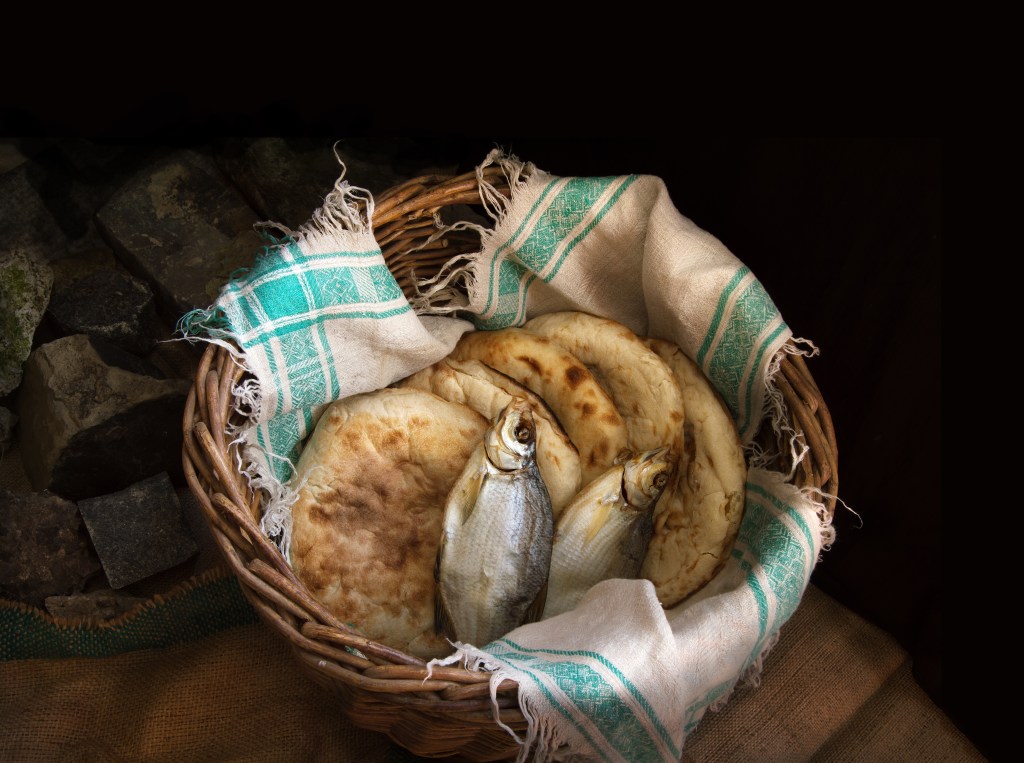
Do you remember the end of The Last Battle when the children were sailing to the end of the world, so filled with wonder and spiritual sustenance that they weren’t hungry for physical food? I wonder whether C.S. Lewis got that idea from these passages in John. As we know, Jesus performed one of his most spectacular miracles after his interchange with Philip, multiplying a young boy’s five barley loaves and two fish to feed an enormous crowd. The men alone numbered about 5,000 (v. 10). This is one of the few events recorded by all four evangelists, though only John tells us the loaves and fish were provided by a young boy, who apparently shared that information with Andrew.
Shutterstock: ArtMari
I’m intrigued by Jesus’s concern in verse 12 that nothing be wasted. If you had the power to feed thousands of people from one lunch, would you be worried about the scraps left over? On the assumption that everything Jesus did and said was purposeful, what do you think this means? And the fact that the leftovers filled twelve baskets? What do you think the disciple did with the twelve baskets of scraps? I would love to know your thoughts!/
I remember my shock when as a teenager, I heard a sermon in which the preacher claimed this incident wasn’t really a miracle of multiplication, but rather a miracle of generosity—that the young boy’s gift shamed others into sharing the food they had brought along. The preacher believed this was as much a miracle—the softening of people’s hearts into concern for their neighbors—as Jesus literally feeding a multitude from five small loaves and two small fish would have been.
Except this isn’t what the text tells us. In each of the four Gospels, we read about Jesus multiplying the food. John says, “When the people saw Jesus do this miraculous sign, they exclaimed, ‘Surely, he is the Prophet we have been expecting!” (6:14). The people weren’t congratulating each other for their generosity. All eyes were on Jesus, the one who, as Matthew 14, Mark 6, and Luke 9 tell us, had spent the day healing the sick and teaching them about the Kingdom of God—ministering to their bodies and their souls—even while carrying a burden of grief for his beloved beheaded cousin, John the Baptist. And before he calmed the storm after Peter’s attempt to walk to him on the turbulent waves.
In ourselves, we never have enough for the needs of others, no matter how much we share and sacrifice. We can’t be enough. Yes, we are asked to share what we have been given. It was the disciples who walked around through that huge crowd serving the people. But the Source of nourishment is God’s overflowing heart of love, for both our bodies and our souls.
The Love of God by Frederick Martin Lehman, sung by Mercy Me

 Debra Kornfield