
But God wants us to remember and tell how he has helped us
1 Samuel 7:12 Samuel then took a large stone and placed it between the towns of Mizpah and Jeshanah. He named it Ebenezer (which means “the stone of help”), for he said, “Up to this point the Lord has helped us!”
[Debbie] I’m delighted to introduce you to Bonnie Budzowski, who offers not just a blog post but a whole book dedicated to noticing, remembering, and sharing with others what God does in our lives. I asked her to do this for Thanksgiving since it’s such a perfect time to begin a lifestyle of intentional honoring of the Lord in this way. As always, I would love for you to share your “But God …” story with me and with the readers of this blog.
Here’s Bonnie:

Sometimes I purchase a greeting card that I’m reluctant to send. It might be the perfect picture, the sentiment, or both that I want to hold onto. Is it a sin to hoard a greeting card?
Once such card features a photograph of a young girl reading from a book. The girl looks to be about six years old. She is happily reading to a dog that is bigger than she is. The dog sits with rapt attention, his pink tongue hanging out of his dog-smile.
The sentiment below the photo is a quote attributed to the poet and activist Muriel Rukeyser: The universe is made of stories, not atoms.
For more than fifteen years, my job as principal of Gravitas Press was to act as a story whisperer, to help people find and articulate their stories in compelling ways. Even before those years, I knew I would one day write a book chronicling the stories of God’s surprising grace in my life. I knew the project would wait until I was near retirement.
What I didn’t know was that in the process of writing the book, something new and fresh would once again surprise me. I would discover a spiritual discipline that is largely missing in people who are otherwise devout Christians.
I discovered that God’s people have always intentionally created memorials to commemorate God’s acts in their history.
For example, following encounters with God and his promises, Abraham built altars. Jacob anointed the stone he used as a pillow the night he saw angels climbing a ladder between heaven and earth. Joshua instructed representatives from the twelve tribes of Israel to each contribute a stone to create a memorial to mark the miraculous crossing of Jordan River. Samuel set up a stone memorial to mark the time God sent a display of raucous thunder to defeat the Philistine army. Samuel called his memorial ebenezer, a word meaning “stone of help.” The psalmists continued the tradition, using words rather than stones. And Jesus commanded we practice a meal of remembrance.
What’s the purpose of this pattern of remembrance? It’s to ground us in the biblical story of God’s work and repeatedly draw us back to trusting in God’s faithfulness. Ebenezer Chronicles: The Missing Spiritual Practice invites you to consider what might happen if you added a practice of intentional remembering into your prayer life, around your table, and in your everyday conversations. It’s also a collection of stories of God’s amazing grace in my broken life. It’s a book in which God is the hero.
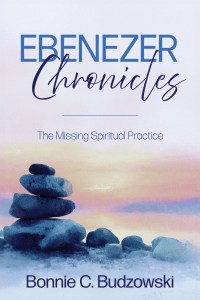
Ebenezer Chronicles, The Missing Spiritual Practice is available at Amazon.com. To read the first chapter, visit me here and learn about workshops for your group, including a virtual book club.
“Here I raise my Ebenezer …” Come Thou Fount of Every Blessing, sung by Chris Tomlin
 Debra Kornfield