Seventeen times!

But Christ suffered for us

1 Peter 2:21 God called you to do good, even if it means suffering, just as Christ suffered for you.

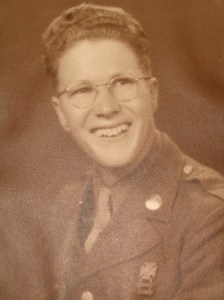
My husband Dave’s dad, William John Kornfield, was a decorated World War II hero. I didn’t know this until Dave’s brother Bill Jr. and his wife Jennie created a display case of Dad Kornfield’s medals and one of his buddies told stories at his funeral in November 2008 (which I missed, because Karis was critically ill sick at the time, and my dad died the same week). Dad K never made a big deal of his war experiences, so even his family didn’t know.

Dad’s medals included a purple heart, a bronze star, and sharpshooter awards

One story that was repeated to me was this:

A request was made for a volunteer to go behind enemy lines to gather information. Dave’s dad volunteered. His commanding officer made it clear that he would be risking his life, but he went anyway. He came back alive, and the next time such a call was made, he volunteered again. The third time, he was told no. No one had ever gone three times and come back alive.

“I’m ready to die,” Dad K said. “If I die, I’ll go straight to heaven. But most of my buddies aren’t ready. Let me do this.”

He went seventeen times before frostbite on his feet took him out. And was awarded a medal of valor.

Dad K in 1943

Dad K showed the same kind of gutsiness after the war, as a pioneer missionary in Bolivia. He married Dave’s mom in May, 1952, and Dave was conceived on their honeymoon. In January 1953, Bill and Gloria arrived in Bolivia, where they joined an international team in Cochabamba, where Dave was born in March. Knowing neither Spanish nor Quechua, these newlyweds and first-time parents were assigned to a small Andean village named Capinota, where they lived without running water, heat, friends, or colleagues. But Dad K always told Capinota stories with humor.

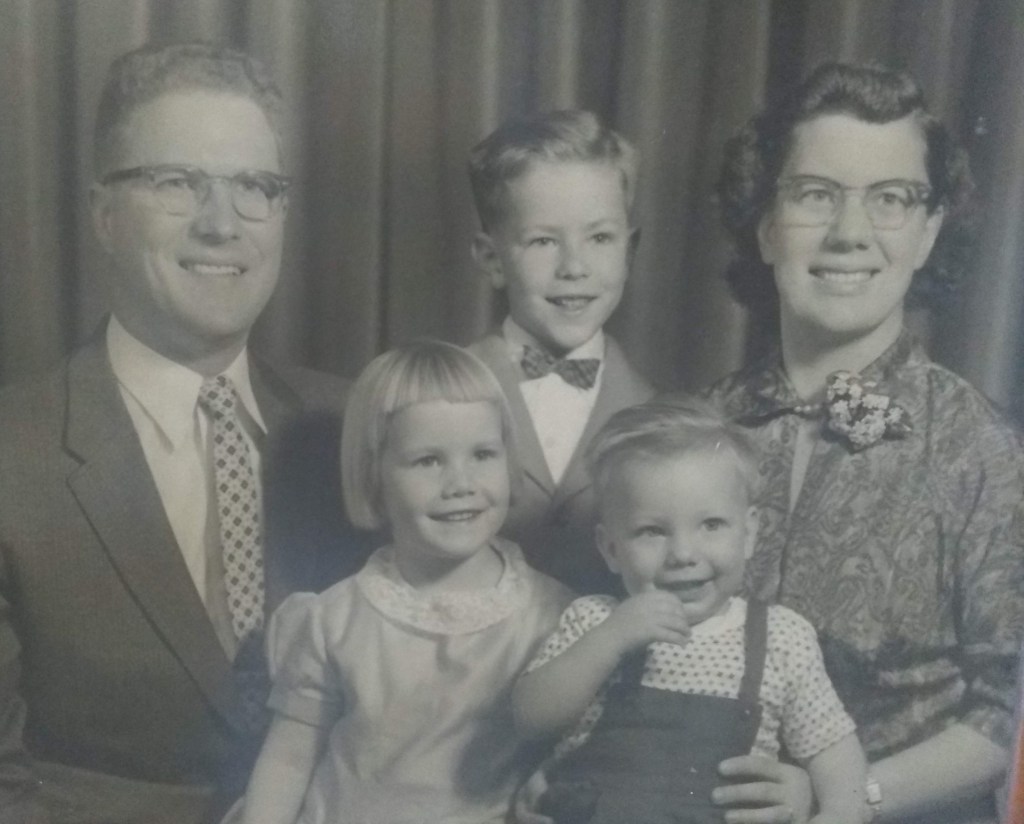
The family in 1957

Kathy joined the family fourteen months after Dave did. Then they lost a child, and finally Billy arrived. By then they had returned to Cochabamba, where Dad K directed a Bible school. They lived in the same three-story urban building that housed the denomination’s main church, a bookstore, the Bible school dormitories and classrooms, and the pastor’s apartment. The kids had nowhere to play. One of them discovered they could crawl into the attic, and they had a great time until the pastor’s wife heard and found them. She marched them into Dad K’s office to be disciplined. Dad K listened to her outrage, thanked her, and assured her he would care for the situation. After she left and he closed the door, he looked at his three children, tried to admonish them, but broke into laughter and gathered them in for a hug.

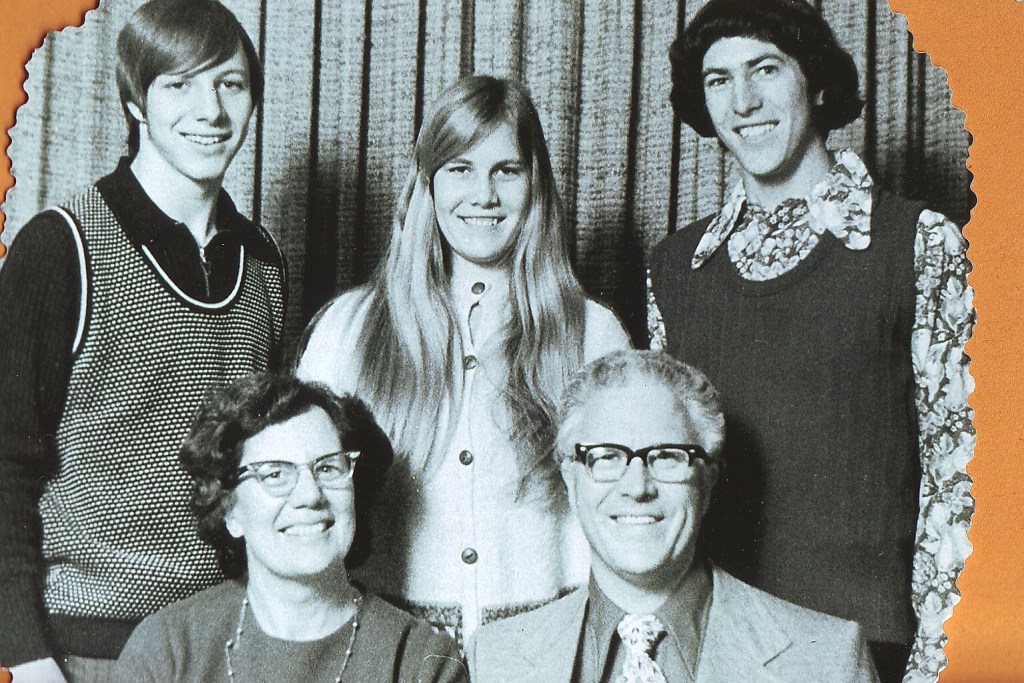
The family when I met them, 1972

On this Memorial Day, I want to honor Dad K for his courage, his resilience, his sense of humor, his delight in adventure, and his deep love for Christ and for people—loves he passed on to his children and grandchildren.

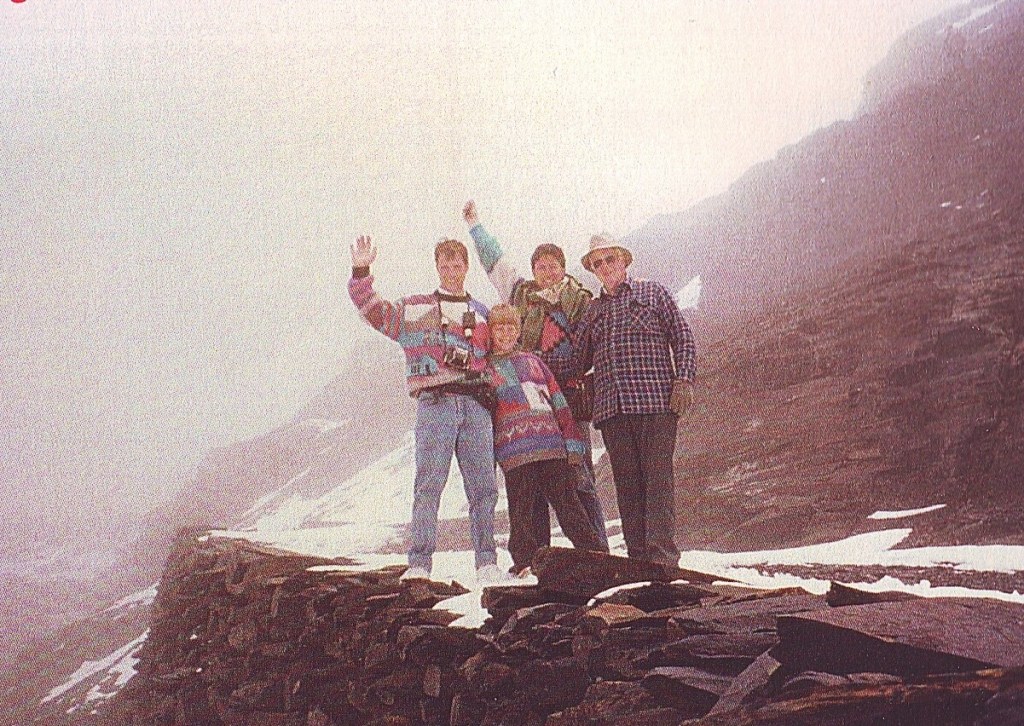
Still adventuring at my age (67)! An example to follow …
Dad K with his sons and grandson on the Inca Trail at 16,000 feet in the Andes Mountains, 1992

Dave says this:

Dad suffered in various ways as a missionary. He and Mom left their parents and siblings in an era when furloughs came only every five years. Their first term they had no vehicle. They brought up my sister Kathy and me in a small rural village in which their only running water was in the stream behind their house. After four years, Dad had to leave Bolivia and his wife and three young children for six months because of illness that couldn’t be treated in Bolivia. Mission policy dictated their children go to the mission boarding school so they wouldn’t “interfere” with their parents’ work. Dad and Mom’s marriage was very challenging, yet he never complained. Indeed, when he got Alzheimer’s and lost some of his inhibitions, he would break out in a declaration of love every time his wife entered the room.

Dad suffered, but you wouldn’t know it. The suffering didn’t enter his soul. It miraculously passed over him like water over a duck’s back. Looking back now, I realize that this might be one of the greatest ways Christ revealed himself in Dad. Christ in us, our hope of glory!

Unfading beauty

But God values inner beauty

1 Peter 3:1-12 Don’t be concerned about the outward beauty of fancy hairstyles, expensive jewelry, or beautiful clothes. You should clothe yourselves instead with the beauty that comes from within, the unfading beauty of a gentle and quiet spirit, which is so precious to God. This is how the holy women of old made themselves beautiful. They trusted God. … For instance, Sarah … You are her daughters when you do what is right without fear.

1 Samuel 16:7 People judge by outward appearance, but the Lord looks at the heart.

Last week, while taking a photo requested by the publisher of the Karis book in Brazil, I accidentally caught my face in an unguarded moment. When I saw it, I was dismayed and promptly deleted it. Is this what people around me have to look at? For the first time, I felt old.

Diane Morris, a friend since 1988 when she cared for missionary kids at our new mission agency, OC International, left a lovely little book with me after a recent visit. It’s called 31 Days of Encouragement as We Grow Older, by Ruth Myers. Diane told me, “It will be fun to know we’re reading the same thing!”

Tuesday’s topic was “Never Too Old to Change.” Ruth writes, “It’s never too late to grow in important ways. … We can pray, Lord, show me things you especially want me to overcome by growth in the three things so important to you—faith, hope, and love. We can pray for increased faith in God—for quiet trust in place of anxiety, fear, or an ‘I can’t’ feeling. Someone infinitely bigger than us is in control. More and more, Lord, may I choose to trust in you.”

Is anything more attractive than quiet, confident trust in our Lord? Teach me, Lord, to do what is right without fear. Increase my faith.

P.S. I wrote this post before reading about the Southern Baptist “Abuse Apocalypse,” here and in other accounts.

Without question, this fits with the theme of God looking at our hearts rather than appearances. Interestingly, I had just read two relevant chapters in Diane Langberg’s (a second Diane for today’s post!) must-read book, Suffering and the Heart of God, How Trauma Destroys and Christ Restores (2015). Chapter 12 is titled “Leadership, Power, and Deception in the Church and the Home”: Power has been given to us so that the world might see something of the glory of God in the flesh—full of grace and truth. That glory is evidenced in humility, love, sacrifice, and death to anything that is not like Jesus Christ. It is a hard road (p. 212).

I highly recommend Diane Langberg’s crystal-clear account of how self-deception leads to the abuse of power. In Chapter 13, “Sexual Abuse in Christian Organizations,” she says, “Some of us have faced the power of systems that name God’s name yet look nothing like him. … We forget that anything done in the name of God that does not bear his character throughout is actually not of him at all” (p. 220).

Here is how she closes the chapter:

Our God demonstrates again and again in his Word that his kingdom is the kingdom of the heart, not the kingdom of institutional structure. … God hates sin wherever he finds it and has gone to death to destroy it. Do we really think he wants us to avoid the death of an organization or institution by hiding sin, by failing to drag it into the light? He would rather see every human organization and institution fall than see such things preserved while full of sin. … When Jesus first called his disciples, to what did he call them—a profession, a creed, a task? No, he first and foremost called them to himself. I fear sometimes we have lost that call … breaking the heart of the Shepherd. He desires our primary allegiance to be love and obedience to him no matter the cost. When we pursue him above all else, the body of Christ will be the safest place on earth for the most vulnerable sheep. … May we, who are already in positions of power and influence, lead the way by falling on our faces, imploring God to make us like himself no matter the cost to our positions, our programs, our organizations, our ministries, or our traditions (pages 228-229).

We could add, I think, “or our politics.” We can’t put anything ahead of Christ in our hearts.

Healing work is an act of love, principles 6-10 by Elaine Elliott

But Jesus’ wounds heal us May 23, 2022

1 Peter 2:19-21, 24 For God is pleased with you when you do what you know is right and patiently endure unfair treatment. Of course, you get no credit for being patient in you are beaten for doing wrong. But if you suffer for doing good and endure it patiently, God is pleased with you. For God called you to do good, even if it means suffering, just as Christ suffered for you. He is your example, and you must follow in his steps. … He personally carried our sins in his body on the cross so that we can be dead to sin and live for what is right. By his wounds you are healed. [quoting Isaiah 53:4-6]

I could write a book about home health aides. Karis and I entertained each other with aide stories, many of them wonderful, and some leaving us shaking our heads. Here’s one of the latter:

It was transplant clinic day and I had multiple errands to run, so I asked our new aide to meet us in the waiting room at the hospital. She could care for Karis through the many hours we had to wait between the early blood draw and when the doctor showed up for clinic, so I could attend to my errands. I carefully explained to the aide what Karis needed, especially how important it was that she not leave her unattended, since Karis was unsteady on her feet and with her walker couldn’t navigate opening the heavy bathroom door, nor safely do all that was needed inside. “I’ll be back by 10:30,” I told her.

I buzzed through my errands and returned to the hospital earlier than I expected. The aide was nowhere to be seen and Karis was so desperate for relief she burst into tears when she saw me. “The aide left right after you did,” she told me. “I didn’t know what to do.”

We cared for her needs, which included a change of ostomy bag because the one she had was so full it was about to rupture. We had just made it back to the waiting room when the aide wandered in, chatting on her cell phone and munching fast food. When she saw me, her eyes widened, and she hastily ended her conversation. “I just stepped out for a few minutes because I was hungry,” she said.

I asked the aide to accompany me to a secluded place so we wouldn’t disturb others in the waiting room and described for her the condition in which I had found Karis and what would have happened if the ostomy bag had ruptured. I asked her why she had not followed my instructions. “But I didn’t!” she protested. “I was only gone for, like, ten minutes!”

Aides were hard to come by. Without one, I couldn’t leave Karis ever for more than a few minutes at a time. I didn’t want my relationship with this one to end before it had even begun. My spiritual director had been telling me God is easy to please because he loves us. I wanted to be easy to please too.

But Karis’s anguished face and her tears and what had almost happened, unbearable shame and mess in a public place, burned my heart.

“I’m sorry to hear you say that,” I said. “If you had told me the truth, we could have talked about giving you another chance. But I can’t entrust my daughter’s wellbeing to someone who disregards my instructions and then lies to me.”

A series of emotions crossed the aide’s face, then she said, “I understand that you are overly attached to your daughter because she’s been sick. For that reason, I have decided to forgive you for the terrible words you just said to me. But really, you need to let her grow up. Helicopter moms are not attractive.” She stood and walked away.

She decided to forgive me … ?

I called the home health agency, told them what had happened, and requested a substitute. They didn’t have anyone else, they said. It might take a few weeks for them to find another aide for us.

With the shortage of aides, did that girl get a by at the agency? Did she learn anything? I’ll never know. The experience was traumatic enough for Karis it took her a while to be able to laugh at what happened. A small illustration of Elaine’s healing principle #6:

Principle 6: Healing may take time

Among the many stories of healing in the gospels, one describes Jesus touching a blind man.  At first, the partially healed man saw people walking around, looking like trees. (Mark 8:24) The story shows that some healings take time, since Jesus’ second touch healed him completely.  Among family and friends, we have seen many healings, and most of them have taken time.  In fact, I now have a far less romanticized view of healing and realize it may take nursing care, doctor’s appointments, physical therapy, and patience.   Sitting patiently with someone ill, or simply prayer over a long period of time, is challenging. 

When my sister Sharon could not walk or raise her hands after a seizure and stroke, recovery took time.  She held on in faith and kept doing the physical therapy, and within several months had become completely well.

Principle 7: Healing ministry honors Christ and is a way of following him

When Jesus sent out his disciples, he told them to Heal the sick, raise the dead, cure those with leprosy, and cast out demons.” (Matthew 10:8) Healing became an important part of their message, bringing kingdom life through their good news. Today we still deal with life-threatening illness, bacterial infections, and psychological challenges.  We can follow Jesus’ instructions and include modern methods.

My mother-in-law had a “return to life” when headed to a life of ministry in Guatemala.  The tetanus shot given her sent her into anaphylactic shock, the doctor arrived late and found she was no longer breathing.  A shot to the heart brought her back.

Principle 8: The one healed has received a gift of healing

Some have suggested that those who are healed are the ones we should say have the gift of healing.  They received something amazing they can share with others and their testimony honors Christ and may encourage faith for others.  Those who Christ or the apostles healed became important parts of the story, evidence that something wonderful is at work in the world.  In the gospels, at least 37 individuals healed become characters we do not forget. Out of 3,779 verses in the four Gospels, 727 regard healing of physical and mental illnesses, nearly a fifth of the whole, demonstrating its importance. Our stories of healing today have similar importance in sharing Christ.

Principle 9: Simultaneously ask for healing and accept the current reality

We can always ask for people to be healed—we should have no shame or embarrassment in making the request.  When we have received positive answers, we are encouraged to keep asking for the next case.  When healing has not occurred, we still trust God’s wisdom.  As the Psalmist prayed, “My health may fail, and my spirit may grow weak, but God remains the strength of my heart; he is mine forever.” (Psalm 73:26)

This challenges us when we face chronic illness where medical research has not come up with any known cures.  In these cases, we can get discouraged and feel like it is hopeless to ask.  But faith keeps asking and stays alert for any help or aids to improvement, even small improvements.  We persist in prayer looking for breakthroughs, and as people exercise their trust in God in the middle of illness and suffering, they give him glory. 

Principle 10: Always be grateful

We can remain grateful however God chooses to act.  We remember that only one of ten lepers came back to offer thanks, but Jesus commended him. (Luke 17:17,18) We can say under the threat of suffering, If we are thrown into the blazing furnace, the God whom we serve is able to save us. He will rescue us from your power, Your Majesty. But even if he doesn’t…” (Daniel 3:17,18) “Even if he doesn’t” answer when we want and what we want, we will still be grateful.  And, unsurprisingly, gratitude has a healing effect.

My ten principles have emerged from my experiences.  Doubtless others can improve or add or change these to create a theological explanation of healing for our time that avoids the extremes of “healing doesn’t happen” versus “healing must happen right now if we have faith—no doctors needed!”

Karis’ life illustrates the principles:  she received cutting edge medical interventions which preserved her life far beyond expectations; when her suffering reached a critical point she received her entry into heaven; thousands of people became engaged in praying for her; many joined with faith when things seemed discouraging; clearly Karis did not have any fault in having a life-threatening birth defect and her story awakened compassion; some of her hospital stays were incredibly long, but she recovered; her story is an announcement of the gospel at work in a community of believers; her life became a gift of healing, a sign of God at work; many (like myself) never gave up hoping for healing while accepting reality; and Karis expressed joy and gratitude in a way that blessed so many of us.

I now know that healing is normally not flashy.  Instead, it is based on love responding to need, something Karis’ family certainly offered her.  Over and over, we are told that Jesus was moved with compassion, and his concern led him to heal.  It was one of the strongest characteristics of his ministry. Healing work is an act of love.  It is a way of loving our neighbor as ourselves.  Healing is far more about love than about power—love is at the root of this gift.  I think I liked the idea of the gift because it seemed glamorous and powerful.  Now I think of healing as humble, patient, and quiet, motivated by love.  We saw that at work in Karis’ story.

I (Debbie) will add that we saw God’s miraculous healing in Karis’s life so many times I lost count. In 2009, for example, doctors told us four times to call our family together (from Brazil, Italy, and several places in the U.S.) to say goodbye to her, because there was nothing more to do; this was the end. Each time God intervened, and Karis recovered. She was not surprised by this. “God still has work for me to do here on earth,” she said. “Why were all of you so worried? It’s nice to see you. But go back now to your own work.”

Compassion always matters: Principles of Healing by Elaine Elliott, Antigua, Guatemala

But God will judge the world May 19, 2022

1 Peter 2:11-25 Dear friends, I warn you as “temporary residents and foreigners” to keep away from worldly desires that wage war against your very souls. Be careful to live properly among your unbelieving neighbors. Then even if they accuse you of doing wrong, they will see your honorable behavior, and they will give honor to God when he judges the world.

A sweet, unexpected thing happened. I walked outside to get in my car and a stranger walking by spoke to me, saying, “I always like walking by your house because of your heart-shaped tree stump. It encourages me.” And her dog pulled her away.

The stump left from our beloved dead tree is heart-shaped? I hadn’t noticed.

My neighbor’s comment healed some of my sadness at having to cut down our aged beloved tree. Her “honorable behavior” blessed me. I don’t know exactly where she lives. I’m watching for her so I can meet her properly and thank her.

When I walked out this morning to take a photo of the stump, I noticed a thistle growing beside it. Thanks to all the rain we’ve had, weeds are flourishing. I decided the thistle illustrates the heart-weeding I need to do of the “worldly desires that wage war against our souls.” So for the moment, I left it in the ground, and in the photo, to remind me to do both kinds of weeding.

Thistle vs. heart-stump. “Worldly desires” vs. “honorable behavior” flowing from hearts filled with God’s love. Peter offers twelve indicators of honorable living. Look up the passage and count them!

I want to focus today on the last one, “you have turned to our Shepherd for healing of your wounds and for spiritual protection,” in verses 24 and 25. I’ll do this by sharing with you ten thoughtfully penned Principles of Healing recently sent to me by my sister-in-law Elaine Elliott. Check out Elaine’s Art and Scripture posts. You’ll love the way she illustrates Scripture with inspiring art from a wide variety of artists.

Elaine’s explanation is longer than what I usually post, but so worth your consideration. I’ve bolded the principles to help you return to them when you need them. I’ll post five today and five next time.

As one of Karis’ aunts, I watched her life (usually from afar) with wonder. The fact that she survived beyond her first month made her a miracle baby. The sacrificial care Debbie gave to her repeatedly prolonged her life. When the family moved to Brazil as Karis seemed completely healed and well, this marked another miracle.  When her health declined and eventually led to her transplants, we followed the ups and downs with prayers for her. When in a medically induced coma after the first transplant failed, I assumed this was the end of the story so was astonished when she traveled to Brazil before transplant #2.  Her example of patience with pain and determination to enjoy life despite her limits served as an inspiration.

For me, Karis’ life, and the book Karis: All I See Is Grace remains an inspiring story of healing despite the messy medical procedures, her suffering, and her ultimate death.  My own journey to understand healing explains why.

The following ten principles have emerged for me over the years. 

Principle 1: Accept and use wisely the advances in medical science

During my freshman year of college, I heard for the first time about the baptism of the Spirit as a post-new-birth experience which led to increased gifting and power.  I was immediately on-board and immersed myself in this exciting new way of being a Christian.  Of all the gifts, healing struck me as the most glamorous, and I read books by contemporary healers hoping to receive this gift.

My immediate thought as a healthy person was to pray that my eyes would heal, thereby removing the need for contact lenses or glasses.  When this did not come about after about three months of unnecessarily poor eyesight (while in college squinting at the blackboard!), it suddenly struck me that I was ignoring the obvious:  if God gave mankind wisdom to come up with something as ingenious as contact lenses, then I should accept that healing could come through medicine. 

This became an important principle for my understanding of how God works, teaching me we must simultaneously pray and trust God as we collaborate with medicine and doctors. We should not be like King Asa of whom it says he “developed a serious foot disease. Yet even with the severity of his disease, he did not seek the Lord’s help but turned only to his physicians.” (II Chronicles 16:12) Nor do we want to be like the woman Jesus healed who “had suffered a great deal from many doctors, and over the years she had spent everything she had to pay them, but she had gotten no better. In fact, she had gotten worse.” (Mark 5:26)

God has used scientific advances to transform treatment of leprosy, such a scourge throughout the Bible. Identified as caused by bacteria in 1873, the first disease so recognized, the accidental discovery of antibiotics in 1928 led to an effective drug in the 1940s and became multi-drug therapy by the 1980s. The disease has nearly been eliminated. I think of how important it was for Jesus to heal lepers with no cure available then or for nearly 20 more centuries. For new cases today healthcare workers diagnose the disease and prescribe some pills. This all can be celebrated as a gift from a wise God who shares his wisdom with curious people.

Using the wisdom regarding preventative illness correlates well with some of the sanitation, dietary, and admonitions to rest in the OT law.  We do well to eat well, exercise, rest, and reduce our stress—all things consonant with living in the Spirit.

Principle 2: Accept the possibility of death as God’s way of healing

I learned another principle when in my second year of college, we went to pray for a girl about eighteen years old whose family went to our church. The girl was so developmentally disabled she was confined to a crib, which I found horrifying. I prayed diligently for her healing. One afternoon I was so convinced she had been healed that it shocked me completely when my grandmother told me she had just died.

After the shock subsided, I suddenly realized, “She is completely healed in heaven!”  Ever since, I have held the strong belief that God, who has the power of life and death, knows when it is best for someone ill to be with him, relieved of their suffering. When things are uncertain, we know death can be an acceptable outcome.  As Paul says, “when our dying bodies have been transformed into bodies that will never die, this Scripture will be fulfilled: ‘Death is swallowed up in victory.  O death, where is your victory? O death, where is your sting?” (I Corinthians 15:54,55) We may grieve, but we have hope.

Principle 3: Prayer close by and from a distance both matter

Often those praying for healing lay hands on someone or anoint with oil or remain present in prayer. But prayers from far away matter too. As the Roman officer who trusted Christ’s authority said, “Just say the word from where you are, and my servant will be healed.” (Matthew 8:8) Our family experienced a profound healing of my sister Bev who had convulsions at the age of 18 while in Mexico. She went into a coma and the doctors predicted either death or brain damage. I learned about her situation while far away in Tucson but prayed for her as did many friends far and wide. She opened her eyes, but at first seemed like a small child. By the time I saw her several months later at Christmas time, she had partially recovered—perhaps to grade school level—but by the following fall went to the university with no ill effects and no one aware of her severe illness unless she told them. Though far away, I felt very present to her through prayer as did many others. It convinced me my prayers mattered.

Principle 4: We can have faith for others even when they lack faith

Another principle is that while it may be helpful for the sick person to have faith for themselves, it also works for us to have faith for others. It is unnecessary to guilt anyone about their illness or to demand they exercise faith. The disciples praying were the ones exhorted that their faith had been inadequate when they failed to heal the epileptic child. (Matthew 17:19,20) 

Someone I knew who struggled with alcoholism did not have much faith for change.  We who cared provided the faith that this challenge could be overcome and rejoiced when that happened.

Principle 5:  Exercise compassion rather than ascribing sin or judgment as the cause of illness.

We do not have a right to explain illness as God’s judgment for sin. When the disciples saw a blind man, they asked “Why was this man born blind? Was it because of his own sins or his parents’ sins?” “It was not because of his sins or his parents’ sins,” Jesus answered. “This happened so the power of God could be seen in him.” (John 9:2,3) God’s power then proceeded to heal him.

Even if someone contributed to their own illness in some way, including sin, Jesus is present to heal, not to condemn. Jesus wasted no time castigating the paralyzed man brought by friends on a mat but pronounced forgiveness and told him to stand. We too can receive forgiveness and forgive others as we have been forgiven, a critical part of inner healing which leads to physical changes.

I remember a woman telling me “Depression is just sin.” But traumatic events that create depression often are not the fault of the one suffering. Seeing trauma and depression healed, I am convinced that loving presence helps transform painful experiences into something full of wisdom. Compassion always matters.

Hold on a little more

But Jesus is the cornerstone of his house

1 Peter 2:4-10 You are coming to Christ, who is the living cornerstone of God’s temple. … And you are living stones that God is building into his spiritual temple. What’s more, you are his holy priests. Through the mediation of Jesus Christ, you offer spiritual sacrifices that please God. … You are a chosen people. You are royal priests, a holy nation, God’s very own possession. As a result, you can show others the goodness of God, for he called you out of the darkness into his wonderful light.

Genesis 18:18-19 All the nations of the earth will be blessed through Abraham. I have singled him out so that he will direct his sons and their families to keep the way of the Lord by doing what is right and just. (See Galatians 3:8-9, Acts 3:25.)

Genesis 22:18 [After saving Abraham’s son by supplying a substitute sacrifice, God said] Through your descendants all the nations of the earth will be blessed.

1 Corinthians 3:16 Don’t you realize that all of you together are the temple of God and that the Spirit of God lives in you?

It’s fun to feel loyalty to a particular country or tradition. Our family will probably always root for Brazil in the World Cup. We’ve been there; we have the t-shirts. The Brazilian flag evokes for us layers of experience from living in Brazil for twenty years. Our children grew up there. Brazil is part of our hearts.

But we’ll get in trouble if we place Brazil in the center of our affections. That sacred space belongs only to God. And our heavenly Father has no favorites (not even Brazilians!). He cares equally for each of his children, as Peter already reminded us (1:17).

Now, in just a few words, Peter references the whole history of God with the Jewish people, descendants of Abraham whom he called his special possession (the Old Testament cites this name at least fifteen times), called for a special purpose: to bless all the nations of the world.

But Peter turns that history on its head by saying believers in Jesus are now God’s special possession, chosen with the same purpose as Abraham and his descendants: to bless the nations. Because God loves the world (John 3:16), Jesus became the once-for-all-time sacrifice for all people. Through Jesus, God revealed his goodness and his love, not for any one type of people but for everyone.

And Peter tells us Jesus is the cornerstone of a new temple, not the one in Jerusalem. And believers in Jesus are living stones, together being built into the place where God dwells by his Spirit. A cornerstone is the first stone set in the construction of a masonry foundation. All other stones are set in reference to this stone, thus determining the position of the entire structure.

So, when people claim to be believers in Jesus yet elevate themselves over others, they are taking God’s name in vain. They have lost their connection to the cornerstone.

We must not dishonor the name and goodness of Christ by confusing earthly loyalties with the Gospel. Or think Jesus is all about us. He calls us to bless those different from us. And show them God’s goodness.

After this I saw a vast crowd, too great to count, from every nation and tribe and people and language, standing in front of the throne and before the Lamb … (Revelation 7:9).

Take a minute to savor the text of this song, as with me you examine your own heart, and pray today for the victims’ families in Buffalo, the ongoing tragedy of Ukraine, and people in your own city suffering violence of all kinds–some of it perpetrated, unconscionably, in the name of Jesus.

A call to holy living

But God’s word remains forever

1 Peter 1:13-2:3 So think clearly and exercise self-control … For the Scriptures say, “You must be holy because I am holy” [Leviticus 19:2]. Remember that the heavenly Father to whom you pray has no favorites. … Show sincere love to each other. … “The grass withers and the flower fades. But the word of the Lord remains forever[Isaiah 40:8].  And that word is the Good News that was preached to you. So get rid of all evil behavior. Be done with all deceit, hypocrisy, jealousy, and all unkind speech. Like newborn babies, you must crave pure spiritual milk so that you will grow into a full experience of salvation. Cry out for this nourishment, now that you have had a taste of the Lord’s kindness.

In the grocery store Tuesday with Caleb and Talita, I felt embarrassed when suddenly they broke away from me, chasing each other around the legs and grocery carts of other shoppers, yelling at the top of their lungs.

Why did I feel embarrassed? Because they represented me. Their behavior resulted in everyone nearby looking at me askance. They caused discomfort and could have caused harm to themselves and others. And they hindered my objective of getting out quickly so we would have more time to play, since we lost our place in line.

Thanks to Covid, Caleb and Talita have hardly ever been in grocery stores, I realized. They need to be taught proper behavior in that setting. I hadn’t explained to them what was appropriate. Once I did, they were contrite (at least, Caleb was).

Best of 26: a recent attempt to get all three of our cherubs sitting still, looking at the camera and smiling all at the same time!

We’re our Father’s “kids.” What we do and what comes out of our mouths reflects positively or badly on him just as surely as my beloved grandchildren’s behavior and speech impacted others at the store in their view of me. Fortunately, God does tell us what he expects of us.

True, holiness in speech and behavior—according to Peter, actions and words which show and promote love—is out of vogue in our society among adults who should know better. Damaging and deceitful actions and words are flung about publicly (and, I suspect, privately) as if adults believe they bear no responsibility for the harm they cause.

Peter says, NOOOO!!!! No more of this!! Don’t shame the name of God, claiming him as your Lord, yet “slipping back into your old ways of living to satisfy your own desires” (verse 14).

God has no favorites. He will judge or reward you according to what you do. So you must live in reverent fear of him (verse 17) and love each other deeply, from the heart (verse 22).

Our Father paid an enormous price to save us from empty living: “And the ransom he paid was not mere gold or silver. It was the precious blood of Christ, the sinless, spotless Lamb of God” (verse 19). When we hurt each other, we betray his sacrifice.

So how can we learn to speak and behave differently? Moses (1500 BC), Isaiah (700 BC), and Peter all remind us of the eternal, indestructible Word God has given to teach and guide us. Peter calls it spiritual milk, whose nourishment we babies need in order to thrive. “Cry out for it,” he tells us.

Shutterstock: LittleDogKorat

Lord, thank you that your word doesn’t pull any punches. Show me today my need to repent and be cleansed, so I can regard even my “enemies” with your kind of love. Make me hungry as a baby for your life-giving word, to strengthen me for holy, counter-cultural living and speaking that honors rather than shames you, and makes your heart happy.

Wonderful joy ahead?

But God gives us joy

1 Peter 1:6-12 So be truly glad. There is wonderful joy ahead, even though you have to endure many trials for a little while. … You love Jesus even though you have never seen him. Though you do not see him now, you trust him; and you rejoice with a glorious, inexpressible joy. … This Good News is so wonderful that even the angels are eagerly watching.

Hebrews 12:1-2 Let us run with endurance the race God has set before us. We do this by keeping our eyes on Jesus … Because of the joy awaiting him, he endured the cross, disregarding its shame.

Trials are temporary. Joy is forever.

That’s great, Peter. But the trials I’m going through feel like forever. It would be easier (though NOT easy) to listen to this if you were someone who knows about trauma and doesn’t want to just stick bandaids over my wounds with some platitude of “one day by and by …” I’m in pain NOW.

Well, actually, Peter did know a bit about suffering. He wrote his letters from Rome, where Christians were being treated very badly because allegiance to Christ seemed antithetical to loyalty to Caesar. In fact, within a couple years of penning these words, both Peter and Paul were not just abused but killed because they refused to renounce their faith, Peter by crucifixion (upside-down, according to tradition), and Paul by beheading.

Well, OK, I’ll stick with you a little longer. But I don’t get the joy thing. At all. And trust? Don’t you know that’s the first thing to go for victims of abuse and trauma? If trust is what it takes, I’m outta here. I’ve been betrayed more times than you can imagine. I don’t trust anyone.

Which is worse, do you think, to be the victim of betrayal, or to realize you yourself have betrayed—dramatically, three times!—the person who means the most to you in the whole world? Just sayin’ … Have YOU ever betrayed anyone? Someone you actually love?

Hmm, well … Let’s not talk about that. Let’s go back to the time thing. “A little while”? What does that even mean? I don’t remember a time in my life when I didn’t feel pain, and confusion, and fear, and anger … Only good times go by in a flash. Hard times seem endless. I can’t even imagine there is wonderful joy ahead.

I hear you. Time is so tricky for us. I’ve heard people (like C.S. Lewis) say we weren’t made for time, and that’s why we don’t ever feel comfortable with it.

We’re like my four-year-old grandson Caleb, still confused by what “yesterday,” “last week,” “later,” “tomorrow,” and “next month” mean. My daughter Valerie, who works three nights a week as a critical care nurse in the ICU of Pittsburgh children’s hospital, has taught Caleb to count her work nights so he can know his mom won’t always be gone or sleeping. “Tonight is number three,” he’ll tell me on Tuesdays. “Then Mommy will be with us.”

But how long will my “little while” be? I wish I could know like Caleb that “today is # three of three, then Jesus will be with us.”

I think that’s why Peter emphasizes trust. We don’t know, and we can’t see, and trust seems like a terrible risk. But we can ask God for the courage to begin learning to trust Jesus, who is unique in that he never betrayed anyone. Not ever. As we begin trusting him, our hearts start opening to the unexpected and unexplainable joy he offers us by the Holy Spirit even through the most awful times. Not something we can ever fake or drum up. A gift.

The only way Peter’s words make sense is that they’re based on the foundation we considered on my first post about these letters, that we can be cleansed by the blood of Jesus. He can cleanse us of the junk and pain and residue left in our souls by our experiences in the past. He can do this because he carried it all for us already, putting his own life on the line for us.

One of my heroes, Diane Langberg, says it like this:

Jesus was made the subject of shame as absolutely as was the custom in that day. Grace abandoned him. In other words, he descended into hell. The Creator is destroyed. Life becomes dead. Glory turns to shame, Beauty is obliterated. Living water thirsts. All Power becomes powerless. The great Clothier of everything is stripped naked. All-Honor is despised. Holiness becomes excrement. Love is forsaken. Heaven enters hell. These truths mean many wonderful, eternal things. They also mean that our God understands trauma. … And that sin can die in us so the life of God can be born in us.

I believe Diane is talking about both the sin committed against us and our own sin. The effects of both can be cleansed, washed away as we open our hearts to him.

And joy—the inexplicable joy Peter is talking about—is the result. Both now, in the middle of tough times, and forever.

All praise

But God names us his heirs

1 Peter 1:3-5 All praise to God, the Father of our Lord Jesus Christ. By his great mercy we have been born again, because God raised Jesus Christ from the dead. Now we live with great expectation, and we have a priceless inheritance—an inheritance that is kept in heaven for you, pure and undefiled, beyond the reach of change and decay. And through your faith, God is protecting you by his power until you receive this salvation, which is ready to be revealed on the last day for all to see.

Psalm 16:5 Lord, you alone are my inheritance.

Sometimes I catch myself so looking forward to seeing Karis again and meeting our son Michael in Heaven that I have to ask myself, “Am I more excited about seeing Karis and Michael than you, Lord?”

He responds, “Don’t worry. It’s not either/or. It’s both/and! Forever!” I’m quite sure the glory of the Lord will be so overwhelming there will be no chance of lesser loves usurping his place.

Indeed, all praise belongs to him. Look at all Peter includes in these few lines as reasons for our praise. Great three-point sermon, Peter!

We have been born again. The Greek word is anagennao. It means a change from one state of being to another. It’s the word Jesus used in his conversation with Nicodemus in John 3 to describe spiritual rebirth. Peter uses it again twenty verses later: For you have been born again, but not to a life that will quickly end. Your new life will last forever because it comes from the eternal, living word (logos) of God (see John 1:1-5).

Because God raised Jesus Christ from the dead. Bodily resurrection to life after having been dead (anastasis) is God’s promise to us as well. Christ was raised as the first of the harvest; then all who belong to Christ will be raised when he comes back (1 Corinthians 15:23).

Bloom #6 of Dan and April’s wedding orchid’s rebirth delighted us on Karis’s birthday yesterday.

We live with great expectation. Indeed! Elpis means hope, looking forward to something with confident expectation. As each day speeds by and I see old age on the horizon (still very distant, of course), this is huge reason for praise. Our spiritual salvation—what we experience now—will one day express itself in new bodies that neither sicken nor sorrow nor age nor die.

We have a priceless inheritance. Here on earth, our bodies “keep the score” of the abuses and traumas we suffer. In Heaven, our new bodies will register the delight of unspoiled LIFE, beyond the reach of change and decay. Won’t it be fun to see the people who have gone before us as their true selves, healed from what they suffered—and inflicted on others—here on earth?!

It’s (almost) enough to be happy about growing older, if that’s what it takes to receive our inheritance.

All praise to God!

As I’ve written this post, a dear friend sits with a close friend of hers in the sacred transition space between earth and Heaven. I thought I would post again on Monday, but to honor this moment, I’ll go ahead to post it today.

And the first bloom on the other stem popped open today. I’ll dedicate this one to my friend who stands on holy ground this morning.

Grace under pressure

But God, Three in One, gives more and more

1 Peter 1:2 God the Father knew you and chose you long ago, and his Spirit has made you holy. As a result, you have obeyed him and have been cleansed by the blood of Jesus Christ. May God give you more and more grace and peace.

Peter wrote his two letters to people who were suffering. There’s no record that he ever traveled through the provinces where they lived, present-day Turkey. Maybe he felt a special bond with them because some were present at his very first sermon on Pentecost, as listed in Acts 2:9.

“More and more grace and peace” could be considered the theme of this letter. Reading further, we discover Peter is talking about inner grace and peace, as they walk through suffering that is more likely to get worse than better.  

Peter gives no promises that circumstances will get better for them; no bandaids as if their wounds are superficial. No pretending things are good when they aren’t. This is a gutsy, honest letter addressing life and death concerns. Today he might be writing to people in Ukraine, or Syria, or Ethiopia, or Venezuela.

Peter knows what he’s talking about. He writes this letter from Rome. Within a year or two, both Peter and Paul will be executed.

When I read this letter, I realize my own “suffering” is small. Yet Peter’s words to people in extreme circumstances resonate with me, too. In tough circumstances, I face the same choices they did. To trust, rather than despair. To live faithfully, rather than cave to pressure. To open my heart to joy when things seem hard. To do good, not harm, even to those who treat me unjustly.

In short, to walk in the footsteps of Jesus. Easy? No.

So, I’m taking to heart Peter’s encouragement as he sets the stage for his letter. Each member of the holy Trinity engages with us in a unique and significant way. We’re not alone in our challenges, not ever! The Father knows us (Greek prognosis) and has chosen us. The Spirit makes us holy (hagiasmos; a growth process resulting in godliness). Jesus cleanses us (rhantismos, sprinkling: a reference to the power of Christ’s sacrifice to sanctify us, as in Hebrews 9:13-14).

My spiritual director often reminds me that God knew what he had to work with when he chose me. He’s not surprised by my limitations or fragilities or sins. He provides what I need to deal with whatever comes my way; the question is whether I’ll receive it. Recognition of my weakness can either turn me toward self-focused despair, or God-focused hope and gratitude. My choice.

Today, Karis’s birthday, Peter reminds me of “her” verse, 2 Corinthians 12:9: The Lord said, “My grace is all you need. My power works best in weakness.”

Thanks, Peter, Paul, and Karis!I’m walking through this day with my hands and heart open for more and more grace and peace.

Shutterstock: Yulia 0606

It’s a partnership!

But God is with us always

Hebrews 13:20-21 Now may the God of peace—who brought up from the dead our Lord Jesus the great Shepherd of the sheep and ratified an eternal covenant with his blood—may he equip you with all you need for doing his will. May he produce in you, through the power of Jesus Christ, every good thing that is pleasing to him. All glory to him forever and ever! Amen.

Matthew 28:20 Be sure of this: I am with you always, even to the end of the age.

I intended to finish Matthew and Hebrews while it was still April, so I could start a new series on First and Second Peter in May, but I didn’t quite pull it off. This is a crazy weekend in Pittsburgh. Not only is it Commencement weekend at the University of Pittsburgh, but today is the annual Marathon, closing off hundreds of streets. And it’s raining all day, with severe thunderstorms likely. (Ah—I just heard the roll of thunder.) Due to inaccessibility, our church held services yesterday evening instead of today, though the youth group is standing in the rain handing out Gatorade to marathon runners.

We’ve been watching with delight the orchid we brought home from our son Dan and April’s wedding last September bloom again. The fourth one opened while we were gone, and the fifth one yesterday. Aren’t they gorgeous?

I’ve been receiving advice about how to care for this orchid. So far, though, all we’ve done is give it a half cup of water every week. And apparently it likes the window where it is placed. It’s a picture for me of partnership. Had we not watered it, the orchid would have died. But the orchid itself has done all the rest. If it’s like it was last fall, these blooms will last for weeks, reminding us daily of the beauty of Dan and April’s lives and their love for each other even though we can’t be with them physically right now.

What if we had thrown out our orchid during its period of dormancy, or stopped watering it when it wasn’t blooming? Aren’t we tempted to disparage ourselves or give up during those times when we don’t see the results of our work? Not so the Lord. He’s faithful to us always, quietly nurturing our souls so we’re ready for those times when we bloom externally. Note that Matthew begins and ends with the assurance that God is with us (“Immanuel, God with us,” Matthew 1:23; “I am with you always,” 28:20). And Hebrews concludes commenting on the eternal covenant he has with us, providing us with what we need to honor him (13:20).

As an introvert, I prefer the times of quiet, when I can do my work in solitude. “Aren’t you excited?!” people have said to me, referencing the three books in three different languages and countries all coming out at the same time. Maybe in a few weeks I will be, when all this extra activity calms down and I can go back into my “cave.” Right now, my extrovert energy feels quite depleted, so please pray for me tomorrow morning during the virtual launch of the Karis book in Brazil. You’re welcome to participate! 11:00 a.m. Eastern time (noon in Brazil), @editorabetania on Instagram.

Pray the book will encourage those who read it, and reward Editora Betânia for their investment. And thank God with me for this promise from Hebrews, that he will equip me for this as I seek to please and honor him.