Mark 15:25-27 It was nine o’clock in the morning when they crucified him. A sign announced the charge against him. It read, “The King of the Jews.” Two criminals were crucified with him, one on his right and one on his left. And the Scripture was fulfilled that said, “He was counted among the transgressors.”
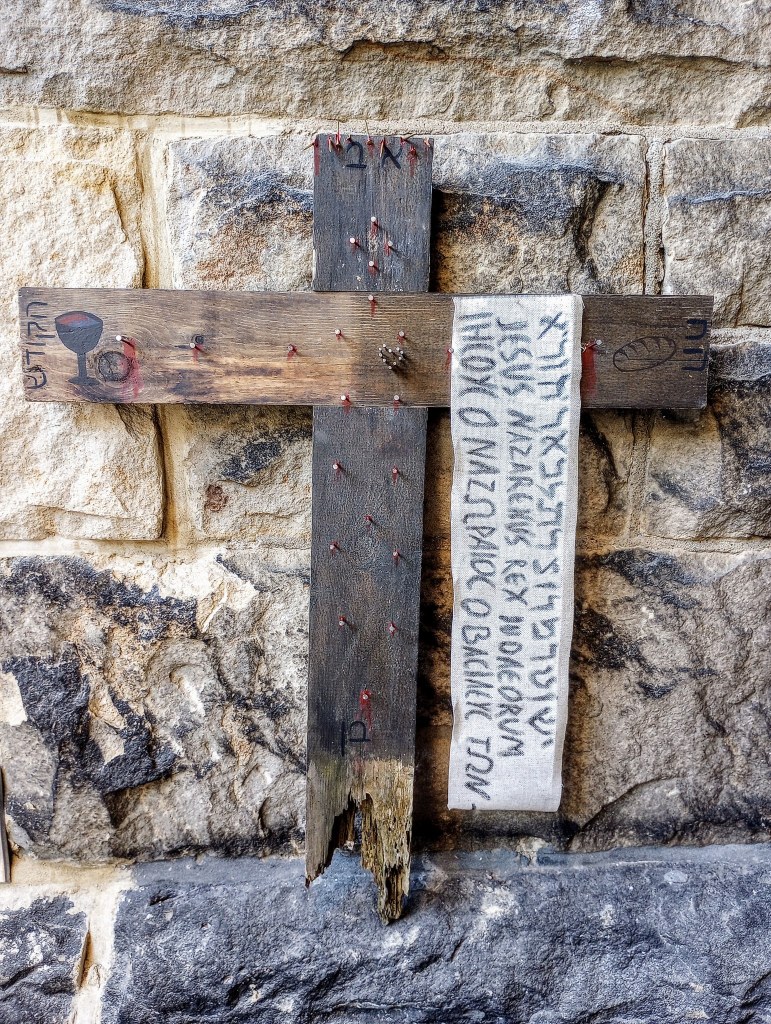
Station 6: Jesus is nailed to the cross
Lucy writes about her work of art:
“When I was making this piece, I wanted a way to represent the pain and suffering of Jesus while also implementing other symbols. I put water and wine on one side of the crossbar and bread on the other symbolizing communion. I put the words, “Jesus of Nazareth, King of the Jews” in Latin, Greek, and Aramaic because that’s what was on the sign on Jesus’s cross.
The Hebrew on the cross translates to Father, Son, and Holy Spirit in their respective places. The nails in the form of a body are supposed to represent the suffering and pain that Jesus endured on the cross.”
[Debbie] The nails in the shape of a heart brought tears to my eyes. I remembered Karis writing in her journal (June 1, 1999) as a hospitalized teenager:
“I’ve been poked with needles until my arms are literally black and blue and red. I thought last night as they poked me again, “What must it have been like for Jesus, not to be pierced by loving nurses and these tiny sharp needles, but rather the soldiers, the nails . . .” I remember Christ and find not the strength not to complain but rather that there is nothing to complain about.”
The words came to mind of the American folk hymn, “What wondrous love is this.” Here it is, sung by Fernando Ortega. With Lucy’s image burned into your mind, close your eyes and worship.
Matthew 27:33-35 They went out to a place called Golgotha (which means “Place of the Skull”). The solders gave Jesus wine mixed with bitter gall … After they had nailed him to the cross, the soldiers gambled for his clothes by throwing dice. This fulfilled the word of the prophet: “They divided my garments among themselves and cast lots for my robe.” (Psalm 22:18)
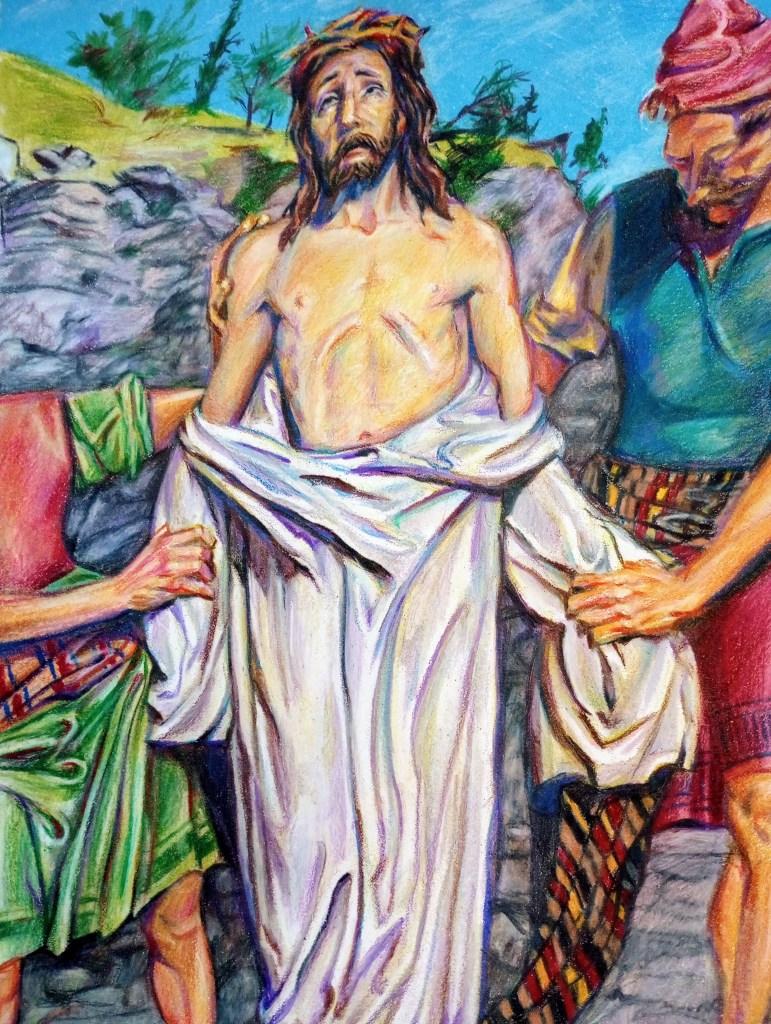
Station 5: Jesus is stripped of his garments
Suzanne says this about her painting:
“I used bright colors to contrast with the subject matter and to show that he was stripped in broad daylight. As I drew, I contemplated how we use clothing not only to cover our nakedness, but to show social status and wealth, to express ourselves, and to look attractive.
The church and followers of Jesus are often called the body of Christ. I wonder what we need to be stripped of.
I left off the head of the man on Jesus’s left not only because I didn’t have room for it on the page, but also so viewers can put themselves in his place. What have you said or done that has metaphorically stripped Jesus and brought him shame?”
Luke 23:27-28 A large crowd trailed behind, including many grief-stricken women. But Jesus turned and said to them, “Daughters of Jerusalem, don’t weep for me, but weep for yourselves and for your children. … Those who plant in tears will harvest with shouts of joy. They weep as they go to plant their seed, but they sing as they return with the harvest (Psalm 126:5-6).
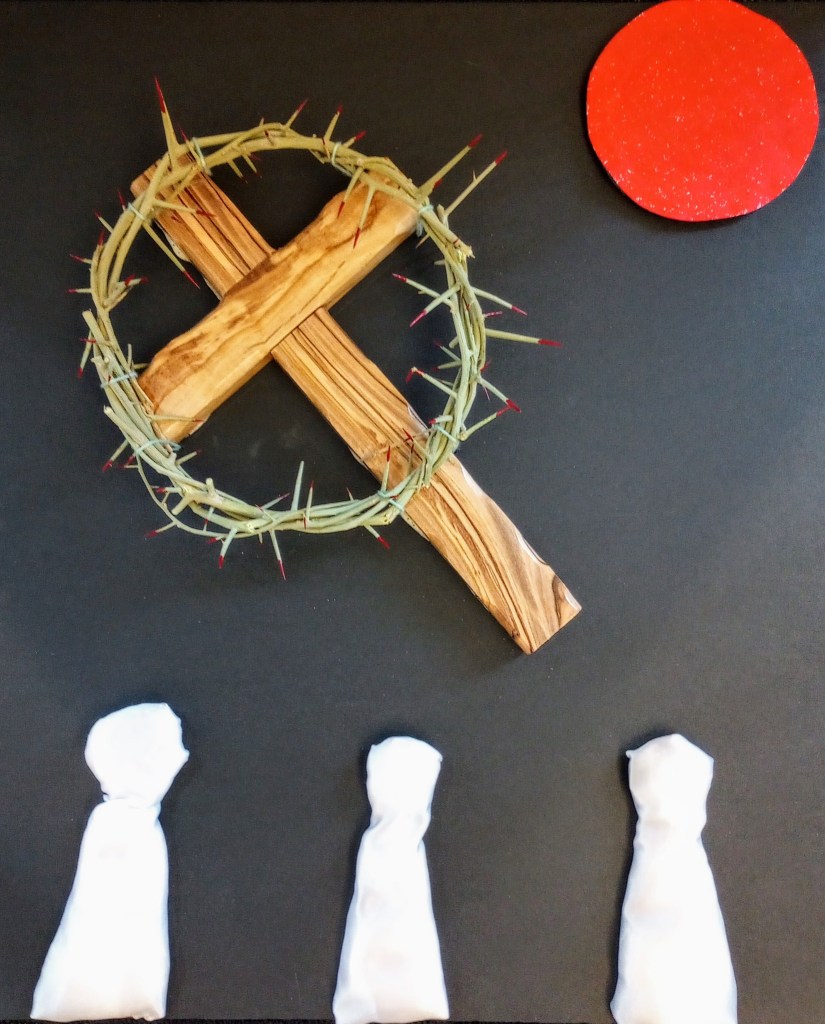
Station 4: Jesus meets the women of Jerusalem
Millicent says of her artwork:
“I made the women in white silk to show tears. They are together, witnessing the same scene, yet each individually bears her own grief. Isaiah 53 says Jesus bears our griefs and carries our sorrows.
Here is a recent example of Jesus noticing my tears and turning to care for me:
On the evening of Sunday, December 11, 2022, my downtown apartment building was on fire. I walked down the fire escape with two elderly ladies and when we got outside, we could see the flames shooting out the windows of one of the apartments. As I stood at the corner, a stranger, slightly inebriated, kept patting my shoulders and asking if I was okay. I said yes and then he said to me, “I’m not a religious person, but I think we should pray.” He cupped his hands and held them out to me. He waited for me to take hold of his hands, which I did. I thought he was going to start praying but realized he was waiting for me to pray. I prayed for the safety of all who were involved in the fire. After thanking this stranger, I walked away thanking God for sending me an Angel who helped me get centered on what was needed at that moment.
Because we weren’t allowed back into the apartment building due to water damage, I was given a choice to call a friend or family member to come get me, or sleep on a cot in the Convention Center. I prayed and asked God to give me a name to call. I called my friends who live on the Northside, and even though it was 12:45 a.m., the husband came to get me while his wife made up the couch. I stayed with them for two nights. When I found out I still couldn’t get into the apartment building on the third day, another friend said I could stay with her. She offered me her bed while she slept on the floor.
On Wednesday, December 14th, the landlord sent those tenants who still had no place to stay to a hotel on the Northside. I was able to stay at the hotel for several night until the apartment building manager came to the hotel to inform us that Tuesday, December 20th, would be the last night they would pay for us to stay at the hotel. We were also informed that we could not go back to the apartment building to live, because all leases were cancelled. On December 21st, a third friend extended hospitality to me. I stayed with her and her husband until I was ready to move.
The next day I looked at an apartment a few blocks from church and filled out an application. While waiting for approval, I received my security deposit in the mail along with December’s rent, prorated. That evening I got word that my application was approved, and the apartment was mine. I was able to use the check I had just received that afternoon as my security deposit for the new apartment. On Friday, December 30th, I moved into my new home. Prayer and praise turned a devastating situation into an experience of joy.”
Note: This article was originally published in The Ascent, a monthly publication of Church of the Ascension, Pittsburgh. Used with Millicent’s permission.
Luke 23:26 As they led Jesus away, a man named Simon, who was from Cyrene [a city in North Africa] happened to be coming in from the countryside. The soldiers seized him and put the cross on him and made him carry it behind Jesus. … “If any of you wants to be my follower, you must turn from your selfish ways, take up your cross, and follow me.” … “Take my yoke upon you. For my yoke is easy to bear, and the burden I give you is light.” Luke 23:26, Matthew 16:24; 11:29-30.
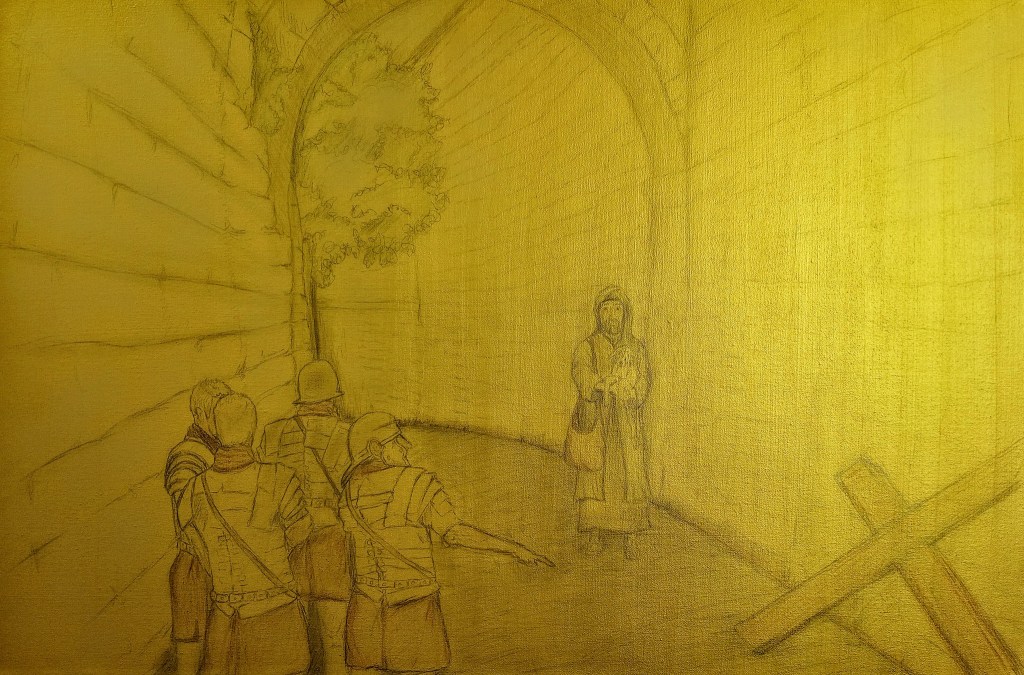
Station 3: The cross is laid on Simon of Cyrene
Doug says the following about his painting:
This piece is very much unfinished, which in many ways reflects the station. It calls each of us to take up the cross and follow Jesus.
My vision for the piece was to capture Simon of Cyrene returning from the field and being surprised by stumbling onto the scene of Christ’s brokenness, the soldiers’ dilemma, and the realization of what he was being called to partake in. In my mind, Simon was off to the Temple to make a celebratory peace offering – hence the young goat in his arms (see Leviticus 7:11-18). In the scene, he’s about to become a partaker in the preparation of a much more significant offering.
I chose a section of the Via Dolorosa that felt closed in, tight, and inescapable, with no option of creating the distance from suffering we so often desire. The dimension is meant to draw the viewer in to see Simon’s confrontation with the cross, feel the tension of a change in course, and emphasize the realizations that can come in a spilt second through the chaos of human drama.
I’m not convinced the current draft captures the intention, but the process of envisioning this work did provide a self-reflection of seeing oneself in the call to love God and others.Even in deep brokenness, facing hostility and suffering, Christ invites us to walk with him.
I hope to continue working on the piece and paint as time allows. Doug
[Debbie] As I’ve taken time to let this painting challenge me, the fact that it’s unfinished lets me see myself in Simon’s place, coming from my own tasks with my own purposes in mind, to a sudden confrontation with Jesus in the very act of laying down his life for me, too hurt and broken to continue bearing the weight of the cross. What will be my response?
Sandi Patty’s beautiful song “Via Dolorosa” captures some of this emotion.
Then Pilate turned Jesus over to them to be crucified. So they took Jesus away, carrying the cross by himself. … Even though Jesus was God’s Son, he learned obedience from the things he suffered. … He was led like a sheep to the slaughter. And as a lamb is silent before the shearers, he did not open his mouth. … Worthy is the Lamb who was slain, to receive power and riches and wisdom and strength and honor and glory and blessing. (John 19:16-17, Hebrews 5:8, Acts 8:32/Isaiah 53:7, Revelation 5:12)
Station 2: Jesus Takes Up His Cross
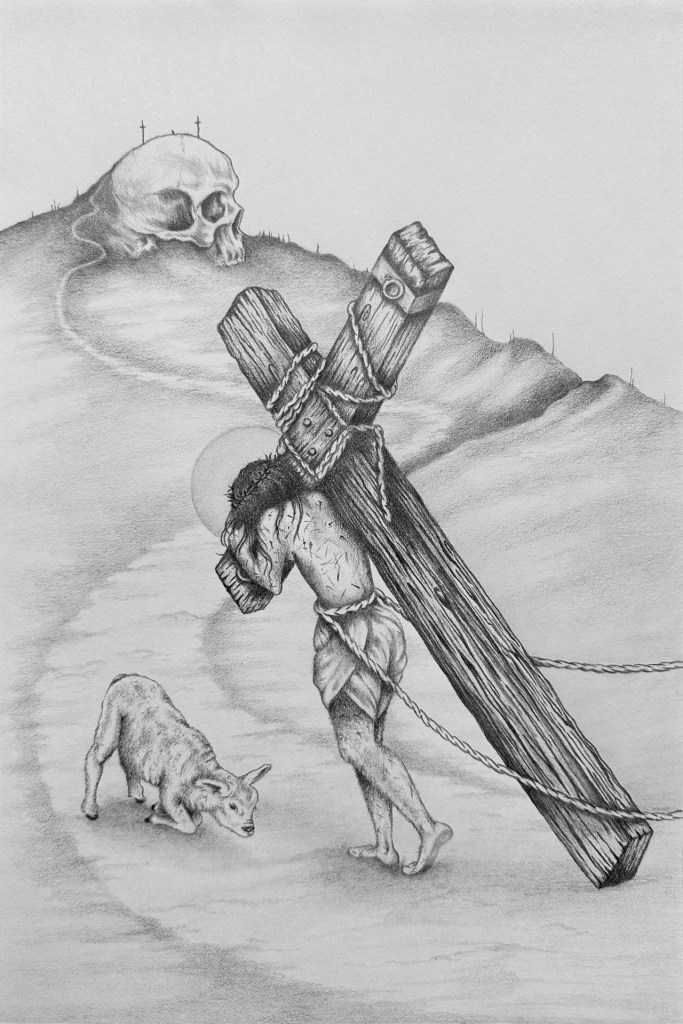
Marissa wrote the following about the significance and the process of creating this drawing:
Before anything else, I prayed. I prayed that the gift of art God gave me would be used to first and foremost glorify him. That after some time away from creating fine art, God would melt away feelings of self-doubt and use me and my now willing hands and heart to create again. I prayed to be led by the Holy Spirit to create something that would be a blessing to many and tell of the immeasurable love that God has for everyone.
Then, I spent time meditating on the Station 2 Scriptures [quoted above]:
I found myself drawn to the use of symbolism. The skull-shaped hilltop with cavernous, tomb-like recesses represents death. Ropes tied about Jesus’ waist, held out of view by soldiers and intended to pull him onward like a lamb led to slaughter, instead trail behind him, symbolizing Jesus’ willing spirit. A halo of light surrounds Jesus’ head, symbolizing his coronation as King of Heaven and Earth. A lamb, traveling the rocky, dirt path opposite Jesus, bows in reverence and gratitude to the truly sinless, spotless Lamb of God, illustrating Jesus as the once-for-all perfect sacrifice for sin. The little lamb is set free from death by Christ’s sacrifice as we too are set free and redeemed — the sheep of his pasture bowing before our Lord. The scene is one of solitude, inviting us to imagine the loneliness that Jesus may have experienced as he selflessly walked the path ahead of him.
I chose graphite on paper as my medium as it has always been a favorite of mine and is forgiving. It often provides me with a feeling of being more connected to the image and the details as they begin to emerge. In particular, I found myself rather emotional, holding back tears, when I began to render Jesus’ wounds. With each stroke of lead, I felt uneasy, sorrowful, guilty and repentant.
I’m so thankful to have had the opportunity to create a piece like this and to be in the company of so many talented artists within the body of the church. I pray that this experience will be a catalyst for more art inspired by Scripture to come into being, not only in the reflective time of Lent, but year round.
Mark 15:1-5 Very early in the morning the leading priests, the elders, and the teachers of religious law … bound Jesus, led him away, and took him to Pilate, the Roman governor. Pilate asked Jesus, “Are you the king of the Jews?” Jesus replied, “You have said it.” Then the leading priests kept accusing him of many crimes, and Pilate asked him, “Aren’t you going to answer them? What about all these charges they are bringing against you?” But Jesus said nothing, much to Pilate’s surprise.
[For other details of this scene, see Matthew 27, Luke 23, and John 18-19.]
Luke 12:7, 11-12 Don’t be afraid; you are more valuable to God than a whole flock of sparrows … When you are brought to trial … don’t worry about how to defend yourself or what to say, for the Holy Spirit will teach you at that time what needs to be said.
It’s tough to stay calm and quiet when unfair accusations are leveled against us. Don’t we instinctively want to defend ourselves and demand justice? Doing so can, though, play right into an aggressor’s hands. He or she now has something concrete to fight back against. A latecomer—say, a schoolteacher called to a bullying situation—may not be able to tell who started it.
What does calm stillness accomplish? For one thing, it can defuse escalation. When only one party is yelling and threatening violence, while the other is silent, the dynamics change. Martin Luther King Jr. demonstrated the power of nonviolent response through the long story of the struggle for basic human rights. As in the case of Jesus, courageous people preferred to be killed than to lower themselves to their accusers’ tactics.
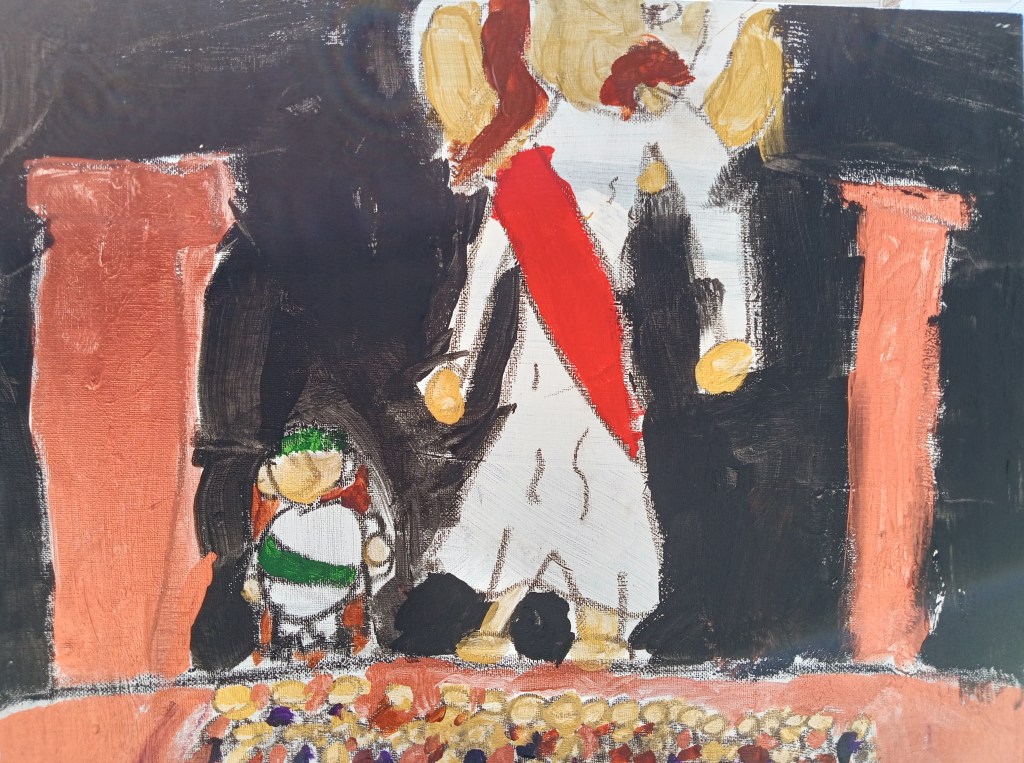
Six-year-old Caleb Massa gave considerable thought to Jesus standing silent before Pilate and the crowd of accusers as he painted a picture for the first Station of the Cross, part of the observance at our church of Good Friday.** Art can communicate even more than the artist had in mind. So before you read Caleb’s thoughts (below), what does this picture say to you about Jesus as he stood before Governor Pilate and the yelling, angry crowd?
Jesus is Condemned to Death, by Caleb Massa
Here’s part of Caleb’s description of his work:
“I painted Jesus huge because Jesus is really big, because he is God. Part of his face is not in the painting because he’s so big. The crowd is at the bottom. Pilate is sitting on a chair. You don’t see any of their faces except Jesus. The background is black because it’s a very sad scene.”
This big, solid, strong, calm Jesus lives inside of me and inside of you through the Holy Spirit. He is with us always. We aren’t alone, ever, even in situations of injustice and threat. We can ask him for help to know what to say and what not to say when we are slandered—even when we ourselves are our own accusers! Caleb’s painting will help me to remember that.
**Traditionally, there are fourteen Stations of the Cross. Church of the Ascension observes eight stations. Each year, a member of the church—a child, young person, or adult—creates art for each station. A guide to this year’s creations says this: “The making of each Station is a labor of love, a formative practice in which the artists participate with the Holy Spirit to reveal afresh the Passion of Christ.” Each artist has given me permission to post his or her work on this blog. I am grateful to each of them.
Psalm 92:1-4, 13-15 It is good to praise the Lord and make music to your name, O Most High, proclaiming your love in the morning and your faithfulness at night. … You make me glad by your deeds, Lord; I sing for joy at what your hands have done … Planted in the house of the Lord, the righteous will still bear fruit in old age. They will stay fresh and green proclaiming, “The Lord is upright; he is my Rock, and there is no wickedness in him.”
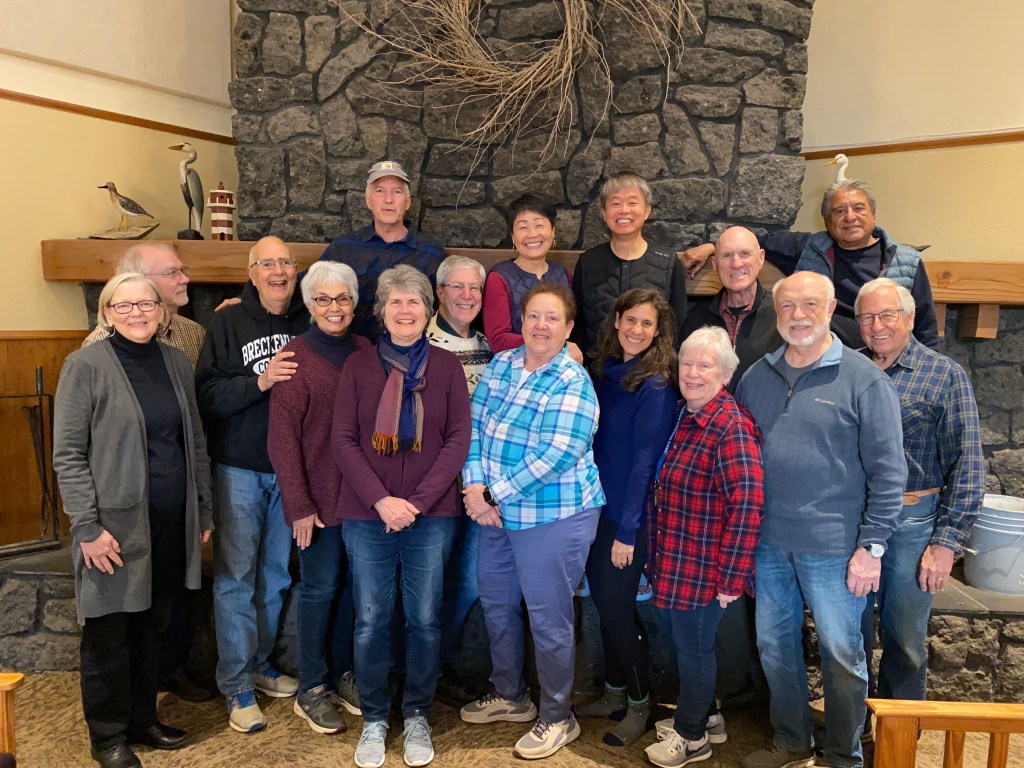
Dave and I have just enjoyed a few days on the coast of Oregon at a lovely camp founded by Quakers almost a hundred years ago. Twice a year we reconnect with the International Ministry Team (IMT), our place to “belong” within OC International.
Don’t you love the duck on Edwin’s head?
It’s a diverse, experienced team working literally all around the world, led by the former president of OCI. It’s a privilege to profit from the wisdom gleaned from years of committed cross-cultural impact across a spectrum of ministry genres. We soak in marvelous stories of God’s love and faithfulness through often-harrowing circumstances.
My favorite part of these gatherings is worshiping the Lord with these lovely people. Half the team is older than we are. They model for us the words of Psalm 92. Rather than just getting old and crotchety and self-centered, they passionately proclaim the worthiness of the Lord to receive our praise. And believe me, their experiences in life have been anything but easy. They have made choices along the way—hundreds, maybe thousands of choices—to seek and find the Lord through their tough times. They have planted their feet on the Rock and found him to be their solid foundation through every storm.
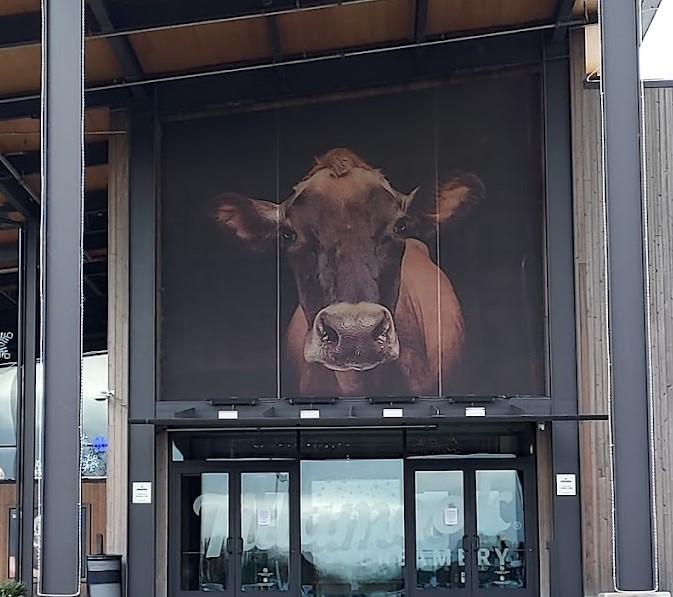
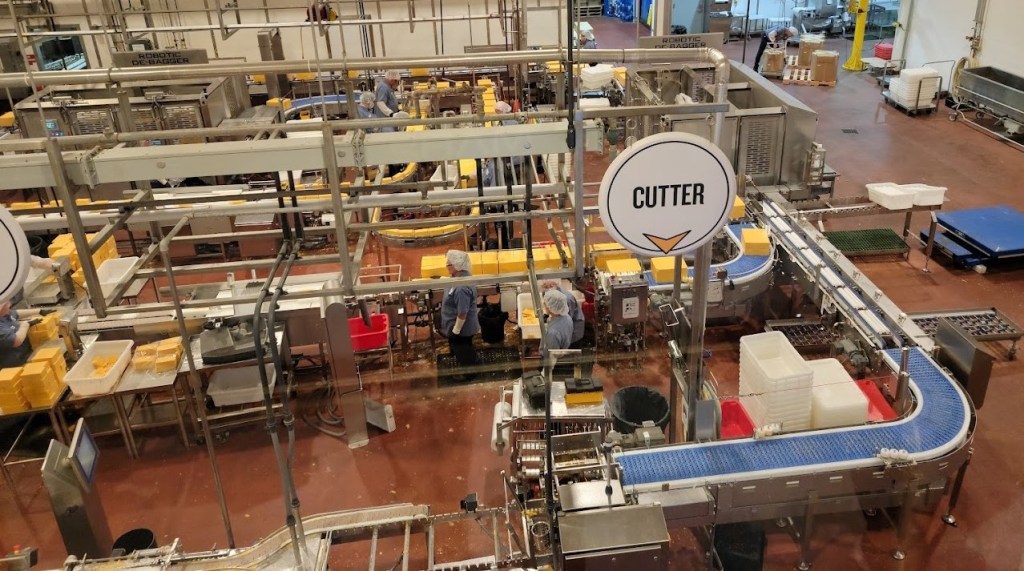
Mid-week, we take a break from meetings to explore a local attraction of the place where we’ve gathered. This time we toured a cheese factory—Tillamook Creamery, a few miles down the coast. Our team leader, Greg, challenged me to write a blog applying something from this tour to our spiritual lives. So here we go:
Entrance to Tillamook Creamery, Tillamook, Oregon
Cheese, like wine, is valued according to how long it has aged.
Of course, good cheese requires good ingredients and a careful process of separation of the curds from the whey. But the time comes when it just needs to rest. Nothing more can be done for the cheese than to leave it alone and let the rennet do its thing, “cheddaring” (further acidifying) the cheese.
Cutting and packaging cheese that has been aging for months!
I didn’t know “cheddar” is a verb! While the cheese is resting, cheddaring is going on, enhancing the flavor and hardness of the cheese.
How often do I rest and let the special ingredient in me, the Holy Spirit, refine me and enhance my “flavor”?
The answer to that question may determine whether, in my old age, I still have something positive to offer those around me, instead of getting grumpy and gripey. Because GOD is faithful, I want to sing for joy until the end of my days. Don’t you?
John 15:5-8 I am the vine; you are the branches. Those who remain in me, and I in them, will produce much fruit. For apart from me you can do nothing . . . But if you remain in me and my words remain in you, you may ask for anything you want, and it will be granted! When you produce much fruit, you are my true disciples. This brings great glory to my Father.
[Debbie] I’m posting today from Oregon, where our mission team is meeting for a few days as we do twice a year. I want to share with you part of a letter from our Syriac scholar/Franciscan friar friend Andrew who visited Krakow a few days ago. Andrew wrote:
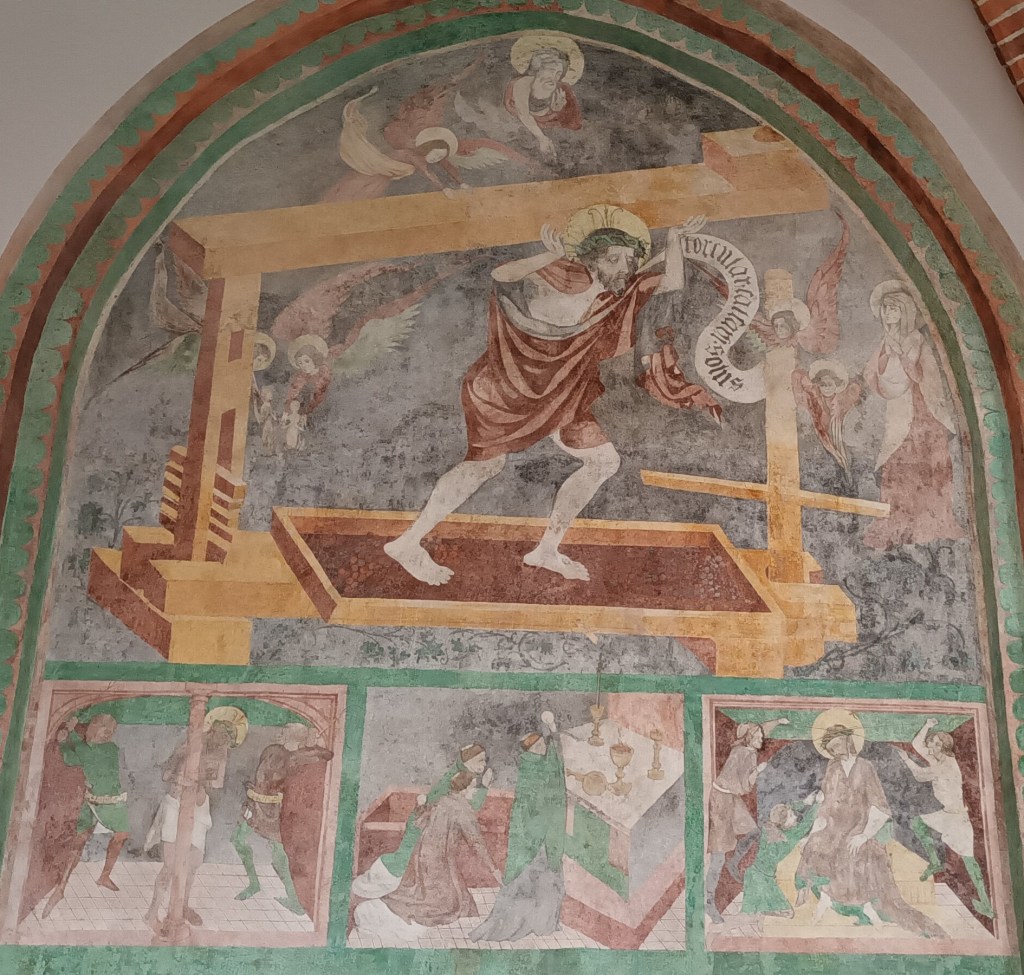
I’m attaching an image of a 15th-century fresco of the “Mystical Winepress” from the friary cloister, one of the few pieces of early art that was not destroyed in a fire that gutted the church in the mid-19th century.
The image shows the suffering Christ carrying his cross, except that the cross is the winepress and he is pressing himself. His own blood – the juice from the grapes – drips down into the chalice of the mass in the picture below. Above is God the Father, beside Christ is the Virgin Mary.
It’s a stark image, as medieval paintings often are. But it also taps into the fact that the message of the cross is about real human suffering.
The Mystical Winepress, photo by Andrew Hochstedler
Am I called to be like Christ, to suffer? We all suffer at some point. It’s part of our human experience, each in different ways. There is one level at which my own sufferings can be united to Christ’s, I can come closer to him in love through my sufferings, as they allow me to accompany Christ and know him in his sufferings (Phil 3:10). I don’t have much practice with this, but I understand it to work if/when we choose to give the sufferings to him, to make them into gift rather than just meaningless pain. This a path that Francis of Assisi followed, very literally, meeting Christ even in “Sister Death.”
At another level, Christ does not need me to suffer like him. His sacrifice is enough. As one of the sisters from St. Faustina Kowalska’s community, the Congregation of our Lady of Mercy, told us during our visit last Thursday, they don’t go out seeking suffering for its own sake. However, I am called to be like the virgin Mary, doing what I can to bring Christ into the world, listening for His voice, saying “yes” to him, making each action a moment of gift so that Christ can enter my sterile life and make it fruitful, bringing love to me and others.
Jacob of Sarug, an early Syriac Christian writer, connects Mary to Christ’s winemaking, recognizing her as the vine on which Christ, the cluster of grapes, grew. In Syriac, by the way, the word for “vine” used in early versions of John 15 can also mean “vineyard”… so in that image Christ can be the vineyard and we can all be vines and/or workers in the “Christ vineyard.” Syriac Church Fathers enjoy playing with imagery that has multiple levels of meaning.
Addressing Mary, Jacob of Sarug says (in Homily on the Nativity 1),
O virginal vine, who although not pruned, gave a cluster [Christ],
behold, by whose wine creation, which was mourning, rejoices!
I love these two lines because they tie so much imagery together: (1) Mary’s virgin birth-giving, (2) Christ’s death on the cross (3) Christ’s blood which becomes Eucharistic, (4) Wine that brings rejoicing, (5) Christ as a new fruit in contrast with the fruit of the tree of the knowledge of good and evil which brought death and sorrow.
Genesis 8:21-22, 9:16 The Lord said to himself, “I will never again destroy all living things. As long as the earth remains, there will be planting and harvest, cold and heat, summer and winter, day and night. …When I see the rainbow in the clouds, I will remember the eternal covenant between myself and every living creature on earth.”
Matthew 26:27-28 Jesus took a cup of wine and gave thanks to God for it. He gave it to them and said, “Each of you drink from it, for this is my blood, which confirms thecovenant between God and his people. It is poured out as a sacrifice to forgive the sins of many.”
2 Timothy 4:6-7 As for me, my life has already been poured out as a drink offering to God. The time of my death is near. I have fought the good fight, I have finished the race, and I have remained faithful.
It rained all or part of every day we were in Ireland. We saw more rainbows in a week than we usually see in a year. And yes, there was treasure at the end of the rainbows. Our “pot of gold” was the wonderful people we met, who shared part of their lives with us. We learned some of their hopes and aspirations—what rainbows symbolize in the Emerald Isle.
As we sat high on Bray Head, County Wicklow, beneath a cross overlooking Dublin Bay, we saw a rainbow begin to form and arc, its colors gradually strengthening. Can you see the developing rainbow in this far-away photo?
But seeing this rainbow on our last day in Ireland, sitting at the foot of a cross, reminded me not only of God’s covenant with Noah, but of the covenant Jesus inaugurated with his disciples the night he was arrested, sharing with them wine which represented the pouring out of his blood for sanctification—remission—forgiveness—cleansing—of their sin, and ours.
In Old Testament worship, two types of liquid offering used in Old Testament worship, familiar to Jesus’s disciples and Paul and Timothy. A blood offering had the power to sanctify (Leviticus 8:15). Paul compared his life to a drink offering, an “extra”—a personal expression of devotion and gratitude (Numbers 28:7).
Jesus’s blood sacrifice carried the weight of covenant. The drink offering Paul invoked communicated how precious that covenant was to him, compelling him to give up everything he had once valued and pursued, his old “pot of gold”: I once thought these things were valuable, but now I consider them worthless because of what Christ has done. Yes, everything else is worthless when compared with the infinite value of knowing Christ Jesus my Lord. … I want to know Christ and experience the mighty power that raised him from the dead. I want to suffer with him, sharing in his death (Philippians 3:7-8, 10).
So, what do I hope for and aspire to? What’s my pot of gold? At the end of my life, what will I think mattered?
Ever since that beautiful morning on Bray Head, the questions have lingered.
… this photo of the Ash Wednesday pottery smashing, referenced in my last post. Thanks, Elise! Also, the mosaic artist, a member of our church, is Anne Melnyk.