Simeon’s song: a long wait rewarded

But God kept his promise

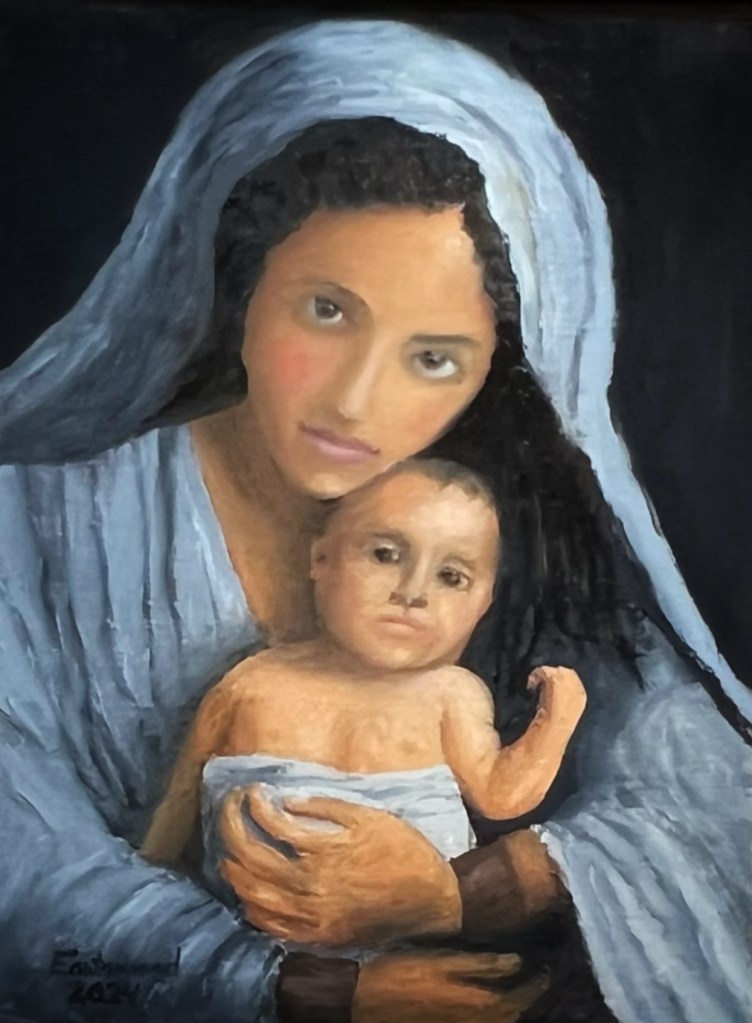
Luke 2:25-35 Simeon was righteous and devout and was eagerly waiting for the Messiah … The Holy Spirit was upon him and had revealed to him that he would not die until he had seen the Lord’s Messiah. That day the Spirit led Simeon to the Temple. So, when Mary and Joseph came to present [eight day old] baby Jesus to the Lord as the law required, Simeon was there. He took the child in his arms and praised God, saying,

Sovereign Lord, now let your servant die in peace, as you have promised.

I have seen your salvation

which you have prepared for all people.

He is a light to reveal God to the nations

Shutterstock: Lopolo

Jesus’ parents were amazed … Then Simeon blessed them, and he said to Mary, “This child is destined to cause many in Israel to fall, but he will be a joy to many others. … The deepest thoughts of many hearts will be revealed. And a sword will pierce your very soul.”

What are you “eagerly waiting” for?

On a walk last week, Dave and I discussed what we each feel we must accomplish before we die. Mine is publishing the book Three-in-One. It’s taking much longer than I expected. Several times I’ve thought I had the final version nailed down. And then one of my early readers comes through with valuable suggestions; each revision has made the book better. I’ve learned that the timeline of my readers doesn’t match mine. I’ve had to practice Simeon’s “eager waiting.”

Can you imagine Simeon’s emotions as he held baby Jesus in his arms, while the Spirit whispered to him, “I’ve kept my promise to you. This tiny baby is the one you’ve been waiting for so long! He will reveal God to the nations!

That’s exactly my hope for Three-in-One, that it will reveal God in ways that delight us as we wait for Jesus’ return. If readers experience even a part of what has thrilled my heart as I have written this book, all my investment—all my waiting—will be more than worthwhile.

What are you waiting for?

Pure light for the glory of God. Hope. Mercy. Healing balm. A song of joy. Your name. Your Kingdom, Lord; not an earthly kingdom. Your power for salvation; not earthly power. Your will be done. “Song for the Nations” by Jim Gilbert, two versions:

(with lyrics; choir) Note: there’s a mistake on the second-to-last lyric slide. It should say in the peoples of the earth, not to the peoples of the earth.

(with inspirational pics; women’s voices)

Lord, may your Kingdom come in us. In me. Here. Today.

The angels’ song: glory

But God became human

Luke 2:8-20

After college, I worked for a time at Tyndale House Publishers. Artist and calligrapher Tim Botts generously designed for Dave and me our wedding invitation and program. He and Handel can tell the story of the angels’ song better than I can. Without doubt, this is one of the most spectacular “But God” moments in history, witnessed by a group of sleepy shepherds in a quiet field outside the village of Bethlehem.

My photos of pages December 22, 23, 24 by Tim Botts, from “Daily Portraits of the Word” calendar published by Inkwell Greetings

Listen: 39:15-43:35 on this recording of Handel’s Messiah by the Academy of Ancient Music and choir of the Queen’s College, Oxford

When the angels had returned to heaven, the shepherds said to each other, “Let’s go to Bethlehem!” … And there was the baby, lying in the manger. After seeing him, the shepherds told everyone what had happened and what the angel had said to them about this child. … The shepherds went back to their flocks, glorifying and praising God for all they had heard and seen (Luke 2:15-20).

I wrestled with this passage, and its tragic aftermath told by Matthew (chapter 2), while writing Three-in-One: The Mysterious Friendship of Derry and Benny, which I hope will be out by Easter. Peace on earth? Good will among men? Fear not?

Like Mary, in quiet moments I ponder the age-old questions. Advent reminds me that we don’t yet know the end of the story. And that God is writing a comedy, a grand romance, not a tragedy.

The ending of Earth’s story will be but the beginning of glory that surpasses even the angels’ song. For the mouth of the Lord has spoken.

10:25-13:15 on this recording of Handel’s Messiah by the Academy of Ancient Music and choir of the Queen’s College, Oxford

Mary’s song of joy

Mary’s song of joy

But God notices

Luke 1:46-55

Oh, how my soul praises the Lord.

How my spirit rejoices in God my Savior!

For he took notice of his lowly servant girl,

And from now on all generations will call me blessed.

For the Mighty One is holy,

And he has done great things for me.

I saved Mary’s song for this week because the theme of Advent 3 is joy. Few songs in Scripture are as joy-filled as the Magnificat as Mary praises the Lord with her whole being.

When our daughter Karis was thirteen, she imagined what it might be like to be Mary and wrote what she called “Mary’s Diary.” It’s available as a booklet, which I’ll be glad to mail to anyone upon request.

Karis imagined Mary writing:

“I guess that’s when God seems the greatest: when he takes a nobody (like me) and makes something out of them. Oh, thank you, God, for your amazing grace … Oh, even this moment, I praise the Lord. Jehovah gave me a song that I have written down, and I am singing it back to him every day. … Oh, how my soul praises the Lord! All my fears for myself have been put to rest. How amazing is Jehovah.”

What song can you sing to the Lord today, from delight at his work in your life?

Magnificat (with Wexford Carol), Keith and Kristyn Getty

Christmas sales Dec 12-Jan 12 direct from Ingram Spark or on Amazon

The Giggly Bug hardcover: normal price $27; sale price $20 until January 12, 2026

Kornfield, Debra

Buy Now

The Giggly Bug soft cover: normal price $15; sale price $12 until January 12, 2026

Kornfield, Debra and Ramsay, Aderyn

Buy Now

Campfire Song Stories hardcover: normal price $55; sale price $35 until January 12, 2026

Kornfield, Debra

Buy Now

Campfire Song Stories soft cover: normal price $32; sale price $25 until January 12, 2026

Kornfield, Debra and Kornfield, Karis Joy

Buy Now

Other titles available from Amazon:

Just out! The Gladness Book: Fun for Kids who Love to Write

Karis: All I See Is Grace Sale price $10.89

Karis: Todo lo que veo es Gracia Sale price for the Karis book in Spanish $10

(For the Karis book in Portuguese, contact me: debrakornfield@gmail.com)

The Callie and Charlie Series:

Horse Thief 1898

Treasure Hunt 1904

Facing the Faeries 1906

Offered with love!

Sitting in darkness

But God’s light breaks in

Luke 1:68-79 Zechariah’s song:

Praise the Lord, the God of Israel, because he has visited and redeemed his people.

He has sent us a mighty Savior from the royal line of his servant David,

Just as he promised through his holy prophets long ago. …

So we can serve God without fear, in holiness and righteousness

For as long as we live. …

Because of God’s tender mercy,

The morning light from heaven is about to break upon us,

To give light to those who sit in darkness and in the shadow of death,

And to guide us to the path of peace.

Do you, too, “sit in darkness”? How would you describe that darkness: anxiety and worry, fears for the future, stuckness over wounds in the past and harmful habits in the present? Do you, too, long for guidance to a path of peace?

Shutterstock: Vlue

Last week the prophet Zechariah from the Old Testament spoke to us about a Day of the Lord bringing life-giving waters to our parched souls. Five hundred years later, the Holy Spirit prophesied through another Zechariah, a priest, father of John the Baptist (Luke 1:67), this time about the gift of light breaking through our darkness.

Three months before Zechariah gave this prophecy, the angel Gabriel informed Mary, newly pregnant with Jesus, that another miraculous pregnancy had taken place: her barren elderly relative Elizabeth, Zechariah’s wife, also expected a baby!

Mary hurried to visit Elizabeth, who by the Spirit recognized the baby growing in Mary’s womb as her Lord. “You are blessed because you believed,” Elizabeth told Mary, in contrast to her husband, who had spent the last six months unable to speak because of his early, shocked disbelief in Gabriel’s message to him. Mary responded with a song of praise we call the Magnificat. We’ll look at this song next week.

After his son John was born, Zechariah prophesied that his child would prepare the way for the Lord, a mighty Savior who would provide salvation and forgiveness of sins to his people. Quoting Malachi and Isaiah, Zechariah foretold Mary’s baby’s birth as light from heaven about to break upon them, offered to the dark world through the tender mercies of God.

Two surprise visits from the angel Gabriel. Two miraculous pregnancies. Two sons. Four celebratory songs. A host of angels. Multiple shepherds. Two elderly witnesses. The fulfillment of ancient covenants and prophecies.

Luke compressed unspeakable wonder into the first two chapters of his Gospel. No wonder Mary needed to take a step back and ponder all that had broken into her heretofore unremarkable experience (Luke 2:19).

Advent offers us space to do the same: to consider the marvels of her baby’s first coming and what they mean to us. To open our hearts in hope of receiving the Spirit’s tender mercies. To welcome his light into our darkness. To deepen our hope as we anticipate his return in glory. And to find the path to the Prince of peace.

Shine Jesus Shine, Graham Kendrick

How long?

But God’s Spirit is more effective than force or strength December 3, 2025

Zechariah 4:6, 7:12 It is not by force nor by strength, but by my Spirit, says the Lord of Heaven’s Armies. … They made their hearts as hard as stone, so they could not hear the instructions or the messages that the Lord of Heaven’s Armies had sent them by his Spirit through the earlier prophets. That is why the Lord of Heaven’s Armies was so angry with them.

Zechariah 9:9, 16; 14:1, 8-9 Look, your king is coming to you. He is righteous and victorious, yet he is humble, riding on a donkey … On that day the Lord will rescue his people, just as a shepherd rescues his sheep. … Watch, for the day of the Lord is coming. … On that day life-giving waters will flow out from Jerusalem … and the Lord will be king over all the earth. On that day there will be one Lord—his name alone will be worshiped.

Image by Carol Amidi

As we enter Advent, the prophet Zechariah offers our last insight into the Holy Spirit at work in the Old Testament. Through God’s Spirit, Zechariah envisioned Advent themes: the sanctification of God’s people ushering in a new age of holiness, and a great shepherd, Messiah, coming to reign over a new kingdom of perfect harmony. Watch, for the day of the Lord is coming, when all earth will be rescued from evil, renewed, rejuvenated, restored.

Zechariah assisted his fellow prophet Haggai, encouraging the people living in Palestine after the Exile to finish rebuilding the Temple and reinstitute worship there under a revitalized priesthood. Centuries later, after the Messiah did come into Jerusalem riding on a donkey, Paul would explain to believers in Messiah’s redemptive work that they themselves, their own bodies, were now the Temple of God, through the Holy Spirit living within them. We, too, need rebuilding from the impact of evil in our time, our worship reinvigorated.

We, too, seek the Lord’s transformation, both personally and collectively, as we also await the Messiah’s coming for the “last battle” as CS Lewis called it. This time, he will usher in the Kingdom, uniting heaven and earth.

We, too, watch and wait for the coming of the Lord, our Shepherd and King.

Zechariah’s words resonate today. We, too, must turn from our evil ways and practices:

Don’t be afraid. But this is what you must do:

Tell the truth to each other.

Render verdicts in your courts that are just and that lead to peace.

Don’t scheme against each other.

Stop your love of telling lies that you swear are the truth.

              I hate all these things, says the Lord. … So love truth and peace.

(Zechariah 1:4; 8:15-17, 19)

How, though? How can we change these things that are so embedded in our culture, in our own hearts? Not by force, nor by strength, but by God’s Spirit, Zechariah tells us. This Advent let’s open our hearts to God’s Spirit so he can do beautiful, regenerative work within and among us.

“How Long” by Ann VosKamp, Leslie Jordan, and Trillia Newbell, sung by St. Andrew’s Lutheran

“Here I raise my Ebenezer” by Bonnie Budzowski, author

But God wants us to remember and tell how he has helped us

1 Samuel 7:12 Samuel then took a large stone and placed it between the towns of Mizpah and Jeshanah. He named it Ebenezer (which means “the stone of help”), for he said, “Up to this point the Lord has helped us!”

[Debbie] I’m delighted to introduce you to Bonnie Budzowski, who offers not just a blog post but a whole book dedicated to noticing, remembering, and sharing with others what God does in our lives. I asked her to do this for Thanksgiving since it’s such a perfect time to begin a lifestyle of intentional honoring of the Lord in this way. As always, I would love for you to share your “But God …” story with me and with the readers of this blog.

Here’s Bonnie:

Sometimes I purchase a greeting card that I’m reluctant to send. It might be the perfect picture, the sentiment, or both that I want to hold onto. Is it a sin to hoard a greeting card?

Once such card features a photograph of a young girl reading from a book. The girl looks to be about six years old. She is happily reading to a dog that is bigger than she is. The dog sits with rapt attention, his pink tongue hanging out of his dog-smile.

The sentiment below the photo is a quote attributed to the poet and activist Muriel Rukeyser: The universe is made of stories, not atoms.

For more than fifteen years, my job as principal of Gravitas Press was to act as a story whisperer, to help people find and articulate their stories in compelling ways. Even before those years, I knew I would one day write a book chronicling the stories of God’s surprising grace in my life. I knew the project would wait until I was near retirement.

What I didn’t know was that in the process of writing the book, something new and fresh would once again surprise me. I would discover a spiritual discipline that is largely missing in people who are otherwise devout Christians.

I discovered that God’s people have always intentionally created memorials to commemorate God’s acts in their history.

For example, following encounters with God and his promises, Abraham built altars. Jacob anointed the stone he used as a pillow the night he saw angels climbing a ladder between heaven and earth. Joshua instructed representatives from the twelve tribes of Israel to each contribute a stone to create a memorial to mark the miraculous crossing of Jordan River. Samuel set up a stone memorial to mark the time God sent a display of raucous thunder to defeat the Philistine army. Samuel called his memorial ebenezer, a word meaning “stone of help.” The psalmists continued the tradition, using words rather than stones. And Jesus commanded we practice a meal of remembrance.

What’s the purpose of this pattern of remembrance? It’s to ground us in the biblical story of God’s work and repeatedly draw us back to trusting in God’s faithfulness. Ebenezer Chronicles: The Missing Spiritual Practice invites you to consider what might happen if you added a practice of intentional remembering into your prayer life, around your table, and in your everyday conversations. It’s also a collection of stories of God’s amazing grace in my broken life. It’s a book in which God is the hero.

Ebenezer Chronicles, The Missing Spiritual Practice is available at Amazon.com. To read the first chapter, visit me here and learn about workshops for your group, including a virtual book club.

“Here I raise my Ebenezer …” Come Thou Fount of Every Blessing, sung by Chris Tomlin

Love expels fear

But God’s Spirit eases our fears

Haggai 2:5 The Lord of Heaven’s Armies says] “My Spirit remains among you, just as I promised when you came out of Egypt. So do not be afraid.”

Exodus 23:9 You must not oppress foreigners. You know what it’s like to be a foreigner, for you yourselves were once foreigners in the land of Egypt.

See also: Leviticus 19:9-10, 33-34; Numbers 15;15-16; Deuteronomy 10:18-19, 24:14-18, 27:19; Psalm 146:9; Jeremiah 7:5-7, 22:3; Zechariah 7:10; Malachi 3:5; Matthew 25:35-40; Hebrews 13:2

Read this poem top to bottom, then bottom to top.

Refugees

by Brian Bilston

They have no need of our help

So do not tell me

These haggard faces could belong to you or I

Should life have dealt a different hand

We need to see them for who they really are

Chancers and scroungers

Layabouts and loungers

With bombs up their sleeves

Cut-throats and thieves

They are not

Welcome here

We should make them

Go back to where they came from

They cannot

Share our food

Share our homes

Share our countries

Instead let us

Build a wall to keep them out

It is not okay to say

These are people just like us

A place should only belong to those who are born there

Do not be so stupid to think that

The world can be looked at another way.

(Now read from bottom to top.)

The Kingdom of Jesus, Porter’s Gate

This is what God says is good

But God’s Spirit fills us with justice, strength, and boldness

Micah 2:7, 3:8 Should you talk that way, O family of Israel? Will the Lord’s Spirit have patience with such behavior? If you would do what is right, you would find my words comforting.But as for me, I am filled with power— with the Spirit of the Lord. I am filled with justice and strength to boldly declare Israel’s sin and rebellion.

Micah 6:8 The Lord has told you what is good, and this is what he requires of you: to do what is right [act justly NIV], to love mercy, and to walk humbly with your God.

At our May annual event, Sisters Celebrating Diversity focused on God’s requirements of us in Micah 6:8. Participants were each given a bracelet that says, “Do justice, love mercy, walk humbly.” I wear mine often. It reminds me to walk into any situation I may encounter with those three principles in mind. It reminds me to ask the questions, from God’s perspective, what does justice look like here? Am I conscious of his merciful heart? Is my chief aim that he and his ways be honored, including the lives of anyone I interact with, each one beloved by God?

Can I do this on my own? No way at all. Only through the Holy Spirit’s guidance and grace.

Sometimes acting justly requires naming wrongdoing, that which hurts God’s heart and other people, so that it can be dealt with and injuries healed. Through the Holy Spirit, Micah found the courage, wisdom, and boldness to do this. A difficult task indeed, and no easier now than it was then. The false prophets were the ones saying, “Hey, everything is OK, nothing to worry about—God’s on our side” (Micah 3) while they made decisions based on bribes and twisted justice for their own profit and idolized their own comfort and power and success.

Yet the Spirit kept reminding beleaguered Micah—and through him, us—that God longed to heal his people and restore their land. That was the goal, like an oncologist who must locate and name a cancer to treat it appropriately.

And he reminds us today that no matter what anyone says, these three matter to God: justice, mercy, and humility.

God said to Micah, “My people’s wound is too deep to heal,” (1:9) and devastation was coming. But later, he said, “But you, O Bethlehem Ephrathah … a ruler will come from you. … And he will stand to lead his flock with the Lord’s strength, in the majesty of the name of the Lord his God … and he will be the source of peace” (Micah 5:2-5; Matthew 2:6).

Just out! The Gladness Book: Fun for Kids who Love to Write

This child has just been born!

Available now for kids who love to write.

Karis is the “teacher” in this unique writing book for kids age 9-12. It’s organized around excerpts from an autobiography Karis wrote when she was thirteen. If kids follow the prompts, by the end they’ll have written their own autobiography, as well as stories and poems. After each entry by Karis, questions are offered at two levels, for beginners and for writers who are more advanced. Aderyn’s mice illustrations add to the fun.