But God

Advent 1, HOPE: Let go. Look up!

Advent ABC playlist

But God gave each of us a race to run

Hebrews 12:1-2 Since we are surrounded by such a huge crowd of witnesses to the life of faith, let us strip off every weight that slows us down, especially the sin that so easily trips us up. And let us run with endurance the race God has set before us. We do this by keeping our eyes on Jesus, the champion who initiates and perfects our faith …

Luke 21:34 Be on guard so that your hearts are not weighed down with … the worries of this life, and that day [Christ’s return] catch you unexpectedly (NRSVA).

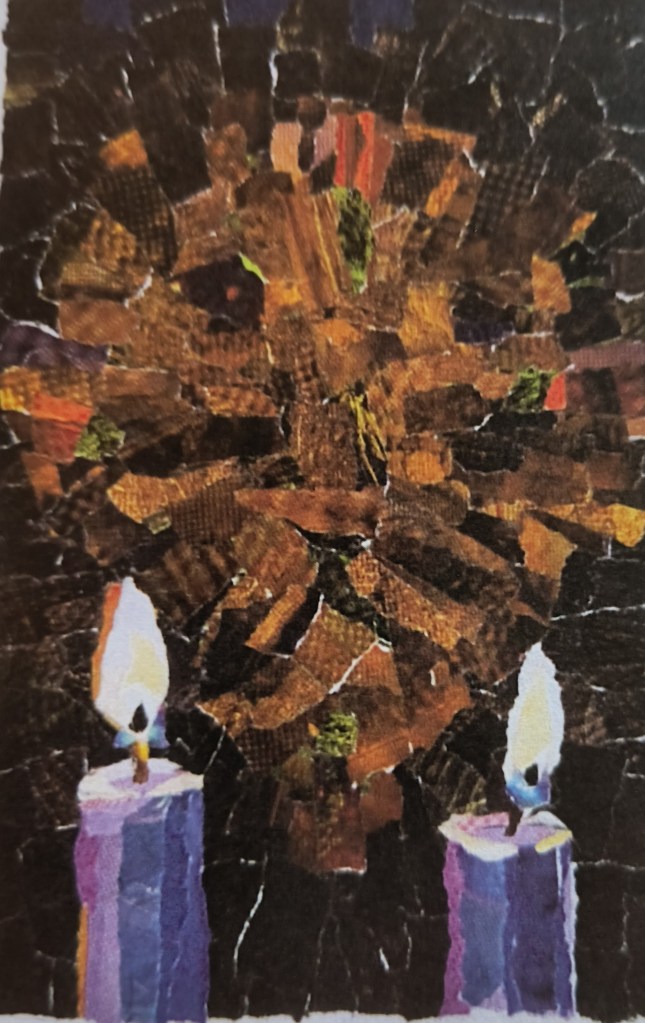
Image by my friend Carol Amidi https://www.carolamidi.net/

On Monday evenings, I meet on Zoom with women from Argentina, Chile, and Venezuela who are leaders in their churches and denominations. This week we are memorizing Hebrews 12:1-2 (in Spanish, of course). I realized yesterday how fitting this passage is for Advent, this interesting time in the year when we anticipate Christ’s return in glory while preparing to celebrate his first coming as an infant.

This year in particular my heart has been weighed down with many concerns. (Yours too?) I asked a prayer team for intercession yesterday about how to handle high stress and at the same time focus on the hope Advent offers us. As our pastor Peter reminded us, Advent hope is rooted in the fact that we know Jesus is good. We know him, his tenderness and compassion, his faithfulness and gentleness—this One who will return one day as a mighty warrior, defeating all evil, to reign in justice. We’ll be able to look into his eyes and know that he is the one who has been our friend and companion all our lives.

My main takeaway from the wonderful prayer offered on my behalf is that I am to live from a center of peace, daily entrusting to Jesus my burdens and worries, both those over which I have a measure of control and those I can’t control at all.

Let go and look up. Accept the support of those whom God has placed around me, and cheer each of them on in their own God-designed races.

Hope. All will be well.

Since he himself has gone through suffering and testing, he is able to help us when we are being tested. … So let us come boldly to the throne of our gracious God. There we will receive his mercy, and we will find grace to help us when we need it most (Hebrews 2:18, 4:16).

I invite you to savor again the wonderful music (5 hours!!) on my Advent ABC playlist:

Be a window

But God shines his light through us

Matthew 5:16 Let your good deeds shine out for all to see, so that everyone will praise your heavenly Father.

Hebrews 13:21 May the God of peace equip you with all you need for doing his will. May he produce in you, through the power of Jesus Christ, every good thing that is pleasing to him.

Last year, our church sent to be cleaned several of the stained-glass windows of our historic building. The difference is stunning, to the point that I’m sometimes distracted from the service by the play of colored light on the huge painting of Jesus’ ascension above the altar. I find this enriching, because I know what those windows convey of the Gospel story.

Cleaning of one of the smaller Ascension windows: photo Marilyn Chislaghi

I know too the passion and prayer of the church to not only receive light through its beautiful windows, but to reflect light into its cosmopolitan neighborhood of Oakland, which attracts people from around the world through its universities and medical center (including us from our beloved Brazil!).

Hence my appreciation of George Herbert’s poem “The Window,” which I’m connecting to chapter 3, “God Most Good,” in the book In His Image I’ve been referencing. Jen Wilkins says “Be good. Others will see it. You’ll be a light causing others to glorify the Father of lights.” Here’s the poem:

The Windows

Lord, how can man preach thy eternal word?

He is a brittle crazy glass;

Yet in thy temple thou dost him afford

This glorious and transcendent place,

To be a window, through thy grace.

But when thou dost anneal in glass thy story,

Making thy life to shine within

The holy preachers, then the light and glory

More reverend grows, and more doth win;

Which else shows waterish, bleak, and thin.

Doctrine and life, colors and light, in one

When they combine and mingle, bring

A strong regard and awe; but speech alone

Doth vanish like a flaring thing,

And in the ear, not conscience, ring.

George Herbert, 1593-1633

How clean is the beautiful window of my redeemed life?

Our great Ebenezer

But God faithfully keeps his word

Hebrews 2:17 Therefore, it was necessary for him [Jesus] to be made in every respect like us, his brothers and sisters, so that he could be our merciful and faithful High Priest before God.

John 1:14 So the Word became human and made his home among us. He was full of unfailing love and faithfulness.

In Chapter 7 of her book In His Image, Jen Wilkin identifies the written word of God, the Bible, as “our great Ebenezer, a memorial stone to the faithfulness of God. … Between its covers a glorious truth is repeated for our great benefit: God is worthy of our trust” (pages 100-101).

What does she mean by calling the Bible a “great Ebenezer”? 1 Samuel 7:12 says, “Samuel then took a large stone and placed it between the towns of Mizpah and Jeshanah. He named it Ebenezer (which means “the stone of help”), for he said, “Up to this point the Lord has helped us!” Samuel did this to memorialize a time when God intervened with a mighty thunderstorm to save his people from an invading army.

The Bible is full of wonderful “But God” stories of God’s faithfulness, to encourage us in our own hard times. Jen continues, “When we spend time in the Bible, our lives begin to bear witness to its faithful message. We ourselves become stones of remembrance for those around us, giving faithful testimony that God is worthy of our trust, no matter what (page 101).

Yesterday, Dave showed me this picture of fifty pastors and leaders in Venezuela who had just been gifted with the Biblia de Estudio para el Discipulado (Discipleship Bible).

The picture triggered a memory of God’s faithfulness to Dave. For six years after Karis and I came to Pittsburgh for intestinal transplant, Dave and I lived on two different continents, always expecting Karis to get well enough for me to go home to Brazil. Finally, Dave realized Karis wasn’t going to get better, so he needed to move to Pittsburgh.

This felt to Dave like a punch in the gut. He was 100% engaged in ministry in Brazil. What would he do in Pittsburgh? Yet in agony of spirit, he took the necessary steps over the next year to obey what he knew God was asking him to do: give up Brazil and join Karis and me here.

But God had a plan. The week before he left São Paulo, Dave received a call from the Brazilian Bible Society asking him to write a Discipleship Bible in Portuguese.

Had Dave stayed in Brazil, he would never have found the time to write. In Pittsburgh, though, this work became his great joy, an eight-year project into which he could pour all that God had planted in him about being and making disciples of Jesus: 450 small group studies, notes for disciples of Jesus on every page, highlighting practical applications, introductions to each book noting what it had to offer disciplers, and a comprehensive index and cross-reference system.

The Discipleship Bible was published in 2018 in Brazil, and last year in Spanish, in multiple printings already.

Dave was faithful to what he understood God was telling him to do, though the cost to him was great. God was faithful in giving Dave a project he could work on in the “foreign land” of Pittsburgh. All so people across Latin America and Brazil who want to walk closely with Jesus, open themselves to transformation by his Word, and help others do this also, could have access to the years of experience and all the passion and wisdom about disciplemaking God had poured into Dave across his lifetime.  

What tough thing is God asking of you? Can you trust his faithfulness, even though you can’t yet see it?

All the Lord does is just and good,
    and all his commandments are trustworthy.
 They are forever true,
    to be obeyed faithfully and with integrity.

Psalm 111:7-8

Celebrating Roots, by Sue Long Hammack, Richmond, VA

But God had other plans: He knew what lay under the desert land

Ephesians 3:17 Christ will make his home in your hearts as you trust in him. Your roots will grow down into God’s love and keep you strong.

Hebrews 10:24 Let us think of ways to motivate one another to acts of love and good works.

I (Debbie) was fascinated by the story my Wheaton College classmate Sue Long told in their last newsletter and am excited to share it with you. It coordinates with the “God Most Loving” chapter in Jen Wilkin’s book, In His Image, which calls us to agape love like God’s: holy, infinite, and costly. “For agape, there is no such category as “unlovable” (page 41).

Here’s Sue:

SIM (at that time Sudan Interior Mission; now SIM International) entered Niger in 1924. Terry and I and my brother Jack will return to Niger in December to celebrate this centennial. SIM’s initial work concentrated on trekking and nomadic outreach. After a decade, SIM asked the French government in Niger for property to establish a surgical hospital among the poorest of the poor in the vast rural areas of the Sahara Sahel. Finally, following 15 years of vigorous discussion, the French ceded to SIM what looked like a wasteland on which to build. It seemed a mockery: “You can try, but you won’t succeed.” But God had other plans!

In July 1950, after a year of French study in Paris, Sue’s parents, Dr. Burt and Ruth Long, landed on a desolate stretch of runway, having leapfrogged across the mighty Sahara Desert to this isolated destination. With two young sons in tow, they reached their new home in a small village scalding in the heat of brilliant sunshine. They would add four more children to the family over the next years.

The village was called Galmi, located far from anywhere, with scrubby bushes, hard, stony ground, lonely thorn (acacia) trees upon which camels chewed, no electricity, and limited water. And HOT. Burt and Ruth had agreed to open the hospital in Galmi as a channel for the gospel and a beacon of hope in a seemingly godforsaken place. Thousands of people lived in scattered villages of the Sahel with no access to medical help and no knowledge of a Savior who offers forgiveness of sins and eternal salvation.


Others had come before them. Two houses and a few other buildings, built with rocks, mud, cement, and tin-pan roofs stood ready to receive the first permanent mission workers. Way down the path from the houses stood the completely empty T-shaped hospital, with cement floors and metal shutters over screened windows.

Galmi became an oasis in the desert after a lake of water was discovered under the property in 1980. God knew the value of the French gift!

You can read the rest of the story in A Family Living under the Sahara Sun, by Sue’s mother Ruth Long, available on Amazon.

Debbie: I’ve just ordered the book. Imagine those thirty years of faithful love and service by the Long family before the underground lake was discovered. Sue says her roots grew down deep into Galmi’s hard soil. Even there, she discovered God’s wonderful love, which propelled her and her husband Terry into a lifetime of service in Nigeria.

Does the soil of your heart feel hard? Your roots growing into his love will make you strong.

Blessings by Laura Story

Role-modeling graciousness

But God is gracious

Hebrews 4:16 So let us come boldly to the throne of our gracious God. There we will receive his mercy, and we will find grace to help us when we need it most.

Colossians 4:6 Let your conversation be gracious and attractive.

Between travel and illness, I haven’t managed to post for the last couple of weeks. If you’ve been tracking, though, you know I’ve been studying the book of Hebrews. I’m also reading Jen Wilken’s In His Image: Ten Ways God Calls Us to Reflect His Character. I intend to use Jen’s categories over the next few weeks, probably in the order she presents them.

Yesterday, though, I was impressed so much by Kamala Harris’s concession speech that I decided to skip ahead to Jen’s chapter 6: God Most Gracious. I’m not good at it yet, but I want to become a gracious person. I’m always on the lookout for role models in “real life,” people who can show me what being gracious looks like. So, Kamala’s speech and attitude and manner caught my attention.

No matter who you voted for, I think you can profit from taking twelve minutes to watch this:

I’ve done so three times already and will probably watch it again.

Graciousness requires humility. It requires caring more about others than about oneself. As Jen says, what people tend to want is not to be treated fairly, but to be treated preferentially. Our love of preferential treatment displays itself in a thousand ways, wanting the best for ourselves. But,

“Christians should have a reputation for playing favorites with everyone except ourselves. As those who have received abundant grace, we do good in abundance. … We should be known as the people who respond to ‘I hate you’ with ‘I love you,’ and as the people who respond to ‘I love you’ with ‘I love you more’” (pages 94-95).

Do everything without grumbling or arguing, so that you may become blameless and pure, children of God without fault in a warped and crooked generation. Then you will shine among them like stars in the sky as you hold firmly to the word of life (Philippians 2:14-16).

One hundred!

But God creates in us the desire to please him

Hebrews 13:21 I fervently ask God to create in you the desire to please Him by doing all kinds of good, accomplishing through your daily activities the things which only Jesus, God’s Appointed One, can equip you for. Such things are especially pleasant in His eyes, for the glory He receives through them endures through all eternity. May it be so in you! (“Consider How the Son Shines!” translation of Hebrews by Ray Elliott)

Last Sunday, October 20th, would have been my dad’s 100th birthday. Thinking about him, I wrote, with contributions from my siblings, a brief synopsis of his adventurous and remarkable life.

Raymond Leroy Elliott, October 20, 1924-November 12, 2008

Birth through age 10, 1924-1934: Born in Independence, Kansas, the second of four boys (Richard, Raymond, Roland, Roger), my father and his family experienced two bitter losses during his first decade of life. First was the death by accident of their baby sister. Second was the loss of their house, foreclosed by their bank for lack of $3.70 to pay their mortgage one month. This sounds unbelievable now. In those years of the Great Depression, the family never fully recovered from the loss of their home.

In his teens, 1934-1944: Dad was a quiet boy, deeply involved in pursuing several interests and hobbies. He couldn’t decide whether he wanted to become a printer or a professional musician or a photographer. In high school, he fell in love with my mom, two years younger. One of her earliest memories of Dad was seeing him stretched out on the floor of his living room eating a huge bowl of popcorn, so immersed in the book he was reading he was oblivious to the high-energy chaos generated by his three brothers and their friends. Dad was 17 when Japan attacked Pearl Harbor. The army refused his service because he had clear vision in only one eye. He decided the best way he could serve people would be as a pastor and began a course of study at Phillips University in Enid, Oklahoma. Mom followed him there after graduating early from high school.

In his 20s, 1944-54: Dad married Helen Ruth Belcher June 10, 1945; he was 20 and she was 18. They took on an interim pastor role for the summer in a small church in the Oklahoma panhandle. To their surprise, that summer they together came to understand the Gospel for the first time (an amazing story). They returned to Enid, OK, where Dad worked and Mom birthed her first baby, Linda, as they prayed for direction. During that year they learned about and moved to Wheaton, Illinois to attend Wheaton College. Both graduated, Dad completed an M.A. in theology, and gained another daughter, Marsha. He and Mom became interested in Bible translation, initially in China, and when those doors closed, in Guatemala.

Back in Independence, a son, Stephen, was born and Dad’s father died. Dad and Mom joined Wycliffe Bible Translators and completed linguistic training. After “jungle camp” in Mexico—training in living in rustic conditions—they moved to Nebaj, a Mayan Ixil village nestled in the Cuchumatanes mountains of Guatemala, where no other white foreigner lived at that time. I was born a year later, in the middle of a CIA-sponsored revolution against the government of Guatemala, two months before Dad turned 30.

In his 30s, 1954-64: Many stories have been told of how Dad and Mom overcame cultural barriers and fear, won acceptance by the Ixil people, and learned their language, which had never been written down. Dad creatively made a tiny two-bedroom home livable, devised an Ixil alphabet, began figuring out Ixil grammar and syntax, ventured into early translation efforts, and fathered two more daughters, Janice and Sharon. Mom offered emergency medical care in a village which had none. Dad transmitted his love of classical and marching band music and singing to his children through LP recordings. One by one, we children left home to study at a boarding school about four hours away on rough roads. Parents were allowed to visit once each semester and had their children at home only for summer vacation and Christmas.

On a furlough in 1961 in Independence, my younger brother, Daniel was born, and Linda moved to Colorado for high school. Back in Guatemala, our youngest sister, Karen, completed the family. Because Dad and his two sons were born in the same hospital in Independence, and all six daughters elsewhere, we joked that if only Mom and Dad had stayed in Independence, perhaps they would have had more sons and fewer daughters.

Dad with his family in Independence, KS 1961 (I’m in the yellow dress.)

Just missing Karen …

By God’s grace and with careful nursing, almost thirteen-year-old Marsha survived a severe case of nephritis, but her recovery was slow. Linda took a semester off from college to help the family through this time, since Karen was a toddler and Danny a preschooler. Dad moved the family to a house across the street from our boarding school for a few months so Marsha could continue studying and graduate from eighth grade with her class.

Guatemala, May 1965

Danny’s 3 year old birthday: Karen 1; Linda in the US for high school. Dad taking the photo.

In his 40s-60s, 1964-94: Dad was asked to become the director of Wycliffe’s Guatemala branch, which required living in Guatemala City more than in Nebaj for a few years and hindered his own Ixil translation work. Dad cultivated his hobby of photography and designed his own needlepoint creations as a way to get through long meetings.

A second furlough, 1965-66, took us to Wheaton, so Dad could complete an M.A. in linguistics at the University of Chicago. Marsha and Steve stayed on in Wheaton for high school. One by one as we in turn graduated from boarding school in Guatemala, the rest of us transitioned to various cities in the U.S. Dad continued Ixil translation work while Mom focused on designing literacy materials and teaching people to read and then train others. Mom invested in building a school in another Ixil village, Salquil, which continues teaching children today. Some years, both of them taught in Wycliffe’s Summer Institute of Linguistics. A brutal civil war (1960-1996) deeply affected the Ixil region of Guatemala in the 1980s, forcing Mom and Dad to spend time in Guatemala City while contributing to relief efforts for the suffering Ixil people.

In his 70s-early 80s, 1994-2008: Dad had a very hard time acknowledging Mom’s early-onset Alzheimer’s. A family intervention when we were together in California for a grandson’s wedding in 1999 forced Dad to accept that he could not safely take Mom back to Guatemala. After some time living with Dan and his family in Wheaton, Dad and Mom moved to a retirement center, Go Ye Village, in Tahlequah, Oklahoma. Finding the silver lining, Dad said, “Helen laughs at my jokes no matter how many times I repeat them.” Dad cared for Mom until his neglect of a leg wound resulted in gangrene (Dad was diabetic). He did not lose his leg, but while he was in the hospital, Mom was moved into a memory care unit and did not live at home again.

Tahlequah, OK 2004 Dad, Mom, and their eight children on his 80th birthday

With a new lease on his own life after convalescing, Dad began traveling to visit his children and twenty-five grandchildren and participated in a large family reunion in Iowa, where he entertained the kids with his creative whittling. Every day, he called his granddaughter Karis, in and out of hospitals, to encourage her.

In August of 2008, the translation of the New Testament into Ixil was finally published. All eight of Dad’s children, most of his sons- and daughters-in-law and seventeen of his grandchildren joined him in Guatemala for this wonderful celebration. Dad did not feel well while in Guatemala, but attributed this to the travel, joyful stress, and different food of the reunion. On his 83rd birthday two months later, he was diagnosed with metastatic cancer. His eight children and our daughter Karis gathered around him for his last weeks of life, while Dad protested that he had too much to do to take time out for being sick.

Just three weeks after his diagnosis, in the early hours of November 12, with Steve at his bedside, Dad died. Karen had gone home to attend to needs there, escorting Karis back to the hospital in Pittsburgh on her way. The other seven of us sat around his bed for hours talking about our father’s life. We felt he had been snatched away from us too soon. None of us were prepared to lose him. We were just beginning to restore our relationships with him after his years of devotion to Mom, who was too advanced in Alzheimer’s to understand what had happened.

As family and friends, including Karen and her family, gathered for Dad’s funeral a few days later, among many other attributes, we remarked on his sense of humor and love of puns, his resilience, his inventiveness, his thoughtfulness and kindness, and his delight in singing in a barbershop quartet at Go Ye Village.

We are grateful for all Dad gave to us and to the Ixil people through his remarkable life and faithful obedience, and his deep love of Scripture.

Countless thousands of angels

But God promises profound joy

Hebrews 12:18, 22 You have not come to Mount Sinai, a place of flaming fire, darkness, gloom, and whirlwind … and terror and trembling. … No, you have come to Mount Zion, to the city of the living God, the heavenly Jerusalem, and to countless thousands of angels in a joyful gathering.

Can you imagine being part of that joyful gathering, surrounded, buoyed, overwhelmed by thousands of angel voices raised in worship of the Lamb, the Lamb who laid down his life for you?

A couple of years ago, I had a tiny taste of what this might be like. I was standing in worship in my church in Pittsburgh when all at once, I could see into Heaven. I can’t explain this; I can only tell you what I experienced. I felt goose bumps; a depth of wonder I don’t know how to describe. Awe.

And gradually I realized: the angels were singing with us. They sang the song we were singing in honor of the Lord. I wish I remembered what that song was.

The time of worship ended. The vision faded. I was so overwhelmed I had to sit down. After the closing prayer I looked around me. Did no one else see what I saw? How could I ever describe it? Was I meant to share it with others? To what end had God given me this glimpse of glory? Was it for me alone, to encourage me in a time of sadness?

I don’t fully know the answer. Tonight, I feel I am to share this with you. Perhaps you are in a moment of discouragement, wondering whether your life will ever come right. Perhaps this second-hand peek into the reality of God’s “heavenly Jerusalem” will prompt you to ask for your own deepened understanding of the joy-filled wonders that await us.

I offer this as a gift, passing on a gift given to me, Heaven touching earth. May the Holy Spirit use it to bless you as only he knows how to do.

Shutterstock: Bruce Rolff

I heard the voices of thousands and millions of angels around the throne … And they sang in a mighty chorus: “Worthy is the Lamb who was slain to receive power and riches and wisdom and strength and honor and glory and blessing.” And then I heard every creature in heaven and on earth and under the earth and in the sea. They sang, “Blessing and honor and glory and power belong to the one sitting on the throne and to the Lamb forever and ever.” Revelation 5:11-13

Worthy is the Lamb, Hillsong

Angels, again

But God’s angels serve us!

Hebrews 1:14; 2:9 Are not all angels ministering spirits sent to serve those who will inherit salvation?

She did WHAT?!

I was reading one of Karis’s journals, age fourteen. She described a habit she had developed, when she couldn’t sleep because of pain. In the early morning hours, she would slip outside and sit on our front step, watching the sun rise and our neighborhood slowly come to life, greeting and blessing passersby hurrying up the hill to catch buses to their jobs across town. We lived in a sort of rowhouse, fronting directly on the street, sharing walls with neighbors right, left, and back.

A view of our street, our open carport on the left, the step where Karis sat behind the neighbor boy in blue (one of Karis’s closest friends). Karis, center, between Rachel and Valerie, holds her dog Buddy. Dave’s dad was visiting us. See the trees and lake in the middle distance? This is the water reservoir for our part of the city; it now boasts a park and walking track designed by a beloved member of our church. Living near the “represa” was one of the perks we enjoyed–along with our wonderful neighbors, who looked out for us in every way they could. We cherish friendships with them still, and visit whenever we can.

Why did I feel alarm—and outrage, if I’m honest—learning about this seventeen years later?

  1. We lived in a dangerous neighborhood in São Paulo, Brazil, where assaults, robberies, and kidnappings were frequent, especially of white, blond children and teens, presumed to be from rich families. Karis knew this. Every one of our neighbors’ homes had been broken into; a teen across the street had been shot; one family’s young children tied up and terrorized; every home robbed … Most of this occurred in the vulnerable early hours of the day. All the horror stories sprung to my mind; our neighbors gathered in our living room seeking solutions. Yet Karis consciously and deliberately exposed herself to harm while the rest of the family slept.
  2. It’s difficult to adequately express the complexity of keeping Karis alive day to day, totally apart from these external threats. On any given day, she could wake up feeling well enough to go to school, and I would proceed with my ministry and household plans for the day, only to be called a few hours later: “We found Karis passed out in the bathroom …” The race across the city to emergency care … the inevitable scolding by her doctor for not acknowledging school was not really an option for a person like Karis. (An extrovert, she hated every single day she missed being with her friends and all the activities of school.)
  3. The cost of Karis care to each of our other children, when so often, for example, family plans had to be cancelled because Karis was once more in the hospital. Christmases, birthdays, weekends spent in one hospital or another. I couldn’t believe Karis would so brazenly add the danger of assault or abduction to her life and ours.
Our family in 1999, Karis age 16

So why did she do this? We didn’t allow our daughters to walk anywhere alone. Not ever.

I took some time to calm down, then kept reading.

Over the course of her high school journals, Karis justified her early-morning breach of family rules because:

  1. She needed those hours away from her pain-filled bedroom. She needed to breathe fresh air and commune with God in the beauty of sunrise, a beauty hard to come by in our concrete jungle.
  2. She needed people. Anytime other people were present, even peripherally, she could focus on them and not on her distressed body. (This reached the point when she was in college that her doctor told us he couldn’t care for her anymore. That’s another story.)
  3. She knew precisely when she had to slip back into the house and her bedroom before others in our home woke up—and figured “What they don’t know, won’t hurt them.”
  4. She wanted to LIVE–and her health limited her in so many ways.
  5. And finally, Karis felt perfectly safe, because she wasn’t alone: her angels were with her. Her angels, Faith, Hope, and Love, whom she could see, whom she talked to and often referenced in her journals.

Hmm, I thought. Perhaps this explains something. I had always wondered why in twenty years there, our house was the only one on our street never broken into. We were the “rich Americans,” the natural target of robbers and kidnappers. And we knew, because neighbors easily made their way into our house to put out a fire while we were away one Sunday, that getting in wouldn’t pose any problem to professional criminals.

Unknown to us, three powerful angels, apparently, resided at our address.

Karis never suffered harm for disobeying our family rules. Each successful escapade reinforced doing it again. And it seems, from her journals, that Karis’s angels supported her adolescent misconduct in this and in many other ways. For example:

  • Riding buses across town (our “town” was a city of 22 million people) without telling us or asking permission.
  • Maintaining relationships with people, including guys, she met on the bus.
  • A whole night spent with her friends in a city park without letting us know where she was. Why didn’t she call when she missed the last bus home after a concert in the park? Because she “knew” we would be asleep and didn’t want to wake us. (We and the other parents, of course, spent the night phone-tagging and worrying and praying.)

How does God assess all that? Some mysteries, we will only understand in Heaven. But once we’re in the presence of the Lord, they probably won’t matter anymore.

Pictures, bullet points, and angels

But Jesus is greater than the angels

Hebrews 1:4 The Son is far greater than the angels.

I’ve been advised that people will read and enjoy my blog and newsletter if I use more pictures and write in bullet points. So let me know how this works for you!

  • If we think angels are cherubs with wings and harps, Hebrews 1:4 sets a low bar for Jesus!

Shutterstock: Lee Yiu Tung

  • The idea that we “earn our wings,” becoming angels when we die, also diminishes the significance of this verse.

Shutterstock: HappyPictures

  • So does the expression I sometimes heard from my mom, “Be an angel and …” (do something for me). It does reference one of the functions of angels, service. But it’s God who commands angels, not us. We don’t ask angels for help. We ask God.

Shutterstock: Siberian Art

  • People in the first century were intrigued by angels, perhaps comparable to the fascination with superheroes today. (This week I heard my six-year-old grandson explain to his four-year-old sister, “God has all the powers.”) The writer of Hebrews takes two chapters to explain that, no, Jesus isn’t just another powerful angel. “He is far greater than the angels” (Hebrews 1:4 through chapter 2).

C.S. Lewis, Physics of Angels

Shutterstock: Melitas

A balanced view does not dismiss the reality of the supernatural, nor does it indulge in curiosity and unhealthy fascination with the unseen world.

Instead, it understands that the invisible realm—like the angels themselves—is everywhere present.

  • Of course, angels weren’t created by Hollywood. They were created by God before humans, to serve God as worshipers (Hebrews 1:6), messengers (1:7) and as “ministering spirits” (Greek leitourgos, Hebrews 1:7, 14), “sent to care for people who will inherit salvation.”

I believe in angels because the Bible says there are angels, and I believe the Bible to be the true Word of God. We face dangers every day of which we are not even aware. Often God intervenes on our behalf through the use of His angels.

Billy Graham, Angels, God’s Secret Agents

Shutterstock: Nikki Zelewski

  • Some people may need more angel-care than others. Our daughter Karis seemed fearless, perhaps because so many times God intervened to save her life when doctors told us this was it. Her father used to say Karis gave her guardian angel a workout. I can imagine her chuckling inside when he said that: we discovered through her journals after she died that she had three angels attending her. She named them Faith, Hope, and Love. A few of her angel stories are told in Karis: All I See Is Grace.
  • Thinking about Karis, I can’t help smiling, because of her joy. God poured out joy on Jesus (Hebrews 1:9), and Jesus filled Karis with joy, even in tough times. I’m soooo glad his angels were there to help and care for her.
  • I have my own angel stories. Do you? I would love to hear them!

Saints and Angels, KingsPorch

Tethered to God’s love

But God never stops loving us

Romans 8:39 Nothing in all creation will ever be able to separate us from the love of God that is revealed in Christ Jesus our Lord.

In the airport, I saw a toddler harnessed to his mother, who also pushed a baby in a stroller. And then heard a passerby say, “That is so wrong! Treating a child like a dog!”

I reacted differently. I thought, “Oh, that is so smart! The child won’t experience the terror of getting lost and separated from his mom. And navigating the crowded concourse, she doesn’t have to worry so much about losing him, while also caring for her baby.”

Perhaps my positive response is linked to the challenge our mission team has given to each of us, to summarize our life story (60, 70, 80 years of intense living) in 35 minutes for our teammates. This begins today, as we are gathered at a Quaker retreat center on the beautiful coast of Oregon.

Twin Rocks at Rockaway Beach, OR Shutterstock: Cynthia Liang

As I’ve thought about my story, the phrase “tethered to God’s love” seems a perfect summary statement. All kinds of forces, both external and internal, have threatened my relationship with my Father. Yet here I am, at seventy, more attached to him than ever. Not because of me, who would so easily wander or run away, but because he holds onto me—while at the same time giving me enough slack to move “on my own.”

As I’ve thought about my life, I’ve recalled numerous times when I’ve not even been sure I wanted to continue living. Everything felt just too hard. But God intervened each time, through people, through circumstances, through his Word, through the Holy Spirit’s comfort. He kept on holding on.

I’m so grateful for his tether.