But God

But God knows all your needs

Matthew 6:26-27, 30b-32 Look at the birds. They don’t plant or harvest or store food in barns, for your heavenly Father feeds them. And aren’t you far more valuable to him than they are? Can all your worries add a single moment to your life? . . . He will certainly care for you. Why do you have so little faith? Don’t worry . . . these things dominate the thoughts of unbelievers, but your heavenly Father already knows all your needs.

IMG_20190113_090312969

Yesterday was a potentially historic and pivotal day for Venezuela, as across the country people poured into the streets in protest of the existing government and a 35-year-old declared himself interim president, with support of the abolished national congress, the U.S., and many other countries and organizations.

We don’t know yet what will happen next. I tend to get very anxious and worried about Venezuela and the well-being of our friends there. Why do you have so little faith? Your heavenly Father already knows all their needs.

I have completed my scheduled “book parties,” and my next goal in regard to the Karis book is to find a way to publish it in Portuguese and Spanish for our friends who speak those languages. I tend to worry about whether I’ll be able to find a publisher interested in translating and distributing Karis. Will I have enough money from sales in English if I have to pay for translating and publishing it myself? Again, I hear Why do you have so little faith? Your heavenly Father already knows all your needs.

When I let these and other worries dominate my thoughts, I am behaving as an unbeliever. But my heavenly Father already knows all your needs, both my own and the needs of each person I am concerned about. He will certainly care for you.

But the Holy Spirit produces fruit

Galatians 5:19-23 When you follow the desires of your sinful nature, the results are very clear . . .  But the Holy Spirit produces this kind of fruit in our lives: love, joy, peace, patience, kindness goodness, faithfulness, gentleness, and self-control. There is no law against these things!

With this post in mind,  I tried to capture the bright red berries on this holly bush, flourishing in the middle of icy cold winter. I’m not sure you can see them very well, but they cheered my heart as I thought about Christina and her family.

With no warning, our friend Christina a few days ago suffered a ruptured aneurysm in her brain. She was beginning to show signs of recovery when she had a second stroke. She’s in the neuro ICU now in a coma as doctors work to stabilize her.

In the midst of all this, Christina’s husband has requested—and received—support from the church for another family doing vigil in the ICU waiting room. When I learned about it, this Scripture came to mind. I praise God for the Holy Spirit’s fruit so evident in Christina’s loving family.

Will you join us in prayer for our dynamic friend Christina, who works with the Sunday School and with a special needs ministry at our church? And for the family her husband has befriended?

Thank you!

But God chose me

Galatians 1:13-15 You know what I was like . . . how I violently persecuted God’s church. . . . But even before I was born, God chose me and called me by his marvelous grace.

Karis didn’t believe in accidents. She had such confidence in God’s sovereignty, power, and personal involvement in her life that that she thought there was a reason, a purpose, for everything that happened to her. She was always asking, “What does God want to do with this . . . “ hospitalization, crisis, pain, disappointment, loss, opportunity—you can fill in the blank.

Of course, Karis recognized that she sometimes caused her own suffering, by a choice to eat something she knew would make her sick, for example, and that the “purpose” of her pain in that case was to teach her better discipline. Sometimes she thought her “rebellion” was worth the pain, just to be able to savor a bit of what the rest of the world experienced without consequences. Often, though, it backfired. She wrote near the beginning of her first semester at Notre Dame:

Aug 30, 2001 After dinner I walked over and picked up a cone, filled it with frozen yogurt, and walked home. On the way to Welsh Fam [her dorm] I was asking myself why I had done that. I’m sick, going to be sicker. Why?

Oh, I was just angry, that’s all, angry at my elusive limits, terrified of this life I’ve gotten myself into. They keep on saying you can miss only three classes or you’ll flunk; if you get behind on the homework you’ll never catch up again.

Oh Lord, help me! I’ll never make it—how could I possibly? I have never in my entire life missed less than three classes a semester or gone without dropping behind. I’m in so much pain. But my body is not where the real pain is . . . You know that.

If Karis put herself into this passage from Galatians, she might say, “You know what I was like—how I sometimes did violence to my body, the temple of the Lord. It just shows even more clearly how amazing God’s grace is, that he chose me, even before I was born, to fulfill his purpose of showing his love to the people around me. It’s all about his grace.”

I have to admit I struggle with Karis’s perspective of God’s sovereignty. I know he can bring good out of any given situation. “But God . . . !” Humans can so hurt themselves and each other, though, and the consequences can be so awful, that I sometimes have trouble hanging on to the optimism and trust that seemed natural to Karis. I understand in my gut the temptation to end the suffering by one’s own hand. God’s “marvelous grace” sometimes gets hidden beneath the weight of trouble and sorrow. Karis encourages me to believe that grace does exist, and that it’s worth seeking, like hidden treasure.

“I will give you treasures hidden in the darkness—secret riches. I will do this so you may know that I am the Lord, the one who calls you by name.” Isaiah 45:3

But God welcomes us, by David Schlafer

Matthew 2:1-15  . . . Some wise men from eastern lands arrived in Jerusalem, asking, “Where is the newborn king of the Jews? We saw his star as it rose, and we have come to worship him.” King Herod was deeply disturbed when he heard this . . . The wise men went their way . . . When they saw the star they were filled with joy! They entered the house and saw the child with his mother, Mary, and they bowed down and worshiped him. Then they opened their treasure chests and gave him gifts . . .

Can you think of a time when you felt clearly out of place? That’s not the same as being away from home. A needed vacation, a change in vocation—either can take us to new and strange, even scary places. But coping with a different place is not the same as feeling out of place. It is, in fact, quite possible to find yourself out of place without ever leaving home:

  • Older kids come over to play with your big sister, and suddenly you don’t have a playmate anymore.
  • You come into a room in your house to find people huddled in animated conversation. Everyone suddenly stops talking. They look up at you with “No Trespassing” signs on their faces.
  • You go back to your alma mater for a class reunion. All your old classmates have made a success of interesting careers. You are stuck in a job that’s going nowhere.

The circumstances can vary widely, but wherever you are, the feeling is the same: I really don’t belong here.  I am out of place.    

What is it that makes the difference between strange territory and alien territory? It’s not so much the place itself as the people that you find there. A fascinating new world can go suddenly flat if you are greeted with uninviting stares. On the other hand, the icy inscrutability of unfamiliar surroundings can melt in a heartbeat if you are met with a warm word of welcome. Part of what often encourages us to venture away from home, in fact, is the belief—or at least the hope—that we will find a word of welcome when we come at last to journey’s end.

Today we hear a story about some folks who do leave home and venture into a far country. A star that they follow seems to convey the impression that they will find a welcome in the land toward which they’re heading.

Wrong!  So much for putting your trust in stars! The wise men stand around in Herod’s palace feeling decidedly out of place. The formal courtesies—they create a chasm. The interest in their mission—it is feigned, forced—palpably hostile.

This is not what the wise men left home to find.

But—cut the King some slack—will you? His Excellency himself is doubtless feeling out of place as well. This unexpected visit can only underscore the anxiety Herod surely feels already. Being a king is not all it’s cracked up to be. “Uneasy is the head that wears the crown,” and Herod’s is uneasier than most. Is Herod selfish? Yes, indeed! Cruel and vicious? Absolutely! Is he powerful? That all depends on what you mean by “power.” Does he have cause to be uneasy? Oh, yes he does! Rome is not an easy-going overlord. Judea is not an easily ruled underling. Herod’s home is a throne on which he does not fit.

Herod is a man who is utterly out of place. Small wonder he makes everyone around him feel the same. Small wonder, too, that, in the presence of these strange visitors, the whole royal court feels every bit as out of place as it makes the wise men feel.

Well!  Nothing for them to do but pack it up, and head on out. This is obviously a dead end—a mission totally misdirected. They might as well go back to the familiar territory from which they’ve come. They probably should never have left home in the first place.

But NO! the star says. NO! And it proceeds to shine them through the final short leg of the journey toward the Welcome they’ve come a long hard way to worship.

When they arrive at last, do the travelers receive the welcome that they came for? Of course, they do!  I should hope they would! Who in their right minds would turn away visitors bearing gifts? Why shouldn’t the Holy Family welcome the wise men with open arms? Gold, frankincense, myrrh—these are very expensive presents!

Yes, the gifts are expensive, all right—and perhaps not only in the way that immediately comes to mind. The gifts these visitors bring come with a high cost to those who receive them—a cost of which those who bring the gifts can hardly have an inkling. But it is a cost, I suspect, that the family to whom they are given has already begun to sense. I can’t think the urgent call to leave for Egypt—a warning call that comes to Joseph in a dream right after the wise men leave—I can’t think that this call descends on him as a total surprise. After all, Joseph and Mary already know by hard experience what it is to be displaced.

Yet here is the irony of it all: it is these Displaced Persons who give the wise men welcome. To all external observations, if anyone should feel at home, Herod should. If anyone should feel out of place, the Holy Family should. And yet things are exactly the opposite of what it seems they should be.

Matthew’s Story of the Visit of the Magi vividly prefigures the life and teaching of the One whom the wise men come to worship. Matthew’s Gospel begins with a standard genealogy—fathers and sons, fathers and sons. But it contains four names that are clearly out of place—women’s names—women, who, through no fault of their own, would have been subjected to shaming and ostracism in their patriarchal cultures. Mary, whom Joseph takes to wife under analogously eyebrow raising circumstances, is in Good Company—the Company of God’s own Commonwealth Kingdom. Mary’s Baby Boy grows up, in Matthew’s telling, to teach in parable after parable, that the Commonwealth of God makes its home precisely where conventional wisdom would decree it totally “out of place.”

Mary’s Jesus Child offers wisdom, food, care, and healing with deliberately discriminating indiscriminacy. He shares His gifts without regard to gender, race, social status, religious affiliation, or political allegiance, even though (as Matthew quotes Him) He Himself has nowhere to lay his head.

Interesting, is it not, how those who know what it’s like to be displaced are frequently the ones who are most adept at making others welcome? Interesting, is it not, that those who cling for dear life to places they cannot hope to hold—these are the very ones who inflict on others their own sense of profound dis-ease? The moves folks make in the power games they play are almost always ploys to seize and secure a place that is forever slipping through their fingers.

Today we celebrate a very different kind of power move—a move in which the Lord of life does not cling to the prerogatives of His position, but gives them up, so that all who have been displaced, or made to feel out of place, are freed to find, in Him, a welcome. And if this welcome is as deep and wide and clear and strong as it claims to be, then even the Herods in our own hearts will no longer need to clutch their shaky thrones, because those thrones are not only insecure but utterly unnecessary.

On our horizons, out of nowhere, unexpected stars can sometimes blaze, calling us from the comfort zones and familiar surroundings of “Home, Sweet Home.” In a curious mixture of trust and trepidation, we follow the light these stars shed on a step-by-step journey toward the Lord of Life. We carry with us whatever gifts we may have to offer. And the One who has no place to lay His head spares no expense to bid us welcome.

That is a Welcome worth leaving home to find. That is a Welcome worth leaving home to share. And doing so, we may just find that, like the magi, we end up returning home “by another way.”


But God had a plan

2 Timothy 1:9 For God saved us and called us to live a holy life. He did this, not because we deserved it, but because that was his plan from before the beginning of time—to show us his grace through Christ Jesus.

How are you at planning? This question makes me smile when I think of Karis. She made extensive plans, many of which she wasn’t able to follow through on.  But that didn’t keep her from planning her next adventure, outing, meal (though she could seldom eat, she LOVED planning crazy menus!), or project. Here’s an example from her journal:

Oct 13, 2008 I got out of the hospital yesterday [from a bowel obstruction] and was just walking down beautiful South Pacific Avenue  thinking of making cookies for each of the neighbors as a way of thanking them for their gardens and getting to know them. I’ll also go on Craigslist and E-bay to look for a better stationary bike. I want to participate in the Friday night group at Jay’s, as well as the women’s group and the Bible study on Wednesday at Alan’s. I’ll have to check out Refugee Services and RAND Corps and UPMC and the Post Gazette for jobs and work on my translation and my thesis and my novel that starts at the corner of Liberty and Gross and ends at the corner of Friendship and Gross Streets.

How many of these things was she able to accomplish? Virtually none of them. But she continued in ensuing entries to brainstorm how best to help slum children in Brazil, creation of a system of children’s libraries there, what was needed in order to revolutionize the Brazilian medical system, and her desire to comb old folks’ homes to capture people’s stories before they were lost.

Karis loved making things for people’s birthdays or Christmas, with all good intentions for completing them on time. Since so often she didn’t manage to do so, she celebrated birthday “weeks.” Sometimes she was able to complete her gift within the week. But eventually, birthday weeks turned into birthday months. Our family has birthdays in January, February, March, April, May, July, August, November, and December. That’s a lot of celebrating! Exactly the way Karis loved to live her life–celebrating each other all the time.

When I woke up this morning, thinking “Today is the tenth day of Christmas” (lords a leaping, anyone?) I realized I could pull a Karis: I could still say Merry Christmas to you, despite my plan to have said it much sooner. And Happy New Year! I hope you (and I) find time to celebrate God’s grace through Jesus every day of 2019! And I’m so glad that when God makes plans, he fulfills them! Even for Karis’s life . . .

But when the right time came, God sent his Son

Galatians 4:3-4 Before Christ came, we were like children . . . But when the right time came, God sent his Son, born of a woman . . .

I woke up in the middle of the night thinking about these verses, and about how confusing time is. I know, I used this text on November 28, but here I am again. I like the expression used in some older translations, “the fullness of time.” The phrase carries for me the idea of ripening; of waiting until a fruit is at exactly the perfect texture and sweetness before cutting into it. Perhaps we can’t get that moment precisely right, though with experience, we may come close. In his wisdom, though, God knew the right moment for Jesus to be born—even though people had been waiting for that moment for thousands of years.

In Advent, we consciously anticipate the right moment for Jesus to come again. We’ve been waiting for such a long time. Has God forgotten his promise? Will he come, and set the world right? When will the “fullness of time” be completed before the creation of the new heaven and the new earth?

As I tried in vain to get back to sleep, I felt like Caleb, who when his mom leaves him to go to work has no way yet to measure how long it will be before she comes back to him, or before his dad comes to pick him up and take him home. Caleb’s joy when either of those events happen is commensurate with his distress when they leave—although he knows me, and his Aunt Rachel, well enough to let us help him fill the time happily until they return.

Karis and I used to talk about how uncomfortable time can be. She experienced “hospital time” as completely different from “home time.” In the hospital, despite our best efforts, time seemed interminable. At home, there weren’t enough hours in the day to accomplish all that she wanted to do. And then, without warning, everything would fall apart, and there would be a rush back to the hospital, minutes and hours filled with intensity as she was stabilized from the current crisis was. And then once more the s l o w n e s s of hospital time as she waited for her body to heal enough that she could go home again . . . for an unpredictable amount of time before the next crash.

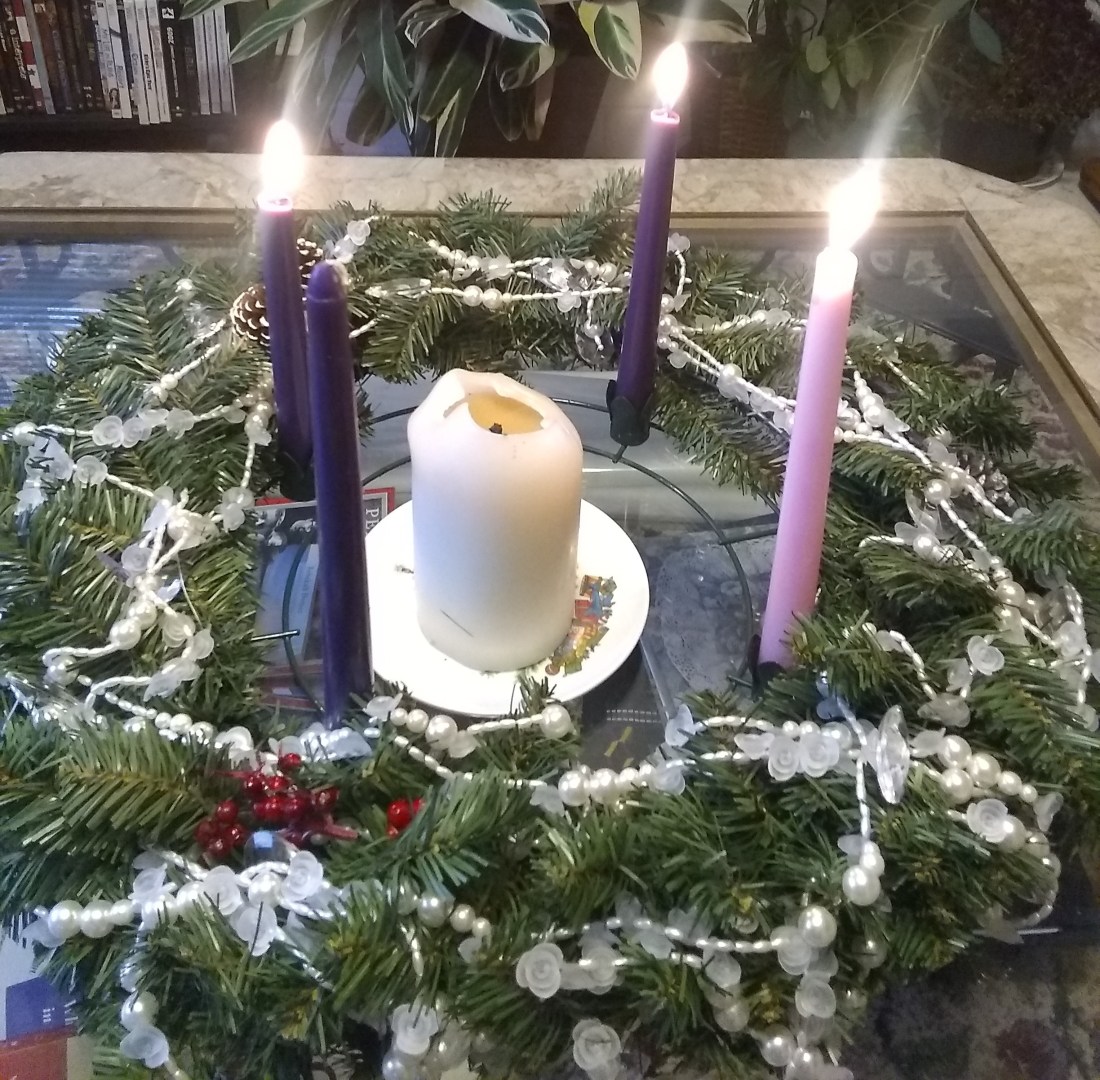
At the beginning of Advent, it seemed we had so much time spread out before us, time to meditate on Jesus’ first coming and to anticipate his second coming. Now, suddenly, it’s almost over. My Advent wreath doesn’t look like it’s almost over—only three of the five candles are lit.

Advent wreath 2018

But tomorrow we’ll light the fourth, and just two days later, the fifth. It feels like the fourth week of Advent has been shortchanged. Like a life that is cut short sooner than we think it should have been. But hurrah—Tuesday is only the first day of Christmas!

“Time is the very lens through which ye see–small and clear, as men see through the wrong end of a telescope–something that would otherwise be too big for ye to see at all.(C. S. Lewis, The Great Divorce)

But God made the heavens

Psalm 96:5, 11-13 The gods are mere idols, but the Lord made the heavens! Let the heavens be glad, and the earth rejoice! Let the sea and everything in it shout his praise! Let the fields and their crops burst out with joy! Let the trees of the forest rustle with praise before the Lord, for he is coming! He is coming to judge the earth. He will judge the world with justice, and the nations with his truth.

And the zebras . . .

I’ll get back to that.

If you’ve been following this blog, these words from Psalm 96 may sound familiar. They’re almost exactly the same as part of 1 Chronicles 16 that I quoted on November 2, an appropriate passage to revisit in Advent, for he is coming! I always think of this passage in connection with Isaiah 55:12, “You will live in joy and peace. The mountains and hills will burst into song, and the trees of the field will clap their hands!”

Back to the zebras. Yesterday I took Caleb to the zoo. The Pittsburgh zoo is built up the side of a fairly steep hill. Before we reached our goal, the aquarium at the top where we could enjoy his beloved fish out of the cold (Let the sea and everything in it shout his praise!), I needed a potty stop. Fittingly, the restroom’s wallpaper features a variety of animals. Including zebras. It took me right back to what could have been identical wallpaper decorating a pediatrician’s waiting room where Karis and I sat one day when she was small.

Zoo-Animals-Wallpaper-1

Our wait was long that day, giving me the chance to make up some too-often-slighted devotional time. Karis and I read together Psalm 96 and Isaiah 55. When we read the verses quoted above from Psalm 96, Karis said, eyeing the wallpaper, “And the zebras will praise God too!” When we reached Isaiah 55:12, she insisted again, “And the zebras. Mom, you left them out!” I showed her, a beginning reader, both texts (no zebras, Sweetheart), but that didn’t dent her conviction that God intended the zebras to be part of both. Somehow, whoever wrote my Bible made a mistake and left them out.

Still killing time as we waited for the doctor, and trying to distract her, I started singing a song set to Isaiah 55. When I got to “and the trees of the field will clap their hands,” Karis sang loudly instead, “and the zebras in the zoos will praise God too.”

For months, any context of praise elicited from Karis, “and the zebras!”

The zebras weren’t in evidence yesterday as Caleb and I climbed the hill past their pasture. Too cold, I guess. But as Caleb and I gazed at the fascinations of the aquarium I was prompted to sing, “and all the fish in the seas will praise God too,” still hearing in my mind Karis’s insistent little voice, “and the zebras, Mama!”

Let everything that breathes sing praises to the Lord!

You have taught children and infants to give you praise. 

If they kept quiet, the stones along the road would burst into cheers!


But God would feed you

Psalm 81:10, 13-16 Open your mouth wide, and I will fill it with good things . . . Oh, that my people would listen to me! Oh, that they would follow me, walking in my paths . . . But I would feed you with the finest wheat. I would satisfy you with wild honey from the rock.

Open wide

I knew a family that made a batch of cookies every day starting with December 1. By Christmas, they had 24 kinds of cookies to share with family and friends!

I’ve never gone that far, but baking tons of cookies is part of my family tradition, going back to when I was growing up in the village of Nebaj in Guatemala, and we took plates of cookies and homemade candy to virtually everyone in town (receiving dozens of yummy tamales in return).

I haven’t really learned to be moderate about Christmas cookies. So I’m trying to figure out how that works with the concept of simplifying this year, which I believe God is calling me to do. What might my family miss of what God wants to give us if my focus and energy go into extensive baking sprees?

I don’t have clear answers yet, but I do know I’m hungry for the finest food, the good things God has for us. I’m opening my mouth wide—even while I’m baking cookies!

But God says, “I will fight those who fight you”

Isaiah 49:23-26 Who can snatch the plunder of war from the hands of a warrior? Who can demand that a tyrant let his captives go? But the Lord says, “The captives of warriors will be released . . . For I will fight those who fight you, and I will save your children  . . . All the world will know that I, the Lord, am your Savior and your Redeemer. . . [verse 23] Those who trust in me will never be put to shame.”

I woke up this morning feeling discouraged about my weaknesses and failures. About gifts and abilities I don’t have. About expectations of myself I haven’t met. I even thought, “What’s the use of going on fighting? I know I will lose. I will let people down. I will disappoint God.”

And then I read these words. “I the Lord will fight. I will save. Trust me.”

My focus this morning has been all wrong. It’s not about me. It’s about him, the sovereign, omnipotent Lord of the universe, fighting for me. Without doubt, HIS purposes will be accomplished. Are being accomplished. Not just despite my weaknesses, but, amazingly, through them. As my spiritual director is fond of saying, “God knows what he has to work with.”

The idea of being in a battle, and the Advent prayer I’ve been hearing at church, took me to Ephesians 6:12-13. “For we are not fighting against flesh-and-blood enemies, but against evil rulers and authorities of the unseen world . . . Therefore, put on every piece of God’s armor so you will be able to resist the enemy in the time of evil.”

The armor, Paul says, is truth, righteousness, peace, faith, salvation, the Word of God, prayer. All of that is directly opposed to the under-handed, dirty, rotten, mean strategies of the enemy, who instead of protecting us in our vulnerable places wants to take advantage of them to destroy not only me, or you, but all that is good in the world, all that we want to preserve for the benefit of our children, and their children.

Truth is the weapon Paul puts first. In this battle, we can’t afford to indulge in un-truth, half-truth, or bent truth. Our enemy, Jesus says, is a liar and the father of lies (John 8:44). He wants me to doubt God’s ability to use me for good. He wants to discourage me to the point of giving up. He wants me to look at what I can’t do very well instead of what God is doing.

Truth: the battle is too much for me. Truth: it’s not about me. God, sovereign and omnipotent, who has said in these last days, “I will save you; I will not forget you,” now says “I will fight for you.”

And he says (again—crazy how it always comes back to this!) “Trust me.” He is the source of all of the pieces of my armor. Including peace.

What battle are you fighting today?

Almighty God, give us grace to cast away the works of darkness, and put on the armor of light.

But God does not forget us

Isaiah 49:15-16 Can a mother forget her nursing child? Can she feel no love for the child she has borne? But even if that were possible, I would not forget you! See, I have written your name on the palms of my hands.

After I read these words, I decided to try an experiment. I wrote one of God’s names on the palms of my hands, to see how often through the course of one day I would see and be reminded of Immanuel, “God with us”:

img_20181204_091039115

I didn’t think about the fact that the writing on my hands would catch other people’s attention as well! And I lost track of how many times I noticed, and remembered, and thanked God that he is not only sovereign over the universe but with me as well, caring about me, one of billions on this tiny planet in our small galaxy.

Saturday night Dave and I thrilled to the words and music of Handel’s “Messiah,” sung by the Mendelssohn Choir of Pittsburgh and played by the Pittsburgh Symphony Orchestra. “For unto us a Child is born . . . .” Immanuel.

The experience was made more fun for us by an elderly gentleman sitting beside us, who had never heard the “Messiah” before. Dave and I had bought three tickets, hoping our daughter Valerie could go with us. But Val had to work, and her husband Cesar was sick. We reached Heinz Hall not knowing what we should do with our third ticket. We noticed an elderly man standing alone in a corner by the entrance. Dave asked him whether he wanted to attend the performance, and that’s how he came to be sitting by us, thrilling with us to the beauty and power of the words, rhythms, melodies, the pure gorgeousness of trumpets surprising us from off-stage . . .

All of it celebrating the Incarnation, Immanuel, God with us. The God who so loved the world that he gave his own Son. The God who has my name—and yours—engraved on the palm of his hand. The God who never forgets us.