Isaiah 43:2 When you go through deep waters, I will be with you.
When you go through rivers of difficulty, you will not drown.
When you walk through the fire of oppression, you will not be burned up;
the flames will not consume you.
Lamentations 3:22-23 The faithful love of the Lord never ends! His mercies never cease. Great is his faithfulness. His mercies begin afresh each morning.
By Earth time, Karis would have turned 42 today. I woke up with the song Goodness of God in my head:
I love You, Lord For Your mercy never fails me All my days, I’ve been held in Your hands From the moment that I wake up, Until I lay my head Oh, I will sing of the goodness of God
And all my life You have been faithful And all my life You have been so, so good With every breath that I am able Oh, I will sing of the goodness of God
I love Your voice You have led me through the fire In the darkest night You are close like no other I’ve known You as a Father; I’ve known You as a Friend And I have lived in the goodness of God
And all my life You have been faithful And all my life You have been so, so good With every breath that I am able Oh, I will sing of the goodness of God
‘Cause Your goodness is running after, it’s running after me Your goodness is running after, it’s running after me With my life laid down, I’m surrendered now I give You everything ‘Cause Your goodness is running after, it’s running after me [and you, too]
But Jesus sees right into our hearts Lenten/Easter question #20
John 21:15-19 After breakfast Jesus asked Simon Peter, “Simon son of John, do you love me?” …
Normally, Pittsburgh weather is what my grandson Caleb calls “boring.” The main question we have to ask at this time of year while nature is bursting into all its bright colors is whether it will be raining or whether we’ll be blessed with a few coveted hours of sunshine.
Tuesday, though, broke the mold. No, not a hurricane or even a tornado, as I explained to Caleb–I was at their house when the storm hit. But we had wind gusts up to 80 mph that killed three people; according to our local news:
Tuesday evening’s storm left a wake of destruction in the Pittsburgh area. Large oak trees toppled from the strength of the winds and roofs were torn off of buildings. Duquesne Light said restoration across the area could take five to seven days, calling the event “unprecedented.”
Over 400 workers rolled into town yesterday to aid Duquesne Light with restoration efforts. We were without power for only 24 hours. The main thing we have to show for it is this “storm art.” Pretty cool, eh?
For our daughter Rachel’s family, though, the adventure is ongoing. “Fireworks!” my granddaughter Liliana exclaimed looking up at the electric pole by their house as she and her sister arrived home from preschool in a torrent of rain, with downed wires on the sidewalk. We hope some of the emergency workers will make it to their neighborhood today. Unfortunately, everything in their house is electric, including their stove.
Here’s what the electric pole right by their house looks like, with the top section snapped off and lying precariously on other wires:
Photo by Rachel’s husband Brian
Needless to say, they’re not parking by their house right now!
All this pales before the devastation, self-inflicted, Peter experienced after Jesus’s arrest in Gethsemane. Just that evening he had declared, “I’m ready to die for you.” Instead, he buckled at three suggestions that he was associated with Jesus. Luke tells us Peter went out and wept bitterly (22:62).
The time has finally come, in this last chapter of John, for Peter to confront his cowardice. Just as he had denied Jesus three times, Jesus asks him, reverting to his old name, the name used in Luke 5, “Simon, do you love me?”
Interestingly, Jesus asks Peter twice, “Do you agape me?” Agape is supernatural, grace-filled, absolutely dependable love. But Peter responds, “Yes, Lord, you know I phileo you.”
The third time, Jesus accommodates Peter. Apparently, he recognizes phileo (brotherly or family love) is all that Peter is capable of claiming at this moment. Jesus has made his point. He has steadfastly loved Peter with agape love through thick and thin, and this is what he wants Peter to grow into.
Agape is the love Jesus shares with his Father. In his prayer for his disciples recorded in John 17, Jesus says, “I have revealed you to them, and I will continue to do so. Then your love (agape) for me will be in them” (John 17:26). Jesus wants all of his followers—you and I included—to experience and practice agape.
In his little book The Four Loves, C. S. Lewis delves into the diverse nuances we miss because four different Greek words are all translated into one English word “love.” At the same time this wordplay is going on between Jesus and Simon Peter, though, another dynamic is at play. Jesus has been preparing Peter to lead. What will Peter’s leadership look like, when Jesus is no longer around to be the leader?
Jesus sums it up in two simple phrases: “Feed my lambs,” the Shepherd tells him (can you feel the affection?) and “Take care of my sheep.” “Be like me in this way too,” I hear Jesus speaking into Peter’s brokenness. “Care for others in the same gentle, committed, insightful, sacrificial way I am caring for you right now.” THIS is leadership in the Kingdom (see Matthew 20:25-28), the same servant love Jesus demonstrated in washing the disciples’ feet.
It’s a reprise not just of Luke 5, but of John 13 after Jesus washed the disciples’ feet, just before Jesus warns Peter he will deny Jesus. “I am giving you [all the disciples] a new commandment: Love (agape) each other. Just as I have loved (agape) you, you should love (agape) each other. Your love (agape) for each other will prove to the world that you are my disciples.”
But Jesus is a master of reconnection Lenten/Easter question #19
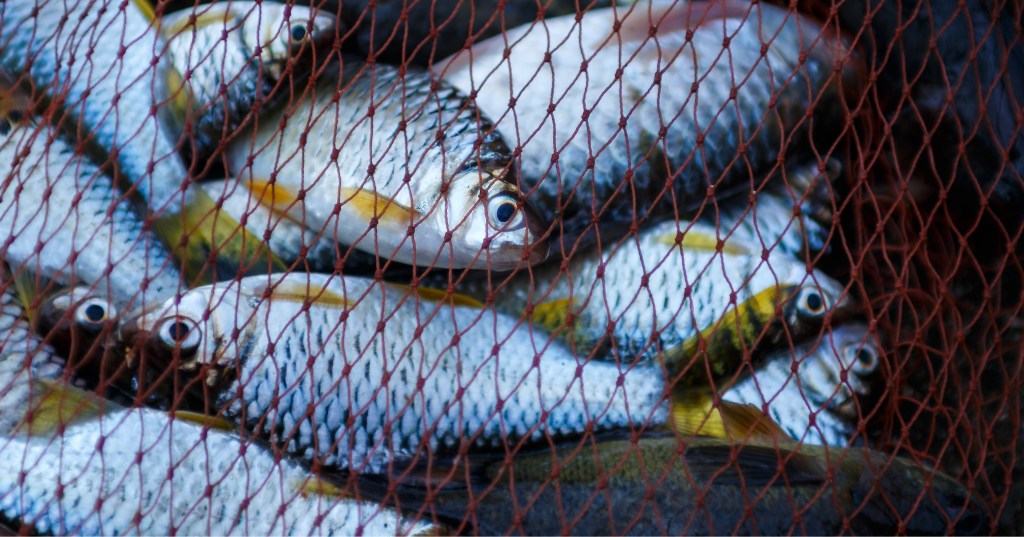
John 21:3-5 Simon Peter said, “I’m going fishing.” “We’ll come too,” they all [six other disciples] said. So they went out in the boat, but they caught nothing all night. At dawn, Jesus was standing on the beach, but the disciples couldn’t see who he was. He called out, “Fellows, have you caught any fish?”
Luke 5:10 (Matthew 4:19, Mark 1:17) Jesus replied to Simon, “Don’t be afraid! From now on you’ll be fishing for people!”
Sudoku. That’s my “go to” when I want something familiar and comfortable. When I’ve been stretched mentally, socially, spiritually, or emotionally. What I love about sudoku, beyond the satisfaction of solving the puzzle, is the fact that there’s only one right answer. The rest of the world may present confusing, chaotic conundrums and confounding challenges. Sudoku is “safe.”
The disciples do something similar in John 21. They are comforted, of course, by knowing Jesus is alive again, but he “randomly” shows up and then disappears again. It’s not clear, though, what happens next. Without his leadership, they don’t know what to do with themselves. Peter and Jesus have not yet dealt with the elephant in the room, his three-fold denial. Beyond his grief and self-recrimination, I’m sure he feels disqualified from the leadership role Jesus had been mentoring him into.
Going fishing, a familiar throwback to the disciples’ old lives before they met Jesus, promises a time out, an activity they can do with confidence and competence. Sunshine above them sparkling on the water, the fresh breeze, the creaking and smells of the boat, the feel of the nets in their hands, the joy of working together with beloved companions, of doing something (not just waiting for Pentecost), the anticipation of roast fish … Ahhh
How often do you do something similar when you’ve been overwhelmed, stretched beyond your comfort zone?
There’s a lot more to Jesus’s simple question “Have you caught any fish?” than a request for information from someone wanting to cook fish for breakfast. John 21 is a masterfully creative reprise of Luke 5 that only an omniscient designer could have achieved. To appreciate it, re-read Luke 5:1-11. For a vivid visual, watch The Chosen’s interpretation of this so-important day in Peter’s life.
“Don’t be afraid! From now on you’ll be fishing for people!” Jesus told Simon, whom he later renamed Peter (Luke 5:10), in a lifechanging “But God” moment Peter doubtless never forgot.
Fast forward a year and a half. “Have you caught any fish?”
I see Jesus accomplishing several things with this question, beyond the disciples’ physical need for nourishment after fishing all night.
*Jesus validates their deeper calling, to be “fishers of men,” a calling they had ample reason to abandon, after they abandoned Jesus in his hour of deepest need.
*Jesus refocuses their attention, after the trauma of the crucifixion and the confoundment of his resurrection. In essence, I think he’s saying, “It’s time to get back to the real work—you know what to do.”
*With his invitation to breakfast (v. 12), Jesus tells them he still cares about them; he still treasures time with them; the rich conversations they had shared on countless such mornings, tramping around Palestine; the friendships they had all cultivated with each other.
*Jesus sets Peter up for the final questions he asks in the gospel of John, the subject of our next post, the last of our “twenty questions.”
But Jesus touches our deepest needs Lenten/Easter question #18
John 20:15 “Dear woman, why are you crying?” Jesus asked Mary. “Who are you looking for?”
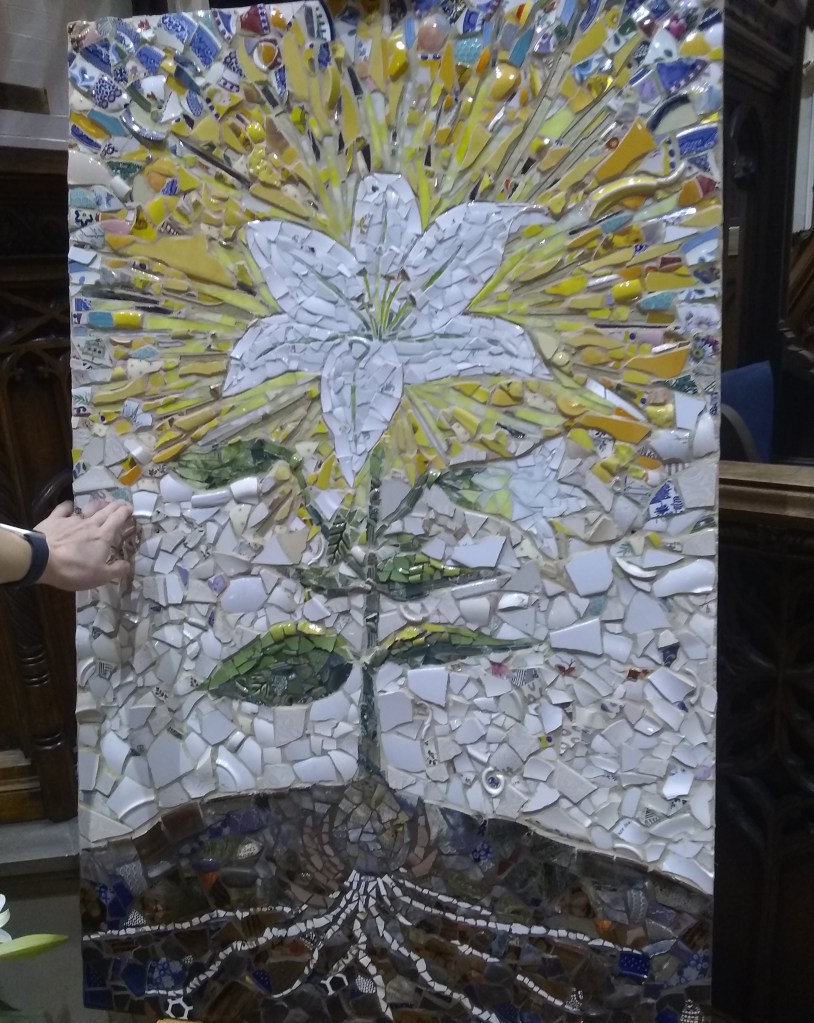
Finding a piece of my cup, among those shattered to create this gorgeous Easter mosaic.
When we lived in Brazil, a pastor’s wife courageously wrote a book called “No Place to Cry,” which directly related to our vision in mission: to care for pastors and their families. In Brazil (and perhaps this is true in other places too), pastors were put on pedestals, a lonely place to live. Pastors and their spouses were expected to care for everyone else, 24/7. They were not supposed to have needs of their own. As my husband often said, “Pastors have a hundred or more ‘kids’ [the members of their congregations]. Their own families are sacrificed on the altar of the church.”
Dave developed mutual support groups for pastors and their spouses, where they could ask each other questions like the ones Jesus asked Mary in the garden after his resurrection. The “safest” groups were interdenominational, because there was little fear what they shared would be gossiped among their peers or superiors or congregations. This had the surprising benefit of breaking down barriers between denominations, as pastors became friends based not on a particular doctrinal emphasis or history, but because of their common experience and needs. Dave’s teachings, summarized in his book “The Leader Who Shines,” helped them accept and practice concepts like boundaries, acknowledging and dealing with their own fears and traumas and complex histories, and developing ministry teams in their churches, rather than trying to do everything themselves. In small, committed groups, they could deeply hear and care for each other. They found a place where they could cry.
John records a series of very personal encounters between Jesus and individual followers after the resurrection. Mary. Thomas. Peter. We can add the two disciples on the road to Emmaus, a story recorded by Luke. This blesses me so much. Even while Jesus sacrificed his life for the world, in the short space of time he spent on earth before his ascension to heaven, he deeply loved and cared for specific people he loved, aware of their unique needs. And within the safety developed over time within the circle of disciples, they could hear and care for each other after he was gone.
Jesus asked Mary, “Who are you looking for?” Obviously, she was looking for him. And that’s true for us, too: the first person we should seek each morning is our Lord. Anchored in relationship with him, whatever happens in our days will be different than if we head into them alone. It occurs to me that in second place, the person we are looking for is our own selves. In the rush of life, we need space to recognize what’s taking place in our own souls. Even a few minutes of quiet with the Lord can help us do this.
Why are you and I crying today, whether we shed tears or stuff it down? Responding to this question is a great way to get in touch with ourselves. Then we can practice Philippians 4:6-7 and experience God’s peace.
But Jesus will turn sadness into joy Lenten question #17 April 17
John 16:16-22 [Jesus said] “In a little while you won’t see me anymore. But a little while after that, you will see me again.” The disciples asked each other, “What does he mean? … We don’t understand.” Jesus realized they wanted to ask him about it, so he said, “Are you asking yourselves what I meant? … I tell you the truth, you will weep and mourn over what is going to happen to me, but the world will rejoice. You will grieve, but your grief will suddenly turn to wonderful joy. … I will see you again; then you will rejoice, and no one can rob you of that joy.”
Our Lenten roses, in full bloom
This will be the last twenty questions post until after Easter, since Jesus asked the last three questions after his resurrection. As Jesus forewarned his disciples about the grief they would feel at his crucifixion, he also told them that horrific event would not be the end of the story.
Soon they would experience their world falling apart. Despite all of Jesus’ warnings along the way, the disciples reacted to Jesus’s arrest, judgment, and death as any of us do to threat and trauma: by “freeze” (their paralysis in the Garden of Gethsemane), by trying to fight (Peter), and by flight (most of them). In his fear, Peter denied knowing Jesus. All of them felt a combination of guilt and despair. Judas killed himself. Others went back to what was safe and familiar (fishing). Thomas lacked the courage to believe the good news when it came. Like Peter and John, he had to see it for himself.
The women, though—including Jesus’s mother—stuck by him. Along with John, they pushed through the mocking crowd close enough to the cross to converse with Jesus as he hung in agony. They witnessed his death.
Did the women remember and believe what he had said, that they would see him again, in great joy? We’re not told. But, like Mary of Bethany (Mark 14:8), they did what they could; they embraced the positive action that was available to them. Still wanting to serve and care for Jesus, they went to his tomb on Sunday, as soon as they could after observing the Sabbath.
Imagine the thrill of the angel, the stone rolled back, the empty tomb, their next task (“Go and tell his disciples”)—and then Jesus, alive! meeting Mary Magdalene in the garden.
Let’s allow ourselves to take part in the narrative, to feel what they felt on that Passover weekend, as the Lamb of God was sacrificed so that his shed blood would protect us from death. With the women and John, let’s find the courage to stand by Jesus at the cross.
And let’s remember it’s OK to ask our questions. Whatever hard place you are in right now, draw near and share your grief and doubts and fears and confusion with the Lord. He understands and welcomes us. We may not be capable of understanding, yet.
John 14:8-9 Philip said, “Lord, show us the Father, and we will be satisfied.” Jesus replied, “Have I been with you all this time, Philip, and yet you still don’t know who I am? Anyone who has seen me has seen the Father!“
Colossians 1:15 Christ is the visible image of the invisible God.
Hebrews 1: 3 The Son radiates God’s own glory and expresses the very character of God, and he sustains everything by the mighty power of his command.
I’m trying to write a book to help kids understand the Trinity (right—as if I understand the Trinity!). Scriptures about the relationships between the Father, Son, and Spirit have fascinated me for a long time.
Bear with me here while I try to articulate a few thoughts. If you’re familiar with Karis’s story, you know that she loved to share her faith with Muslim people, in Arabic if that was their heart language. To the extent that she could, she became part of the Muslim community here in Pittsburgh, both in and out of the hospital. She had always wanted to live in North Africa. That was not possible because of her health, but God surprised her by bringing Arabic speakers here, in large part because her chief transplant surgeon was Egyptian.
When I think about Philip in this passage from John, I feel like I understand him better because of what I observed through Karis’s friendships. It seemed to me that our Muslim friends had an “Old Testament” faith, as of course did the Jewish people before Jesus came to earth. They talked about God in similar ways to what I hear even from Christians when they reference the “God of the Old Testament”: majestic, holy, distant, judgmental, punishing, strict, deserving of all our devotion but unknowable, too far above and beyond us to feel any true intimacy in relation to him.
My Old Testament professor in college tried to dissuade his students of this perspective of God as revealed in the most ancient Scriptures. He believed the Father’s love shone through just as much in the Old Testament as in the New. But I’m not sure he was very successful about changing our minds. After all, people DIED by even touching the Ark of his presence to keep it from falling onto a rough road (2 Samuel 6:6-7). Despite the passages describing God’s love and care, God in the Old Testament inspired more terror in us than affection.
If Philip carried some of these same sentiments about God the Father, it’s not surprising that he did not immediately connect Jesus—the Jesus he watched heal and gently care for people, the Jesus he walked, talked, ate, slept, laughed, and wept with—as being the same as the God he knew.
That’s largely the point of the Incarnation, right? That Jesus would give people a more accurate understanding of the Father’s heart and character. Without knowing Jesus, would Dr. Schultz have “read back” into the Old Testament the nature of God as essentially loving? I don’t know. “My Father and I are one,” Jesus said again and again.
John’s passion for this theme comes out in his three letters to the churches. Try to put yourself in his place—try to imagine for a moment that you have never understood these truths—and feel John’s excitement as he wrote,
We proclaim to you the one who existed from the beginning,
Whom we have heard and seen.
We saw him with our own eyes
And touched him with our own hands.
He is the Word of life.
This one who is life itself was revealed to us and we have seen him.
And now we testify and proclaim to you that he is the one who is eternal life.
He was with the Father; and then he was revealed to us!
We proclaim to you what we ourselves have actually seen and heard
So that you may have fellowship with us.
And our fellowship is with the Father and with his Son, Jesus Christ.
We are writing to you so that you may fully share our joy.
1 John 1:1-4
Has YOUR idea of God been transformed by knowing his Son, Jesus?
But Jesus took on the role of a slave Lenten question #15 April 15, 2025
John 13:3-5, 12-17 Jesus knew that the Father had given him authority over everything and that he had come from God and would return to God. So he got up from the table, took off his robe, wrapped a towel around his waist, and poured water into a basin. Then he began to wash the disciples’ feet, drying them with the towel he had around him. … After washing their feet, he put on his robe again and sat down and asked, “Do you understand what I was doing? … Since I, your Lord and Teacher, have washed your feet, you ought to wash each other’s feet. … I tell you the truth, slaves are not greater than their master.”
Philippians 2:6-8 Though Jesus was God, he did not think of equality with God as something to cling to. Instead, he gave up his divine privileges;he took the humble position of a slave and was born as a human being. When he appeared in human form, he humbled himself in obedience to God and died a criminal’s death on a cross.
I’ve always loved books like The Prince and the Pauper and The Scarlet Pimpernel and Zorro, in which a person appears ordinary, concealing the fact that he or she is playing a grand role in a lifesaving, history-changing endeavor. The bumbling Clark Kent, aka Superman, is another example, as is Rand (the Dragon Reborn) in The Wheel of Time. Do you have favorite stories with this theme?
Perhaps my fascination with these characters stems from the ways they mirror the greatest story of all: Jesus, King of kings, giving up the privileges of Heaven to live as a man from a poor family, raised in an obscure village as a carpenter’s son, with the scandal of his mother’s premarital pregnancy hanging over his head.
In the narrative of John 13, which we will commemorate on Thursday, Jesus knowing the Father had given him authority over everything washed his disciples’ feet, usually the task of a slave. And then he challenged his disciples to serve as he had served them.
Shutterstock: imaagio stock
Knowing we are beloved by the Father, we are called to care as he cared. I love this quote from Mother Teresa: “If you are humble nothing will touch you, neither praise nor disgrace, because you know what you are.”
After asking “Do you understand what I was doing?” Jesus told his disciples, “Slaves are not greater than their master.” What our master was willing to do for us is so much greater than anything we can ever do. Let’s not let pride get in the way of whatever our Lord asks of us. May the Spirit daily grow his love in us.
John 12:7, 23-28, 32 [Mary, sister of Lazarus, anointed Jesus with expensive perfume and was criticized for doing so.] Jesus replied, “Leave her alone. She did this in preparation for my burial. … Now the time has come for the Son of Man to enter into his glory. … My soul is deeply troubled. Should I pray, ‘Father, save me from this hour?’ But this is the very reason I came! Father, bring glory to your name. … And when I am lifted up from the earth, I will draw everyone to myself.”
Hebrews 4:7-8 While Jesus was here on earth, he offered prayers and pleadings, with a loud cy and tears, to the one who could rescue him from death. And God heard his prayers because of his deep reverence for God. Even though Jesus was God’s Son, he learned obedience from the things he suffered.
Yesterday was “Whiplash Sunday.”
To begin, we waved palms like the crowd welcoming Jesus to Jerusalem, singing hosannas in triumphal procession.
A few minutes later, as performers narrated the events of Holy Week (using Luke’s account this time), we yelled, “Crucify him! Crucify him!”
Whiplash.
Imagine what it was like for Jesus, knowing even as the crowd shouted their Hosannas, that soon exuberant acclamation would turn to hostile condemnation and most bitter suffering and death.
And then, in the great Reversal, the glorious resurrection.
Whiplash.
As we walk through this week, we will probably feel the whole range of emotions. Take extra time to go deeper with Jesus in this eventful week. Ask him to help you understand WHY he chose to walk this road.
John 11:23-25 Jesus told Martha, “Your brother [Lazarus] will rise again.”“Yes,” Martha said, “he will rise when everyone else rises, at the last day.” Jesus told her, “I am the resurrection and the life. Anyone who believes in me will live, even after dying. Everyone who lives in me and believes in me will never ever die. Do you believe this, Martha?”
1 Thessalonians 4:13-14 And now, dear brothers and sisters, we want you to know what will happen to the believers who have died so you will not grieve like people who have no hope. For since we believe that Jesus died and was raised to life again, we also believe that when Jesus returns, God will bring back with him the believers who have died.
Yesterday my husband and I flew from Colorado back home to Pittsburgh, watching the transformation of desert into well-watered spring. I found myself thinking about a similar flight soon after our daughter Karis’s death, gripped by pain sharper than any other I have experienced. Would this grief ever soften into some version of beauty less stark?
I don’t know even how to describe it. A transplant friend, whose son had died a few months earlier, texted me: “Just BREATHE.” For as long as I owned that phone, I looked back often at that text as loss stabbed me yet again.
Jesus, who wept with Mary and Martha at Lazarus’s grave even though he knew he would shortly bring Lazarus back to life, understands that pain. He offers himself, his presence with us, as we grieve.
As intense as this grieving has been, I’ve often wondered, with deep compassion, what it would have felt like if I didn’t have the hope of life after death. I’ve watched people without that hope enter profound despair. What if I didn’t know that Karis’s SELF did not die, but is whole and well? What if I didn’t know I will see her again, healed, released from her suffering, exuberantly alive? Would I have survived the grief? I don’t know.
I love imagining what people who have gone before us are like now, freed from all that hampered and troubled them on earth and face to face with Jesus, who IS life. Death could not keep him in its grip (Acts 2:24 NLT). Because he broke death’s power, we too can know life after death—the truly abundant life for which God created us.
As I hear Jesus asking me today the question he asked Martha, I can say with profound thankfulness, “Yes. I do believe his resurrection makes possible eternal life for us.” Lazarus did eventually die again, yet I know he now celebrates along with his beloved sisters the unlimited joy of forever resurrection.
A friend whose father recently died shared with me this beautiful anthem, All Things New, by Elaine Hagenberg, sung at the funeral. The text is adapted from a 19th c. poem by Frances Havergal. So appropriate as we walk into next week:
Light after darkness, gain after loss
Strength after weakness, crown after cross.
Sweet after bitter, hope after fears
Home after wandering, praise after tears.
Alpha and Omega, beginning and the end
He is making all things new.
Springs of living water shall wash away each tear.
But Jesus’ good works foreshadow the greatest miracle of all Lenten question #12
John 10:30-42 [Jesus said] “The Father and I are one.” Once again the people picked up stones to kill him. Jesus said, “At my Father’s direction I have done many good works. For which one are you going to stone me? … Why do you call it blasphemy when I say, ‘I am the Son of God’? … If I do the Father’s work, believe in the evidence of the miraculous works I have done, even if you don’t believe me. Then you will know and understand that the Father is in me, and I am in the Father.” … And many who were there believed in Jesus.
Have you experienced miracles in your life? I have. I wrote about several of them in Karis: All I See Is Grace. And there are many others. God is constantly at work in our world and in our lives.
But all the miracles we have heard about in Scripture or in other people’s lives or experienced ourselves pale before the greatest miracle of all, which we will celebrate in just a few days: the miracle of Jesus’ resurrection from the dead. This is the great historical pivot when death was swallowed up in victory (1 Corinthians 15:54), when HOPE became possible, when the joy at the center of the universe broke through despair. We sorrow, yes. But we know that our griefs are not the end of the story. We live in a comedy, not a tragedy.
First, though, we’ll walk with Jesus through the multilayered injustices of slander, rejection, mocking, shame, abuse, cruelty, abandonment by those closest to him, and the horrible suffering of death by crucifixion. We’ll hear Jesus say in the midst of all that, “Father, forgive them, for they don’t know what they are doing.”
And because Jesus walked that road, we know there is nothing we experience which he cannot relate to. “He was beaten so we could be whole. He was whipped so we could be healed” (Isaiah 53:5).
May the Lord give each of us deeper insight these next days into these mysteries of grace and love.




 Debra Kornfield