But God

But Jesus said, “Wake up and look around”

John 4:1-42 Jesus said [to the Samaritan woman], “Please give me a drink.” The woman was surprised, for Jews refuse to have anything to do with Samaritans. She said to Jesus, “You are a Jew, and I am a Samaritan woman. Why are you asking me for a drink?” Jesus replied, “If you only knew the gift God has for you and who you are speaking to, you would ask me, and I would give you living water… a fresh, bubbling spring, giving you eternal life.” [Later he said to his disciples] “You know the saying, ‘Four months between planting and harvest.’ But I say, wake up and look around. The fields are already ripe for harvest.”… [The people of the village said to the woman] “Now we believe, not just because of what you told us, but because we have heard Jesus ourselves. Now we know that he is indeed the Savior of the world.

Enmity between people in the same land—people who claim to worship the same God—is at least as old as Israel and Samaria. Jesus didn’t let that deter him. He both used and broke through accepted social conventions because he saw this woman’s heart. He understood her story. He saw her need. And he used her cultural setting (the well) and custom (drawing water from the well) to offer what he had to give, living water.

Hmm, sound like a description of missions? In the Anglican tradition, today is World Mission Sunday. Having grown up in Guatemala as an MK (“missionary kid”), I’ve never known life apart from missions; it frames the way I think and understand everything—maybe that can help you make sense of things I say. For me, borders between countries are in a sense artificial constructs imposed on this world God loves. His family—our brothers and sisters—live in every nation. It’s as impossible for me to embrace one country as being “first” as it is to imagine God having favorites among his children.

I thought it would be fun to share a couple of worship songs from countries I have lived in. Don’t worry about understanding the words; just try to enter into their spirit, their heart.

From Guatemala: Julio Melgar died in 2019 at age 46. Here’s an example of the worship legacy he left, Tus Cuerdas de Amor (Your Cords of Love), recorded in 2018 in the middle of a two-year fight with cancer (Lord, you never lost control...Your cords of love have fallen on me… this is my security, my peace… your love sustains me…).

His son Lowsan later sang this song like this.

From Brazil: When she was a little girl, Dave took board games as gifts when he stayed with Ana Paula Valadão’s family on visits to her city of Belo Horizonte. Ana Paula and her group, Diante do Trono (Before the Throne) has had an incalculable influence on worship in Brazil. Here’s one of my favorites, a song first recorded in 2002, Águas Purificadoras.

Oh! I just found this video of Ana Paula singing Águas Purificadoras last year in English!

Living water… a fresh bubbling spring.
But Jesus came down from heaven

John 3:1-21 [Jesus said to Nicodemus] I assure you, we tell you what we know and have seen, and yet you won’t believe our testimony…No one has ever gone to heaven and returned. But the Son of Man has come down from heaven…For God loved the world so much…God sent his Son into the world not to judge the world, but to save the world through him.

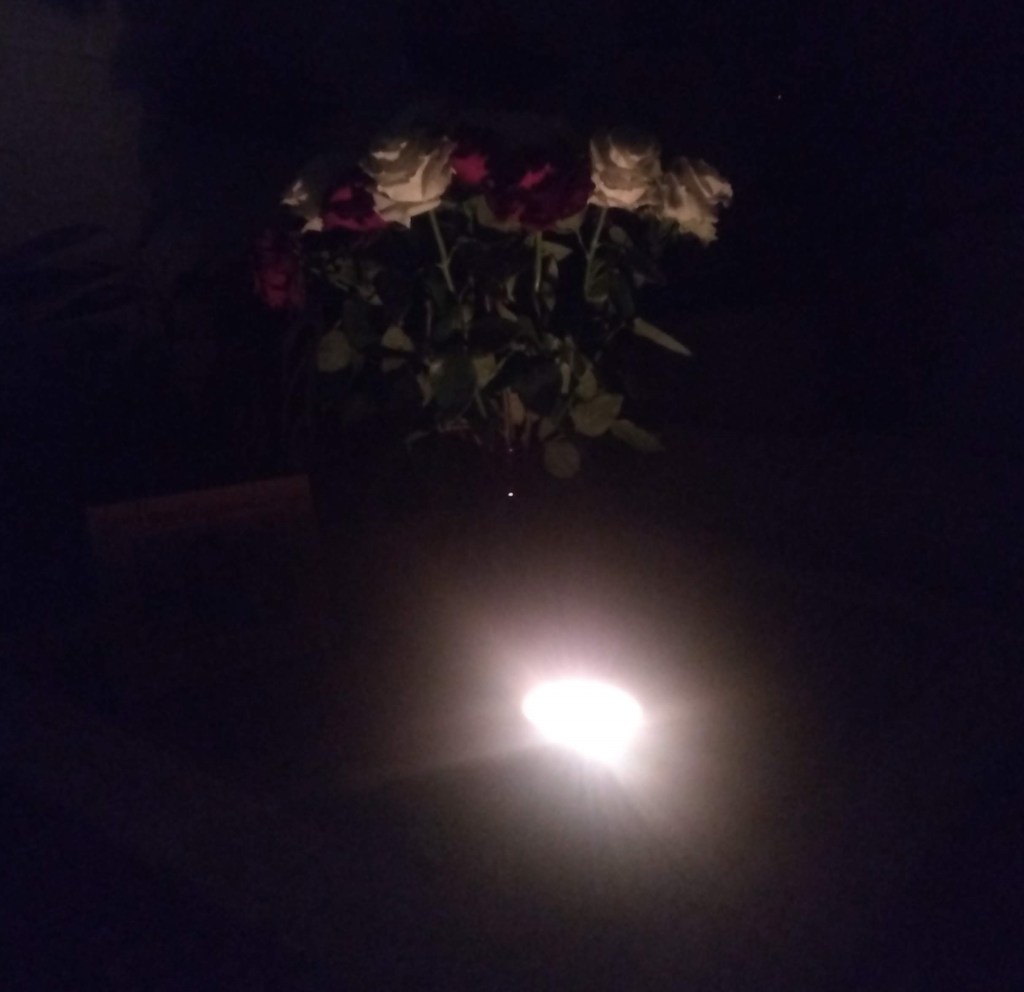
This morning early, I lit a candle and listened to Bach’s Toccata and Fugue as we did seven years ago when three angels and Michael escorted Karis to Heaven.

Heaven. When Jesus talks about heaven, we should pay attention. Because he lived there.

This week a friend in Chicago asked me whether I had heard of capoeira and the berimbau. Her son in Seattle is learning them.

Her words immediately conjured happy days at Ibirapuera Park in São Paulo pressing into the crowd to watch in fascination the blend of martial arts, play fighting and choreographed dance/gymnastics of a capoeira group showing off their skills, to the thrum of the berimbau and the shake shake shaking of the caxixi.

Yes, I’m familiar with capoeira and the berimbau. It takes a lot of practice and highly developed skills to do it well. I know, because I lived in Brazil for years and saw capoeira many times.

Suppose someone tried to tell me capoeira is a type of hmm, a type of Brazilian chocolate. I would just look at them and shake my head, maybe laugh a little.

I had an experience like that once. I was at a conference in Arkansas and struck up a conversation with a woman sitting across from me at lunch. When she found out I lived in Brazil, she immediately started telling me what I needed to understand about Brazil and how to do effective work there. Had she ever been to Brazil? No. But once she had talked to someone who had heard a speaker who said… My new acquaintance was not interested in my experience from having lived there, at that point, more than ten years. She “knew” what my husband and I ought to be doing, and how, and why. She took the rest of the meal to explain this to me. All I could do was shake my head and laugh a little.

Jesus knew about heaven. He had lived there since before our world was even made. Nicodemus thought he knew. As a Pharisee, he thought God was all about rules and control, of himself and of other people. No, no, no, Jesus said. It’s about freedom, the Holy Spirit dancing like the wind, birthing life, life that is unending, into people’s spirits. It’s about love, God loving people so much, so much that he gave them what was most precious to him. It’s about light, dispelling the darkness of judgment and fear of condemnation, of not measuring up to all the rules. “Come into the light—true light from heaven,” Jesus invited Nicodemus. “Then you’ll see what God is like, what he actually wants.”

I heard on NPR an interview with Steve Bannon in which he was chuckling over how vulnerable people are, how easy it is to exploit their fears and make them believe anything. I couldn’t believe it. I looked up the interview later to see whether I had heard him correctly. He said these things with no shame, no attempt to cover them up. This was no underground operation. He reveled in his power to take advantage of people for his own ends. He could make people believe anything, he said, if he played on their fears and repeated it often enough.

No, no, no. No. Evoking and exploiting fear is NOT the language of heaven. There is nothing remotely like God in that. So what makes us vulnerable to it? Paul offers an antidote: Let your roots grow down deep into the soil of God’s wonderful love to keep you strong (Ephesians 3:17). I’ve chosen that as my 2021 year verse. Then you’ll have the ability to know, to understand and experience, the dimensions of God’s love, Paul continues. You’ll be able to speak the language of heaven.

More than anyone I’ve known, Karis learned the language and culture and values of heaven while she still lived on earth, the language of love and joy, freedom, and grace. I have no doubt she’s very much at home there.

And God’s given me a “vision” of her this week: welcoming into heaven those who have died from Covid, helping heal their trauma, helping them transition into wellness. She can do this because she knows what it’s like to die from a horrible virus. In her case it was H1N1, but from what I observed of her last illness and what I’ve heard about Covid deaths, it’s not much different. As I grieve our friends who have died from Covid, it comforts me to think of Karis meeting them and caring for them in their new home, her sparkling blue eyes and that irresistible smile even more radiant because she’s free from pain, as they will be. Are.

I have to share what appeared at our door this week, accompanied by a note from Karis. Photos don’t do them justice—the roses are glorious. My husband outdid himself. Every time I’ve felt a wash of sadness this week, missing Karis, I’ve looked at my roses and soaked in the love they represent. A tangible, visible sign of God’s love. Sacrament. And I echo Karis’s poem, “Lord, make my life sacrament.”

But Jesus didn’t trust them

John 2:23-24 Because of the miraculous signs Jesus did in Jerusalem at the Passover celebration, many began to trust in him. But Jesus didn’t trust them, because he knew human nature. No one needed to tell him what mankind is really like.

John 6:26-27 [After the feeding of more than five thousand people, Jesus said] I tell you the truth, you want to be with me because I fed you, not because you understood the miraculous signs. But don’t be so concerned about perishable things like food. Spend your energy seeking the eternal life that the Son of Man can give you.

I doubt the concept of mind mapping was a thing when John wrote his Gospel. But making a mind map for John helps me see the connections he saw when he organized his material—not chronological links, but conceptual. These two verses at the end of chapter 2 refer back to Passover in Jerusalem while pivoting to the topic Nicodemus chooses to open his conversation with Jesus in chapter 3: Jesus’ miracles. And they introduce the topic of trust.

Have you tried mind mapping? Google mind map and you’ll find an endless list of resources and models, like this one. Doing a simple mind map helps me sometimes to get thoughts and feelings swirling around in my head into an external form I can look at. Connections and insights follow; usually “aha!” moments (we are still in the season of Epiphany, the season of revelations!) that give me clarity and direction. Pick a topic that’s troubling you and try it! I’d love to know your experience.

from Shutterstock by studioworkstock

You could try, for example, the topic of trust. Who/what do you trust, and why? Who/what don’t you trust, and why? Put the topic “trust” in the center of your mind map and see where it takes you.

Trust is a tricky topic because we can’t live without it, but we fear setting ourselves up for disappointment or betrayal. What we fear is integrally linked into what or who we trust. So our fears have a place on our “trust” mind maps. It might help to do a “fear” mind map first, to clarify our needs before we look at what we do to try to meet those needs.

Hit a nerve? Don’t keep all your thoughts and feelings stuffed inside you. Talk to someone you (ahem) trust!  

I had this post mostly written before I heard our pastor open his sermon last Sunday with the question, “How can we know we can trust someone?” You can listen to the sermon here (the one at the top of the listing, by Jonathan Millard 1/31). Well worth your while!

But God will see us face to face, by Virginia Webster

1 Corinthians 13:12 Now we see things imperfectly, like puzzling reflections in a mirror, but then we will see face to face. All that I know now is partial and incomplete, but then I will know everything completely, just as God now knows me completely.

Seeing more clearly is a central theme of the season of Epiphany.

In January of last year people were jokingly saying that it was the year for clear vision. 2020. I only paid attention to it because my ophthalmologist informed me that cataract surgery was needed. All of a sudden, I was very aware of seeing. Seeing colors, movement, people, faces, emotions. Seeing is really important, especially if you think you won’t be able to see in the future. Then COVID hit and 2020 didn’t seem very clear. Everything became blurry. It was unsettling.

The word of the Lord comes to Jeremiah: ‘What do you see, Jeremiah?”

“I see the branch of an almond tree,” and then the Lord replies, “You have seen correctly, for I am watching to see that my word is fulfilled” (Jer. 1:11-12).

God’s Word is full of seeing. Eve sees a piece of fruit and in the taking she sins. Abraham sees three visitors and in their company he receives the promise —  his son will be a blessing to the nations. Noah sees a flood and is delivered in the ark of redemption; Joseph sees the bottom of a pit because of his brothers. The Israelites see bondage and plagues, the parting of the Red Sea, Mount Sinai on fire, and manna raining down in the wilderness. Joshua literally sees the sun stop until the battle is won. Naomi sees famine, death and depression. David sees Absalom’s rebellion. Job sees an ash heap, before he hears God speak out of creation. Job replies, “My ears had heard of you but now my eyes have seen you” (42:5).

Mary sees her newborn lying in a feeding trough. His name is Jesus, because he will save his people from their sin. Anna waited her entire widowed life to see this little baby, to see the redemption of Jerusalem. Even the blind see because of Jesus. The disciples see Jesus too on the Mount and in the Temple. They see Jesus breaking bread and pouring the cup. They see Jesus on the cross. They see an empty tomb and his resurrected body. They see his nail scared hands and his wounded side.

In Revelation, John’s praying imagination sees what is to come. He sees the son of Man in all his glory, he sees the throne of Heaven, he sees the seven angels with the last seven plagues, he sees the worship surrounding the throne of the Lamb. John sees a new heaven and a new earth.

Jeremiah sees an almond branch. What do you see in the year of our Lord 2021? We see the Light shining in the darkness, and the darkness has not overcome it. We may be zoom weary and vaccine anxious, but we see the Lord high and lifted up. Christopher Wright in Here are your gods” writes, “Idolatry is the attempt to limit, reduce, and control God by refusing his authority, constraining or manipulating his power to act, having him available to serve our interests.” I’ve been forced to reexamine my expectations of what God should be doing for me. Instead, I see Him faithfully giving to me what I hardly know I need. The Lord is watching over me. Face to face relationships in community are a real blessing, never to be taken for granted. Truth is important. The world is not careening out of control. God is still sovereign.

I’ve already been back to the ophthalmologist for a check-up. She did mention that I was an exceedingly particular patient when it comes to seeing well. Sitting in the UAB Callahan waiting room I did a lot of looking. Patients shuffling in trying to navigate vision, masks and social distancing. God sees our human condition. He knows us. I am encouraged by Paul’s Corinthian Love chapter that we see but only a reflection, as in a mirror, but one day will see God face to face and then we will know fully even as we are fully known. Until then, like Jeremiah, I want to be faithful even when life seems harder than expected. I do want to see God’s Word fulfilled. And that kind of seeing is worth watching for.

But Jesus meant his own body

John 2:13-22 [Jesus chased merchants and traders out of the Temple.] He told them, “Get these things out of here. Stop turning my Father’s house into a marketplace!” … But the Jewish leaders demanded, “What are you doing? If God gave you authority to do this, show us a miraculous sign to prove it.” “All right,” Jesus replied. Destroy this temple, and in three days I will raise it up.” “What!” they exclaimed. “It has taken forty-six years to build this Tempe, and you can rebuild it in three days?” But when Jesus said “this temple,” he meant his own body. After he was raised from the dead, his disciples remembered he had said this, and they believed both the Scriptures and what Jesus had said.

John is not writing a chronological account of Jesus’ life. Likely this “cleansing of the Temple” occurred at the end of his ministry, as recorded in the other Gospels, rather than at the beginning. So the two vignettes in chapter 2 bookend Jesus’ years of ministry. Why would John put them together?

A clue is the first phrase, “On the third day.” The “third day” references in Scripture, both in the Old and New Testaments, are more than chronological notations. They signal important information about Jesus’ resurrection, his unparalleled, universe-transforming victory over death and sin.  

Suddenly, Jesus’ lavish miracle is not just about providing wine for a friend’s wedding. It’s a vivid commentary on his resurrection, about a transformation as radical and extravagant as water into wine; as shocking as the concept of rebuilding the Temple in three days. John spells it out for us: He meant his own body. After he was raised from the dead, his disciples remembered…

A lot will happen in Jesus’ life between these two chapter 2 vignettes. But John tells us right off the bat, though we may feel we’re trapped in the suffering of Friday or the seemingly endless waiting of Saturday, Sunday IS coming. Hold on to the hope and wonder of the third day. Jesus cites it as the source of his authority for restoring the Temple to its true function, forecasting the day he will set everything right.

For God has set a day for judging the world with justice by the man [Jesus] he has appointed, and he proved to everyone who this is by raising him from the dead (Acts 17:31).

Maranatha. Come, Lord Jesus.

But Jesus first revealed his glory by making a party more memorable

John 2:1-12 … [Turning water into wine for the wedding in the village of Cana] was the first time Jesus revealed his glory. And his disciples believed in him. After the wedding he went to Capernaum for a few days with his mother, his brothers, and his disciples.

120-180 gallons of wine! Toward the end of the wedding celebration!

Raised in a teetotaler family (with an edge, because our grandfather was alcoholic), within a faith tradition that held drinking alcohol of any kind to be unacceptable, I always kind of skipped over this story once I understood Jesus actually made wine and not just grape juice. “The point of the story,” I was told, “is that Jesus approves of marriage.”

Well, yes. But he could have made that point another way.

I find it interesting that in crafting his Gospel, John put this story right after his triple identification of Jesus as son of Joseph, Son of God, Son of Man. Dad Joseph wasn’t at the wedding, nor does he appear in any of the Gospels after Jesus grew up. Probably he was no longer alive. But the story is framed by Jesus’ interactions with his earthly family, his mother and brothers. Attending the celebration is a thoroughly “Son of Man” thing to do. Jesus was attuned to his culture. He knew how to go about solving the wine crisis—working through the servants and the master of ceremonies. And the miracle revealed him as the Son of God.

But what touches my heart in this first revelation of the glory of God in Jesus is his generosity, his extravagant gifting of the best wine anyone in that humble village had ever tasted. Not just enough to save the wedding couple’s honor, but an enormous abundance that initially “only” the servants were aware of (John notes this fact). I’m reminded of the host of angels singing to the shepherds. The heaping baskets left over when Jesus later fed the crowds. Not just a word of comfort to the widow of Nain but her dead son returned to her alive! When the Lord saw her, his heart OVERFLOWED with compassion (Luke 7:13).

The sun could just rise and set, but twice a day the Creator paints our sky with magnificent colors. The heavens declare the glory of God. They, like this miracle in the village of Cana, show us what God is like. Not skimpy. Not mesquinho (mean, miserly, stingy). So generous we catch our breath, though if we paid attention, we could see this display almost every day.

In my despair during the last days of Karis’s life, God touched my breaking heart with a unique word of comfort, miraculously communicated so I would know it was from him. At her funeral, he gave back to us our son Michael. I feel goosebumps just remembering. These stories are told in chapter 20 of Karis, All I See Is Grace. And so much more. One of Karis’s surgeons—and so many other amazing friends and family—took time out of their hectic lives to honor her; in blizzard conditions filling the church and our hearts with the warmth of their compassion and generosity.

Not just “enough.” Abundance.

But what does this mean to us today, stretched thin from a year of pandemic and all the rest of it?

Lord, I’m looking to see how you reveal to us, now, two thousand years later, in January of 2021, this dimension of your glory.

I wrote that much yesterday morning, before spending a couple of the last hours with my sister and brother-in-law before they drove away from Pittsburgh, moving to Georgia. And then I went home and cried, for missing them, for the circumstances that took them away; for missing my São Paulo friend Cristina who died this week, for my friend Patty who lost her husband (my high school “big brother”) last week, for all the families missing loved ones because of Covid or a myriad of other reasons. For January 20 seven years ago when my daughter could not breathe. For the heavy burdens on too many shoulders.

Lord, where? Where is your abundance in all this? Please open my eyes so I can see it.

And then I heard Amanda Gorman’s poetry.And prayed with two friends. And something began to shift inside of me. A stirring of hope.

“…to put our future first, we must first put our differences aside. We lay down our arms so we can reach out our arms to one another.” Thank you, Amanda.

And I think, as I begin this new day, God has gifted our weary, fractured, grieving country with a leader who is a healer and peacemaker; the gifts we need at the time we need them. I think we’re being offered a chance—a window—an opportunity—to put our energy into restoration. With the compassion that overflows to us and through us from Jesus’ extravagantly generous heart. His abundance that never runs out. Even on the cross, when he said not “Look how much I am suffering,” but “Father, forgive them.”

From his abundance we all have received one gracious blessing after another (John 1:16).

Including the gift of a new day, a new beginning. His mercies renewed for today.

But Jesus, “son of Joseph,” was both Son of God and Son of Man

John 1:43-51 Jesus found Philip and said to him, “Come, follow me.”… Philip went to look for Nathanael and told him, “We have found the very person Moses and the prophets wrote about! His name is Jesus, the son of Joseph from Nazareth.” … Nathanael exclaimed [to Jesus], “Rabbi, you are the Son of God—the King of Israel!” … Jesus said, “I tell you the truth, you will all see heaven open and the angels of God going up and down on the Son of Man, the one who is the stairway between heaven and earth.”

1 Timothy 2:5 For there is only one God and one Mediator who can reconcile God and humanity—the man Christ Jesus.

Martin Luther King Jr. wrote in 1957,

But the end is reconciliation; the end is redemption; the end is the creation of the beloved community. It is this type of spirit and this type of love that can transform opposers into friends. The type of love that I stress here is not eros, a sort of esthetic or romantic love; not philia, a sort of reciprocal love between personal friends; but it is agape which is understanding goodwill for all men. It is an overflowing love which seeks nothing in return. It is the love of God working in the lives of men. This is the love that may well be the salvation of our civilization (from “The Role of the Church in Facing the Nation’s Chief Moral Dilemma”).

On our vacation last week, Dave and I watched a movie called “The Help,” set in 1963 Jackson, Mississippi. In 1963, Dave was growing up in Bolivia and I in Guatemala. We both remember where we were when we learned about the assassination of JFK. But we didn’t know the social context the movie portrays. Our naiveté seems unpardonable, but we were startled all over again to realize “those things happened in our lifetime—a hundred years after the Civil War.”

And another 58 years have gone by, and our nation still struggles with injustice, discrimination, racism… How God’s heart must bleed for his children!

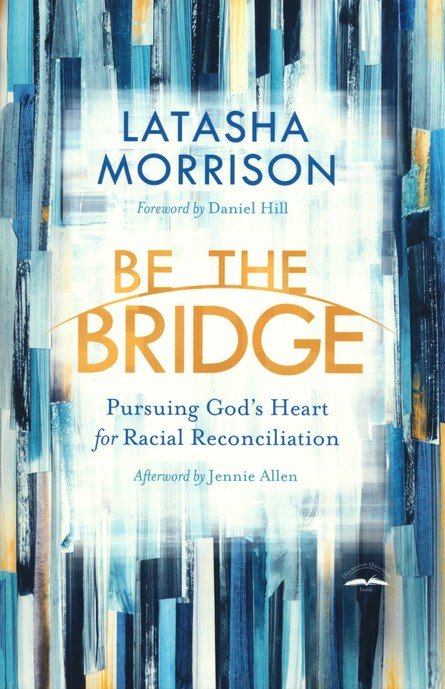
I’ve been delighted to find an organization whose explicit goal is to foster racial healing within the church, which rather than leading the way toward justice and reconciliation, has often been the worst offender. Check out Be the Bridge online and on Facebook. You’ll find a whole course you can take to learn or re-learn what we all need to understand. There are materials that have been used and tested across our nation to bring communication and healing to people on both sides, in mixed groups of believers. One of my hopes for 2021 is to get involved in another Be the Bridge group in the fall, if Covid is under control enough to allow in-person gatherings again.

Be the Bridge by Latasha Morrison

This morning I heard these prayers on our church’s daily Youtube devotions. May they be ours today, as we remember the life and death of MLK Jr. and his longing for the Beloved Community:

O God, you made us in your own image, and you have redeemed us through your Son Jesus Christ: Look with compassion on the whole human family; take away the arrogance and hatred which infect our hearts; break down the walls that separate us; unite us in bonds of love; and work through our struggle and confusion to accomplish your purposes on earth; that, in your good time, all nations and races may serve you in harmony around your heavenly throne, through Jesus Christ our Lord.

Almighty God, grant us grace to contend fearlessly against evil and to make no peace with oppression; and help us to use our freedom rightly in the establishment of justice in our communities and among the nations, to the glory of your holy Name; through Jesus Christ our Lord.

Increase, O God, the spirit of neighborliness among us, that in peril we may uphold one another, in suffering tend to one another, and in homelessness, loneliness, or exile befriend one another, until the disciplines and testing of these days are ended, and you again give peace in our time; through Jesus Christ our Lord, Amen.

But the King is the Lamb

John 1:29 The next day John saw Jesus coming toward him and said, “Look! The Lamb of God who takes away the sin of the world!”

Since I sat down to write, the silhouette of a giant blue spruce has slowly emerged against the lightening sky through the kitchen window. I knew the tree was there, but I couldn’t see it until light eased in around it. Over the last few minutes, though I still don’t see color, details of contour and depth are becoming clearer.

For some of us, the events of Epiphany, Jan. 6, shone light on a reality we haven’t wanted to see.

John the Evangelist tells us his xará (what we call in Brazil a person with the same name or birthday) John the Baptist “was not the light; he was simply a witness to tell about the light,” (v. 8), the true light (v. 9), who reveals God the Father to us (v. 18). By the time the writer cites John the Baptist as recognizing Jesus as the Lamb of God, the Chosen One (v. 34), he has already described Jesus as the eternal Word, the world-Creator, the Life-giver, the unextinguishable Light, the status- and family-sharer (v. 12), the enabler of new beginnings (v. 13), the ultimate boundary-crosser and cultural contextualizer, full of unfailing love and faithfulness (or grace and truth, depending on your translation, v. 14 and 17), the revealed glorious only Son (the rest of God’s children are adopted), the one who is “far greater” (v. 15), the unstinting Giver of one blessing after another, the unique One who is himself God, near to the Father’s heart.

It will take us the rest of our lives to absorb all this. We won’t see all the shades and colors clearly until the full light of God’s glory shines on Jesus, when we’re with him face to face. Don’t you feel a bit jealous of those who are already there?

And then John the Baptist brings us back to earth with a thump. Jesus is the Lamb of God. My emotional reaction is similar to what I feel reading John the Evangelist’s description in Revelation 5: And I saw a strong angel, who shouted with a loud voice: “Who is worthy to break the seals on this scroll and open it? But no one in heaven or on earth or under the earth was able to open the scroll and read it. Then I began to weep bitterly because no one was found worthy to open the scroll and read it. But one of the twenty-four elders said to me, “Stop weeping! Look, the Lion of the tribe of Judah, the heir to David’s throne, has won the victory! He is worthy to open the scroll and its seven seals.”

From bitter weeping to the excitement of victory! But then comes the twist: Then I saw a Lamb that looked as if it had been slaughtered.

No! No! No! Don’t do it! How can you kill the king, the eternal one, the creator, the life-giver?

I want to linger in the glory. But John (both Johns) drive us forward, force us to our knees, back to tears, our faces on the ground. The Lion becomes the lamb, the sin of the world is my sin, the gracious, loving, faithful Truth-teller reveals to me more than I can bear. And so he bears it for me, both the hard truth and its inevitable consequence. Do I really want the light? John asks. Because to live in light requires practicing truth. It requires confessing my sins and my need for his cleansing, the cleansing only possible because Jesus the King, the one who is life itself, became the Lamb of God, offering his life in my place (1 John 1:1-9).

Come.

See.

But the light of Jesus can never be extinguished

John 1:1-5 In the beginning the Word already existed The Word was with God, and the Word was God. He existed in the beginning with God…The Word gave life to everything that was created, and his life brought light to everyone. The light shines in the darkness, and the darkness can never extinguish it.

 The arrival in Bethlehem of wise men from the East bearing gifts, following the light of the star, to worship the one born king of the Jews. The revelation that Jesus came not just for his own people, but for the world…We’ll have time to consider the significance of Epiphany as we walk through the next weeks, until Lent begins February 17.

From Shutterstock by losw

Of course, the Epiphany celebration of light for the nations is the air Dave and I breathe. I look forward to sharing stories with you from the ten countries where we chiefly invest. For today, I commend to you this video by Prayercast called “Shine,” Psalm 67 set to music, with stunning photography from around the world, shared with us by a friend in Brazil:

May God be gracious to us and bless us and make his face shine upon us, that your ways may be known on earth, your salvation among all nations.

May the peoples praise you, O God; may all the peoples praise you. May the nations be glad and sing for joy, for you rule the peoples justly and guide the nations of the earth.

But the unique One, Jesus, has revealed God to us

John 1:18 No one has ever seen God. But the unique One who is himself God, is near to the Father’s heart. He has revealed God to us.

Perhaps because I spent the day with my three grandbabies, on this second-to-last night of Christmas, I haven’t been able to sleep–this hymn keeps going through my head, encouraging me to leave my cares and concerns with him.

From Shutterstock by Anneka

I can’t think of a better way to continue walking into the Gospel of John. Over the next few weeks, I intend to draw “But God” Scriptures from John’s rich images of our Lord. Here are the words to this marvelous hymn. Listen to it again.

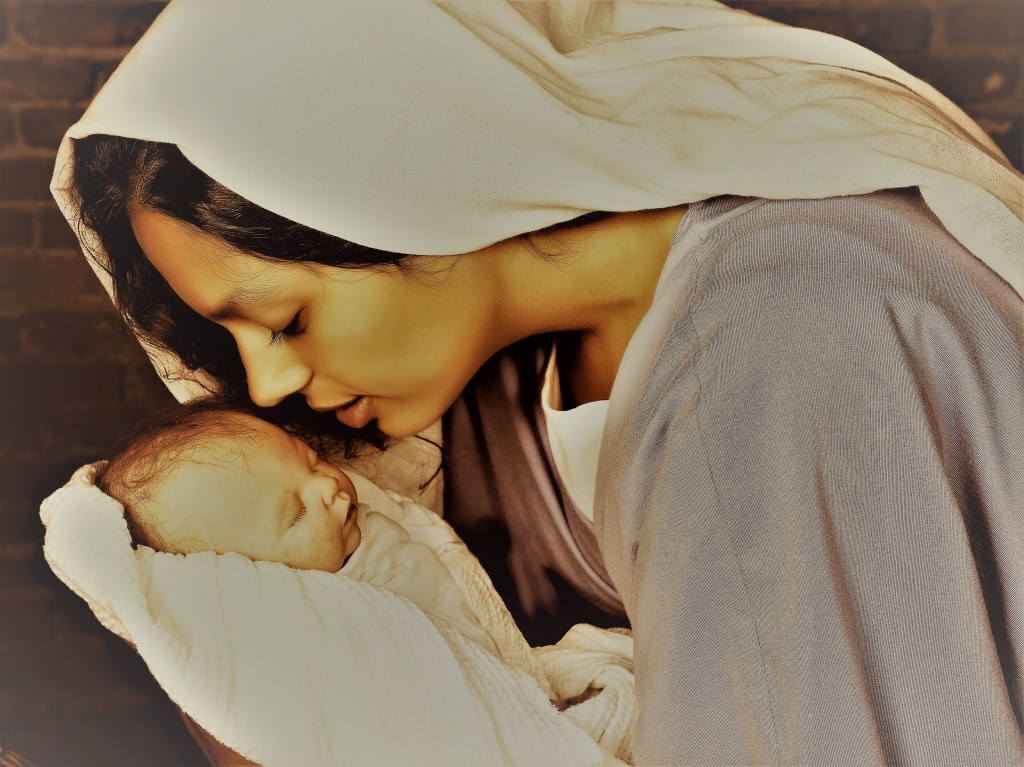
Mary, did you know that your baby boy
Would one day walk on water?
Mary, did you know that your baby boy
Would save our sons and daughters?
Did you know that your baby boy
Has come to make you new?
This child that you delivered, will soon deliver you

Mary, did you know that your baby boy
Would give sight to a blind man?
Mary, did you know that your baby boy
Would calm the storm with his hand?

Did you know that your baby boy
Has walked where angels trod?
When you kiss your little baby
You kiss the face of God!

The blind will see, the deaf will hear
The dead will live again
The lame will leap, the dumb will speak
The praises of the Lamb

Mary, did you know that your baby boy is Lord of all creation?
Mary, did you know that your baby boy
Would one day rule the nations?
Did you know that your baby boy
Is heaven’s perfect Lamb?

That sleeping child you’re
Holding is the great I Am!

            Written by Mark Lowry 1984; music by Buddy Greene 1991