But God

Willing to be made willing?

But Jesus offered himself

Matthew 26:51-54 One of the men with Jesus [as he was being arrested] pulled out his sword and struck the high priest’s slave, slashing off his ear. “Put away your sword,” Jesus told him. “Those who use the sword will die by the sword. Don’t you realize that I could ask my Father for thousands of angels to protect us, and he would send them instantly? But if I did, how would the Scriptures be fulfilled that describe what must happen now?

Hebrews 7:27 Jesus once for all offered himself as the sacrifice for the people’s sins.

In Outlander by Diana Gabaldon, Jamie submits to a second brutal lashing rather than submit to a degenerate Redcoat, though it may cost him his life. It is a masterful, moving portrayal of courage and resilience. His sister Jenny later points out that even had Jamie submitted to what the British officer wanted, Black Jack would still have tortured him, likely to his death.

Eyewitness Matthew, though, in his unique account of Jesus’ arrest, shows us a huge difference between Jamie Fraser and Jesus. Jamie had no means of escape; he could only endure what he was powerless to prevent. Jesus, as Ray Overholt’s hymn memorialized it, “could have called ten thousand angels to destroy the world and set him free.” Jesus was not victimized by the Jewish leaders or by Pilate. He chose to lay down his life for us.

My husband’s mentor, Edmund Chan, explores the difference between resilience and yieldedness in the following reflection. Join me in this meditation, while Jesus still lies dead and his followers mourn.

Resilience vs Yieldedness by Edmund Chan, Singapore, 3/31/22

Resilience is important. But there’s something else that’s even more important.

In leadership, resilience is one of the most important virtues. In challenging times, we need resilience. It divides between the men and the boys.

But for men and women of God, there is something more that God wants to tutor our soul in. Our Eternal Father wants to teach us the power of yieldedness.

Yet in our stubborn ways, foolish pride and distraught theology, we regard ‘yieldedness’ as a distasteful proposition and would misguidedly withhold our yieldedness unto the Almighty.

As a young man, I sought for resilience in life and leadership. As a senior citizen, I learn more and more to lean towards a yielded spirit.

Yielding our yieldedness to God is a step into the light. It is in essence our willingness to be made willing. And it goes a long way – even beyond the horizon of resilience – to draw us into the sacred intimacy and empower us in our anxious impotence.

There are at least ten differences between resilience and yieldedness.

1. Resilience is important when times get tough. Yieldedness is important when times get tougher.

2. Resilience is important when we are seeking answers. Yieldedness is important when the answer we’ve found doesn’t work.

3. Resilience is important as it deals with our energy. Yieldedness is important as it deals with our ego.

4. Resilience is important to show that we are in control. Yieldedness is important to show that God is in control.

5. Resilience is important as it shows our fighting spirit. Yieldedness is important as it shows our faith.

6. Resilience is important as it tutors us in resourcefulness. Yieldedness is important as it tutors us in restedness.

7. Resilience is important as it shows who we are. Yieldedness is important as it shows whose we are.

8. Resilience is important to reclaim lost ground. Yieldedness is important to accept our losses (and frees us to embrace new gains!).

9. Resilience is important to cultivate the mastery of circumstances. Yieldedness is important to celebrate the mystery of God.

10. Resilience is important to push on. Yieldedness is important to pray on.

In championing the value of gutsy resilience, may we not miss the virtue of godly yieldedness.

May we be willing to be made willing.

The power of lament

But God heard Jesus cry

Hebrews 5:7-9 While Jesus was here on earth, he offered prayers and pleadings, with a loud cry and tears, to the one who could rescue him from death. And God heard his prayers because of his deep reverence for God. Even though Jesus was God’s Son, he learned obedience from the things he suffered. In this way, God qualified him as a perfect High Priest, and he became the source of eternal salvation for all those who obey him.

Matthew 26:38-39 Jesus told Peter, James, and John, “My soul is crushed with grief to the point of death. Stay here and keep watch with me.” He went on a little farther and bowed with his face to the ground, praying “My Father! If it is possible, let this cup of suffering be taken away from me. Yet I want your will to be done, not mine.”

Psalm 116:10-11 I believed in you, so I said, “I am deeply troubled, Lord.” In my anxiety I cried out to you.

Have you ever felt your soul crushed with grief?

I can’t compare my experience with Jesus’s. But in the months following Karis’s death, these counter-cultural verses from Hebrews were lifesaving for me. They gave me permission to express my anguish, rather than just confining it inside and going into the death of long depression. They add so much color and sound to the Gospel accounts of Gethsemane that I wonder whether the anonymous author of Hebrews might have been in the olive grove that night.

Oklahoma City National Memorial, Shutterstock: angie oxley

When we give expression to our heartbreak, voicing lament at the same time helps us define and contain it. It seems the entire world has lost its moorings, but no: I realize I am torn up inside about this and this and this.

Lament is like releasing pressure from a pressure cooker, so the contents can be dealt with safely. We can lament privately, but it’s effective in a different way when someone we trust hears and feels with us and to some extent at least understands our anguish, feelings too overwhelming to deal with alone. I’m grateful for Luke 22:43, which tells us an angel came to Jesus in Gethsemane to care for him when the disciples failed to do so. In my experience, feeling alone in grief compounds its impact many times over. Compassionate people can help anchor us and give us the safety of boundaries when it feels like everything has fallen apart.

What happens when we don’t lament? The pressure inside us can come out in anger and mistreatment of others. It can generalize into paralyzing fear leading to irrational beliefs and actions. It can freeze into chronic depression. It can manifest in illnesses.

I called the verses in Hebrews counter-cultural because somehow in some Christian traditions the idea took hold that expression of emotions is not godly or decorous; it reveals a lack of faith and maturity. We admire people who are “strong,” meaning they bear their sorrows stoically. At all times they wear the demeanor of a “victorious Christian.” They keep their masks firmly in place.

Until, if they are like me, they simply can’t anymore. And then they may hear words like, “I’m disappointed in you. I always thought you were a woman of faith.” This anti-biblical culture, I believe is changing. I’m glad.

Jesus, the perfect, sinless, Son of God, lamented with loud cries. And though his Father could not remove the cup of suffering from him, Jesus walked into the betrayal of Judas and all that came next as he was mocked, scourged, slandered, and nailed to a cross knowing his Father had heard him and walked with him. Though his own disciples fled, Jesus knew he was not alone. David, the man after God’s own heart, expressed lament through the psalms. Jeremiah wept over his people. The great apostle Paul told the Corinthians some of what he had been through for the sake of the Gospel.

Lament is a gift we all need. I’m grateful for the biblical characters who model it for us. Beginning with Jesus, our Lord.

My friend Timmy introduced me to the sung Psalms of The Corner Room. Here’s an example. They are helping me give expression to the feelings stirred up by the launch of Karis, só vejo a graça in Brazil. Maybe they will help you, too, in your own need to lament in faith.

And this website might help as well.

What will we choose today?

But Jesus accepted the woman’s gift, and knew what it cost her

Matthew 26:6-16 Meanwhile [while Jewish leaders plotted his death], Jesus was in Bethany at the home of Simon … While he was eating, a woman came in with a beautiful alabaster jar of expensive perfume and poured it over his head. The disciples were indignant when they saw this. “What a waste!” they said. “It could have been sold for a high price and the money given to the poor.” But Jesus, aware of this, replied, “Why criticize this woman for doing such a good thing to me? You will always have the poor among you, but you will not always have me. She has poured this perfume on me to prepare my body for burial. … Then Judas Iscariot, one of the disciples, went to the leading priests and asked, “How much will you pay me to betray Jesus to you?” And they gave him thirty pieces of silver. From that time on, Judas began looking for an opportunity to betray Jesus.

Hebrews 12:15-16 Look after each other so that none of you fails to receive the grace of God. Watch out that no poisonous root of bitterness grows up to trouble you, corrupting many. Make sure that no one is immoral or godless like Esau, who traded his birthright as the firstborn son for a single meal.

Shutterstock: Tara Steffen

If you’ve been following this blog or have read Karis, All I See Is Grace, you know Karis identified closely with the woman in this story, seeing her life as perfume broken and poured out over the Body of Christ, the church.

But today I want to ask a simple question. Today, what choice will you and I make?

Every day we face the choice to offer ourselves to the Lord, pouring out our time, our talent, our treasure to honor him. Or to try to use our special status with God, as his beloved children, for our own benefit, twisting the Gospel into a tool of manipulation or a means of personal gain.

We see this blatantly on television, in politics, and sadly, in churches. In our own lives it may be more subtle, especially if we value the prestige that goes along with appearing godly or spiritual. What it costs us to actually be godly, following Jesus into places where we may suffer criticism and misunderstanding like the woman in this story, is a choice more difficult to make.

Whose approbation do we value most, Jesus’s or other people’s? Do we each have one or two or three people who know what that struggle looks like for us personally, what our specific vulnerabilities are to the enemy’s wiles? Each of us needs someone with whom we are transparent, who can support us in choosing God’s grace.

Because the choice comes to each one of us, whether in big ways or small.

They didn’t get it. Do we?

But Jesus knew

Matthew 26:1-4 Jesus said to his disciples, “As you know, Passover begins in two days, and the Son of Man will be handed over to be crucified.” At that same time the leading priests and elders were meeting at the residence of Caiaphas, the high priest, plotting how to capture Jesus secretly and kill him. “But not during the Passover celebration,” they agreed, “or the people may riot.”

Hebrews 11:27-28 Moses kept right on going because he kept his eyes on the one who is invisible. It was by faith that he commanded the people of Israel to keep the Passover and to sprinkle blood on the doorposts so that the angel of death would not kill their firstborn sons.

Colossians 1:15 Christ is the visible image of the invisible God.

“No one expects the Spanish Inquisition.” Remember that silliness from Monty Python? It’s a wee bit of humor that keeps our family laughing in times of unexpected events. If we only knew what will happen next, we could better prepare for it, right?

It’s normal to feel anxious. Anxiety is fear, dread, and uneasiness about what may happen in the future, which usually resolves along with whatever we’re worrying about. Anxiety disorders, on the other hand, don’t resolve without help and treatment. According to the APA, anxiety disorders increased fourfold in 2020-2021 as compared with pre-Covid 2019:

7.4% – 8.6%

Range of average monthly percentages of U.S. adults reporting symptoms of anxiety, January–December 2019

28.2% – 37.2%

Range of average submonthly percentages of U.S. adults reporting symptoms of anxiety, April 2020–August 2021 

Not too surprising, right, that a worldwide pandemic and all its permutations would burst our bubble of optimism about the future? Once something we’re anxious about goes really badly, or when we’re shocked by a completely unexpected traumatic event, we’re more vulnerable to feeling anxious. I’ve had to fight anxiety about the births of each of my youngest children and my grandchildren, worrying that something will go wrong. I didn’t have that problem before Karis surprised us with a life-threatening congenital defect in her digestive tract.

Jesus told the disciples outright many times that he would be crucified. But they just couldn’t get it. If they had been paying better attention, they wouldn’t have been caught so flatfooted. You and I know what will happen to him on Thursday, Friday, Saturday, and Sunday of this week. What we don’t know is how this remembering may affect us.

But Jesus knows. He knows the treasures he has prepared for each one of us in this Holy Week. We can prepare by keeping our eyes on him, God made visible, and following where he leads us. Remember, our Father only gives good gifts to his children, even if we don’t immediately understand.

Shutterstock: vystekimages

Walk through this week with Jesus

But Jesus says, “You did it for me” by Ed Fox, from San Andrés Sajcabajá, Guatemala

Matthew 25:34-40 Then the King will say, “Come … For I was hungry, and you fed me. I was thirsty, and you gave me a drink. I was a stranger, and you invited me into your home. I was naked, and you gave me clothing. I was sick, and you cared for me. I was in prison, and you visited me. … I tell you the truth, when you did it to one of the least of these my brothers and sisters, you were doing it to me!

As we walk with Jesus through Holy Week, we can experience once again the way he identifies with us in our own much smaller suffering. As so many people are pouring out resources to care for victims of the war in Ukraine and in other places of deep need, Jesus says they are doing it for him. But first, he poured out his life for us.

Ed Fox, a childhood friend from Guatemala, responded to the last post, “Turn toward not away,” illustrating this. Thank you for sharing with us, Eddie.

Antigua, Guatemala (home of my brother Steve and Elaine) Holy Week sawdust carpets GettyImages-505656257

“This story and lesson from Karis’s and your experiences has touched me to the core. So many of the thoughts she expressed to you and in her journals are similar to my own.

My own dad experienced terrible physical and emotional suffering and anguish. He turned towards Jesus and not away. Until the day he died, I asked God to put at least some of Dad’s suffering on me, in part so he might finish the tasks God had given him as a Bible translator. He and Mom did indeed finish shortly before he passed away, and I think of your dear parents, as well, and Mary and myself, as we stumble to the finish line.

About six months following Dad’s departure to Heaven, my own chronic sufferings began and have never ended. Many friends in Guatemala consider my physical (and perhaps emotional) suffering to be a result of my own sin and shortcomings. The “health and wealth” gospel is the main thing going in many of the new Guatemalan congregations, both Evangelical and Catholic. On top of that is the reticence in Mayan culture to make public any illness or trouble in one’s own life. That has fed the idea that it is shameful or an embarrassment when one must ask for prayer. Most troubles in this life are considered to be brought on by one’s own failings and shortcomings.

My suffering, though, has drawn me much closer to Jesus. I believe Jesus has chosen me to walk with Him in His and other people’s sufferings. In turn, I have chosen, as Dad and Karis did, to walk with Jesus and do my best to encourage others along the way.

We have a choice. We can choose to suffer and walk with Jesus, or we can choose to suffer and be bitter and angry. As you say, we choose to turn towards, not away. Although God has provided me with many small encouragements and victories along the way, He has chosen not to heal me completely. I’m usually okay with that after 22 years, but not always! Mary hears my complaints nearly every day of our lives, and so does God!

I want to leave you with a song that encourages me in my pain. Thy will be done on earth as in Heaven.

Turn toward, not away

But Jesus predicts hardship

Matthew 24:7-14, 20, 25 Nation will go to war against nation … There will be famines and earthquakes in many parts of the world. But all this is only the first of the birth pains, with more to come. Then you will be arrested, persecuted, and killed. You will be hated all over the world because you are my followers. And many will turn away from me and betray and hate each other. And many false prophets will appear and will deceive many people. Sin will be rampant everywhere, and the love of many will grow cold. But the one who endures to the end will be saved. … See, I have warned you about this ahead of time.

One reason Karis cites in her journals for wanting her story told is the prevalence in some places of a “health and wealth gospel,” the idea that if you have “enough” faith, God will make you prosperous and free of suffering. A message Jesus neither modeled nor taught. Karis reacted passionately against the implied judgment of this belief on many of her friends who were neither healthy nor wealthy but lived their lives of hardship in deep faith and joy in God’s love for them, measured not in gifts of the world but in gifts of the heart.

Karis’s journals, written over twenty years in her tiny script

One time when Karis was hospitalized as a teenager, suffering from uncontrollable diarrhea and dehydration that led to several months on TPN (nutrition through her blood stream), “chained,” as she said, to an IV pump, a woman we didn’t know showed up in her hospital room. The woman told me she had crossed Brazil by bus to deliver a message from God to Karis. She then turned to Karis, who was too weak at the time to stand, and demanded she confess her sins of unbelief, get out of that bed, and live the triumphant life of faith. “You are a disgrace to the Gospel and to God,” she shouted at Karis. “Shame on you! Shame on your family, pretending to be ministers of the Lord. Look at you, wasting resources on hospitals and machines and medicines. Unbelievers! This money should go to the churches!”

She walked over to Karis and yanked her arm. “Down on your knees now, you hypocritical sinner! Confess your unbelief! Then stand up and walk and end this charade!”

By then, of course, I was loosening the woman’s grip on Karis and escorting her to the door. “I have been obedient! I have delivered God’s message! The rest is up to you!” She was still shouting as I closed the door and ran to Karis, who heaved with sobs.

Later, when she was stronger, Karis spoke to me about the woman’s visit, with an intensity I had not seen in her before. “Mama,” she said, “that woman blasphemed my Lord. I can’t bear it.” She began crying again. “It’s not what she said about me—I can handle that. I know I need to grow in faith, especially in faith to trust him when I’m weak and in pain. It’s what she said about who God is, as if he hasn’t walked with me and loved me and comforted me and provided for me with such gentle tenderness all my life. As if his words to me every day—words of love and encouragement—are not true. That hurt me to my core. Mama, please don’t let such a thing happen again. I can’t bear it. It’s like a sword piercing my heart.”

Then her smile broke out. “Maybe that woman doesn’t know about the thousands of people praying for me around the world. They can’t all be as deficient in faith as us, right?” She giggled. “Well, I’m in cahoots with God. From now on, I’m going to pray for God to heal whatever has wounded her. I’m going to pray she can know how extravagantly her Father loves her.”

Perhaps in Heaven Karis has been privileged to know the result of her prayers for this woman whose name we never learned. Lord, if she’s still alive, please care for her.

Reading Matthew 24—which sounds all too sadly familiar, doesn’t it?—this is what caught my attention. “Many will turn away from me … and the love of many will grow cold.”

Love God and love each other (John 13:34-35). Isn’t that Jesus’ central message? A direct contrast to “betray and hate each other.”

When we turn toward Jesus, our love for him and for people grows. When we turn away from Jesus, the natural consequence is hatred and slander.

Let’s turn toward Jesus. Whatever the circumstances of our lives.

Hold tightly!

But God keeps his promises

Hebrews 10:23, 34 Let us hold tightly without wavering to the hope we affirm, for God can be trusted to keep his promise. … There are better things waiting for you that will last forever.

Matthew 28:20 “Be sure of this: I am with you always, even to the end of the age.”

One thing I enjoyed about having breakfast with our friends Mary and Bill was the “promise of the day” they read from a small card extracted from their “promise box.” I imagine Bill continues this practice even though Mary is not there to enjoy it with him.

The promise I most depend on is this one, the last words recorded by Matthew: “I am with you always.” Since Jesus is with me, I’m not ever alone. Everything I care about is under his care and sovereignty. And he himself is the fulfillment of all the other promises.

I want to tell you a “But God” story from last week that relates to this promise. The Karis book in Portuguese will finally be launched by Editora Betânia in Brazil on May 2, 11:00 Eastern time, through an Instagram “Live” @editorabetania. The book has been delayed by Covid, by scheduling issues, and by lack of paper for printing. Finally, though, it’s all coming together. You’re welcome to join us, though it will be in Portuguese!

With its own Brazilian-style cover and color photos inside!

Along with this exciting news, Betânia’s marketing director, Egleson, gave me a long list of tasks to complete. Since I’m not in Brazil, my part of the promotion of the book must be done virtually. It’s not intuitive for me! I had to learn to use Instagram and invite my Brazilian Facebook friends to follow me and Betânia on that site so they can attend the launch. I had to make videos and other posts that fit within Instagram’s parameters. (I know, it’s probably simple for you.)

I struggled one whole morning without much success with understanding a series of procedures new to me. In frustration I cried out to the Lord, “I need help! I need someone who can show me what I’m doing wrong!

Within seconds of my prayer, a message flashed onto my Instagram screen from a Brazilian friend I haven’t seen or talked to for at least twenty years. “Debra, do you need any help with online advertising for the Karis book? I’m trained in that.”

Yeah. I was (am!) stunned. But wait—there’s more!

When I told Vanessa her offer was a direct answer from God, she said, “Well, your need is a direct answer to my prayer. Last week I was diagnosed with metastatic cancer. I asked God to give me something to do to divert my focus from myself, my fear and worry about this health struggle. Then I saw your announcement on Facebook. I want to do all I can to help you let people know about this book. I’ve been reading other things I’ve found written about Karis, and her faith is helping to stabilize mine as I face a huge battle with cancer.”

My need is small. Vanessa’s is huge, literally life-threatening. That God could use us (and the internet!) to help each other is so creative and generous of our Lord. Could there be any greater confirmation that God is with me, even though this work is hard for me? That it is worth what it cost me and my family to write the book? At this moment, for me, I can’t imagine anything that would more effectively shout God’s promise, I am with you. And with Vanessa, facing the assault of cancer.

Many times, I have not felt God’s presence with me. I have cried out to him and have not seen such an immediate response. You too?

Yet our feelings don’t change the trustworthiness of God’s promise, for God cannot lie. He is with us, in our need, whether enormous like Vanessa’s or small like mine. Hold tightly, the author of Hebrews encourages us!

As if to put this word from God to me in bold and italics, yesterday in church we sang a song new to me. I hope it will encourage you as it does me.

Do you practice lament?

But Jesus grieves

Matthew 23:23; 37-39 “What sorrow awaits you hypocrites! For you are careful to tithe even the tiniest income from your herb gardens, but you ignore the more important aspects of the law—justice, mercy, and faith. … O Jerusalem, Jerusalem, the city that kills the prophets and stones God’s messengers! How often I have longed to gather your children together as a hen protects her chicks beneath her wings, but you wouldn’t let me. And now look, your house is abandoned and desolate. For I tell you this, you will never see me again until you say, ‘Blessings on the one who comes in the name of the Lord.’”

A new month. Are we any wiser? Or just older, continuing in our same patterns of behavior as we conclude Lent and prepare for Holy Week … We still have time, time to sit before the Lord and ask him to reveal to us our own hearts and his. Time to soften our resistance to his still, small voice of love, inviting us to be freed from our selfishness and blindness. Inviting us into his care.

Matthew 23 is a chapter we tend to skip over, except for verse 37. Jesus pours out a blistering rebuke of the leaders of his day, repeating the phrase “What sorrow awaits you” seven times. It’s an anguished cry of lament. “They don’t practice what they teach … They crush people and never lift a finger to ease the burden … Everything they do is for show …”

The last line I quoted refers back to Jesus’ “triumphal entry”–after which the Jewish leaders, indignant, began to plot how to kill him.

I find most shocking Jesus’ declaration to these leaders that they will be held responsible for the murder of “all godly people of all time,” beginning with Cain’s murder of Abel. “This judgment will fall on this very generation,” Jesus says, before launching into his lament over Jerusalem. We know he would shortly bear on the cross the penalty for all the sin committed for all time.

Can you feel his anguish over innocent people who are killed by others with evil motives? It’s the lament of the Old Testament prophets, a revelation of God’s tender heart. “I hate all your show and pretense—the hypocrisy of your religious festivals and solemn assemblies” the Lord said through the prophet Amos after decrying those who oppress the poor and crush the needy. “Instead, I want to see a mighty flood of justice, an endless river of righteous living” (Amos 5:21, 24).

And then comes the phrase Jesus appropriated: “What sorrow awaits you …” (Amos 6:1). “How foolish you are when you turn justice into poison and the sweet fruit of righteousness into bitterness” (Amos 6:12).

Lord, you see our nation. You see all that’s going on in our broken, weary, bleeding world. And you see my heart. Take the blinders from my eyes so I can see it too. Let me find refuge beneath your wings.

Do you have a favorite Pooh quote?

But God merits our confidence

Hebrews 10:21-22, 35 Since we have a great High Priest who rules over God’s house, let us go right into the presence of God with sincere hearts fully trusting him. … Do not throw away this confident trust in the Lord.

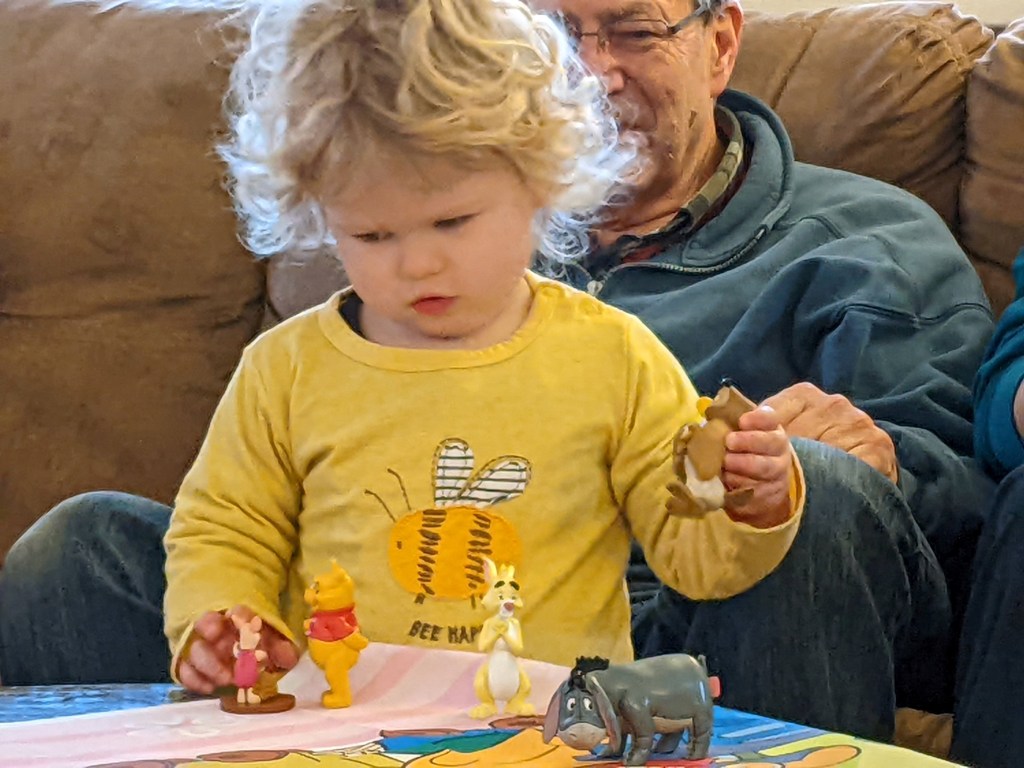
Saturday our family gathered in the Hundred Acre Wood to celebrate our granddaughter Liliana’s second birthday. Lili loves Winnie-the-Pooh, especially Owl.

My sister Linda told us a story I hadn’t heard before. When she was five or six (before I was born), Mom suffered anaphylactic shock while the family was in Mexico. The doctor declared her dead. Dad informed the Lord in no uncertain terms that this was unacceptable because he couldn’t take care of his three children adequately without her. And she started breathing again. A woman who helped the family while Mom convalesced read Winnie the Pooh to Linda. And that’s how Pooh, Piglet, Eeyore, and the others came to be part of our family.

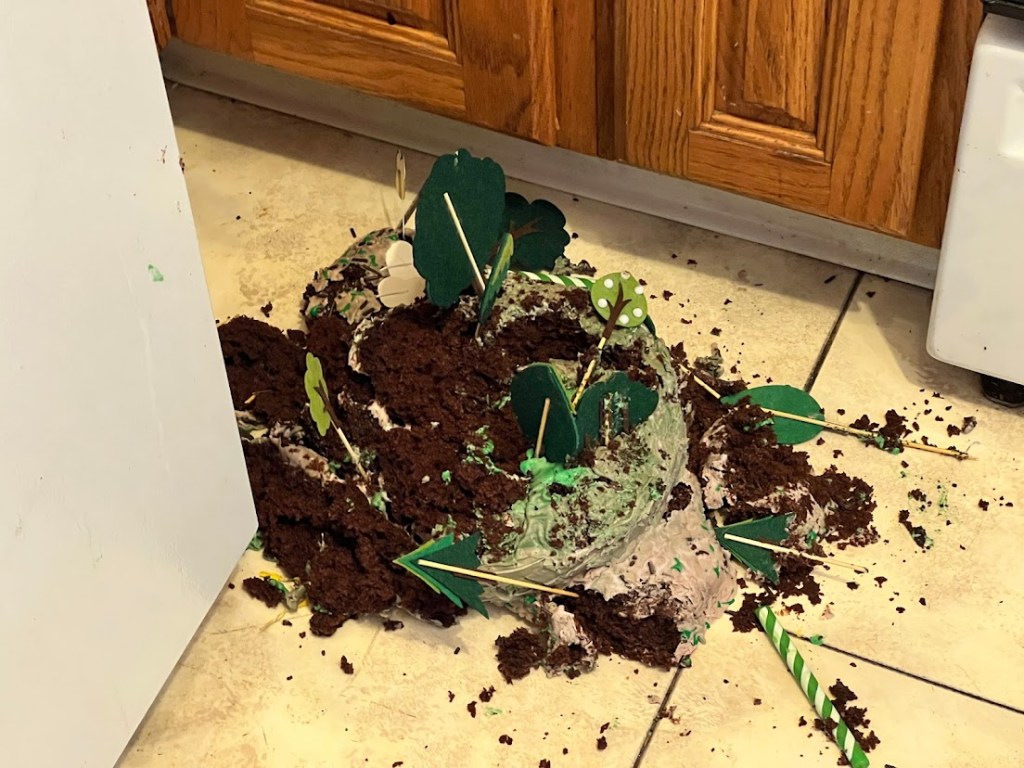
While the adults lingered at the table after lunch, Liliana decided it was time for cake. Her parents had commented that she was tall enough to reach things on the kitchen counter. The first we knew about Lili taking things into her own hands was when she emerged from the kitchen clutching three Pooh cake decorations in her chocolate-covered hands. We had a merry time cleaning up chocolate tracked through the house and on living room furniture. And of course, Lili herself.

Fortunately, we have pre-collapse photos of the cake:

Oh bother!

What makes me smile in telling this story is that it truly was a merry experience, with lots of laughter. Not a single person expressed irritation. Doubtless, Liliana will hear about what she did many times in the coming years. But without a hint of frustration at what she did to her mom’s beautiful cake.

I am so very grateful that our daughters and their families can take potential stressors in stride so much better than I was always able to manage when our kids were growing up.

Experiences like this birthday party show me, better than any number of words, what confident trust looks like. Pure grace.

Here are a couple of my favorite Pooh quotes:

“A little consideration, a little thought for others, makes all the difference.” – Eeyore

“A friend is someone who helps you up when you’re down, and if they can’t, they lay down beside you.” – Winnie-the-Pooh

How is Lent going for you?

But Jesus is our high priest

Hebrews 10:12-18 But our High Priest offered himself to God as a single sacrifice for sins, good for all time… For by that one offering he forever made perfect those who are being made holy.And when sins have been forgiven, there is no need to offer any more sacrifices.

Philippians 1:6 God, who began the good work within you, will continue his work until it is finally finished on the day when Christ Jesus returns.

When I was in college in the ‘70s, some of us wore buttons that said PBPGINFWMY. Do any of you remember that? Please be patient, God is not finished with me yet.

I just discovered vintage buttons are still available on the internet!

How different this is from what I understand to be “cancel culture” (feel free to correct me!), wherein a person can be condemned and ostracized if they make one mistake or commit one sin—even if they repent, confess and ask forgiveness. Especially if it’s a sin of a certain type which brands them forever as a “bad” person.

PBPGINFWMY acknowledges there is “badness,” immaturity, self-centeredness, blindness, ignorance, stupidity, and sin in each of us. The good news of the Gospel, however, tells us Jesus has provided a way forward. Though he was perfectly good, he chose to be “cancelled” so the rest of us wouldn’t have to be. He endured false accusations and paid the penalty of the judgment made against him, fulfilling the terms of the sentence once for all.

All of this so we (who are in fact guilty) can be forgiven and live in freedom. And have space and time to grow up into goodness, confident we are already accepted and dearly loved.

So, this mid-point of the season of Lent seems a good time to ask: How is Lent going for you?

If we try to do Lenten work on our own, it can be a total downer. But if we trust our High Priest and depend on the Holy Spirit and soak in the Father’s unfathomable love for us, we can experience hope and relief and gratitude and joy.

Like my friend who just received news of a clean scan, after a long, difficult fight with cancer. It wouldn’t have been a kindness for her doctor to have patted her on the back and said, “You’re OK, I’m OK.” Recognizing the cancer that was killing her, though it led to tough, painful times during treatment, was essential. This is the lifesaving, life-transforming kindness of God we can experience during Lent.

The disciplines of Lent offer us time to pay attention to areas of our lives which still need to change and mature. Recognizing and admitting them is called confession. Repentance includes choosing to do all in our power to live, think, behave, and treat others with the grace we receive through God’s forgiveness of our sins and failings. This process is called sanctification.

Making us holy is a joint effort between us and the Trinity. We humbly accept that we can’t make ourselves better. While we open ourselves to the Holy Spirit, asking him to produce his beautiful virtues in our lives, Jesus, our High Priest, intercedes for us. And our Father holds us in his love.

So, PBPGINFWMY!

Lenten roses in my back yard