But God

Gentle, meek, and mild?

But Jesus got angry

Mark 3:1-5 Jesus went into the synagogue again and noticed a man with a deformed hand. Since it was the Sabbath, Jesus’ enemies watched him closely. If he healed the man’s hand, they planned to accuse him of working on the Sabbath. Jesus said to the man with the deformed hand, “Come and stand in front of everyone.” Then he turned to his critics and asked, “Does the law permit good deeds on the Sabbath, or is it a day for doing evil? Is this a day to save life or destroy it?” But they wouldn’t answer him. He looked around at them angrily and was deeply saddened by their hard hearts.

Ephesians 4:26 Don’t sin by letting anger control you. Don’t let the sun go down while you are still angry.

Hebrews 12:15 Look after each other so that none of you fails to receive the grace of God. Watch out that no poisonous root of bitterness grows up to trouble you, corrupting many.

James 3:14-15 If you are bitterly jealous and there is selfish ambition in your heart, don’t cover up the truth with boasting and lying. For jealousy and selfishness are not God’s kind of wisdom.

All my life I’ve been afraid of anger, because in my experience anger was linked to emotional and physical violence. So when I came to this story in Mark, my first instinct was to skip over it in favor of something more positive and cheerful. I could write, for example, about the stunning rainbow that hovered over Pittsburgh Wednesday afternoon …

Shutterstock: Pushish Images

But God didn’t let me get away with that. In the background of my thoughts, I kept wrestling with the issue of anger and how I would just shrivel up or melt into a puddle on the floor if I perceived Jesus was angry with me.

I am in no way an expert on dealing with anger. Far from it! But here are a few simple guidelines that seem helpful to me at this moment in my journey.

Anger is an emotion we all feel—unless we’re in denial. Ignoring it doesn’t make it go away. If we don’t give it proper attention, it may instead turn inward and become a “secondary” emotion, hurting us and others through depression, bitterness, apathy, resentment, unhealed grief, or other emotional states. When anger settles in, as part of our emotional furniture, it becomes harmful. Hence the wisdom of Ephesians 4:26.

If we feel anger, we need to pay attention to it. “Primary” emotions, I’m told, surge and then recede in our bodies in about 90 seconds. Until the emotion has passed through, we shouldn’t take any action. But once the emotion has dissipated, we can ask ourselves questions: What was the source of the anger? Against what or whom was it directed? Was it appropriate, i.e. did its intensity match the severity of the provocation? What did I want to do while I was feeling the emotion? Is that action appropriate, i.e. will it reduce or escalate the perceived threat? What else is going on in my life that could intensify the feeling of anger (fear, fatigue, stress, the sense of repeated offense, a feeling of impotence, a narrative I am telling myself about this person or situation …)? Anger can show us a lot about ourselves and the condition of our souls.

Anger is our body’s response to the perception that something is wrong. We need to pay attention to this and decide what to do about it. There is always something we can do about perceived injustice, even if it is “only” relinquishing our pain to God and praying for those who have offended or hurt us. The Scriptures are full of references to God’s justice and the wisdom of entrusting to him those situations we are not properly positioned to do anything about. But often there is something positive we can do, contributing to God’s purposes of healing and redemption, rather than harm and destruction.

The energy of anger propels us to act. This can be a good thing, or it can be terrible. Good actions can be carried out calmly. The impulse of the feeling of anger, though, can often be harmful. Self-control includes hanging in there with the seemingly interminable 90 seconds so we can then evaluate possible actions with our rational brain engaged, not just our impulsive brain. If I yell and hit back when my child yells and hits, for a moment I may feel relief, but the fruit of those actions will damage my child and his or her trust in me.

Thinking about all this took me back to the story in Mark 3, and to the other references cited above. One thought I had (and I would love to hear yours!) is that Jesus’s frustration with the religious leaders opened a window of opportunity for them to see things differently. They placed enforcement of their (mis)interpretation of the law ahead of the wellbeing of one of their congregants. Had their hearts been in tune with God’s loving heart, they could have seen grace in what Jesus did, and wonderful rejoicing could have strengthened all present. Instead, they went away to plot how they could kill Jesus.

Jesus was not for one second out of control of himself and his actions. The religious leaders’ offense had become engrained. Not even Jesus could “make” them change their minds and hearts. Yet he offered them an invitation, through bringing to light the condition of their hearts. An opportunity to repent, to change, to grow. To respond positively to truth.

Your thoughts about this complex topic?

It’s only a matter of time

But Jesus’s perspective is different

Mark 1:34, 41; 2:11 Jesus healed many people who were sick with various diseases … Moved with compassion, Jesus reached out and healed the leper. “I am willing,” he said. “Be healed!” … Then Jesus turned to the paralyzed man and said, “Stand up, pick up your mat, and go home.”

2 Corinthians 12:8-9 Three different times I begged the Lord to take it away [a tormenting “thorn” in Paul’s body]. Each time he said, “My grace is all you need. My power works best in weakness.”

How can a loving father with power to heal, NOT heal his beloved daughter?

Karis took this vexing question to the Lord again and again during her life. At age 11, she chose 2 Corinthians 12:8-9 as her life verses. She referred to them often in journals when she details her intimate conversations with God. Another frequent phrase is, “Don’t ask why. Ask what for.” Her high view of God’s sovereignty, combined with her absolute trust in his love for her, led her to look constantly for what he was doing through her difficult circumstances. I came to expect this question when we were once again in crisis and on the way to the hospital: “I wonder who’s there this time who needs to see God’s love?”

I mentioned on the last blog that the conversation between Jesus and Little James in the second episode of Season 3 of The Chosen could have been lifted from Karis’s journals. Here’s my transcript. It’s not complete but most of the conversation is there, in case you want to refer back to it later.

Jesus has just instructed the twelve disciples to go out two by two in different directions, giving them the authority to heal, as they have seen him heal many people. Lame Little James asks Jesus for a conversation afterwards.

James: How can I heal others when you haven’t healed me?

Jesus: Do you want to be healed?

James: Yes. Why haven’t you?

Jesus: Because I trust you.

James: What?

Jesus: Precious Little James, listen carefully. Within the Father’s will, I could heal you right now, and you would have a good story to tell.

James: That you do miracles.

Jesus: Yes. That’s a good story to tell. But there are already dozens who can tell that story, and there will be hundreds more, even thousands. But think of the story that you have if I don’t heal you. That you still praise God in spite of this [disability]. That you know how to focus on all that matters so much more than the body. That you show people you can be patient with your suffering her on earth, because you know you can spend eternity with no suffering. Not everyone can understand that. How many people do you think the Father and I trust this with? Not many.

James: But the other disciples—they’re so much more …

Jesus: Are you fast, impressive when you walk? Maybe not. But these are things the Father doesn’t care about. You are going to do more for me than most people ever dream. So many people need healing in order to believe in me … That doesn’t apply to you. And many are healed or not healed because the Father has a plan for them which may be a mystery. And we remember what Job says, “The Lord gives and the Lord takes away.”

James joins Jesus saying: “Blessed be the name of the Lord.”

Jesus: When you pass from this earth and you meet your Father in heaven, Isaiah promises you will leap like a deer. Your reward will be great. So hold on a little longer. And when you discover yourself finding true strength because of your weakness, and when you do great things in my name in spite of this [your lameness], the impact will last for generations. Do you understand?

James, with tears: Yes. Thank you, Master.

Jesus: A man like you healing others. Oh, what a sight! I can’t wait to hear your stories.

Jesus starts to walk away after they bless each other but turns back.

Jesus: And James, you will be healed. It’s only a matter of time.

Karis’s famous smile … on a Christmas day in the hospital

Your healing will come.

But Jesus shares his authority

Mark 6:7, 12-13 Jesus called his twelve disciples together and began sending them out two by two, giving them authority to cast out evil spirits [and to heal all diseases, Luke 9:1]. … So the disciples went out, telling everyone they met to repent of their sins and turn to God. And they cast out many demons and healed many sick people, anointing them with olive oil.

I’m skipping ahead in Mark today, because of something that happened last night. We had an evening without other commitments, and Dave suggested we watch the second episode of the new Season 3 of The Chosen (we haven’t managed to accompany the episodes as they’ve been released). The episode is called “Two by Two.” It dramatizes this passage in Mark, Luke 9, and Matthew 13.

After Jesus gives his instructions to the disciples and is walking away, the “other James” follows Jesus and asks for a conversation. In Mark 15:40, this James is referred to by a word that means least, less, little, small. English versions translate this variously as James the young, the younger, the youngest, the less, the lesser, the little. In The Chosen, he is called Little James, and James the brother of John is called Big James. Additionally, Little James is cast in The Chosen as a man with a lame leg.

As I listened to the conversation between Jesus and Little James, I had goosebumps. I watched with my mouth open. Because the conversation could have been lifted straight from the pages of Karis’s journals. Clearly the script was written by someone who has been there, who has asked God the question, “Why haven’t you healed me? How can I heal others like—like this?” Jesus’s response is exactly what Karis records God saying to her, multiple times from her adolescence on.

To understand more deeply the impact of this for me, it may be helpful to know that all her life, since being born with a severe intestinal anomaly, Karis, Dave and I, and our family have been challenged by Christians who believe God only doesn’t heal because of sin and/or lack of faith. Therefore, Dave and I, and later Karis as she grew up, were exhorted again and again to confess the sin for which she/we were being punished, to confess our lack of faith, and to live our lives out of the belief she had been healed (i.e., stop seeking medical help for her, especially when her life was at risk, as “proof” of our faith). Make her get out of bed. Make her see this illness is not real; what is real is the health God promises every believer.

All of this is one of the main reasons Karis cites in her journals for wanting her story written down. She wanted believers to understand the deeper grace God offers when he chooses not to heal someone physically. “If God heals me—gives me a brand-new intestine—that story will make a big splash,” she wrote. “For a little while, many people will be excited. But quickly it will become old news. Instead, for as many days or years God gives me, I want to show people a different kind of grace—the grace that allows me to praise God even through my pain. The doors that open for me exactly because I am disabled. The compassion God has given me for all who suffer, with any kind of pain, whether physical, emotional, social, or mental. The joy greater than my circumstances that wells up from the Spirit inside me. That’s what I want people to see when they look at my life: not a ‘big splash,’ but the daily faithfulness of God, available to everyone, everywhere, in any condition of life.”

Karis’s journals, from age 9 until the week before her last coma, age 30

So, imagine how intrigued I was to hear Jesus’s words to Little James on the screen last night. You’ll find the conversation at 53:12-59:44 on Episode 2 of The Chosen Season 3, called “Two by Two.” I’ve transcribed it, but will wait until the next post to quote part of the conversation for you. I hope meanwhile you’ll take the time to watch it.

In fact, God did perform miracles in Karis’s life. Huge miracles that restored her again and again when the doctors told us (again) that this time there was no hope, from infancy on. But never “the big miracle,” the big splash. Her story is both bigger and deeper than that, to the glory of God.

At the end of the conversation, Jesus starts to walk away. Then he turns back and says to Little James, “Your healing will come. It’s just a matter of time.”

That is true for every one of us.

Your sacred center

But Jesus takes his orders from the Father

Mark 1:35-38 Before daybreak, Jesus got up and went out to an isolated place to pray. Later Simon and the others went out to find him. When they found him, they said, “Everyone is looking for you.” But Jesus replied, “We must go on to other towns as well. … That is why I came.”

John 5:19 Jesus explained, “I tell you the truth, the Son can do nothing by himself. He does only what he sees the Father doing.”

Are you a people-pleaser? I certainly have been. I love knowing people are happy with me and with ways I try to serve them.

But do I shape my own sense of wellbeing around other people’s happiness with me? Ah, there’s the rub, right? Because in fact I am not responsible for whether other people feel happy.

Jesus made it clear to his disciples right away that he took his orders from the Father, not from them or from the people surrounding them. I’m sure this bothered some of the disciples.

And to understand the Father’s directions, Jesus had to spend time with him. Again and again in the Gospels we see him doing so.

I love the concept of having an audience of One, making my Father’s pleasure the center of my life. If I am spending time with him, submitting my priorities and desires to him, and following his direction as well as I can, I can better keep my balance I terms of all the other voices in my life and my natural desire to serve and care for the people I love.

Here’s another lovely passage from Henri Nouwen, The Inner Voice of Love. The meditation is titled, “Set Boundaries to Your Love”:

You give whatever people ask of you, and when they ask for more, you give more, until you find yourself exhausted, used, and manipulated. Only when you are able to set your own boundaries will you be able to acknowledge, respect, and even be grateful for the boundaries of others … The great task is to claim yourself for yourself … True mutuality in love requires people who possess themselves and who can give to each other while holding on to their own identities. … You must learn to set boundaries to your love.

Later, Nouwen says, “the identity that makes you free is anchored beyond all human praise and blame. … Only God can fully dwell in that deepest place in you and give you a sense of safety. Don’t let others run away with your sacred center.” Amen.

Here’s a song to make you smile, a flashback to 1955. In light of this post, think of the lyrics directed to the Father.

Real authority

But Jesus came to serve

Mark 1:22 The people were amazed at Jesus’s teaching, for he taught with real authority, quite unlike the teachers of religious law.

Mark 10:42-45 Jesus called his disciples together and said, “You know that the rulers in this world lord it over their people, and officials flaunt their authority over those under them. But among you it will be different. Whoever wants to be a leader among you must be your servant … for even the Son of Man came not to be served but to serve others and to give his life as a ransom for many.”

Philippians 2:5-7, 14 You must have the same attitude that Christ Jesus had. Though he was God, he did not think of equality with God as something to cling to. Instead, he gave up his divine privileges; he took the humble position of a slave and was born as a human being. … Live clean, innocent lives as children of God.

One of my favorite books when I was a child was The Scarlet Pimpernel, published in 1905 by Baroness Orczy. I loved the fact that Sir Percy led a double life, apparently a wealthy fop, but secretly risking his life to save others. The ridicule Percy experienced actually protected him–no one suspected he could be the one carrying out amazing heroic deeds. Orczy wrote this long before Marvel popularized the idea of a superhero who seemed a mild-mannered, ineffectual, or unremarkable person. In fact–just after writing that–I read on Wikipedia that Stan Lee, the Marvel co-creator, read The Scarlet Pimpernel as a boy and has called Sir Percy the first character who could be called a superhero.

I’m not sure I can agree with Stan Lee, and you probably anticipate what I’m going to say. The Gospels show us members of Jesus’s family and his neighbors not thinking there was anything special about Jesus. He was looked down on for his humble place in society, for coming from a nothing place (“Can anything good come from Nazareth?”), for not having wealth or credentials or position. He was killed like a common criminal.

Yet Jesus’s words and acts as a teacher, a healer, a servant, and a redeemer have impacted the world, transforming lives, for two thousand years.

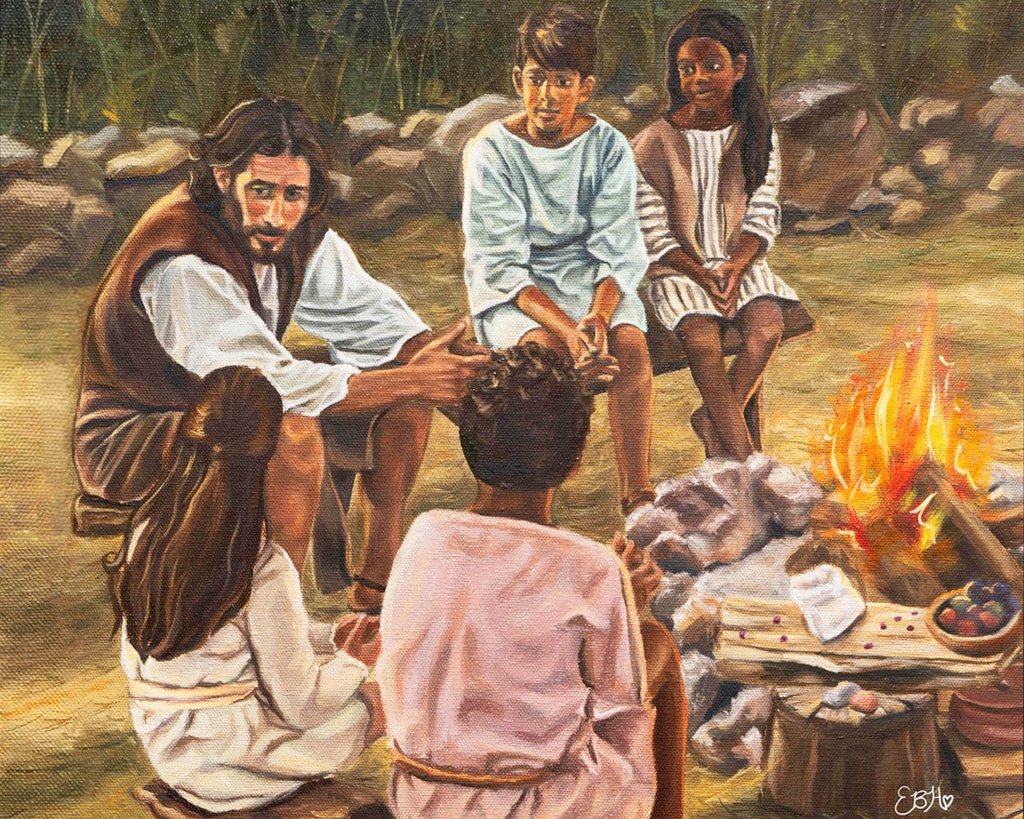
In the current film series “The Chosen,” early episodes show us Jesus playing with children. In the episode about Jesus healing the paralytic let down through the roof, kids watch the spectacle from another roof nearby. OCD Matthew awkwardly climbs up beside them and starts to tell the children who Jesus is. “We know him,” they nod, startling Matthew. We can imagine Matthew’s churning thoughts: Who is this man?

By Allen Hogan. I couldn’t find one of the kids on the wall with Matthew.

Real authority comes not from words alone, but from deeds and attitudes that match the words, done not to garner attention but out of love. It’s called integrity. Some of integrity’s fruits are safety and trustworthiness. I love this passage from Henri Nouwen’s little book, The Inner Voice of Love (pages 49 and 50):

A part of you was left behind very early in your life … it is full of fears. Meanwhile, you grew up with many survival skills. But you want your self to be one. So you have to bring home the part of you that was left behind. That is not easy, because you have become quite a formidable person, and your fearful part does not know if it can safely dwell with you. … Jesus dwells in your fearful, never fully received self. Where you are most human, most yourself, weakest, there Jesus lives. Bringing your fearful self home is bringing Jesus home. As long as your vulnerable self does not feel welcomed by you, it keeps so distant that it cannot show you its true beauty and wisdom. Thus, you survive without truly living. … When you become more childlike, your small, fearful self will no longer feel the need to dwell elsewhere. It will begin to look to you as home. Be patient … Gradually you will become one, and you will find that Jesus is living in your heart and offering you all you need.

Nothing enchants me more than discovering quiet integrity. It’s as thrilling now in real life as it was for me through fiction as a child. And no one embodies this more than Jesus, loving us in the past, the present, and the future.

This is an old song with a still-relevant message.

Being human is good

But Jesus, fully God, is fully human as well

Mark 1:1 This is the Good News about Jesus the Messiah, the Son of God … John [the Baptist] baptized Jesus in the Jordan River. As Jesus came up out of the water, he saw the heavens splitting apart and the Holy Spirit descending on him like dove. And a voice from heaven said, “You are my beloved Son, and you bring me great joy.”

Hebrews 4:15 This High Priest of ours understands our weaknesses, for he faced all of the same testings we do.

2 Peter 1:2-3 May God give you more and more grace and peace as you grow in your knowledge of God and Jesus our Lord. By his divine power, God has given us everything we need for living a godly life.

During these seven weeks of Epiphany, I want to look at the question, “Who is this man?” from the perspective of the Gospel of Mark. Mark isn’t part of our lectionary readings this year, but I’ve written a lot in the past from Matthew, Luke, and John and have neglected Mark.

Since I’m on vacation, I invite you to listen to Kevin Antlitz’s New Year’s sermon, “What Christmas teaches us about being human.” Our problem is not that we’re human; it’s that we’re not human enough, as Jesus was. Kevin cites St. Gregory: “What Jesus does not assume [we could use the word “incarnate” here], he does not heal.”

Happy listening!!

This is the irrational season

When love blooms bright and wild.

Had Mary been filled with reason

There’d have been no room for the child.

—Madeleine L’Engle

Twelve drummers drumming

But God sent his Son for everyone

Psalm 145:21 I will praise the Lord, and may everyone on earth bless his holy name forever and ever.

Psalm 24:9-10 Open up, ancient gates! Open up, ancient doors, and let the King of glory enter. Who is the King of glory? The Lord of Heaven’s Armies—he is the King of glory.

Psalm 102:15 The nations will fear the name of the Lord. All the kings of the earth will revere your glory.

John 3:16-17 For God loved the world so much that he gave his one and only Son, so that everyone who believes in him will not perish but have eternal life. God sent his Son into the world not to judge the world, but to save the world through him.

Drumroll please! Because January 6 is a very special day.

In some parts of the world, it’s the day of the Three Kings, Día de los Reyes, the day children receive gifts in commemoration of the magi who followed a star from far-off lands to recognize and honor the baby Jesus with their worship and their gifts.

It’s the day called Epiphany, the day of revelation to the world that this child born in a stable to humble parents is the King of kings for all nations, not only for Israel.

In Eastern traditions, it’s called Theophany, to remember the revelation at Jesus’s baptism, when God’s voice from Heaven declared Jesus to be his beloved Son, and the Holy Spirit attested to this in the form of a dove.

In every case, believers ask on this day for greater and clearer revelation of who Jesus was, is, and will be. “Open my eyes, Lord. I want to see Jesus.”

So, I like the drummers drumming on the twelfth day, reminding us the King is coming! We must prepare our hearts to receive and honor him!

Shutterstock: kzww

Whatever the origin of “The Twelve Days of Christmas,” published in England at least as early as 1780 and popularized in its now-standard version by Frederic Austin in 1909, the number twelve reminds me as well of the twelve apostles, whose task it was to reveal Jesus to the world as the resurrected Christ, the Anointed One (Acts 1:22).

We are invited to share in this joyful task, to beat our drums for the King of kings as we await his full revelation to the world, saying with the Apostle John, Maranatha. Come, Lord Jesus.

Ten lords a-leaping?

But God hears our cries for help

Psalm 145:19-20 The Lord grants the desires of those who fear him; he hears their cries for help and rescues them. The Lord protects all those who love him.

Matthew 28:20 [Jesus said] “I am with you always, even to the end of the age.”

Luke 6:46-48 “Why do you keep calling me ‘Lord, Lord!’ when you don’t do what I say? I will show you what it’s like when someone comes to me, listens to my teaching, and then follows it. It is like a person building a house who digs deep and lays the foundation on solid rock. When the floodwaters rise and break against that house, it stands firm.”

1 Peter 1:6 There is wonderful joy ahead, even though you have to endure many trials for a little while.

The image that comes to mind is comical. I picture a game of leapfrog, with the ten lords in all their finery becoming ever more disheveled and wet as they fall in the grass sodden and muddy from all the rain we’ve been having.

Shutterstock: Wallenrock

And that reminds me of my then three-year-old grandson slipping and falling in mud. When I heard his cries and went to rescue him, I slipped too, and we were both lying there covered in mud and with no apparent way to clean ourselves up enough to get in the car and go home from the park.

On this tenth day of Christmas, the last thing I feel I need is ten lords a-leaping. I need only one Lord who hears my cries for help and rescues me. For my heart is shattered with a loss I can’t describe to you. Maybe that’s OK, because your heartache is different from mine, and I want you to hear this word of comfort from Psalm 145 through the lens of your own grief or need.

Wait a minute! you may be thinking. I don’t see the Lord granting my desires or rescuing and protecting me. I feel like God has forgotten me, or maybe, with the world in such a mess, he doesn’t care about my concerns. I’m like that crying three-year-old lying cold in the mud.

I hear you. Sometimes nothing makes sense, even words of comfort like these words from Psalm 145. Sometimes the Lord rescues us in ways we don’t understand until much later.

I’ve gone through a lot of trouble and anguish in my life, and what I want to tell you, even in my own grieving today, is that the Lord does hear, and he does care. Sometimes I wish he didn’t so much respect our free will and would swoop in and prevent us feeling the effects of our own and others’ poor choices and wounded hearts and wrong thinking and acting. I wish I could go back to being like three-month-old Juliana whose every need my daughter attends to.

But God wants me to grow up, painful and messy as that process can be. And while this “vale of tears” can be very dark at times, light and hope come to us through the promise of final defeat of wrong and evil. This isn’t “pie in the sky by and by.” Our solid rock, the anchor for our souls, our unwavering confidence is that Jesus is with us now, today, walking through it all right beside us, caring for us in big ways and small.

Please open my eyes; let me see you with me, Lord.

Today.

Two turtledoves …

But God is close

Psalm 145:17-18 The Lord is righteous in everything he does; he is filled with kindness. The Lord is close to all who call on him, yes, to all who call on him in truth.

Hebrews 2:16-18 We know the Son did not come to help angels; he came to help the descendants of Abraham. Therefore, it was necessary for him to be made in every respect like us, his brothers and sisters, so that he could be our merciful and faithful High Priest before God. Then he could offer a sacrifice that would take away the sins of the people. Since he himself has gone through suffering and testing, he is able to help us when we are being tested.

It seems like every time I ask Youtube to play Christmas carols, sooner or later I’m treated to yet one more rendition of “The Twelve Days of Christmas.” And on NPR I learned that someone (sorry, I didn’t catch who) prices the cost of the “goods and services” in this song each year as a measure of inflation: giving your true love the gifts of all twelve days would cost you 10.5% more this year than last year. Especially turtledoves! Sorry, that’s about all I remember, but feel free to research it!

What is it that so fascinates us about this dated song that we keep on playing it and listening to it?

Hearing about this on NPR did prompt me to think about turtledoves, because they show up periodically in Scripture. They are cited in Song of Solomon as a sign of spring (no wonder they are expensive at the moment, huh). In Psalm 74:19, God’s beloved people are compared to turtledoves. In Leviticus a series of texts describes using them for sacrifices, for those too poor to purchase a lamb. In Luke we learn that Mary and Joseph fell into that category, because they took two turtledoves to the Temple to substitute legally for their firstborn Jesus’s dedication to the Lord when he was circumcised at eight days of age.

The Temple priests didn’t know Jesus was the Lamb, the One who would be sacrificed for each one of us. The One described by the old man Simeon in the Temple as “the consolation of Israel.”

Two turtledoves, the offering of the poor. For the Magi had not yet arrived to bring him their costly gifts.

On this second day of Christmas, I am filled with awe thinking about the mystery of God become a tiny, helpless baby.

My favorite carol again this Christmas: https://www.youtube.com/watch?v=ifCWN5pJGIE

How long, Lord?

How long, Lord?

But God opens his hand

Psalm 145:15 The eyes of all look to you in hope; you give them their food as they need it. When you open your hand, you satisfy the hunger and thirst of every living thing.

Psalm 130:5 I am counting on the Lord; yes, I am counting on him. I have put my hope in his word.

What a delight to care for my two-month-old granddaughter Juliana yesterday, satisfying her hunger with the milk my daughter had left for her.

I felt overwhelmed with gratitude for little JuJu’s health. I couldn’t help flashing back to Karis at that age, in the hospital and unable to swallow without bilious vomiting even one teaspoon slow drip over an hour.

And I started thinking about all the ways God fed Karis despite her dysfunctional intestines. Had she been born even a few years earlier, TPN (elemental nutrition administered directly into the veins) would not have been available for her. She was the first baby to survive infancy with her condition, thanks to TPN and to God’s dramatic intervention when the doctors asked us to remove life support and let her go, and instead her intestine inexplicably started functioning for the first time.

After that, for a while, she was able to nurse. When her intestines shut down again, she had a combination of TPN and pregestimil, administered half-strength slow drip through a kangaroo pump. (At other times in her life she actually drank that horrible stuff.) There were long periods when the only foods she tolerated were yogurt and boiled chicken breast. She had her own special “yogurt spoon.”

There were periods when she could eat a variety of foods, but that could morph in a matter of minutes into painful, life-threatening bowel obstructions and dehydration. We tried all kinds of combinations and concoctions. When she lost too much weight, the docs would put her back on TPN, which led to its own complications and scary line infections.

One day in Brazil when Karis was in high school, struggling to live a version of “normal life,” I carried my Bible into her bedroom open to Psalm 145 and told her God had spoken to me very directly through one verse; could she guess which it was?

She glanced at the page to see which psalm I was showing her and said, “Verse 15, right, Mom? Don’t I keep telling you to stop worrying about me? But Mom, what about all the children who starve, not because they can’t eat, like me, but because they simply don’t have food to eat? How does this verse apply to them?”

Her eyes filled with tears. “Mom, I wish I could use the money our insurance is spending to keep me alive to feed the children who don’t have food. Why can’t I, Mom? The world is totally out of whack, with so many resources invested in me and so few in them. It’s not right. What can I do? How can God bear it? How can we make the world a more equitable place?”

By now Karis was sobbing, and I with her. I still don’t know the answers to her questions. We have so much. Others have so little.

Remembering all this today, I think of God’s promise that the time will come when there is no more hunger and thirst. For the Lamb on the throne will be their Shepherd. He will lead them to springs of life-giving water. And God will wipe every tear from their eyes (Revelation 7:16-17). How long, Lord? How long?

As this season focuses our attention on the Source of our hope, God himself become a helpless, hungry infant, savor this beautiful reflection by Luci Shaw, “Mary’s Song” (thanks, Shari!):

Blue homespun and the bend of my breast

keep warm this small hot naked star

fallen to my arms. (Rest . . .

you who have had so far

to come.) Now nearness satisfies

the body of God sweetly. Quiet he lies

whose vigor hurled

a universe. He sleeps

whose eyelids have not closed before.

His breath (so slight it seems

no breath at all) once ruffled the dark deeps

to sprout a world.

Charmed by doves’ voices, the whisper of straw,

he dreams,

hearing no music from other spheres.

Breath, mouth, ears, eyes

he is curtailed

who overflowed all skies,

all years.

Older than eternity, now he

is new. Now native to earth as I am, nailed

to my poor planet, caught that I might be free,

blind in my womb to know my darkness ended,

brought to this birth

for me to be new-born,

and for him to see me mended

I must see him torn.

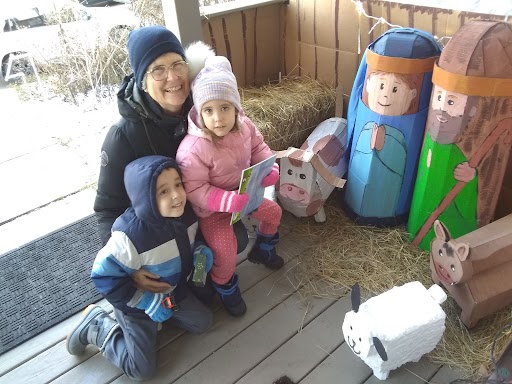
Waiting for Baby Jesus … beautiful creche fashioned from cardboard boxes, tape, and paint by our friend Lineth.