
1 Corinthians 15:19-20 If our hope in Christ is only for this life, we are more to be pitied than anyone in the world. But in fact, Christ has been raised from the dead!

1 Corinthians 15:19-20 If our hope in Christ is only for this life, we are more to be pitied than anyone in the world. But in fact, Christ has been raised from the dead!
Galatians 5:4-6 If you are trying to make yourselves right with God by keeping the law, you have been cut off from Christ! You have fallen away from God’s grace. But we who live by the Spirit eagerly wait to receive by faith the righteousness God has promised to us. For when we place our faith in Christ Jesus . . . what is important is faith expressing itself through love.
After all the drama we’ve walked through with Jesus since he raised Lazarus and invoked a serious plot to kill him, this day of Passion Week, “Holy Saturday,” feels like a “nothing” day. It’s another day of winter when we’re longing for spring. It calls us to wait a while longer, when we’re eager for the joy of Easter.
The waiting reminds me of sitting in, yes, the waiting room while Karis was in surgery to remove her graft after she contracted Legionnaire’s disease. It was impossible by any standard for her to survive that surgery with her lungs consumed by pneumonia. But it would be impossible for her to live if her body had also to contend with her suppurating intestine. So, our gathered family waited. With hope against hope.

Were any of Jesus’s friends, family, disciples waiting with hope against hope that Saturday? Did any of them remember he had told them he would rise again on the third day?
After Karis came back to us, two months after that waiting day, she was frustrated. Why had we ever doubted? Didn’t we realize God still had work for her to do here on earth? I remember staring at her, with no words to even begin to express to her the agony of day after day, hour after hour, not knowing whether she would make it through the next minute. Waiting.
Many wonderful books have been written about all God does inside us when we’re forced to wait. Turns out, it’s not a “nothing” time. It’s a time when God’s deepest work can be accomplished in us. Paul reminds us it’s not what we can do for ourselves that matters during this time. It’s what he can do in us. Our part is to turn to him in trust.
I’m excited! What will God do in me today, on this waiting day?
The link is https://www.youtube.com/watch?v=i9Nm4-nEcF4&feature=youtu.be
The bulletin is https://www.ascensionpittsburgh.org//wp-content/uploads/2020/04/2020.04.09-Maundy-Thursday-BW.pdf
A children’s resource is https://www.ascensionpittsburgh.org//wp-content/uploads/2020/04/MTh-Last-Supper-KRegan-Coloring-Sheet-copy.pdf

Titus 3:2-5 Believers must not slander anyone and must avoid quarreling. Instead they should be gentle and show true humility to everyone. Once we, too, were foolish and disobedient . . . But when God our Savior revealed his kindness and love, he saved us, not because of the righteous things we had done, but because of his mercy.
John 13:34-35 So now I am giving you a new commandment: Love each other. Just as I have loved you, you should love each other. Your love for another will prove to the world that you are my disciples.
This is the message of Maunday Thursday. The word “maunday” means commandment. It’s the day we remember that Jesus took a towel and washed his disciples’ feet. John tells the story with this preface: He had loved his disciples during his ministry on earth, and now he loved them to the very end (13:1). After he sat back down at the table, Jesus said, “I have given you an example to follow. Do as I have done to you . . . Love each other” (John 13:15, 34).
How did Jesus love? With humility, gentleness, kindness.
Several people in my life are showing me in this Covid-19 crisis what humble, gentle, kind love looks like. They likely have no idea that I’m watching them, because they’re not doing it to win points or for show. They have experienced Jesus’ love for them and are passing it on.
Thank you, Lord.
If you’re looking for a way to participate in Holy Week services during this strange time, you can access the Palm Sunday, Maunday Thursday, Good Friday, and Easter services. The schedule and links are here: https://www.ascensionpittsburgh.org/blog/
Titus 3:3-7 Once we, too, were foolish and disobedient. We were misled and became slaves to many lusts and pleasures. Our lives were full of evil and envy, and we hated each other. But when God our Savior revealed his kindness and love, he saved us, not because of the righteous things we had done, but because of his mercy. He washed away our sins, giving us a new birth and new life through the Holy Spirit generously poured out on us through Jesus . . . Because of his grace he declared us righteous.
HE saved us. Lent teaches us we can’t save ourselves. We can, though, pray like the tax collector in one of Jesus’ stories, “O God, be merciful to me, a sinner.” You can read this beautiful story in Luke 18:9-14.
This last day of Lent feels bittersweet. It has gone by so fast! Have I taken enough time to sit with the Lord so he can accomplish in me all he desires? I’m comforted by realizing I can—and must—continue this practice through Holy Week and on through the “ordinary time” to come.
Ordinary time? What’s that? Will we ever experience ordinary time again? Read my friend Pam’s poetry, below, as she reflects on what coronavirus time means to her.
What has God done for you during this Lenten season? I would love to share YOUR “But God” story, to encourage everyone who reads this blog. Send it to me here: debrakornfield@gmail.com.
Pam Sider works with One Challenge International like we do, but in Spain. She recently sent a beautiful poem, perfect for the conclusion of our Lenten walk toward Jerusalem. Here’s what she says about the context of the poem:
“Here in Spain during our two+ weeks so far of lockdown, we have had a LOT of spring rain. There have been conversations about if the rain makes it easier to have to stay indoors, with varying opinions. In general, most of us living in southern Spain are completely spoiled with the many days of sun. But today, the rain is speaking…and I for one, am listening.”

Let It Rain
by Pam Sider
The hard rain is buffeting the ground
The ground is oversaturated
and sits in docility
Receiving the abundance
The streets, patios, alleys & drains
surge with drops & swirls & rivulets
They join other sources in growing strength
And course together down the street in victory.
Oh! that it could wash away the virus!
Oh! that it could cleanse the air forever!
How we all need these spiritual rains
Showering down on our heads, our minds
Sanitizing our thoughts, unhealthy defaults
We need this atoning drizzle over our hearts & souls
I need it to pour over my emotions
taking the negative & toxic ones away in the stream
I need gentle showers over my spirit
refreshing, restoring, redeeming
And over all our bodies
Please let it rain atonement, cleansing, healing.
This hard rain buffeting the ground?
It is music, it is provision, it is life
It is God´s invitation to a deeper, internal work.
Purify me from my sins, and I will be clean; wash me, and I will be whiter than snow (Psalm 51:7).
Here’s the last section of another poem by Pam, which arrived in my Inbox just this morning. The poem is called “Holy Pause.” Pam says, “For us in Spain, our quarantine (cuarentena) has lined up with Lent (cuaresma) and Easter. I doubt that is a coincidence. This year Passion Week will be full of a different kind of opportunity, a different kind of community, a different memory for years to come. May your home be full of love & grace.”
This extraordinary time calls for extraordinary attention.
Attention to the One writing out history.
Attention to the One who is redeeming in the midst of wars, chronic illness, vulnerability, natural disasters, human trafficking, crime, poverty….
Attention to the One who can redeem this virus, too.
Attention to our own hearts & His activity there.
Can we release our plans, our freedom, our right to choose?
Can we hold both hands open to our compassionate God,
One filled with grief and the other with trust?
For these two are companions; we experience both.
One does not cancel out the other;
we have to find a way to live with both, to hold both.
Like a lot of things Jesus does,
He accomplishes through paradoxes.
He is Love, Compassion, Power, Comfort, Mercy, so many things…
But he is also Mystery.
We cannot have it all figured out,
But we do know he is speaking.
So, this forced quiet, this compulsory isolation
Is it not an opportunity?
This gift of seclusion, is it not from God?

Mark 1:7-8 John announced, “Someone is coming soon who is greater than I am—so much greater that I’m not even worthy to stoop down like a slave and untie the straps of his sandals. I baptize you with water, but he will baptize you with the Holy Spirit!”
The context of this statement by John the Baptist is repentance and forgiveness. John invited people to be baptized to show “that they had repented of their sins and turned to God to be forgiven” (verse 4). Obviously, Jesus didn’t need either to repent or to forgive. His baptism was sealed by a revelation of the Trinity, the Father affirming him with precious words we all love to hear when we make God our own Father, and the Holy Spirit descending on him.
But the linking Mark made in telling how John joined repentance to forgiveness reminded me of something I learned from one of Karis’s aides. I could write a book about our experiences with aides during the two and a half years they frequented our home! We had a huge turnover of aides, for all kinds of reasons. Two of them were a huge blessing and were with us for several months. Others—not so much.
One morning we met a new aide at the hospital in the waiting room for transplant clinic. After Karis had her blood drawn, we typically waited several hours for results to come back so she could see the doctor. I had urgent errands which I planned to accomplish during this waiting period while the aide stayed with Karis.
I carefully explained to our new gal what Karis would need while I was gone: principally, helping her to and in the rest room and getting water for her, since at that time she was not mobile on her own. I would be back in about an hour. The aide must not leave Karis’s side while I was gone, because no one else would care for her while she was in the waiting room.
I zipped through my errands and got back to the waiting room to find Karis frantic for the rest room and for a drink of water. “The aide left right after you did,” Karis told me through tears. “She said she was hungry.”

GRRRR. I was settling Karis after tending to her needs when the aide wandered in, chatting on her phone and eating French fries from a fast food bag. When she saw me, her eyes widened, and she quickly ended her phone call. “I didn’t expect you back so quickly,” she said. “I was hungry.”
“Karis, are you OK now for a few minutes? We are going to find a more private place to talk.”
I described to the aide how I had found Karis when I returned. I asked her what I had said she must do while I was gone.
“Stay with her,” she remembered.
“But you didn’t stay with her.”
“Like I said, I was hungry.”
I explained that the number one requirement for being an aide for Karis was trust. Karis and I had to be able to trust her to do what we asked. Karis’s wellbeing absolutely depended on that. “You haven’t shown us you are trustworthy. Would you like the chance to do better?”
“Ma’am, I am digging deep into my soul for the strength and patience to be able to forgive you for what you just said to me. I am telling myself some mothers just get too attached to their daughters. I am willing to forgive you if you never speak to me that way again.”

“All right. I promise I will never speak that way to you again, because you are dismissed. I will call your agency to explain what happened. Goodbye.”
“But—I need this job! Can you at least give me a recommendation?”
“Uh—no. Goodbye.”
Our aide was far from repentant. In fact, she flipped the table to make it seem I was the one who needed her forgiveness.
Crazy, right? Frightening. Exasperating. Draining.
But haven’t you and I done the same thing with God from time to time? We blame God for the consequences of something we ourselves have done. And then feel noble when we decide to “forgive” God for “making” us suffer those consequences.
This Lent, I realized I’ve done exactly that with God regarding one specific aspect of my life. And you know what? I’ve found God generous with second chances. But first I needed to recognize what I had done, admit it (confess), repent (turn away from rather than keep trying to justify my attitude and behavior), and humbly ask for forgiveness. And then ask for a fresh infilling of the Holy Spirit to enable me to make restitution.
You too?
If we claim we have no sin, we are only fooling ourselves and not living in the truth. But if we confess our sins to him, he is faithful and just to forgive us our sins and to cleanse us from all wickedness (1 John 1:8-9).
Zechariah 3:1-2 The Accuser, Satan, was there making accusations against Jeshua. But the Lord said to Satan, “I, the Lord, reject your accusations, Satan.” [CEV: But the Lord said, “Satan, you are wrong.”]
Dave was in Paraguay the first week of March when I took our 2005 Toyota Corolla to our mechanic for its annual inspection. I made the appointment as early in the month as possible because I was concerned about a warning light on our dashboard.
Indeed, our trusted mechanic called me with a list of problems. That little dashboard light signaled the most expensive of them: the catalytic converter. “Your car will never pass emissions testing,” he told me. “All told, even using recycled parts, you’re looking at several thousand dollars to pass inspection. Save your money to replace this car.”
I reported this to Dave by email, and he said he would start looking for a “new” reliable and affordable car when he got home. We would have three weeks to replace our car before we would become liable for fines for not renewing our inspection and emissions testing.
A couple of days later, the little light on the dashboard disappeared. It still had not come back on when I drove to the airport March 8 to pick up Dave. “Here’s what I think we should do,” I told him on our way home. “I think we should seek a second opinion.”
Dave agreed it couldn’t hurt (other than losing time on our car search). I made an appointment for Thursday, March 12 with a mechanic recommended by a friend. At that point, if the second opinion matched the first, we would have a little over two weeks to replace our car.
The little light stayed off, but the other mechanic had identified so many problems, I wasn’t optimistic.
“Your car is ready. Pick it up any time before 4:00.”
“Really? I mean—I beg your pardon?”
He probably thought I was half deaf. The mechanic repeated what he had said and hung up. When I got there, he handed me the bill and the keys. Our car sported bright shiny stickers with March 2021 on them. We were legal for another year.
“You didn’t find any problems?”
“Nope. Just a small oil leak. Looks like it’s been there for a while. Not worth fixing.”
“It passed the emissions test.”
“Yep. I did rotate your tires. Charged you $1 for that.”
“If it were you, would you keep this car?”
“Absolutely. She still has a lot of life in her.”
Bemused, I paid the inspection and emissions testing fees and drove home. Dave shrugged and we looked at each other with eyebrows raised. We still don’t know how to explain any of this. Or what will happen next. At the least, we gained a reprieve.
All that happened before social distancing and shelter-at-home became our new lifestyle. (Can that really be true? It seems like we’ve been doing this for a long time already!) We didn’t know that soon all non-essential businesses would be closed. We don’t know whether we would have been able to find a replacement car under these conditions.
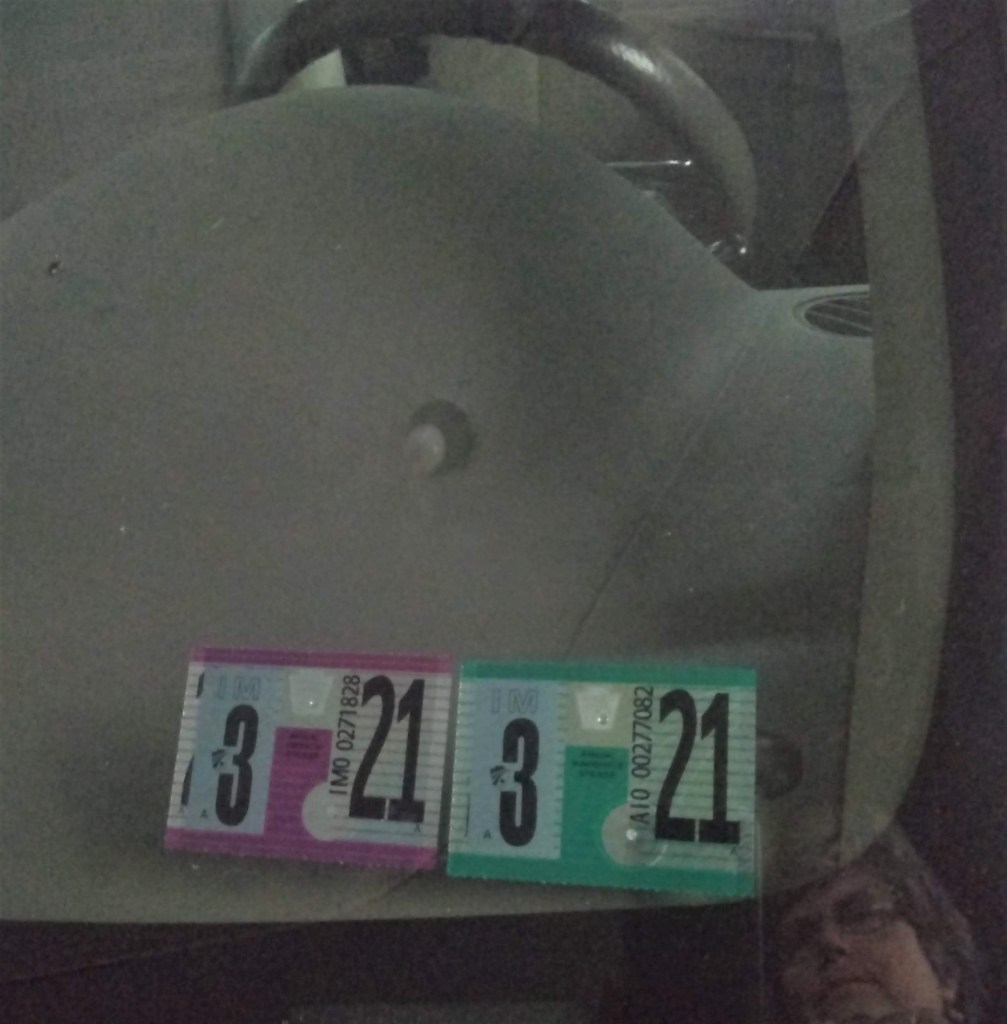
I thought of this experience when I re-read this intriguing passage from Zechariah, led there by the old and new clothing imagery in our Lenten reading in Ephesians. Keep reading in Zechariah to understand what I mean. It is so cool that God rejected Satan’s accusations while Jeshua still wore filthy clothes: See, I have taken away your sins, and now I am giving you these fine new clothes (Zech 3:4, compare with Ephesians 5:21-24 and Colossians 3:9-10).
I think Lent includes recognizing we can’t do anything for ourselves, other than accept God’s second opinion. What we can do is gratefully trust and lean into his new lease on life, for the joy of using the resources he gives us to serve others.
The dashboard light still hasn’t come back on. Which reminds me: I’m off to the grocery store in my Corolla to shop for a neighbor who can’t get out . . .
Ephesians 2:12-18, 31 In those days you were living apart from Christ . . . But now you have been united with Christ Jesus . . . For Christ himself has brought peace to us . . . he broke down the wall of hostility that separated us . . . He made peace between Jews and Gentiles by creating in himself one new people from the two groups. Together as one body, Christ reconciled both groups to God by means of his death on the cross, and our hostility toward each other was put to death . . . Now all of us can come to the Father through the same Holy Spirit because of what Christ has done for us. . . We are carefully joined together in him, becoming a holy temple for the Lord.
Perhaps, like me, you’ve been dismayed by reports of people slurring racial groups over the coronavirus pandemic. This behavior may be par for the course for people who don’t know Jesus, but for us who want to follow him, it indicate basic misunderstanding of the Gospel: Jesus’ love for the world—for all people everywhere—and the role of the cross in breaking down racial hostility.
I love Jesus and have been adopted into his big family (Eph 1:5). Anyone anywhere who loves Jesus is my adopted brother or sister. Jesus tells us over and over to love each other. As John records it, I count nine times Jesus said this in his last few days on earth.
In case that’s not enough, Jesus also tells us to love those we consider “enemies”: But I say, love your enemies! (Matthew 5:44); Love your enemies! Do good to them . . . Then you will truly be acting as children of the Most High (Luke 6:35).
So, any time we think, speak, or act in racially prejudicial ways, we are acting AGAINST Jesus, rather than for him.
Why am I making such a point about something so obvious? The church has a horrible history of hate and hurt rather than love. And it can be subtle. Someone makes a racial slur as a joke. We laugh because we want to be accepted in our crowd. And because it got a laugh, we repeat it somewhere else . . . It can be as contagious as the virus.
Let’s so anchor ourselves to Jesus and let our roots grow down deep into his love (Ephesians 3:17-19) that we can help heal the harm that has been done in God’s name, rather than adding to it. COVID-19 offers us one more opportunity to do just that. Let’s make love contagious!
One organization seeking to heal the wounds: bethebridge.com
Proverbs 16:1-9, 16, 32 We can make our own plans, but the Lord gives the right answer. People may be pure in their own eyes, but the Lord examines their motives. Commit your actions to the Lord, and your plans will succeed. . . We can make our plans, but the Lord determines our steps.
Like everyone, literally, around the world, Dave and I have been caught off guard by the sudden changes to our plans: events canceled, travel disrupted, churches, schools, libraries and businesses closed . . . with no certainty of how long this will last, or what the final costs will be in terms of lives and livelihoods.
So, chapter 16 of Proverbs, scheduled for today in the Anglican lectionary, feels timely, especially coming as it does in the middle of Lent. The Message translates verse 1 this way: Mortals make elaborate plans, but God has the last word. Dave usually makes his schedule a year ahead of time. He had no idea, of course, that COVID-19 would be part of the picture for 2020. But God knew, and I can imagine him smiling as we innocently (“pure in our own eyes”) made our “elaborate plans” for this year.
I’m NOT saying God made the coronavirus and unleashed it on the world! But I do think God has purposes he wants to accomplish in me, in us as a couple, during this time. He can use the frustrations and limitations to focus our attention and help us to hear him. Curious, I’m thinking about other proverbs in this chapter, asking God to show me where he wants me to grow. The one that stands out to me today is verse 20, Those who trust the Lord will be joyful.
If you’ve tracked with me for a while, you know that trust is not easy for me. Where the rubber hits the road for me today is the difficulty of trusting God with the lives of the people I love in Venezuela. Here in Pittsburgh, I’ve seen friends become anxious about the coronavirus. But we have food, clean water, warm houses, medical care, gas for our cars, electricity, internet . . . Imagine facing into the virus being able to count on none of these things. Imagine a population that has been in survival mode for years already being hit with yet this.
Yesterday, when President Duque of Colombia took the logical step of closing his border with Venezuela to protect his own people, I felt panic. That sense of fear is right below the surface for me. I face a huge temptation to give in to anxiety, rather than learning to trust the Lord in this situation. The fear fritzes my mind. I don’t know yet how to pray for Venezuela and specifically, for our dear ones there, with faith. That’s what I’ll be asking God to show me as I walk through this day. “Help, Lord!” is as far as I’ve gotten.
Though I’ll celebrate with my husband his 67th birthday (also my dear Venezuelan friend Idagly’s 40th birthday), thanking God for his faithfulness to us, another part of me will be listening, trying to understand how to grow in trust, and in joy.

And though I don’t have words of my own to pray, I can turn to the great prayer book of the Psalms and use those ancient prayers to be my own:
Bend down, O Lord, and hear my prayer. Answer [the prayers of those who love you in Venezuela] for they need your help. Protect them, for they are devoted to you. Save them, for they serve and trust you. You are their God. Be merciful to them, O Lord, for they are calling on you constantly. Give [Idagly] happiness [today on her birthday], for she gives herself to you. . . Listen closely to my prayer O Lord; hear my urgent cry. . . For you are great and perform wonderful deeds. You alone are God (Psalm 86:1-6, 10).
 Debra Kornfield