Collector of "But God . . ." stories, through childhood as a missionary kid in Guatemala, high school as a "foster" kid in Raytown, Missouri, college at Wheaton, marriage to David Kornfield, nursing school at Rush in Chicago, four years in Port Huron, Michigan completing our family of four children, twenty years in São Paulo, Brazil split with ten years with Karis in Pittsburgh before she moved to Heaven.
Romans 5:1-5 … Because of our faith, Christ has brought us into this place of undeserved privilege where we now stand, and we confidently and joyfully look forward to sharing God’s glory. We can rejoice, too, when we run into problems and trials, for we know that they help us develop endurance. And endurance develops strength of character, and character strengthens our confident hope of salvation. And this hope will not lead to disappointment. For we know how dearly God loves us, because he has given us the Holy Spirit to fill our hearts with his love.
Undeserved privilege. That sounds good. Health, wealth, and happiness, right?
Oops—no. Problems and trials. Confidence and joy. Endurance. Character. Hope. God’s glory.
They all go together?
Wait—what happened to health, wealth, and happiness? Isn’t God supposed to bless me, if I have enough faith?
Sorry to pop this balloon. Jesus never offered health, wealth and happiness. He did promise to walk WITH us through our problems and trials.
This is Paul talking. Take a look at 1 Corinthians 4:9-13, 2 Corinthians 6:4-10 and 11:23-33. Paul earned the right to talk about confidence and joy in the face of problems and trials. He knew God’s precious love for him was not connected to comfort. He’s the guy who sang praises to God after he was beaten and clamped in the stocks.
No pat answers here. No bandaids. I love comfort. Don’t you? So I’m going to sit with this for a while.
Acts 28:30-31 For the next two years, Paul lived in Rome at his own expense, [bound with a chain to a Roman guard, v. 16, 20]. He welcomed all who visited him, boldly proclaiming the Kingdom of God and teaching about the Lord Jesus Christ. And no one tried to stop him.
Acts 16:25 Around midnight [in prison in Philippi], Paul and Silas were praying and singing hymns to God, and the other prisoners were listening … See also Ephesians 4:1, Philippians 1:13-14, Colossians 1:9, 24, 4:10, 2 Timothy 1:8, Philemon 1:1.
John Bunyan was arrested in 1660 and spent twelve years in jail for preaching about Christ. While a prisoner, along with other works he wrote Pilgrim’s Progress, one of the most read and beloved works in the English language.
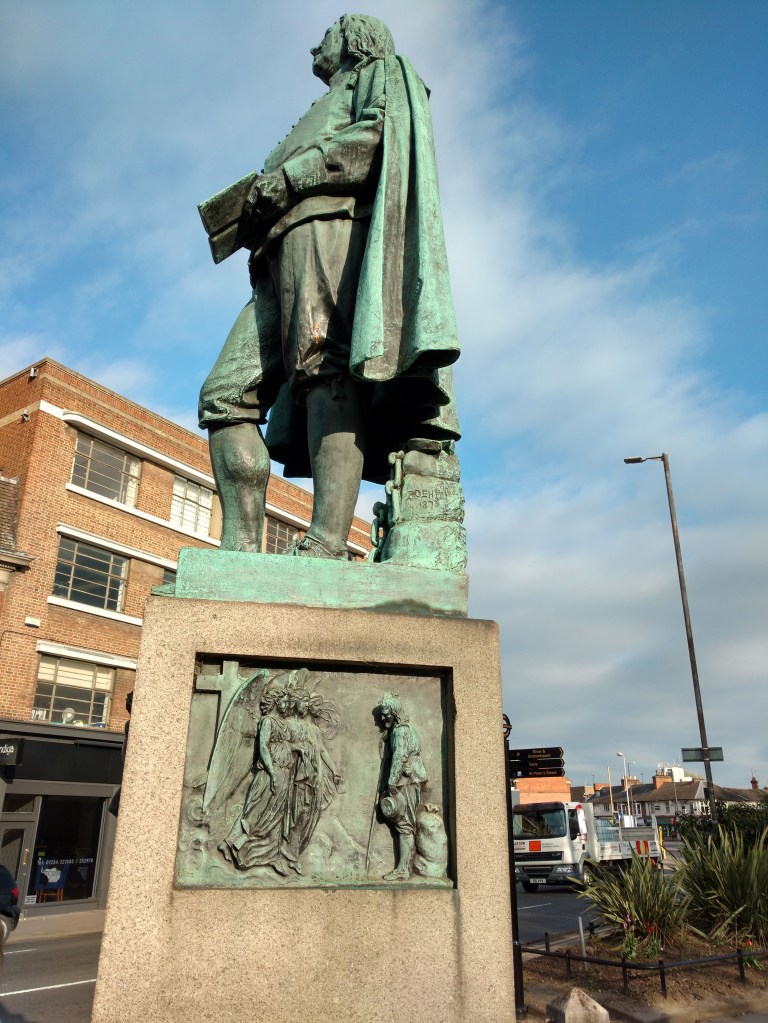
Bedford UK 7/04/2017 A bronze statue of English Christian writer John Bunyan stands on St Peter’s Green, Bedford, England. The statue was sculpted by Sir Joseph Edgar Boehm, it was erected in 1874.
Three centuries later, in 1963, Martin Luther King Jr. wrote Letters from a Birmingham Jail.
Over his 27 years of imprisonment 1962-1989, Nelson Mandela wrote his Conversations with Myself, collected and published in 2010.
Any of these three, and so many others, could have broken under the stress of what they and their families suffered. Instead, like Paul almost two thousand years before, they used their time as prisoners to write.
Karis penned hundreds of pages from her own “imprisonment” in hospitals. Even when she could be home, unable to get away from the prison of her ailing body, she wrote precious words of encouragement to others.
Did you know that thousands of people have used Covid lockdown to write to write? Publishers have been flooded by this work. Last year, 100,000 titles were added to Amazon every month! Many artists created master works or composed music.
Covid lockdown hasn’t been fun or easy. For many people, it’s been awful. But people around the world have grown closer to the Lord through their time of isolation. Like Paul, they have responded with prayer and worship. Through the Holy Spirit’s empowering, they have boldly (Acts 1:8) shared the Gospel. They have taken time to reflect on their lives and have seen God’s faithfulness and presence with them even in their loneliness.
There’s so much we don’t know, because it wasn’t written down or what was written wasn’t preserved. I take from this once again the encouragement to Remember and Tell what we notice God doing in our world, in our generation. I’m waiting for your story! How has God been at work in your life? I would love to know!
Let’s take for ourselves these words Paul wrote to Timothy from prison in Rome: God has not given us a spirit of fear and timidity, but of power, love, and self-discipline. So never be ashamed to tell others about our Lord. … Keep a clear mind in every situation. Don’t be afraid of suffering for the Lord. Work at telling others the Good News, and fully carry out the ministry God has given you (2 Timothy 1:7-8, 4:5).
Acts 28:17-31 Three days after Paul’s arrival [in Rome], he called together the local Jewish leaders. … “I asked you to come here … to explain that I am bound with this chain because I believe that the hope of Israel—the Messiah—has already come. … The Holy Spirit was right when he said to your ancestors … ‘the hearts of these people are hardened … their hearts cannot understand, and they cannot turn to me and let me heal them’” [Isaiah 6:9-10; Matthew 13:15].
I’m at Fall Run Park with two-year-old Caleb, his baby sister Talita in a pack on my chest. Caleb dawdles on footbridge #5, watching the brook gurgle over the rocks. I turn to see whether he’s coming. He looks up and runs as fast as he can to catch up to us, trips over a stone in the path and falls flat. In an instant he is up and running to me, shrieking, blood running down his arms and legs. Others on the path reach out, wanting to help.
But it’s to me he runs, even as I jog the few steps back toward him, wanting to care for his wounds, but even more, to comfort his heart. I know I can do this. The bond between us is strong. In that moment, there is nothing else in my mind and heart but the desire to restore my grandson to the joy he had been experiencing moments before.
Shutterstock: Maria Sbytova
“Turn to me and let me heal you.” Can you hear the yearning in the Father’s heart? He sees me in need, and he has the solution to my needs. His arms are open wide, an expression of love and compassion and tenderness on his face. He longs to care for me. But I am afraid and shrink away. It was my own fault I fell. I am so clumsy! I should have—so many things! Not run so fast, watched where I was running, not dawdled in the first place . . . I am ashamed. I turn to others, seeking comfort and protection and healing in other places, inadequate places. The Father’s face falls, even while his arms still stretch toward me. His heart is broken because I have listened to other voices, telling me I must heal myself before I can turn to him—something I can do no better than my two-year-old grandson could care for himself.
The Father’s invitation still stands, his arms open wide, hope and love on his face. Turn to me and let me heal you.
Acts 27:9, 20-26 We [apparently Luke was along on this voyage] had lost a lot of time. The weather was becoming dangerous for sea travel because it was so late in the fall, and Paul spoke to the ship’s officers about it. … A terrible storm raged for many days, until all hope was gone. No one had eaten for a long time. Finally, Paul called the crew together and said, “Men, you should have listened to me in the first place and not left Crete. You would have avoided all this damage and loss.
But take courage! … For last night an angel of the God to whom I belong stood beside me, and he said, ‘Don’t be afraid, Paul, for you will surely stand trial before Caesar! What’s more, God in his goodness has granted safety to everyone sailing with you.’ So, take courage! For I believe God. It will be just as he said.”
Whenever I see a reference to angels in the Bible, I mark it with an A. Biblical writers comment on angels matter-of-factly. Karis did too; for her they were a part of normal life. Several times in her journals she mentions seeing her guardian angels. As her father sometimes commented, she pushed her limits so recklessly she needed more than one. Because she saw her angels from time to time, I wonder whether the net effect was to make her bolder, rather than more careful (as her mother often would have preferred).
But God speaks to me in other ways. As far as I remember, I’ve never seen an angel, nor heard one speak. Have you? If you have an angel story, I would love to hear it!
One artist’s depiction of a guardian angel Shutterstock: Zwiebackesser
In fact if you have a “But God” story (and I’m sure you do!) I would love to hear it and post it to encourage others. We’re surrounded by so many challenges in this broken world that we need to take note when God intervenes in our stories, as Luke did in writing Acts. “Remember and tell!” are frequent invitations in Scripture, especially in the Psalms.
Don’t you remember better when you put an experience into words, and when you share it with others? Whether in the moment happy or sad, scary or tranquil, our interface with God helps us plant our feet more firmly and hearten each other more concretely. “This happened to me” carries more punch than just about anything else we can say.
We wouldn’t know this story—about Paul standing up in the middle of a typhoon to encourage his shipmates with what he heard an angel say to him—had Luke not taken the time and trouble to write it down. So, I challenge you: take the time. Record for yourself, for your family, for your friends, for people you don’t even know, what God has done for you. Share with us how he has intervened in your wild and precious life.
I’ll make you a bet: once it’s clear in your own mind, clear enough to write, God will give you opportunities to share your experience with others who need it. As Paul said, “Take courage!” Believe God. He even sends angels to communicate with us. Pass it on.
Acts 27:1-3 When the time came, we set sail for Italy. Paul and several other prisoners were placed in the custody of a Roman officer named Julius, a captain of the Imperial Regiment. … Julius was very kind to Paul and let him go ashore [at Sidon] to visit with friends so they could provide for his needs.
Galatians 4:4 (also Romans 5:6, 1 Timothy 2:6, Titus 1:3) But when the right time came, God sent his Son …
Will we meet Captain Julius in heaven? I wouldn’t be surprised!
Did God delay Paul’s journey to Rome for more than two years just so he could know Julius? It’s an interesting question, I think, in light of Jesus’ parable about how much he cares for individual people (Luke 15:3-7).
But—two years! More than two years stuck in prison in Caesarea, dragged out now and then to “entertain” the guys in power with his bizarre beliefs?
Again and again in Scripture, I’m puzzled by God’s sense of timing. Israel waited for the Messiah for centuries—more than four hundred years after the last prophecy of his coming. In what way was that particular starry night in Bethlehem “the right time”?
Questions to ask in Heaven (if I still care).
I thought about timing yesterday at a Pittsburgh Symphony Orchestra concert—the opening weekend celebration of the first in-house concerts since Covid began. Tchaikovsky’s Symphony No. 4 evoked childhood evenings in the village of Nebaj, Guatemala. If we had electricity, Dad spun his disks while we five or six or seven kids read books or made jigsaw puzzles in our small living room, the fireplace adding warmth on chilly nights. Dad loved Tchaikovsky, the sweetness and the thunder.
Shutterstock: Africa Studio
There’s so much that goes into music of this caliber, I mused yesterday as the woodwinds danced with each other through Glinka and Ravel. The musicians bring their skill and their instruments, of course. But they also bring a willingness to submit their wills to the conductor’s baton. If any one of them decided to play by his or her own timing, the whole performance would be ruined. Implicit in each one’s choice to join the orchestra is the ability to blend, to add to the whole his or her hard-won skill as designated by the score.
I wonder whether any of them questions the conductor’s decisions, in practice or in private, as I sometimes question God about the timing of events in my own or other’s lives.
And I wonder how different our world might be if each of us were willing to watch, trust, and submit to our Conductor’s baton.
Shutterstock: Stokkete
A side note: The only way I’ve figured out to honor my no-screens-on-Sundays practice is to switch But God postings from Sundays and Wednesdays to Mondays and Thursdays–not that I’ve always been consistent. But that’s my intent. Some of you were kind enough to notice I missed a couple of weeks around our son’s wedding and a retreat with several of my siblings. Life happens!
April and Dan leaving the ceremony. The wedding had a Tolkien theme, thus the bridesmaids carried bows and arrows and the bride a lantern. Many guests came dressed as elves, dwarves, or hobbits. So fun!
Acts 26:21-22, 30-32 [In his defense before Governor Festus, King Agrippa, and his wife Bernice, Paul said] “Some Jews arrested me in the Temple for preaching that all men must repent of their sins and turn to God, and they tried to kill me. But God has protected me right up to this present time so I can testify to everyone, from the least to the greatest …” Then the king, the governor, Bernice, and all the others agreed, “This man hasn’t done anything to deserve death or imprisonment.” And Agrippa said to Festus, “He could have been set free if he hadn’t appealed to Caesar.”
Sometimes, God uses what seems to us flat out wrong for our good and to accomplish his purposes.
Karis recognized this—eventually. For a long time, her goal was to live in sub-Saharan Africa to work as a journalist in defense of women’s rights. She designed her own major at Notre Dame to that end, including study of Arabic and French. She never made it to Africa. She was crushed when her doctors said, “Absolutely no way.” She described herself to me as a prisoner of her body and of those who cared for it. During her last years, she seldom made it out of Pittsburgh. We were thrilled when she could be home from the hospital from time to time.
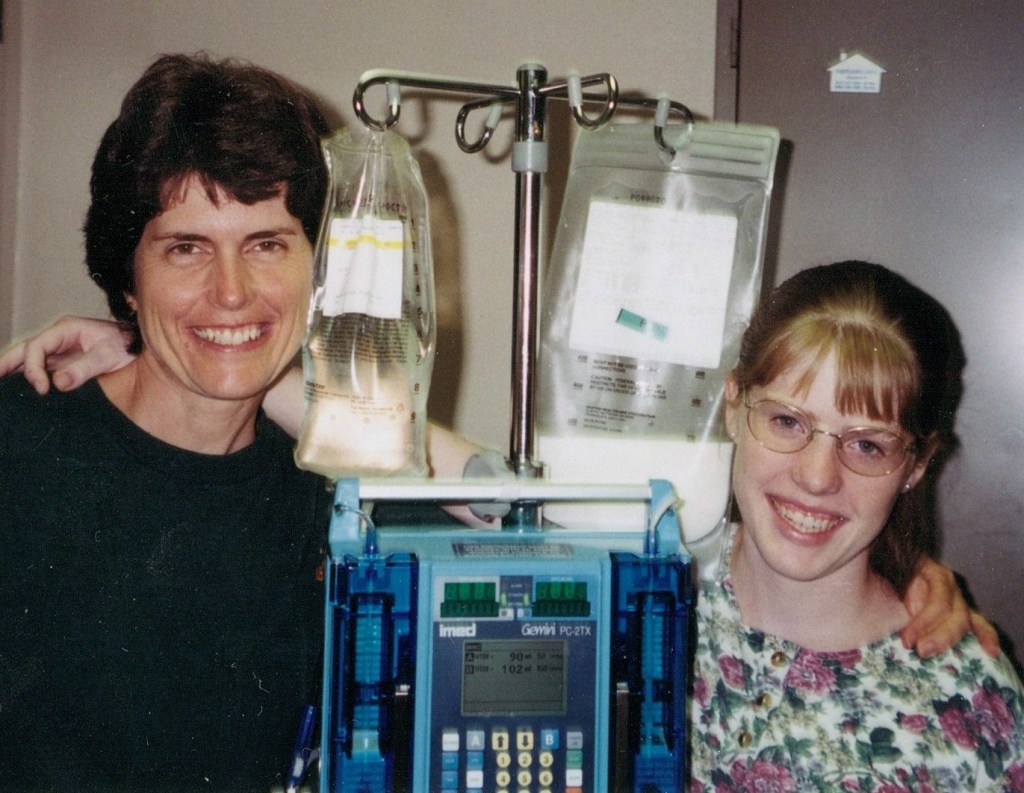
But God brought Arabic and French speakers to Karis, not just from Africa but from Middle Eastern countries as well. Her chief surgeon was Egyptian and attracted to Pittsburgh intestinal transplant patients from across the Arabic-speaking world. They found here a small blonde woman in a hospital gown toting an IV pole just like theirs, who spoke their language and loved them.
We were both pretty tired when this photo was snapped!
Paul spent two years (!) as a prisoner in Caesarea, first under Governor Feliz and then under Governor Festus. During that time, he was brought out to testify multiple times, although all the Roman authorities agreed he had done nothing deserving death or imprisonment. Ironically, God used his captivity to protect him. Had he been set free, his enemies would have killed him. Instead, (spoiler alert) he will travel to Rome (Acts 23:11) under the safety provided by Roman law to its arrested but not-yet-tried citizens.
A Brazilian idiom says, “I was happy and didn’t know it.” Are you dealing with constraining, unjust circumstances? Sometimes what we most struggle against, God uses to protect us from greater harm. One day, we’ll understand it all, from the perspective of the One who loves us more than we can comprehend.
Trust in the Lord with all your heart; do not depend on your own understanding. Seek his will in all you do, and he will show you which path to take. Proverbs 3:5-6
Acts 21:27-22:23 After Roman officers arrested Paul in Jerusalem to save him from a crowd beating him and calling for his death, Paul asked the commander to let him talk to the crowd. The people listened until he told them in 22:21, But the Lord said to me, “Go, for I will send you far away to the Gentiles.”
I heard my parents tell about arriving at the top of a mountain in Guatemala in 1953 and looking down on the Mayan village which would be their new home. They had already come through near-death experiences in Mexico (my mom had actually been pronounced dead), but they were convinced God had sent them to this village, to learn the Ixil language in order to translate the Scriptures for these particular people.
A view of the Nebaj valley in 2008, when our extended family joined Dad for the dedication of the Ixil New Testament. Nebaj is now a small city!
As they gazed into the Nebaj valley, holding their three young children, God brought Joshua 1:9 to their minds: Be strong and courageous! Do not be afraid or discouraged. For the Lord your God is with you wherever you go. On the strength of this encouragement, with no idea what awaited them, Mom, Dad and my older siblings continued their journey down the rough road into Nebaj, into both hardships and joys they couldn’t anticipate.
When Paul spoke to the angry crowd in Jerusalem in Acts 22, he recounted his experience of God saying “Go” after his conversion on the road to Damascus. But the larger context was his conviction that God had sent him to Jerusalem to be threatened and arrested (I am bound by the Spirit to go to Jerusalem … jail and suffering lie ahead, 20:22-23).
Through that arrest, God would now send him to Rome, to tell people there about Jesus. God reaffirmed this through a dream in 23:11, Be encouraged, Paul. Just as you have been a witness to me here in Jerusalem, you must preach the Good News in Rome as well. Paul will live under guard in Rome until he is executed.
How different all this is from the “health and wealth” version of the Gospel! Jesus never offered or modeled a life of comfort and prosperity. He stated flat out, Here on earth you will have many trials and sorrows (John 16:33). What he does promise is to be with us, to walk with us through whatever we encounter along the way—the sorrows and the joys.
So whenever we hear God say “Go,” we can know he goes with us. And nothing can ever separate us from his love.
Acts 20:28-32 [Paul saying goodbye to the Ephesian elders] So guard yourselves and God’s people. Feed and shepherd God’s flock—his church, purchased with his own blood—over which the Holy Spirit has appointed you as elders. … Even some men from your own group will rise up and distort the truth in order to draw a following. Watch out! … And now I entrust you to God and the message of his grace that is able to build you up and give you an inheritance with all those he has set apart for himself.
At the end of his teary farewell to beloved friends, Paul returns to the topic of grace—my favorite subject, my deepest longing.
Grace builds up. I want to tell you my experience at the writer’s conference listening to two different keynote addresses.
The first, to open the conference, earnestly described how terrible America is today, and who he thinks is at fault for the mess we’re in, with political references that made me think of Romans 13:7 (“Give respect and honor to those who are in authority”) only by contrast. What have I gotten myself into? I wondered.
So, I felt anxious when I saw the topic of the closing-day keynote was “Our Voice in a Hostile Culture.” If it’s more of the same, I can’t listen to it, I thought. I don’t want to leave this conference feeling upset and disappointed with the event leaders who have been so kind to me.
As I listened, though, I found myself in tears. The speaker called us to Kingdom values. We are citizens of Heaven first, and we serve a King whose nature is love, and justice, and righteousness, and mercy. We are to represent him. Our voice is to be characterized by grace:
“In all things, become love—so that if anyone thinks of love, they think of you. In all things, all the time, become love. Patiently listen. Hear what people have to say. Treat them with respect. Look for what you have in common, the ways you can connect. Have an attitude of grace. Practice grace. Pray into it. Offer vision and hope. Be compassionate. Our lives are to be a lovely fragrance attracting people to the King whose grace we ourselves have experienced …”
In the flood of comments in the chat (we were on Zoom), one person wrote, “This talk has been worth the whole price of the conference.” I agree. Of all the thousands of words I listened to over three intense days, these are the words that most impacted and encouraged me. The words that will continue to challenge me.
Lord, teach me grace. Remind me constantly of your grace in my life. Please show me today how to build up those whose lives touch mine.
Acts 20:22-24 [Paul saying farewell to Ephesian elders] And now I am bound by the Spirit to go to Jerusalem. I don’t know what awaits me, except that the Holy Spirit tells me in city after city that jail and suffering lie ahead. But my life is worth nothing to me unless I use it for finishing the work assigned me by the Lord Jesus—the work of telling others the Good News about the wonderful grace of God.
Looking back this morning over the faithfulness of God through the ups and downs of our 44 years of marriage (today is our anniversary), Dave and I commented that the stage we’re in now is similar to what Paul expressed about the value of his life: both Dave and I have work we feel called and compelled to complete. His work is different from mine, but both of us want to, in our own ways, “tell others the Good News about the wonderful grace of God.”
I’m in the middle of an online writer’s conference. Yesterday I had the chance to ask advice from a web designer. He said I was the first person who had ever given him a cogent argument for having two websites. What struck me in the conversation is that for both ButGod.blog (“All I see is grace”) and HorseThief1898.blog (“A hint of magic and touches of grace”), the key word is grace. I thought this morning of the phrase from John Newton’s song, “’Twas grace that brought us safe thus far, and grace will lead us home.”
So as we observe the world around us and feel concern for our grandchildren’s future, I invite you to take a few moments to let John Newton’s powerful words penetrate your mind and anchor your soul:
Did you catch the “But God” in Newton’s lyrics? What is your But God story today?
Acts 19:15-20 One time when the seven sons of Sceva, a leading priest, tried to cast out an evil spirit, it replied, “I know Jesus, and I know Paul, but who are you?” Then the man with the evil spirit leaped on them, overpowered them, and attacked them with such violence that they fled from the house, naked and battered. The story spread through Ephesus … A solemn fear descended on the city and the name of the Lord Jesus was greatly honored. Many who became believers confessed their sinful practices … So the message about the Lord spread widely and had a powerful effect.
John 3:34-35 Jesus speaks God’s words, for the Father gives him the Spirit without limit. The Father loves his Son and has put everything into his hands.
Have you ever longed to hear Jesus speak to you, just personally to you? During a time of trouble in Brazil, I shared this longing with an older missionary friend. She said, “Well, let’s ask him.” I’ll never forget that precious moment. It has strengthened me many times since.
The thing is, hearing him speak requires being still and listening. Leanne Payne, a woman of deep prayer, used to say, “Listen for the word of love the Father is always speaking to you.” How can we hear those words when we’re so flooded by other voices?
I resonated yesterday with the urging of Kevin, one of our pastors, to take a weekly sabbath from screens. I’ve done this before, with great benefit, but had let the habit slip away. I’m excited about so again, being quiet enough for a whole day weekly to hear God’s fortifying words of love—not in general for the world, but for me.
When God’s voice is strong and solid inside me, I can handle the other voices better. Isn’t that true for you, too? Want to try this challenge with me?
By doing so, like the Ephesians, we are honoring Jesus above everything else. We are allowing him to nourish our souls.
Kevin quoted for us Mary Oliver’s famous poem, “The Summer Day,” the one that ends with “Tell me, what is it you plan to do with your one wild and precious life?” The part that caught my attention yesterday was Who made the grasshopper? This grasshopper, I mean-
After we got home from church, Dave helped me bag a huge pile of weeds I had pulled until dark the night before. He showed me a huge grasshopper-like creature attached to the brown bag he was stuffing with weeds:
I don’t know what this is–haven’t found it online yet. It’s five inches long.
This grasshopper … Thanks, Lord. Message received:
Be still. Be attentive. Let the Lord nourish your soul. Know Jesus and let him know you. Honor him by listening to his voice–his words of love for today.










 Debra Kornfield